26 Sep 2014 | Digital Freedom, Europe and Central Asia, News, Politics and Society
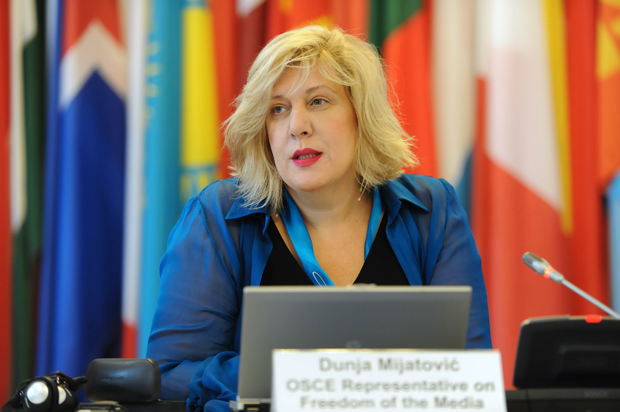
Dunja Mijatovic, OSCE Representative on Freedom of the Media
“States must stop trying to define who is and isn’t a journalist. The media landscape has changed irreversibly,” said Dunja Mijatovic, OSCE Representative on Freedom of the Media, as she opened the organisation’s Open Journalism event in Vienna on Friday, 19 Sept.
Journalism – wherever you draw its boundaries – has more voices than ever, but are all they all being properly recognised and safeguarded? This was one of the main problems addressed by the expert panel, which included Index on Censorship, alongside delegates from Azerbaijan, Serbia, Estonia, Russia, Kazakhstan, Bosnia and many other OSCE member states.
Gill Phillips, the Guardian’s director of editorial legal services, spoke via pre-recorded video about difficulties in defining journalism and deciding who gets journalistic protection. She cited the Snowden scoop, which was led by Glenn Greenwald, a former lawyer, and later embroiled his partner, David Miranda. Who gets the protection? Greenwald? Miranda? Lead staff reporter David Leigh? All three?
There was widespread condemnation of Russia’s new law, which compels bloggers with more than 3,000 views per day to be registered with the authorities. “[The bloggers] have certain privileges and obligations,” said Irina Levova, from the Russian Association of Electronic Communications, who repeatedly defended the law. “Online and offline rights are not the same,” she said, adding that some of those who deemed the law a mode of censorship have been revealed as “foreign agents”.
Another topic – raised repeatedly by various attendees – was Russian media’s growing influence over citizens in nearby countries. Begaim Usenova of the Media Policy Institute in Kyrgyzstan said: “The common view being spread from the Russian media is that the United States is starting world war three and only Putin can stop him.”
Yaman Akdeniz, a Turkish cyber-rights activist, shared news of Twitter accounts that remain blocked in his country, including some with over 500,000 followers. Igor Loskutov, a business director from Kazakhstan, looked back on the first 20 years of internet in his country and how authorities have gone from ignoring their first rudimentary websites to now wanting complete control.
The thorny issue of “public interest” was also discussed. Jose Alberto Azeredo Lopes, professor of International Law at the Catholic University of Porto, raised some smiles with his theory: “It’s like pornography. You can’t define it. But you know it when you see it.”
As the day-long discussions wrapped up, one delegate asked: if a blogger’s first-ever post goes viral, are they immediately subject to the same laws as the press? Especially in countries that now insist bloggers register.
The debate over the difference between journalists and bloggers went round in circles – as it always does – but the OSCE is hoping to be able to compile all the findings from its expert meetings into an online resource to move the discussion forward.
Azeredo Lopes concluded: “If you don’t distinguish freedom of expression from freedom of the press, you end up with no journalists, and that is the crisis that journalism faces today.”
Read our interview with Dunja Mijatovic, OSCE’s Representative on Freedom of the Media, in the autumn issue of Index on Censorship Magazine, coming soon
This article was published on Friday September 26 at indexoncensorship.org
25 Sep 2014 | Azerbaijan, Azerbaijan News, Uncategorized
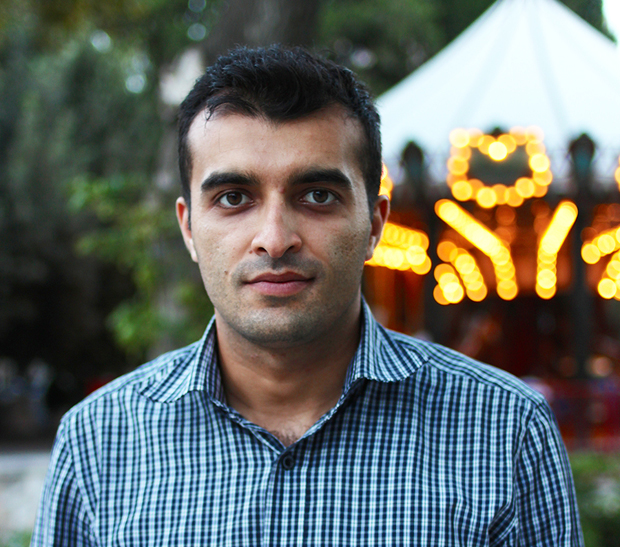
Rasul Jafarov in September 2013 (Photo: Melody Patry)
This is the appeal of Azerbaijani political prisoner, Rasul Jafarov. It was sent to Index on Censorship by his brother, Sanan Jafarov. Jafarov has now been detained for 54 days.
Article 157 of the Code of Criminal Procedure deals with the restrictive measure of arrest. Article 157.2 states that arrest as a restrictive measure may be chosen in the light of the requirements of Articles 155.1 – 155.3 of this Code. In other words, a restrictive measure, including the restrictive measure of arrest may be chosen when the grounds stipulated in the Articles 155.1 – 155.3 exist. These grounds are the following, and I present my arguments regarding the baselessness of the attribution of each ground to me and the fact that there was a ‘political order’:
- 1.1 – hiding from the prosecuting authority;
In connection with my activities as a human rights defender, I have regularly been in the spotlight of the local community and the media. At least once a week, I gave interviews to local media outlets in their offices. The interviews were explicitly related to the human rights situation in Azerbaijan. To talk about these issues one needs to constantly live in Azerbaijan. And I have always lived in Azerbaijan. Despite of making numerous trips in connection with my work, I always returned to the Homeland. This was the case on the eve of my arrest. I came back to Baku in late June after participating in the summer session of the Parliamentary Assembly of the Council of Europe. From 29 June to 5 July I was on a visit to Serbia, Bosnia and Herzegovina, and from 6 to 11 of July on a visit to Kiev. The last visit is particularly important, because on July 7, while I was in Kiev, the Sabail District Court issued a decision to arrest my current bank accounts based on the request of the investigating authority, i.e. while stil in Kiev I already knew that the Prosecutor General’s Office conducts an investigation related to me. Nevertheless, I did not choose to hide from the investigating authority and returned to Baku on July 11. On July 16, I submitted a formal application to the Sabail District Court requesting a copy of the decision to arrest my bank accounts, in order to appeal that decision. On July 28, I left Baku for Tbilisi by train for a next working trip; in the morning of July 29, I was told at the Boyuk Kesik border crossing point that the Prosecutor General’s Office imposed a ban on my exit from the country on July 25. This ban is, as a rule, imposed on suspects and accused persons. However till then I had not been prosecuted as a suspect or accused. Yet, I not only did not think about hiding, but immediately returned to Baku after being taken off the train and informed the local media about this ban. After this information was disseminated in numerous media outlets, a member of the investigation team, an investigator by name Igbal Huseynov called me on July 30 and invited me as a witness to the Depatment for Investigation of Serious Crimes of the Prosecutor General’s Office on July 31, at 9.30. I did not hide from the investigation and was in the investigating authority at the specified time in order to answer the questions of the investigation. There, I gave evidence for 4 fours in the presence of two investigators, and answered all the questions that interested the investigating authority. After the questioning, a search was conducted in the apartment where I live for 2 hours with my own participation (the search order was made on July 25). Since the investigating authority found nothing as a result of the search, I told that I can voluntarily present the documents that the investigating authority needed. Thus, on July 31, August 1 and on the day of my arrest, i.e. August 2, voluntarily presented the financial and accounting documents of the human rights projects that we carried out during the period 2011-2014. On August 2, after presenting the last documents on the projects I was charged as the accused. Because I cooperated with the investigation, regularly complied with the summons of the investigating authorities and, above all, presented all the documents requested for normal conduction of the investigation, there remained no logical or any other point in my hiding from the investigation from that moment on. On the other hand, due to the ban imposed on my exit from the country, I could not hide from the investigation by leaving the country, even if I wanted.
- 1.2- obstructing the normal course of the investigation or court proceedings by illegally influencing parties to the criminal proceedings, hiding material significant to the prosecution or engaging in falsification;
Firstly, I should note that the scope of the persons involved in the criminal proceedings is unclear to me. The current criminal case was launced on 22 April 2014 and covers the activity of more than 20 NGOs and NGO representatives. In such a case, it is difficult to even imagine the possibility of how and which parties to the criminal proceedings were influenced during nearly 4 month until my arrest. If we answer the question “who were these people?” with assumptions, we can suppose these people to be the persons who rendered different services under the projects that we carried out. The projects that we carried out, the people involved in them, the documents that emerged as a result of projects and the outcomes have regularly been in the spotlight of local and a number of foreign media, and discussions have been opened around them. On the other hand, the identity of the persons involved in the projects, the jobs that they were engaged in and the amounts of funds they received in return for their work are indicated in the financial and accounting documents that I voluntarily presented to the investigating authority. I should underline that I present not the copies but the original documents to the investigating authority and relevant acts were drawn up. In such a case, there remains no point in inluencing the people involved in projects for any reason, because all original documents related to them have already been presented to the ivnestigating authority. This fact also proves the fact that it is impossible to falsify any document or material. Since on 3 consecutive days I voluntarily presented the documents requested by the investigation, the concealment of any document is out of the question, as we have no document to hide. The projects that we carried out were obvious, I gave additional information about each of the projects during my testimony on July 31, the investigating authority possesses bank statements about my bank accounts, I have presented all financial and accounting documents on the projects, thus I let the investigation know the exact scope of persons involved in the projects. This being the case, the hiding or falsying of which documents can one talk about? Or is there a need to influence the people, when their involvement in the projects is proved by their own signatures and the investigating authority already has these documents?
- 1.3 – committing a further act provided for in criminal law or creating a public threat.
The nature of the crimes with which I am charged is so that it is impossible to commit them again in the course of the current criminal proceedings; Because the projects have been stopped due to the criminal case, all my current bank accounts have been arrested by a court decision, the documents of all the previously implemented projects are in the possession of the investigating authority. This being the case, how can I re-commit the crimes with which I am charged? The crimes with which I am charged are not homicide, causing grievous bodily harm, hooliganism, drug possession, drug trafficking, rape or crimes resulting in serious consequences of these kinds, there do not exist grounds for prevention of their re-commital or a public threat.
- 1.4 failing to comply with a summons from the prosecuting authority, without good reason, or otherwise evading criminal responsibility or punishment;
As I noted above, the first time I was summoned by the investigation on July 30, and on July 31, at 9.30, I was at the investigating authority, I also complied with the August 1 and August 2 summons of the investigating authority in a timely manner, without any delay. As we can see, I not only did not avoid the summons of the investigating authority, to the contrary, I have consistently complied with them. After my July 31 evidence, the search in my apartment and the presentation of the documents to the investigation, I gave information about what had happened on my Facebook page, stating that my activity was transparent, that I had not committed any crime and that I would prove this to the investigation. I repeated my similar interviews in the interviews that I gave to the local media both on the same day and August 1.
- 1.5 preventing execution of a court judgment;
How might I have prevented the execution of a court judgment, when there exists no court judgment on this case or in relation to me. It has been set out in Article 155.2 of the Code of Criminal Procedure that in resolving the question of the necessity for a restrictive measure and which of them to apply to the specific suspect or accused, the preliminary investigator, investigator, prosecutor in charge of the procedural aspects of the investigation or court shall bear in mind:
155.2.1. the seriousness and nature of the offence with which the suspect or accused is charged and the conditions in which it was committed;
– Only one of the crimes with which I am charged, abuse of office, is considered a serious crime by its category, the other 2 crimes belong to the category of less serious crimes. In other words, if we summarize the crimes, among them, I am accused of committing only 2 less serious and 1 serious crimes. These charges filed against me cover my human rights activity that I have implemented for 3 years, i.e. I have established the non-governmental organization not to commit these crimes, but to implement human rights activity. And, I obtained the TIN (taxpayer identification number) in 2008 not to avoid payment of taxes or engage in illegal business activity, but to be registered as a taxpayer and pay the taxes. In other words, even if we suppose that the crimes have been committed, there are no proofs to claim the gravity of the circumstances of their committal, or to show that there was a specific intent or planning, or criminal intention in the action. As a result of the action that has been allegedly committed, no one has lost their life or suffered serious injuries, there has not been an obvious disrespect for a society, no one’s Constitutional rights or freedoms have been violated, and there is no concrete victim or complainant. The article of the Criminal Code that concerns tax evasion, one of the charges brought against me, itself provides for the exemption from criminal responsibility.
155.2.2 the personality, age, health and occupation of the suspect or accused and his family, financial and social positions, including whether he has dependents and a permanent residence;
– I have worked in civil society organizations since 2007, and have been author, implementer or participant of a number of projects that were useful for the society. I graduated from the university with good and excellent mars and got a master’s degree in law. In 2006-2007 I served in the army and was discharged with the rank of junior sergeant. I am considered the head of my family since 2004, as my father died in October of that year, and since then I play a key role in maintaining our family that consists of me, my mother and younger brother. I have a resident which is my property and the investigation knows this, there is no other address where I actually live, I do not have a citizenship of any other country or have no obligation to a foreign state. In 2010, I was the winner of the Asian Justice Makers Competition of the International Bridges to Justice organization, in 2013 I was a participant of the prestigious joint program of the American Jewish Committee and Fridrich Naumann Foundation called “Promoting Tolerance”, I closely participated in numerous meetings of the Council of Europe, the UN, the European Union, OSCE and other international organizations, and made speeches on the theme of human right at a number of events.
155.2.3 whether he has committed a previous offence, the previous choice of restrictive measure and other significant facts;
I have never been convicted before, no restrictive measure has ever chosen in respect of me, I have never been recognized as a suspect or accused in committal of a crime, even no administraive measure has ever been applied to me, and my name has not been mentioned in any criminal case. I complied with the summons of the investigating authority in a timely manner and cooperated with the investigation.
Conclusion
There was no ground to refuse choosing the measure of house arrested in respect of me as an alternative to the resitrictive measure of arrest. Along with the house arrest, the court could completely ban me from leaving my place of residence as an accompanying measure and additional restrictive measures stipulated in Article 163 of the Code of Criminal Procedure could be applied. We have presented reliable evidence proving this to all local courts. When our evidence are taken into account not seperately but as a whole, it becimes clear that there is no serious ground or necessity to apply restrictive measure of arrest to me. Thus, instead of arrest, the measure of house arrest, which is its alternative according to the legislation, could have been easily chosen in respect of me.
This article was posted on 25 September 2014 at indexoncensorship.org
9 Jul 2014 | Campaigns, Press Releases
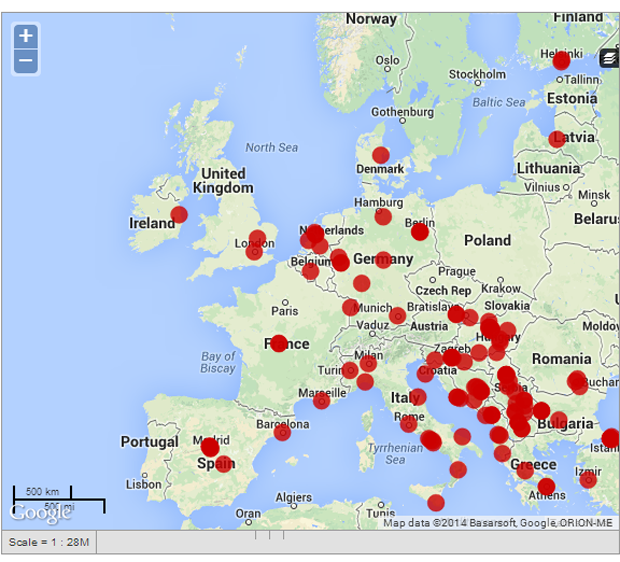
Over 170 cases have been submitted on a new media freedom crowdsourcing platform since its launch in May, while about half of the mapped cases of censorship and violations that spread in all 28 EU member states and candidate countries occurred in southern and southeast Europe.
Mediafreedom.ushahidi.com is a website that enables media professionals and citizen journalists to report and map media freedom violations across the 28 EU member states plus candidate countries. Ushahidi means ‘testimony’ in Swahili. Single cases can be uploaded through direct reporting on the platform or sent via email and be visualised on a Google map.
Information on the map reveals some common trends and similar problems across the region.
Over 40 of the reported cases involve legal measures taken against a journalist or a media, suggesting the pressing need of legal support and protection of those affect. Despite the existence of several associations and NGOs offering such support, journalists often fail to get the help they need on time, if ever.
Meanwhile arrests, verbal and physical attacks continue to be used as a tool to scare or discredit professionals. In some cases, journalists are detained in the field without clear explanation or warrant only to be released several hours later, when they can no longer report the event they originally intended.
A high concentration of violations is observed in Turkey, Italy and Serbia.
In Turkey, where 17 cases have been reported, financial and legal pressure seems to be one of the main tools used to silence critical voices.
In Serbia, where 16 cases have been reported, May’s devastating floods unleashed a series of worrying developments that made the international and local community turn their eyes towards the state of media freedom and spreading censorship in the country. For instance, several blogs experienced blockades and attacks after criticizing the government’s role and reaction to the floods.
In Italy 15 cases have been reported, with many involving threats and assault.
About the project
The Ushahidi media freedom crowd-sourcing platform has been developed in partnership by Osservatorio Balcani e Caucaso and Index on Censorship. OBC participates in the initiative as part of the EU-funded Safety Net for European Journalists project, implemented in partnership with SEEMO, Ossigeno Informazione, Professor Eugenia Siapera (Dublin City University).
For more information please contact:
[email protected]
[email protected]
26 Jun 2014 | About Index, Campaigns, Statements, Ukraine
President Petro Poroshenko
11 Bankova street
01220 Kyiv
Ukraine
26 June 2014
Mr President,
We, the undersigned members and partners of the Human Rights House Network (HRHN), condemned in the strongest terms human rights violations which took place throughout Ukraine since 29 November 2013, and now call upon you to extend the mandate of the International Criminal Court investigations (taking into account events in Crimea and Eastern Ukraine) and to ratify the Rome Statute, in order to encourage such investigations, as an essential part of bringing peace to the country.
We welcome the repeated pledges of Ukrainian authorities to investigate all human rights violations committed since 29 November 2013 and hold those accountable, throughout the country and irrespective of which side the violator belongs to in the ongoing armed conflict in East Ukraine. The current situation of impunity must end.
The International Criminal Court is the only international body able to not only document grave human rights violations, amounting to core international crimes (war crimes, crimes against humanity, or genocide), but also investigate individuals responsible for such crimes. In order to restore peace and strengthen trust into State institutions, those responsible for such human rights violations have to be held accountable. We have for a long time called for a comprehensive reform of the judicial system in the country, which still remains to be initiated. Unfortunately, the national judicial system now shows its limits and in our view it is clear that it does not have the adequate knowledge, independence and resources to investigate all human rights violations since 29 November 2013 throughout the country.
Therefore, it is necessary to activate the international justice system, based on the complementarity principle, to guarantee that investigation into core international crimes committed by all parties in Ukraine, including by members of law enforcement and State agents, is credible and transparent, bringing those responsible to justice.
The Court’s jurisdiction should however not be limited in time, as it is now. On 17 April 2014, the Government of Ukraine indeed lodged a declaration under Article 12(3) of the Rome Statute accepting the jurisdiction of the ICC over crimes committed on its territory from 21 November 2013 to 22 February 2014.[3] We now call upon the Government to issue a declaration extending ICC jurisdiction from 21 November 2013 until the date of the entry into force of the Rome Statute for Ukraine.
We also call upon the authorities in Ukraine to accede to the Rome Statute as soon as possible. By doing this, Ukraine will make an important step to permanently depart from the culture of impunity that is prevailing.
In addition to the investigation into human rights violations, and action taken to end the use of violence in the country, Ukraine needs to undertake a massive reform of its legislation and practice in many fields. Ukraine’s law enforcement agencies have needed radical reform for a long time now: It is not about changing the names of institutions and units or about window-dressing, but about systemic changes, starting from the principles for establishing and structuring enforcement agencies, and ending with approaches to evaluating their performance.
We therefore support Ukraine’s efforts to propose a resolution at the United Nations Human Rights Council’s on-going session, although we deeply regret the draft resolution’s silence about the role of civil society in the country and the need for an investigation by the Court.
In Ukraine, human rights NGOs have proven their strong commitment to the rule of law and the respect of all human rights for all people, as well as their high level of professionalism and excellence. No country can build a sustainable future without full inclusion of civil society in decision-making, especially Ukraine in its present situation. Furthermore, States and leaders in all sectors of society must acknowledge publicly the important and legitimate role of human rights defenders in the promotion of human rights, democracy and rule of law, and avoid stigmatisation, as stated by the Human Rights Council resolution 22/6 of 21 March 2013.
Finally, we also welcome the reference in the draft resolution on Ukraine at the Human Rights Council to the extremely worrying human rights situation in Crimea and join Ukrainian authorities, the United Nations, the Organisation for Security and Cooperation in Europe, and other international voices, in condemning the enforcement of legislation of the Russian Federation on the territory of Crimea, at variance with the United Nations General Assembly resolution 68/262.
The role of civil society is essential in documenting human rights violations in Crimea and providing support to victims of such violations. A field mission has been launched by Ukrainian and Russian human rights defenders in co-operation, with which we expect full cooperation by all governmental agents in Ukraine.
On this background, we call upon you Mr President and the Government, with no further delay, to issue a declaration to extend the jurisdiction of the International Criminal Court from 21 November 2013 until the date of Ukraine’s accession to the Rome Statute either through appeal of the competent body of the Government or by adopting the Draft Law #4081a.
We further call upon you to:
- Take all necessary measures to support the work of human rights NGOs, journalists and bloggers and other media, including by investigating any threats, intimidation, harassment and violence against them, including arbitrary detentions, abductions, attacks and killings;
- Strongly and publicly acknowledge the important and legitimate role of human rights defenders in the promotion of human rights, democracy and the rule of law as an essential component of ensuring their protection; In line with United Nations Human Rights Council resolution 22/6 of 21 March 2013, paragraph 5
- Ensure that the reform process in the country, as well as all dialogue about the future of the country, is inclusive and transparent, giving space to civil society.
Sincerely,
Human Rights House Kyiv (on behalf of the following NGOs):
- Association of Ukrainian Human Rights Monitors on Law Enforcement (Association UMDPL)
- Centre for Civil Liberties
- Human Rights Information Center
- Institute of Mass Information
- Kharkiv Human Rights Protection Group
- La Strada Ukraine
- NGO “For Professional Journalism” – Svidomo
- Ukrainian Helsinki Human Rights Union
Education Human Rights House Chernihiv (on behalf of the following NGOs):
- Chernihiv Public Committee of Human Rights Protection
- Center of Humnistic Tehnologies “AHALAR”
- Center of Public Education “ALMENDA”
- Human Rights Center “Postup”
- Local Non-governmental Youth organizations М’АRТ
- Transcarpathian Public Center
- Ukrainian Helsinki Human Rights Union
Azerbaijan Human Rights House (on behalf of the following NGOs):
- Association for Protection of Women’s Rights – APWR
- Azerbaijan Human Rights Centre (AHRC)
- Institute for Peace and Democracy
- Human Rights Centre
- Legal Education Society
- Legal Protection and Awareness Society
- Media Rights Institute
- Public Union of Democracy Human Rights Resource Centre
- Women’s Association for Rational Development (WARD)
Barys Zvozskau Belarusian Human Rights House in exile, Vilnius
- Belarusian Association of Journalists
- Belarusian PEN Centre
- Belarusian Helsinki Committee
Human Rights House Belgrade (on behalf of the following NGOs):
- Belgrade Centre for Human Rights
- Helsinki Committee for Human Rights, Serbia
- Human Rights House Belgrade and Lawyers’ Committee for Human Rights –YUCOM
Human Rights House London (on behalf of the following NGOs):
- Index on Censorship
- Vivarta
Human Rights House Tbilisi (on behalf of the following NGOs):
- Article 42 of the Constitution
- Caucasian Centre for Human Rights and Conflict Studies (CAUCASIA)
- Georgian Centre for Psychosocial and Medical Rehabilitation of Torture Victims
- Media Institute
- Human Rights Center
- Union Sapari – Family Without Violence
Human Rights House Oslo (on behalf of the following NGOs):
- Human Rights House Foundation
- Norwegian Helsinki Committee
- Health and Human Rights Info
Human Rights House Voronezh (on behalf of the following NGOs):
- Civic Initiatives Development Centre
- Confederation of Free Labor
- For Ecological and Social Justice
- Free University
- Golos
- Interregional Trade Union of Literary Men
- Lawyers for labor rights
- Memorial
- Ms. Olga Gnezdilova
- Soldiers Mothers of Russia
- Voronezh Journalist Club
- Roronezh – Chernozemie
- Youth Human Rights Movement
Human Rights House Yerevan (on behalf of the following NGOs):
- Helsinki Citizens’ Assembly – Vanadzor
- Journalists’s Club Asparez
- Public Information and Need of Knowledge – PINK
Human Rights House Zagreb (on behalf of the following NGOs):
- APEO / UPIM Association for Promotion of Equal Opportunities for People with Disabilities
- B.a.B.e.
- CMS – Centre for Peace Studies
- Documenta – Centre for Dealing with the Past
- GOLJP – Civic Committee for Human Rights
- Svitanje – Association for Protection and Promotion of Mental Health
The Rafto House in Bergen – Norway (on behalf of the following NGOs):
The House of the Helsinki Foundation For Human Rights – Poland (on behalf of the following NGOs):
- Helsinki Foundation for Human Rights, Poland
Copies have been sent to:
- Mr Oleksandr Turchynov, Chairman of Verkhovna Rada
- Office of the Commissioner for Human Rights of the Council of Europe
- Private Office of the Secretary General of the Council of Europe
- Chairman of the Organisation for Security and Cooperation in Europe (OSCE)
- OSCE Special Monitoring Mission to Ukraine
- OSCE’s Office for Democratic Institutions and Human Rights
- United Nations Human Rights Monitoring Mission in Ukraine
- Delegation of the European Union in Ukraine
- Subcommittee on Human Rights of the European Parliament
- Diplomatic community in Kyiv, Brussels, Geneva and Strasbourg
- Various ministries of foreign affairs and parliamentary committees on foreign affairs
About the Human Rights House Network (www.humanrightshouse.org)
The Human Rights House Network (HRHN) unites 87 human rights NGOs joining forces in 18 independent Human Rights Houses in 13 countries in Western Balkans, Eastern Europe and South Caucasus, East and Horn of Africa, and Western Europe. HRHN’s mandate is to protect, empower and support human rights organisations locally and unite them in an international network of Human Rights Houses.
The Human Rights House Kyiv and the Education Human Rights House Chernihiv are members of HRHN. 10 independent Ukrainian human rights NGOs are members of both Human Rights Houses.
The Human Rights House Foundation (HRHF), based in Oslo (Norway) with an office in Geneva (Switzerland), is HRHN’s secretariat. HRHF is international partner of the South Caucasus Network of Human Rights Defenders and the emerging Balkan Network of Human Rights Defenders.
HRHF has consultative status with the United Nations and HRHN has participatory status with the Council of Europe.