3 Jun 2014 | Campaigns, Politics and Society
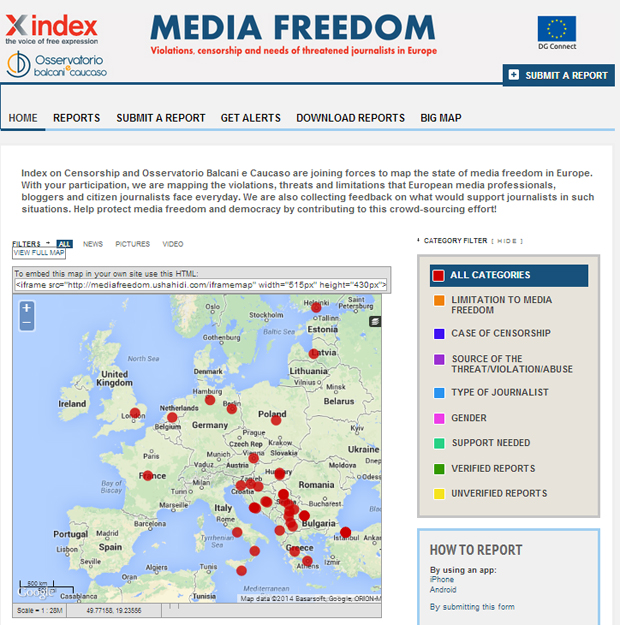
As part of its effort to map media freedom in Europe, Index on Censorship’s regional correspondents are monitoring media across the continent. Here are incidents that they have been following.
AUSTRIA
Police block journalists’ access to protest
Police denied journalists access to the site where members of the right-wing group “Die Identitären” were demonstrating on May 17. News website reports and a video from Vice News show police using excessive force against demonstrators. The Austrian Journalists’ Club described the police’s treatment of journalists as one of the recent “massive assaults of the Austrian security forces on journalists” and called for journalists to report breeches in press freedom to the club. (Austrian Journalists’ Club) (Twitter)
CROATIA
Croatian law threatens journalists
Croatia’s new Criminal Code establishes the offence of “humiliation”, a barrier to freedom of expression that has already claimed its first victim among journalists – Slavica Lukić, of newspaper Jutarnji list. A Croatian journalist is likely to end up in court and be sentenced for “humiliation” for writing that the Dean of the Faculty of Law in Osijek, Croatia’s fourth largest city, is accused by the judiciary of having received a bribe of 2,000 Euros to pass some students during an examination. For the court, it is of little importance that the information is correct – it is enough for the principal to state that he felt humbled by the publication of the news. According to Article 148 of the Criminal Code, introduced early last year, the court may sentence a journalist (or any other person that causes humiliation to others) if the information published is not considered as of public interest.
CYPRUS
Cyprus’ Health ministry Director General accused of 30million scandal whitewash
9.5.2014: The former Director General of the Ministry of Health, Christodoulos Kaisis, is alleged to have censored the responses of two ministerial departments during an audit regarding a 30 million scandal of mispricing of drugs. He did not send the requested information to the Audit Committee of the Parliament. (Politis)
DENMARK
Journalists convicted for violating law protecting personal information
On May 22 2014 two Danish journalists got convicted for violated Danish law protecting personal information because they named twelve pig farms in Denmark as sources of the spread of MRSA, a strain of drug-resistant bacteria. They argue they had been trying to investigate the spread of MRSA, but the government had wanted to keep that information secret. Their defense attorney claims revealing the names was appropriate because ‘there is public interest in openness about a growing health hazard’. The penalty was up to six months imprisonment, but the judge ruled they have to pay 5 day-fines of 500 krone (68 euro). The verdict is a ‘big step back for the freedom of press’ in Denmark, one of the journalists, Nils Mulvad said after the trial.
FINLAND
ECHR rejects journalist’s free speech claim
On April 29 2014, the European Court of Human Rights rejected a free speech claim over a defamation conviction by a Finnish journalist. In August 2006 journalist Tiina Johanna Salumaki and her editor in chief were convicted of defaming a businessman. The newspaper published a front page story, asking whether the victim of a homicide had connections with this businessman, K. U. The court ruled that Salumaki and the newspaper had to pay damages and costs to K. U. According to Salumaki her right to free expression was breached.
GERMANY
Journalist’s phone tapped by state police
A journalist’s telephone conversation with a source was tapped by state criminal police. The journalist, Marie Delhaes, spoke about the police’s subsequent contact with her on the media show ZAPP on German public television. Police asked her to testify as a witness in a criminal case against the source she communicated with, an Islamist accused of inciting others to fight with rebels in Syria. Delhaes was threatened with a fine of 1000 Euros if she were to refuse to testify. She has since claimed reporter’s privilege, protecting her from being forced to testify in a case she worked on as a journalist. (NDR: ZAPP)
Local court rules police confiscation of podcasters’ recording equipment and laptops was illegal
A court ruled on May 22 that police officers’ 2011 confiscation of recording equipment and laptops in a van used by the podcasters Metronaut and Radio Freies Wendland was illegal. The podcasters were covering the transport of atomic waste through Germany and were interviewing anti-atomic energy activists. When the equipment was confiscated, police officers also asked the podcasters to show official press passes, which they did not have. The court ruled that police failed to determine the present danger of the equipment in the van before confiscating it for three days. Metronaut later sued the police. (Metronaut) (Netzpolitik.org)
GREECE
Lost in translation
The Greek newswire service ANA-MPA is accused by its own Berlin correspondent of engaging in pro government propaganda after a translation of the official announcement by the German Chancellor regarding Angela Merkel’s Athens visit is ‘revised’, eliminating all mentions of ‘austerity,’ replacing the word with ‘consolidation’. (The Press Project)
Radio advert from pharmacists banned
A union representing pharmacists in Attica has accused the government of censorship, after it was told it may not broadcast adverts deemed by the authorities to be a political nature in the run up to elections later this month. (Eleftherotypia, English Edition)
ITALY
The regional Italian newspaper “L’ora della Calabria” is shut down due to political pressure
After the complaint, in February, against the pressures to not refer in an article to the son of senator Antonio Gentile, and to the block of the printing presses on the same day (an episode that is under investigation by the judiciary), now the newspaper L’Ora della Calabria is closing. The publications have been halted, even that of the website. This was decided by the liquidator of the news outlet, who had for a long time been in financial difficulties.
Reporter sued for criticizing the commissioner
Marilena Natale criticized a legal consultancy that cost €60’000 in the town whose City Council has dissolved for mafia, and which suffers from thirst due to the closure of the artesian wells. Ms Marilena Natale, reporter for the Gazzetta di Caserta and +N, a local all-news television channel, was sued. She had in the past already been the victim of other complaints and assaults. To denounce the journalist was Ms Silvana Riccio, the Prefectural Commissioner who administers the City of Casal di Principe, fired due to Camorra infiltrations. The Commissioner Riccio feels defamed by a series of articles written by the reporter in which the decision to spend €60’000 for legal advice is criticized, while the citizens suffer thirst due to the closure of numerous wells due to groundwater pollution.
MACEDONIA
A band to defend press freedom
24.4.2014: A music band called “The Reporters” was created recently by famous Macedonian journalists. The project aims to defend press freedom in Macedonia and support their colleagues who are facing censorship and other limitations. (Focus)
Macedonian government member encourages censorship in the press
14.5.2014: The Macedonian government quietly encourages censorship in the press, buys the silence of the media through government advertising and at the same time gives carte blanche to use hate speech, said Ricardo Gutierrez, Secretary General of the European Federation of Journalists during a conference of the Council of Europe in Istanbul on the 14th of May. (Focus)
Macedonian Journalists ‘Working Under Heavy Pressure’
24.3.2014: Sixty-five per cent of Macedonian journalists who responded to a survey publish last March, have experienced censorship and 53 per cent are practicing self-censorship, says the report, entitled the ‘White Book of Professional and Labour Rights of Journalists’. (Balkan Insight)
MALTA
The Nationalist Party complains of censorship by the public broadcaster PBS
The Nationalist Party (PN) has accused PBS of censoring it in its coverage of the European parlament elections campaign. The party noted that PBS did not send a journalist to report on Simon Busuttil’s visit to Attard and Co on Tuesday and it had also failed to sent a reporter to cover a press conference addressed by PN Secretary General Chris Said in Gozo this morning. “This is nothing but censorship during an electoral campaign,” the PN said. The PN has also complained with the national TV station on its choice of captions for news items carried in the bulletin.
NETHERLANDS
Press photographers’ equipment seized
During a raid on a trailer park in Zaltbommel on may 27 2014, the cameras of two press photographers were seized by the police. According to the spokesman of the court of Den Bosch the police took the cameras after several warnings. The photographers were on the public road. After a few days the two photographers got their cameras back, but their memory cards with the photo’s are still not returned. The NVJ, de Dutch journalist Union, has pledged to stand with one of the journalists in his claim to get his photo’s back.
SERBIA
Serbia Floods Interrupt Free Flow of News
Websites criticising the government’s handling of the flood disaster in Serbia have come under attack from hackers in what some call a covert act of censorship. Creators of the Serbian blog Druga Strana, which published critical posts on the Serbian state’s handling of the flooding, were forced to shut it down on Tuesday after repeat attacks on the site. “The site has been under heavy attack so we decided to shut it down in order not to compromise other sites on the server,” Nenad Milosavljevic said.
Serbian Newspaper Editor Fired After Criticising Govt
The sacking of Srdjan Skoro, editor of state-owned newspaper Vecernje Novosti, who publicly criticized Serbia’s new ministers, has been described as an attack on independent media. Skoro said that he was told that he was no longer the editor of the Serbian tabloid Vecernje Novosti on Friday morning, but was given no explanation for his sacking. “I have been told to find another job and that I would perhaps do better there,” Skoro said. He said that although no one has said it directly, the reason for his dismissal was his recent appearance on public service broadcaster RTS’s morning TV show, in which he openly criticised some candidates for posts in the new Serbian cabinet.
SERBIA
Media in Serbia: the government’s double standard
Aleksandar Vučić’s government seems to be adopting a double standard when it comes to media: one for the EU, one for Serbia, with tight control over newspapers and television stations. I do not believe in chance, and I know “where all this is coming from and who is behind it”. Thus Aleksandar Vučić, Prime Minister of Serbia, commented the statement by Michael Davenport, head of the EU Delegation, about “unpleasant and unacceptable” issues in Serbian media. Davenport said that elements of investigations conducted by the judiciary are leaked to the public through some media, and that the “cases” of parallels being made between representatives of civil society and crime are “a clear violation of the ethical standards of the media”.
SLOVENIA
If you can’t stand the heat, don’t turn up the oven: Strasbourg Court expands tolerance for criticism of xenophobia to criticism of homophobia
On the 17th of April 2014, the European Court of Human Rights issued a judgement in the case of Mladina v. Slovenia. In this case, the Court further develops its standing case law on “public statements susceptible to criticism”. When assessing defamation cases, the Court has in the past found that authors of such statements should show greater resilience when offensive statements are in turn addressed to them.
SPAIN
The government threats to censor social media
“We have to combat cybercrime and promote cybersecurity, and to clean up undesirable social media.” These were the words of the Spanish Minister of Interior, Jorge Fenández Díaz, after the wave of comments published on social media about the assassination of Isabel Carrasco, president of the Province of León and member of the government party (Pp). Although the majority expressed their condolences to the family of the victim, there were some that took advantage of the moment to openly criticize the politician, including mocking her assassination. These tweets generated a strong reaction of rejection in certain circles. For their part, Tweeters have reacted by creating two hashtags, #TuiteaParaEvitarElTalego (Tweet to stay out of Jail) y #LaCárcelDeTwitter [Twitter Prison], through which many Internet-users vent their frustration against politicians who want to silence them. On the other hand the Federal Union of Police has published a note that proposes a change in legislation with the alleged intent of protecting minors, relatives of victims, and users in general.
Extremadura public television don’t broadcast the motion of censure on the regional president Monago
Extremadura public television did not broadcast the debate and subsequent vote of no confidence on the regional president and member of the government party Antonio Monago on May 14th, despite the political relevance of the issue (the debate was broadcasted only trough the TV’s website). The workers called a protest to consider a motion of censure “is a matter of highest public interest and should be covered by public broadcast media in all its channels”, as expressed by the council in a statement.
TURKEY
Founder of satirical website sentenced for discussion thread considered insulting to Islam
The founder of the satirical online forum Ekşi Sözlük was given a suspended sentence of ten months in prison. Forty authors for the user-generated website were detained in connection to a complaint that a thread in an Ekşi Sözlük forum was insulting to Islam. Founder Sedat Kapanoğlu and another defendant received suspended prison sentences for insulting religious values. (Hürriyet Daily News)
Journalists recently released from prison speak out against government using release for political capital
Journalists who had been imprisoned for two years in connection to the KCK case were released this month. Several of the released journalists gave a press conference on May 13 condemning the government’s manipulation of the case to improve its own human rights and press freedom standing internationally. Yüksek Genç, a journalist who spoke at the press conference, said that the amount of journalists in prison can not be the only measure of Turkey’s press freedom, since the government has other ways of meddling in media and putting economic pressure on news organisations. A number of journalists have been released from prison this year after a court regulation was changed, enforcing a shorter maximum detention time for prisoners awaiting trial on terrorism charges. (Bianet)
Police detain and injure journalists at May 1 protests
During May Day protests in Istanbul, police blocked journalists’ access to demonstrating crowds and demanded they show official press passes to enter the area around Taksim Square. At least 12 journalists were injured by police officers using rubber bullets, teargas and bodily force. Deniz Zerin, an editor of the news website t24, was detained trying to enter his office and held for three days. (Bianet)
Prominent journalist sentenced to ten months in prison for tweet insulting Prime Minister Erdoğan
On April 28, the journalist Önder Aytaç was sentenced to ten months in prison for a 2012 tweet that the court ruled to be insulting to Turkish Prime Minister Erdoğan under blasphemy laws. The tweet included a word that translates to “my chief” or “my master” (relating to Erdoğan), but included an additional letter at the end that made the word vulgar. Erdoğan sued Aytaç, who maintained that the extra letter in his tweet was a typo. (Medium)
For more reports or to make your own, please visit mediafreedom.ushahidi.com.
With contributions from Index on Censorship regional correspondents Giuseppe Grosso, Catherine Stupp, Ilcho Cvetanoski, Christina Vasilaki, Mitra Nazar
This article was posted on June 3, 2014 at indexoncensorship.org
27 May 2014 | About Index, Campaigns, European Union, Press Releases
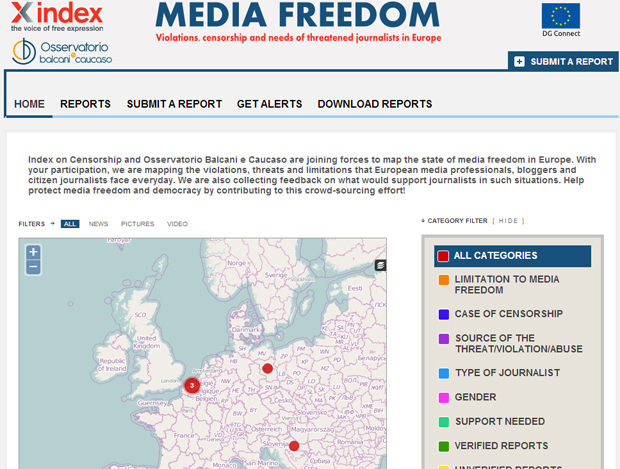
Index on Censorship and Osservatorio Balcani e Caucaso are launching mediafreedom.ushahidi.com to track media violations in Europe.
Index on Censorship, (London, United Kingdom) and Osservatorio Balcani e Caucaso, (Rovereto, Italy) have launched mediafreedom.ushahidi.com, a website that will enable the reporting and mapping of media freedom violations across the 28 EU countries plus candidate countries. The platform will collect and map out crowd-sourced information from media professionals and citizen journalists across Europe over the course of a year.
Based in London, Index on Censorship is an international organisation that promotes and defends the right to freedom of expression. Since its founding in 1972, Index has used a unique combination of journalism, campaigning and advocacy to defend freedom of expression for those facing censorship and repression, including journalists, writers, social media users, bloggers, artists, politicians, scientists, academics, activists and citizens.
“Index believes that free expression is the foundation of a free society and this website will enable journalists to report incidences of violations as soon as they happen. By mapping these reports online, the entire system will act as an advocacy, research and response tool, highlighting that violations on media freedom still occur in Europe.” explained Melody Patry, Index on Censorship senior advocacy officer.
Osservatorio Balcani e Caucaso (OBC) has been reporting on the socio-political and cultural developments of South-East Europe since 2000. Through the online platform, OBC will monitor and document media freedom violations in 11 countries, among which Bulgaria, Croatia, Greece, Romania, Serbia and others, and collect the needs of journalists under threat.
“We aim at improving the working conditions of media professionals and citizen journalists in Italy, South-East Europe and Turkey and ultimately at enhancing the quality of European democracy,” said Luisa Chiodi, scientific director of OBC.
This new website is part of a European Commission grant project under the EU’s Digital Agenda (DG Connect). In light of remaining violations to media freedom and plurality in Europe, and longer-term challenges in the digital age, the DG Connect launched a call for proposals to address the issue.
The successful candidates- the International Press Institute, Index on Censorship, Osservatorio Balcani e Caucaso together with SEEMO, Ossigeno per l’Informazione and Dr Siapera, as well as the European University Institute in cooperation with the Central European University– will spend the next year working on four projects, under the title European Centre for Press and Media Freedom.
For more information on the projects and the website, please read EU project to explore media freedom and pluralism or contact Melody Patry, [email protected], +44 (0) 207 260 2671 or OBC, [email protected].
27 May 2014 | About Index, European Union, News, Politics and Society
(Photo: Anatolii Stepanov / Demotix)
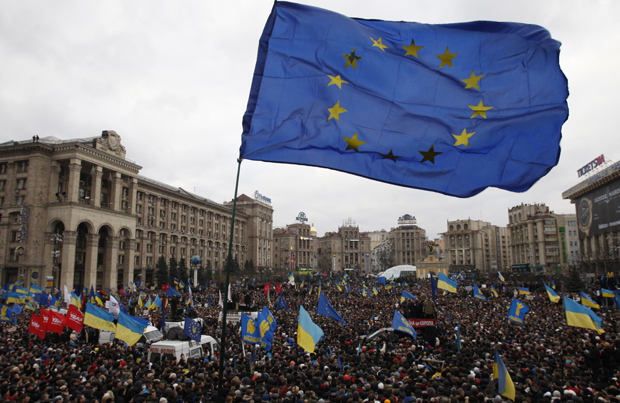
Free speech has always been a concern to the EU, with flaws in the world of press freedom and pluralism in Europe still apparent today. In an attempt to raise awareness to these problems, both on an institutional scale and publicly, DG Connect, tasked with undertaking the EU’s Digital Agenda, launched a call for proposal for funding for a new project to allow NGOs and civil society platforms to research and develop tools to tackle this problem.
The successful candidates- the International Press Institute, Index on Censorship, Osservatorio Balcani e Caucaso and the European University Institute in cooperation with the Central European University– will spend the next year working on the project, under the title European Centre for Press and Media Freedom.
“It is true that we regularly receive concerns about media freedom and pluralism that come from citizens, NGOs and the European Parliament,” Lorena Boix Alonso, Head of Unit for converging media and content at DG Connect told Index.
The Vice President of the European Commission, Neelie Kroes, began implementing action on this topic in 2011 with the creation of a high level group on media freedom and pluralism, but there are still violations in the world of European media freedom that need to be dealt with. These projects will be useful to raise awareness, according to Boix Alonso, to something which many people have little knowledge on.
Index on Censorship
In 2013, an Index on Censorship report showed that, despite all EU member states’ commitment to free expression, the way these common values were put into practice varied from country to country, with violations regularly occurring.
Building on this report, the DG Connect-funded project will enable Index to implement real-time mapping of violations to media freedom on a website that covers 28 EU countries and five candidate countries. Working with regional correspondents, specialist digital tools will be used to capture reports via web and mobile applications, for which workshop training will be provided. Index led events across Europe will discuss the contemporary challenges currently facing media professionals, allowing them to share good practices, while learning how to use the tools.
“Index believes that free expression is the foundation of a free society. Enabling journalists to report on matters without the threat of censorship or violations against them means promoting the right to freedom of expression and information, which is a fundamental and necessary condition for the promotion and protection of all human rights in a democratic society,” explained Melody Patry, Index on Censorship Senior Advocacy Officer.
The DG Connect grant demonstrates the current focus of the EU on the needs of journalists and citizens who face these violations to media freedom and plurality, according to Patry, as well as longer term challenges in the digital age.
Click here to visit the mediafreedom.ushahidi.com website
The Centre for Media Pluralism and Media Freedom
For some, the need to safeguard media freedom is at the forefront of the work they do. The Centre for Media Pluralism and Media Freedom (CMPF) is one such organisation and, in collaboration with the Centre for Media and Communication Studies (CMCS) at the Central European University, will continue to do so with funding from DG Connect for their project Strengthening Journalism in Europe: Tools, Networking, Training.
“The role of journalists is to both serve as guardians of government power and to enable the public to make informed decisions about key social and political issues that affect their daily lives,” the CMPF and CMCS told Index.
“The ability of journalists to freely report on issues without censorship is therefore critical- it’s the cornerstone of the checks and balances that make democracies work.”
The collaborative project will develop legal support, resources and tools for reporters, editors and media outlets to help them defend themselves in cases of legal threat, as well as raising awareness to ongoing violations to free expression and how these “impact the foundation on which democratic systems are based.” NGOs and policy makers will also benefit from this EU-funded scheme.
The International Press Institute
For over 60 years the International Press Institute (IPI) has been defending press freedom around the world, working to improve press legislation, influencing the release of imprisoned journalists and ensuring the media can carry out its work without restrictions.
London may have earned the title over recent years of libel capital of the world but what restrictions are placed on European journalists through defamation laws? This question forms the base of the IPI project, analysing existing laws and practices relating to defamation on both a civil and criminal nature; comparing this to international and European standards; and looking to the extent of which these affect the profession of journalism in all 28 EU countries and five candidate states.
After initial research, workshops will be hosted in four countries where the IPI believes they will have the greatest impact on the ground in countries where press freedom is limited by defamation to teach journalists which defamation laws affect their work, what the legitimate limits to press freedom are and what goes beyond what is internationally accepted.
According to the IPI the EU currently has no strong standards with regards to defamation and the threat to press freedom, a fact the led to their project proposal. “We hope that at one point the work we are doing will lead to a discussion within the EU about the need to develop these standards,” Barbara Trionfi, IPI Press Freedom Manager, explained to Index. “The defence of press freedom is a fight anywhere and it does not stop even in western Europe. It is still a major problem.”
Osservatorio Balcani e Caucaso
“We aim at improving the working conditions of media professionals and citizen journalists in Italy, South-East Europe and Turkey and ultimately at enhancing the quality of democracy,” Francesca Vanoni, Project Manager at Osservatorio Balcani e Caucaso (OBC) told Index.
OBC has been reporting on the socio-political and cultural developments of south-east Europe since 2000 and through their DG Connect funded project will monitor and document media freedom violations in nine countries, including Bulgaria, Croatia, Macedonia, Romania and Serbia.
Offering practical support to threatened journalists, the project will raise public awareness of the European dimension on media freedom and pluralism, stimulating an active role of the EU with regard to media pluralism in both member states and candidate countries. This will be implemented, among other means, through social media campaigns, a crowd-sourcing platform, an international conference for the exchange of best practices and transnational public debates.
The idea behind the project was to help build a European transnational public sphere in order to strengthen the EU itself. The ethics and professionalism of media workers is crucial, according to Vanoni. A democratic environment is built upon the contribution of all parts involved: “The protection of media freedom is fundamental for the European democracy and it cannot be left aside of the main political priorities.
“Being part of a wider political community that tackles shared problems with shared solutions offers stronger protection in case pluralism is threatened,” explained Vanoni.
To make a report, please visit http://mediafreedom.ushahidi.com
This article was published on May 20, 2014 at indexoncensorship.org
30 Apr 2014 | About Index, Azerbaijan Letters, Campaigns, Statements
Minister Usubov Ramil Idris oglu
Minister of Internal Affairs of the Republic of Azerbaijan
Azerbaijan Avenue 7
1005 Baku
Republic of Azerbaijan
Email: [email protected]
Prosecutor General Zakir Bakir oglu Garalov
Nigar Rafibayli street 7
1001 Baku
Republic of Azerbaijan
Email: [email protected]
Mr Minister, Mr Prosecutor General,
We, the undersigned members and partners of the Human Rights House Network (HRHN) and the South Caucasus Network of Human Rights Defenders, express our deep concern over the persecution and hindrance of free movement of human rights defender Leyla Yunus and her husband Arif Yunus. We call upon you to put an end to the attacks, detention and harassment of human rights defenders and to take steps in order to foster a safe environment for human rights defenders, in line with Azerbaijan’s international obligations and commitments, including as a member of the Council of Europe.
On 28 April 2014 Leyla Yunus and her husband, the historian Arif Yunus, were prevented from leaving the country at Baku’s airport. She then was detained and interrogated by the police regarding the case of the arrested journalist Rauf Mirkadirov and questioned about the relation between the journalist and the Institute for Peace and Democracy. She was released only in the after-noon on 29 April 2014. Searches were conducted in the office of the Institute for Peace and Democracy, and continued in the private home of Leyla Yunus until the night of 29 April 2014. According to Leila Yunus, she was humiliated during the search by the officers. The official grounds on which Leyla Yunus and Arif Yunus were prevented from leaving the country and detained are unclear, as well as the grounds on which the searches are being carried out.
Leader of the Institute for Peace and Democracy, Leyla Yunus is a well-known Azerbaijani human rights defender. Her NGO is a member of the South Caucasus Network of Human Rights Defenders and has from the very start in 1995 worked on the issue to release political prisoners and to establish rule of law in Azerbaijan. Leyla Yunus has within several projects worked to establish dialogue between civil society actors in the South Caucasus. She is a Chevalier of the National Order of the Legion of Honour, as a tribute for her longstanding work promoting human rights.
We are worried that the persecution is related to her outspoken criticism in the past few days against the detention of Rauf Mirgadirov, the investigative journalist of the leading Russian-language newspaper Zerkalo (Mirror), who is now facing charges of treason for his efforts in the peace building process of the Nagorno-Karabakh conflict. Rauf Mirkadirov participated in the numerous joint projects between the Institute for Peace and Democracy and Armenian NGOs.
Under Azerbaijan’s commitments within the Organisation for Security and Cooperation’s Misnk Group, we strongly believe that public diplomacy and cooperation between civil society in the South Caucasus contributes to efforts aiming at finding a peaceful solution to the Nagorno-Karabakh conflict.
As the Commissioner for Human Rights of the Council of Europe Nils Muižnieks stated on his Facebook page, “this is an additional example showing the extent of intimidation and repression of critical voices in Azerbaijan, a problem which I have repeatedly highlighted […] and asked the Azerbaijani authorities to address.”[1]Azerbaijan should indeed guarantee the right to freedom of expression of all human rights defenders and critical voices, in line with its obligations as a member of the Council of Europe.
Furthermore, authorities should prevent the use of unreliable evidence and unwarranted investigations against human rights defenders, as laid out in the United Nations Human Rights Council resolution 22/6 of 21 March 2013.
We are extremely worried to see that human rights defenders, including journalists and bloggers, are persecuted, attacked and detained due to their work. In addition to Leyla Yunus, the Chairperson of the Election Monitoring and Democracy Studies Centre (EMDS) Anar Mammadli, the Executive Director of EMDS Bashir Suleymanli and Elnur Mammadov, president of the Volunteers of International Cooperation, are facing court trials[2].
Ahead of the Chairmanship of the Council of Europe by the Republic of Azerbaijan, we call upon you to put an end to the crackdown of the civil society and to take steps in order to foster a safe environment for human rights defenders.
We further call upon you to report to the Council of Europe on your plans to investigate the acts of the State agents, which prevented Leyla Yunus and Arif Yunus from leaving the country and later detained them and to end all persecutions against them and other human rights defenders.
Sincerely,
Human Rights House Azerbaijan (on behalf of the following NGOs):
- Azerbaijan Lawyers Association
- Institute for Reporters’ Safety and Freedom
- Legal Education Society
- Media Rights Institute
- Women Association for Rational Development
Belarusian Human Rights House in exile, Vilnius (on behalf of the following NGOs):
- Belarusian PEN Centre
- Belarus Watch
- City Public Association “Centar Supolnaść”
- Human Rights Centre “Viasna”
Human Rights House Belgrade (on behalf of the following NGOs):
- Belgrade Centre for Human Rights
- Lawyers Committee for Human Rights YUCOM
- Civic Initiatives
- Helsinki Committee for Human Rights in Serbia
- Policy Centre
Human Rights House Kiev (on behalf of the following NGOs):
- Association of Ukrainian Human Rights Monitors on Law-Enforcement
- Human Rights Information Centre
- Center for Civil Liberties
- Kharkiv Human Rights Protection Group
Free Word Centre London (on behalf of the following NGOs):
- Index on Censorship
- Vivarta
Human Rights House Sarajevo (on behalf of the following NGOs):
- Helsinki Committee for human Rights in Bosnia and Herzegovina
Human Rights House Tbilisi (on behalf of the following NGOs):
- Georgian Centre for Psychosocial and Medical Rehabilitation of Torture Victims – GCRT
- Caucasian Center for Human Rights and Conflict Studies
- Human Rights Centre
- Union Sapari
- Article 42 of the Constitution
- Media Institute
Human Rights House Oslo (on behalf of the following NGOs):
- Health and Human Rights Info
- Human Rights House Foundation
- FIAN Norway
Human Rights House Voronezh (on behalf of the following NGOs):
- Charitable Foundation
- Civic Initiatives Development Centre
- Confederation of Free Labor
- For Ecological and Social Justice
- Free University
- Golos
- Interregional Trade Union of Literary Men
- Lawyers for labor rights
- Memorial
- Ms. Olga Gnezdilova
- Soldiers Mothers of Russia
- Voronezh Journalist Club
- Voronezh-Chernozemie
- Youth Human Rights Movement
Human Rights House Yerevan (on behalf of the following NGOs):
- Armenian Helsinki Association
- Helsinki Citizens’ Assembly-Vanadzor
- Journalists’ Club “Asparez”
- Democracy Today
Human Rights House Zagreb (on behalf of the following NGOs):
- APEO/UPIM Association for Promotion of Equal Opportunities for People with Disabilities
- B.a.B.e.
- CMS – Centre for Peace Studies
- Documenta – Centre for Dealing with the Past
- GOLJP – Civic Committee for Human Rights
- Svitanje – Association for Protection and Promotion of Mental Health
Rafto Foundation, Norway
Helsinki Foundation for Human Rights, Poland
Public Union of Democracy Human Rights Resource Centre, Azerbaijan
Legal Protection and Awareness Society, Azerbaijan
Copies have been sent to:
- Ministry of Justice of the Republic of Azerbaijan
- Presidency of the French Republic
- Ministry of Foreign Affairs of the French Republic
- Office of the Commissioner for Human Rights of the Council of Europe
- Private Office of the Secretary General of the Council of Europe
- Chairman of the Committee of Ministers of the Council of Europe
- Delegation of the Council of Europe in Azerbaijan
- UN Special Rapporteur on human rights defenders
- Office for Democratic Institutions and Human Rights of the Organisation for Security and Cooperation in Europe (OSCE ODIHR)
- Delegation of the European Union in Azerbaijan
- Subcommittee on Human Rights of the European Parliament
- Diplomatic community in Baku, Brussels, Geneva and Strasbourg
- Various ministries of foreign affairs and parliamentary committees on foreign affairs
About the Human Rights House Network (www.humanrightshouse.org)
The Human Rights House Network (HRHN) unites 90 human rights NGOs joining forces in 18 independent Human Rights Houses in 13 countries in Western Balkans, Eastern Europe and South Caucasus, East and Horn of Africa, and Western Europe. HRHN’s aim is to protect, empower and support human rights organisations locally and unite them in an international network of Human Rights Houses.
The Human Rights House Azerbaijan is one of the members of HRHN and served as an independent meeting place, a resource centre, and a coordinator for human rights organisations in Azerbaijan. In 2010, 6’000 human rights defenders, youth activists, independent journalists, and lawyers, used the facilities of the Human Rights House Azerbaijan, which has become a focal point for promotion and protection of human rights in Azerbaijan. The Human Rights House Azerbaijan has been closed after the Ministry of Justice of the Republic of Azerbaijan ordered all activities to be been ceased on 10 March 2011.
The Human Rights House Foundation (HRHF), based in Oslo (Norway) with an office in Geneva (Switzerland), is HRHN’s secretariat. HRHF is international partner of the South Caucasus Network of Human Rights Defenders and the Balkan Network of Human Rights Defenders.
HRHF has consultative status with the United Nations and HRHN has participatory status with the Council of Europe.
[1]Statement available at https://www.facebook.com/HumanRightsHouseNetwork/posts/10152035306640965.
[2]Further information on those cases available at http://humanrightshouse.org/Articles/20033.html.
