13 Dec 2013 | Europe and Central Asia, News, Russia
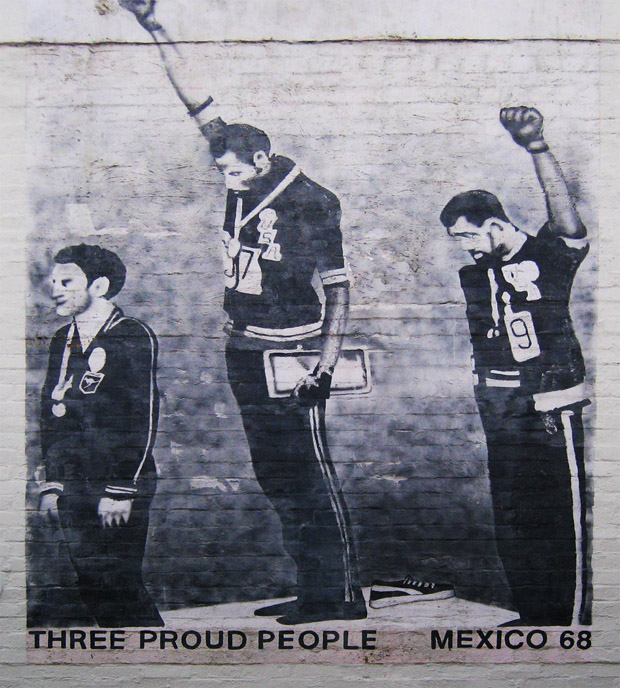
Grafitti of Tommie Smith, John Carlos and Peter Norman showing solidarity for the civil rights movement at the Mexico City Olympics in 1968 (Image: Newtown graffiti/Wikimedia Commons)
Athletes preparing to head off to Sochi Winter Olympics in February, have been reminded that they are barred from making political statements during the games.
”We will give the background of the Rule 50, explaining the interpretation of the Rule 50 to make the athletes aware and to assure them that the athletes will be protected,” said IOC President Thomas Bach in an interview earlier this week. Rule 50 stipulates that ”No kind of demonstration or political, religious or racial propaganda is permitted in any Olympic sites, venues or other areas.” Failure to comply could, at worst, mean expulsion for the athlete in question.
Political expression is certainly a hot topic at Sochi 2014. The games continue to be marred by widespread, international criticism of Russia’s human — and particularly LGBT– rights record. The outrage has especially been directed at the country’s recently implemented, draconian anti-gay law. Put place to “protect children”, it bans “gay propaganda”. This vague terminology could technically include anything from a ten meter rainbow flag to a tiny rainbow pin, and there have already been arrests under the new legislation.
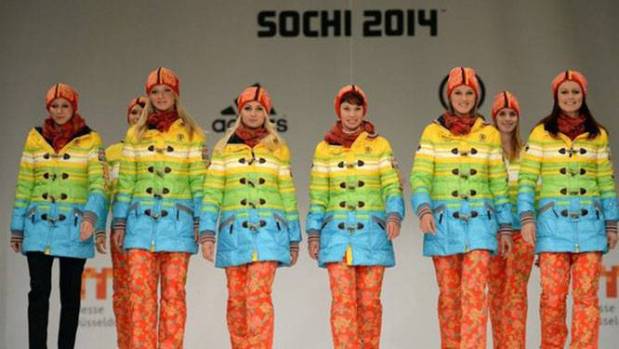
The confusion continued as the world wondered how this might impact LGBT athletes and spectators, or those wishing to show solidarity with them. Russian authorities have for instance warned of possible fines for visitors displaying “gay propaganda”. Could this put the Germans, with their colourful official gear, in the firing line? (Disclaimer: team Germany has denied that the outfits were designed as a protest.)
On the other hand, Russian president Vladimir Putin has promised there will be no discrimination at the Olympics, and IOC Chief Jaques Rogge, has said they “have received strong written reassurances from Russia that everyone will be welcome in Sochi regardless of their sexual orientation.”
On top of this, the IOC also recently announced that there will be designated “protest zones” in Sochi, for “people who want to express their opinion or want to demonstrate for or against something,” according to Bach. Where these would be located, or exactly how they would work, was not explained.
But while the legal situation in Russia adds another level of uncertainty and confusion regarding free, political expression for athletes, rule 50 has banned it for years. And for years, athletes have taken a stand anyway.
By far the most famous example came during the 1968 Olympics in Mexico City — American sprinters Tommie Smith and John Carlos, on the podium, black gloved fists raised in solidarity with the ongoing American civil rights movement. The third man on the podium, Australian Peter Norman, showed his support by wearing a badge for the Olympic Project for Human Rights. All three men faced criticism at the time, but the image today stands out as one of the most iconic and powerful pieces of Olympic history.
However, the history of Olympians and political protest goes further back than that. An early example is the refusal of American shotputter Ralph Rose to dip the flag to King Edward VII at the 1908 games in London. It us unknown exactly why he did it, but one theory is that it was an act of solidarity for Irish athletes who had to compete under the British flag, as Rose and others on his team were of Irish descent.
The Cold War years unsurprisingly proved to be a popular time for athletes to put their political views across. When China withdrew from the 1960 Olympics in protest at Taiwan, then recognised by the west as the legitimate China, taking part. The IOC then asked Taiwan not to march under the name ‘Republic of China’. While considering boycotting the games, the Taiwanese delegation instead decided to march into the opening ceremony with a sign reading “under protest”.
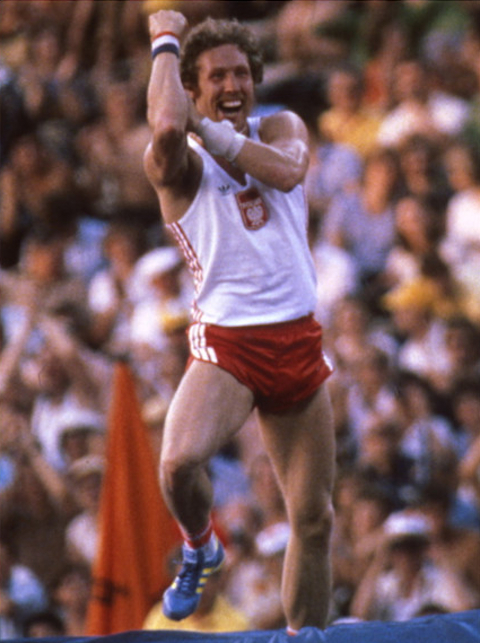
The same year as the Smith and Carlos protest, a Czechoslovakian gymnast kept her face down during the Soviet national anthem, in protest at the brutal crackdown of the Prague Spring earlier that year. And that was not the only act of defiance against the Soviet Union. During the controversial 1980 Moscow Olympics, boycotted by a number of countries over the USSR invasion of Afghanistan, the athletes competing also took a stand. The likes of China, Puerto Rico, Denmark, France and the UK marched under the Olympic flag in the opening ceremony, and raised it in the medal ceremonies. After winning gold, and beating a Soviet opponent, Polish high jumper Wladyslaw Kozakieicz also made a now famous, symbolic protest gesture towards the Soviet crowd.
But there are also more recent examples. At Athens 2004, Iranian flyweight judo champion Arash Miresmaeili reportedly ate his way out of his weight category the day before he was set to fight Israeli Ehud Vaks. “Although I have trained for months and was in good shape, I refused to fight my Israeli opponent to sympathise with the suffering of the people of Palestine” he said. A member of the South Korean football team which beat Japan to win bronze at the 2012 London Olympics, celebrated with a flag carrying a slogan supporting South Korean sovereignty over territory Japan also claims.
When the debate on political expression comes up, the argument of “where do we draw the line” often follows. If the IOC is to allow messages of solidarity with Russia’s LGBT population, should they allow, say, a Serbian athlete speak out against Kosovan independence? Or any number of similar, controversial political issues? Is it not easier to simply have a blanket band, and leave it at that?
The problem with this is, as much as the IOC and many other would like it, the Olympics, with all their inherent symbolism, simply cannot be divorced from wider society or politics. The examples above show this. With regards to Sochi in particular, the issue is pretty straightforward — gay are human rights. Some have argued we should boycott a Olympics in a country that doesn’t respect the Universal Declaration on Human Rights, or indeed the Olympic Charter. This is not happening, so the very least we can is use the Olympics to shine a light on gay rights in Russia. At its core, the Olympics are about the athletes — they are the most visible and important people there. It remains to be seen whether any of them will take a stand for gay rights, outside cordoned-off protest areas, in the slopes and on the rink, where the spotlight shines the brightest. And if they do, they should have our full support.
This article was posted on 13 Dec 2013 at indexoncensorship.org
3 Dec 2013 | Campaigns
Members and partners of the Human Rights House Network condemn in the strongest terms the excessive use of force by Ukrainian authorities to disperse peaceful demonstrations, following the refusal by Ukraine to sign the European Union association agreement.
Tuesday, 03 December 2013, by Human Rights House Foundation (HRHF)
In their joint letter [download on the right], member and partner NGOs of the Human Rights House Network (HRHN) also call upon President Viktor Yanukovych to immediately revoke measures aiming at using force against protestors and release all protestors and journalists detained, and ensure that relatives of injured and arrested protestors and journalists were informed of their situation.
The 29-30 November 2013 demonstration on Maidan Nezalezhnosti, Kyiv’s Independence Square, essentially of students and activists, was peaceful until the police used excessive force to disperse it. The NGOs call upon Ukrainian authorities to undertake an independent and transparent investigation on the unlawful dispersal of the peaceful protest, and bring those responsible to justice, as requested by one of the members of the Human Rights House Kyiv, the Ukrainian Helsinki Human Rights Union.
Another member of the Human Rights House Kyiv, the Information Centre for Human Rights reports that 52 journalists were injured by police forces or by stones and grenades thrown by violent elements. The Centre for Civil Liberties, also a member of the Human Rights House Kyiv, is coordinating the legal aid “EuroMaidanSOS” since Sunday night. The Centre has received around 200 phone calls during the weekend. So far, they have registered 75 complaints related to arrests, beatings and people who were temporarily taken away from the 29-30 November demonstration. This does not include clashes with the police in front of the Presidential Administration Sunday 1 December. The NGOs call upon Ukrainian authorities to immediately and unconditionally drop all charges against peaceful protestors and journalists, release and compensate all of them, and ensure that they can carry out their work.
According to “EuroMaidanSOS”, 14 people (youth activists and students apparently) have disappeared, since the police intervention on 29-30 November 2013 at Maidan Nezalezhnosti. “EuroMaidanSOS” and human rights groups have called hospitals but not found information allowing them to trace back to the disappeared people. The NGOs call upon President Viktor Yanukovych to ensure that law enforcement authorities inform relatives of injured and arrested protestors of their situation. Ukraine has the obligation to protect anybody from being a victim of an enforced disappearance, even more so when injured or arrested by law enforcement authorities at a peaceful protest.
In their joint letter, the NGOs call upon you President Viktor Yanukovych to follow advice from Ukrainian civil society, including by:
Taking concrete measures aiming at stopping the use of force by police to disperse protestors, even if they occupy governmental buildings, and to publicly acknowledge the right of anybody to peacefully protest and the duty of the State security forces to protect peaceful protestors;[1]
Undertaking an independent and transparent investigation on the unlawful dispersal of the peaceful protest of 29-30 November 2013, and ensure that those responsible are brought to justice and do not enjoy impunity; Immediately and unconditionally dropping all charges against peaceful protestors and journalists, release and compensate all of them; Ensuring that law enforcement authorities inform relatives of injured and arrested protestors of their situation, protecting everybody from being a victim of an enforced disappearance, including by immediately investigating the cases of 14 people disappeared following the police intervention on 29-30 November 2013 at Maidan Nezalezhnosti;[2]
Ensuring that human rights NGOs and journalists are able to monitor assemblies and report on police violence without fearing retaliation, and that human rights defenders and activists are not charged for participating in peaceful protests.[3]
Signed by:
Human Rights House Kyiv (on behalf of the following NGOs):
Ukrainian Legal Aid Foundation
Ukrainian Helsinki Human rights Union
Human Rights Information Center
Association of Ukrainian Human Rights Monitors on Law Enforcement (Association UMDPL)
Azerbaijan Human Rights House (on behalf of the following NGOs):
Women’s Association for Rational Development
Institute for Reporters’ Freedom and Safety
Society for Humanitarian Research
Media Rights Institute
Association for the Protection of Women’s Rights in Azerbaijan after D. Aliyeva
Legal Education Society
Azerbaijan Lawyers Association
Barys Zvozskau Belarusian Human Rights House in exile, Vilnius
Human Rights House Belgrade (on behalf of the following NGOs):
Helsinki Committee for Human Rights in Serbia
Lawyers Committee for Human Rights (YUCOM)
Belgrade Centre for Human Rights
Human Rights House Sarajevo (on behalf of the following NGOs):
Association Transitional Justice Accountability and Remembrance in Bosnia and Herzegovina
Helsinki Committee for Human Rights in Bosnia and Herzegovina
Renesansa
Serbian Civic Council
Human Rights House Tbilisi (on behalf of the following NGOs):
Article 42 of the Constitution
Caucasian Centre for Human Rights and Conflict Studies
Georgian Centre for Psychosocial and Medical Rehabilitation of Torture Victims
Human Rights Centre
Union Sapari – Family without Violence
Human Rights House Oslo (on behalf of the following NGOs):
Human Rights House Foundation
Human Rights House Voronezh (on behalf of the following NGOs):
Charitable Foundation
Civic Initiatives Development Center
Confederation of Free Labor
For Ecological and Social Justice
Free University
Golos
Interregional Trade Union of Literary Men
Lawyers for labor rights
Memorial
Ms. Olga Gnezdilova
Soldiers Mothers of Russia
Voronezh Journalist Club
Voronezh-Chernozemie
Youth Human Rights Movement
Human Rights House Yerevan (on behalf of the following NGOs):
Helsinki Citizens’ Assembly – Vanadzor
Socioscope
Jurists against Torture
Human Rights House Zagreb (on behalf of the following NGOs):
Association for Promotion of Equal Opportunities for People with Disabilities
B.a.B.e. – Be active, Be emancipated
Centre for Peace Studies
Documenta – Centre for Dealing with the Past
GOLJP – Civic Committee for Human Rights
Svitanje – Association for Protection and Promotion of Mental Health
Election Monitoring and Education Center, Azerbaijan
Helsinki Foundation for Human Rights, Poland
Human Rights Club, Azerbaijan
Index on Censorship, United Kingdom
2 Dec 2013 | Croatia, News, Religion and Culture
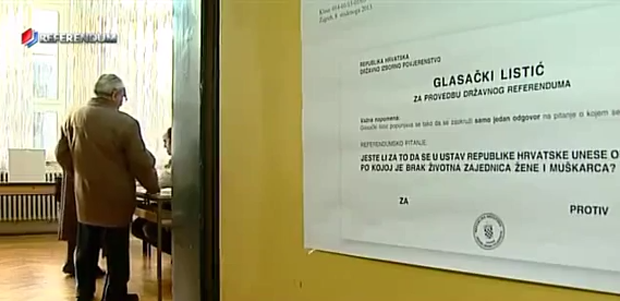
Croatians cast their votes on whether marriage should be constitutionally recognised as being between a man and a woman (Image: Mc Crnjo/YouTube)
Croatia’s voters moved Sunday to amend the country’s constitution to define marriage as being between a man and a woman. The campaign had been orchestrated by the country’s religious institutions. Sixty-five percent of voters supported a change that effectively bars gay marriage.
The campaign used some interesting and controversial tactics. Religious teachers in schools threatened students that they wouldn’t get a passing grade if they did not provide proof of their families’ support for the constitutional change. This was reported by an English language teacher from Split, the second largest city in Croatia, to the inspection body of the Ministry of Education around mid-November.
“If this is the situation in Split I believe it is even worse in smaller towns”, concluded the teacher who did not want to sign her name.
Following this, the media received numerous letters from school teachers confirming that religious teachers around Croatia were blackmailing students to make sure their family members vote “for the protection of the family” — the Catholic Church’s interpretation of the referendum question.
“If the president of the country and other public persons can talk about voting at the referendum why can’t a religious teacher do so?” commented Sabina Marunčić, senior advisor for religious education at the Croatian Education and Teacher Training Agency.
Since the call for a referendum on 8 November, the campaign has been the main topic of discussion in Croatia, despite the country facing a severe economic crisis and an unemployment rate of 20.3 per cent. While Croatian law defines marriage as a union between a man and a woman, this definition does not exist in the constitution. A recent announcement of a new law on same-sex partnerships has caused conservative movements to come together in the initiative “In the Name of Family”. They started spreading fear about gay marriage being legalised, despite the centre-left government showing no intention to do this. A 2003 law on same-sex partnerships has been seen as practically useless because it secures only a few, less important rights, and only after a relationship breaks down.
For weeks all anyone talked about was who will vote “for” and who will vote “against”, in the first national referendum in the Republic of Croatia set up by popular demand. The Social Democratic prime minister Zoran Milanović, President Ivo Josipović and numerous ministers all came forth against introducing the definition into the constitution. A large portion of powerful media was also openly against it. However, public opinion polls showed that 68 per cent of the citizens would vote for the proposal; 26 per cent against.
In the referendum campaign, the Catholic Church have firmly been advocating “for”. It has has a strong influence in the country of 4.29 million, with 86 per cent declaring themselves Catholic according to the latest census, released in 2011. The initiative “In the name of family” which has succeeded in gathering signatures of 740,000 citizens in order to hold a referendum is also linked to the Catholic Church.
“The church did not want to start the initiative for a referendum but it wholeheartedly accepted In the Name of Family, whose numerous members are conservative Catholics close to certain Croatian bishops,” says Hrvoje Crikvenec, editor of the religious portal Križ života (“Cross of Life”).
“However, I believe that the entire organisation and initiative is supported more by politics, that is, a marginal political right-wing party Hrast, than Croatian bishops. They have now become more involved in the campaign in the hope of what would for them be a positive outcome of the referendum, which would ultimately show them as winners.”
The initiative’s leaders do come from the non-parliamentary right-wing party Hrast, as well as conservative associations opposing the introduction of sex education in schools, artificial insemination and abortion. Some of them have been linked to Opus Dei, a secretive Catholic organisation which has been strengthening its presence in Croatia. In the Name of Family and the fight against a possible equal standing of homosexual and heterosexual marriages has provided them with the support of a larger portion of the public.
The Catholic Church has undoubtedly helped the success of a In the Name of Family. Signatures were gathered in front of churches and elsewhere, even in universities. Cardinal Josip Bozanić had written a note instructing priests to encourage believers in masses to attend the referendum and vote for the definition of marriage as a union between a man and a woman. Group prayers for its success were also organised throughout Croatia in the lead up to the vote.
“We can’t blame the bishops for advocating the referendum from the altar because this is a part of the church’s program. They are more entitled do so than to say who to vote for at the elections, which they also do. However, it is inadmissible for religious teachers to influence children in schools,” university professor of philosophy and political commentator Žarko Puhovski says.
Despite Croatia being a majority Catholic country, every fourth marriage ends in divorce and a decreasing number of couples are deciding to marry.
“The church’s influence on citizens is far greater regarding political than moral views. Church morality is accepted in principle, but political views supported by the church gain additional power. That is why the referendum is causing a short-term increase in the influence of the church, which has for years been weakening,” Puhovski explains.
Church leaders are often complaining about the non-existent dialogue with the current, left-wing government, especially regarding the issues they consider to be related to religion – education of children, family care and marriage.
“The ultimate success of this referendum is in showing the power of the church in Croatia. It has shown the government that it can move masses of people so in the future, the government will have to think carefully before making any decision which could harm their interests,” said a group of Roman Catholic theologists in a joint letter made public on 29 November.
“The relationship between the church and the state has mostly been disturbed by militant statements of individuals from the Catholic Church leadership, which seem to be best served with a one common mindset rather than political and worldview pluralism,” sociologist and ex-ambassador for the Holy See, Ivica Maštruko says.
“We are not dealing with a normal criticism of the current social state and relations, but bigotry, inappropriate discourse and civilisational and religious malice,” Maštruko added.
An example of such a discourse is provided by reputable former minister and theologist Adalbert Rebić who, earlier this year, was quoted as saying: “The conspiracy of faggots, communists and dykes will ruin Croatia.” Pastor Franjo Jurčević was convicted for publishing homophobic and extremist posts on his blog.
But in the campaign for the referendum the Catholic Church was joined by representatives of the other most influential religious communities in Croatia – Orthodox Christians, Muslims, Baptists and the Jewish community Bet Israel. Together they supported the referendum and invited the believers to vote in order to “secure a constitutional protection of marriage”. Religious communities in Croatia are usually rarely seen forming such shared views.
“The most interesting thing is the agreement between the Catholic Church and the Serbian Orthodox Church which have in the past twenty years completely missed the chance to initiate reconciliation, dialogue and co-existence during and after the wars in ex-Yugoslavia. Religious communities in the region can obviously agree only when they find a common enemy, which in the case of this referendum are LGBT persons,” Cirkvenec says.
Žarko Puhovski considers it indicative that religious communities in Croatia succeed in forming shared views only with regards to sexual morality.
“They have failed to reach a consensus on any other moral or political issue,” he concludes.
This article was published on 2 Dec 2013 at indexoncensorship.org
26 Nov 2013 | Campaigns, European Union, United Nations
In a joint letter to Baroness Catherine Ashton, High Representative for Foreign Affairs & Security Policy and Vice-President of the European Commission, Index on Censorship has joined 66 human rights NGOs from European Union member States, States from the European Partnership and States in cooperation with the European Union stress that the intent to reduce OHCHR’s budget is a signal in the wrong direction. The programme budget for the biennium 2014-2015 for 2014-2015 already decreases the budget of OHCHR by a net 4.8%, whilst the promotion and protection of human rights represents only 3% of the overall UN budget.
Keeping in mind that within the overall UN budget, the share allocated to the promotion and protection of human rights represents approximately 3%, the intent to reduce OHCHR’s budget is a signal in the wrong direction. Soon the Human Rights Council will celebrate its 10 years of existence – we believe that all States and group of States aiming at promoting human rights should ambition to raise that share to at least 10% to celebrate the 10 years of existence of the Council, which will be made impossible if the European Union continues to pressure for more and more “across the board” cuts in the UN’s human rights budget.
20 years after the Office was established, does the European Union really want to a force contributing to undermining the sustainability of OHCHR, hence weakening the voice for human rights within the UN system?
Azerbaijan Human Rights House (on behalf of the following NGOs):
Association for Protection of Womens’ Rights
Azerbaijan Lawyers Association
Human Rights Center of Azerbaijan
Institute for Peace and Democracy
Legal Education Society
Women’s Association for Rational Development
Media Rights Institute
Public Union of Democracy and Human Rights Resource Centre
Society for Humanitarian Research
Barys Zvozskau Belarusian Human Rights House in exile, Vilnius
Human Rights House Belgrade (on behalf of the following NGOs):
Belgrade Centre for Human Rights
Lawyers’ Committee for Human Rights
Helsinki Committee for Human Rights in Serbia
Policy Center
Human Rights House Kiev (on behalf of the following NGOs):
Association of Ukrainian Human Rights Monitors on Law Enforcement (Association UMDPL)
Center for Civil Liberties
Human Rights Information Center
Human Rights House Tbilisi (on behalf of the following NGOs):
Article 42 of the Constitution
Caucasian Centre for Human Rights and Conflict Studies
Georgian Centre for Psychosocial and Medical Rehabilitation of Torture Victims
Human Rights Centre
Media Centre
Union Sapari – Family without Violence
Human Rights House Oslo (on behalf of the following NGOs):
Human Rights House Foundation (HRHF)
Health and Human Rights Info
Norwegian Helsinki Committee
Human Rights House Voronezh (on behalf of the following NGOs):
Charitable Foundation
Civic Initiatives Development Centre
Confederation of Free Labor
For Ecological and Social Justice
Free University
Golos
Interregional Trade Union of Literary Men
Lawyers for labor rights
Memorial
Ms. Olga Gnezdilova
Soldiers Mothers of Russia
Voronezh Journalist Club
Voronezh-Chernozemie
Youth Human Rights Movement
Human Rights House Yerevan (on behalf of the following NGOs):
Armenian Helsinki Association
Helsinki Citizens’ Assembly – Vanadzor
Jurists against Torture
Guaranteeing Equal Opportunities
Shahkhatun
Socioscope
Women’s Resource Center
Human Rights House Zagreb (on behalf of the following NGOs):
Association for Promotion of Equal Opportunities for People with Disabilities
B.a.B.e. – Be active, Be emancipated
Centre for Peace Studies
Documenta – Centre for Dealing with the Past
GOLJP – Civic Committee for Human Rights
Svitanje – Association for Protection and Promotion of Mental Health
Russian Research Centre for Human Rights (on behalf of the following NGOs):
Human Rights Network Group
Independent Psychiatric Association of Russia
Moscow Centre for Prison Reform
Moscow Helsinki Group
Mother’s Right Foundation
Non-violence International
Right of the Child
Right to Live and Have Civil Dignity
Social Partnership FoundationUnion of the Committees of Soldiers’ Mothers of Russia
Helsinki Foundation for Human Rights, Poland
Human Rights Club, Azerbaijan
Rafto Foundation, Norway
Human Rights House Foundation (HRHF)
Index on Censorship