Index at 50: The battles won, lost and currently raging
Volume 51.01 Spring 2022

Volume 51.01 Spring 2022
Since returning home to the Democratic Republic of Congo in the winter of 2020, after spending several years travelling throughout Africa, I found the winds of change blowing over the country. Expectations were high that these winds would bring new freedoms, including freedom of expression and the media, which had been overlooked under the old administration.
But it was not to be. I quickly found that yesterday’s victims – the current ruling party leaders – had turned into the new oppressors. Journalists and thought leaders, even musicians, were arrested, threatened, taken to court and jailed. Others would self-censor to avoid trouble. They did not want to get in trouble with the authorities. The new leader of the DRC, Felix Tshisekedi, failed in his promise to protect the media, just like previous leaders had.

DRC leader Felix Tshisekedi, who has presided over a crackdown on the press. Credit: www.kremlin.ru/Wikimedia
Many would decry the way I reported, saying that I was putting myself in danger. But I was trained in South Africa, where the media is more free. I didn’t want to self-censor. So when Index on Censorship asked me to write about Tshisekedi’s failed promises to put the media first, I accepted.
I did not realise then quite how much it would put me in danger. A few weeks after filing, I was told that those in power were angered by my article and that spies were being sent to look for me. I also heard allegations that a list of anti-regime journalists had been issued by ruling party supporters – each person to be hunted down. Apparently, my name was on that list.
The weeks that followed were a sort of hell. I slept uneasily, fearing for my life. My wife and I were separated – pending a divorce – and on a level that felt like a blessing. At least I knew she and our children would be safe, away from me. If a hitman came to finish me off, I would die alone, and spare the lives of our kids.
I wanted to leave the capital city, my birthplace, but I did not know where to go. At the time I was staying in a hotel due to the breakup of my marriage. I quickly packed a suitcase with my clothes. While I wasn’t sure exactly when or if someone would come for me, I couldn’t take the risk. I left in haste. I didn’t even have time to pick up my trousers and shirt that were being repaired at a makeshift dressmaker.
The money I had was very little. It would be hard to purchase a ticket to West Africa, a region that I love and that I believe is one of the world’s underreported zones. With the money that I did have, I travelled to the troubled east of the country. It wasn’t a decision made lightly. Rather from there it would be relatively easy to cross the border into other, safer countries.
In the DRC’s east many journalists have been killed and others threatened in recent years. The media work under duress. They face threats and attacks from security forces and intelligence agencies, and from armed groups. For example, in October 2020 a radio journalist went into hiding after army generals threatened to kill her.
While there I was told that I had to be very careful; two gunmen in army uniforms had come looking for a journalist near where I was staying. Once again, I started to make plans to leave, and this time round to leave the DRC for good. Again, I had very little money. Index fortunately gave me an advance on my next article, which really helped. It was time to go. Before it is too late.
I went first by ship, the whole night, 100.4 km to the south, then by car crisscrossing mountains, hills and valleys, another 100 km further south, all amid the presence of dozens of armed groups.
I finally made it safely out of the “danger zone”. I was out of reach, both from the government, its army, and militia.
But new challenges quickly emerged. On the way to where I was supposed to go to be able to seek refuge I was robbed. My laptop was taken and all my money. Those who robbed us said that if we ever tried to report the incident to the authorities they would hunt us down. Again, silenced and gagged.
Back to square one. Those days were a struggle. Minimal food and money, no laptop, no phone, no permanent place to stay. I felt hopeless and helpless in a strange country.
I worried about where I would sleep and eat and also about the stories I would struggle to report.
These beautiful and exciting lands have been transformed into a hostile zone run by political leaders who hate the media. I long for West Africa – “my second home”. I want to go there and be at peace and rest. Not to retire though, no, because I firmly believe that I was born to write, expose, criticise and hold the powerful to account.
This account was given to Index in January. Since then the writer has managed to leave the DRC and is reporting for Index in the upcoming 50th anniversary special issue.
[vc_row][vc_column][vc_column_text]The global Covid-19 pandemic has been the root cause of some of the most concerning and frightening attacks on journalists worldwide.
For The Times’ Red Box, Index’s Head of Content Jemimah Steinfeld laid out why the attacks were so concerning:
“Even we have been shocked by the scale of the attacks,” she said. “Journalists have been detained in Serbia; they’ve been called ‘wimps’ by Brazil’s leader Jair Bolsonaro; they’ve been expelled from China; banned from asking questions at lobby briefings in the UK; assaulted by police in South Africa; cowed by legislative change in Hungary.”
“The attacks have been relentless.”
[/vc_column_text][/vc_column][/vc_row]
“The invasion of privacy is the reverse side of censorship. If you don’t feel that your privacy is immune, you’re not going to speak out, you’re going to hold your tongue. Or not talk about certain things. So it has this strange underbelly of censorship,” said Judith Vidal-Hall, former editor of Index on Censorship from 1993 to 2007. I meet Vidal-Hall on a sunny afternoon at a river-side cafe in West London to discuss her experiences of editing the magazine. We’re chatting about the internet and the privacy concerns that come with it, a concern that went from almost non-existent to ubiquitous during her time as editor.
“One of the greatest threats to free expression at the moment is privacy,” she added.
Vidal-Hall worked at Index at one of the most pivotal eras in recent world history. In 1993 the Twin Towers still stood, the world wide web was in its infancy and South African apartheid continued to be enforced. By 2007 the political and social landscape had become almost unrecognisable.
Under Vidal-Hall’s stewardship, Index navigated this global metamorphosis, identifying those in power who obscured the truth, those who were being shut out of the narrative, and gave the “voiceless a voice”.
How did Vidal-Hall find herself editing the magazine in 1993?
“It’s quite a long story, it’s a bit of a saga,” she told me over sausage rolls and tea. And a bit of a saga it really is. Returning to the UK in 1976 after a couple years of travelling, Vidal-Hall approached the Guardian, on behalf of a Bangladeshi friend, to start the Guardian Third World Review. It was, she said, “an absolutely pioneering supplement where third world people told their own stories”.
She remembers a Guardian journalist at the time asking her: “Don’t you think we treat the third world fairly?”. “That’s not the point.” she had replied. “You’re keeping their voices out…I didn’t use the word at the time I don’t think, but they’re censored. You keep them out.
Without skipping a beat, she added: “We then started a magazine called South.” South: The Voice of the Third World, was a monthly magazine which was about including other voices. South closed its doors in 1989 and, Vidal-Hall chuckled, “my husband buggered off at the same time so I was left with no husband, no income”.
Shortly after, she received a call from Philip Spender, who was running Index, asking for a reference for Andrew Graham-Yooll, who had been an editor at South. Graham-Yooll became the editor of Index, and it was he who brought Vidal-Hall into the fold.
It was not the best time for Index. Many of Index’s funders had seen it as “a Cold War weapon” and, believing communism to be over with the fall of the Berlin Wall in 1989, they had withdrawn their funding. By the early 1990s Index was “basically bankrupt”.
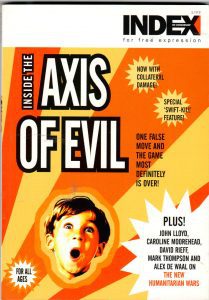
Inside the axis of evil, the spring 2003 issue of Index on Censorship magazine
Enter the Fritt Ord Foundation, a group of Norwegian newspaper owners “ashamed of the takeover of their media by the Nazis in the [19]40s, and they had made a resolution, never again to work for anyone but themselves and to support independent media.”
And so in 1993, supported by funds from the Fritt Ord Foundation, Index was relaunched with Vidal-Hall as the editor, who had some big plans.
“One was to make it an attractive, readable magazine.”
Next: “I wanted it to be much more diverse…it did have a sort of Cold War focus and I wanted to bring in a much more global focus.”
“The third thing I wanted was to get rid of the idea that censorship was what they did out there, not what we did. They censor, we don’t. So I wanted to make it universal, the concept of censorship.”
I discuss with Vidall-Hall an Index article from 2002 by Noam Chomsky, Confronting the Monster. In this article Chomsky, writing in the wake of 9/11, examines how the West considers only actions taken by the enemy to be war crimes, while believing their own actions are always justified.
“He was so much my hero,” Vidal-Hall said on hearing Chomsky’s name.
“The them and us, it’s a good way to put it [referencing Chomsky’s article]. They do it, we don’t. And I wanted to break that, so that was my main [aim], to make Index inclusive not only of all genders, colours etc and creeds, don’t forget creeds, but also to make it inclusive of us, as guilty as them in a different way.”

Underexposed, the November 1999 edition of Index on Censorship magazine, which was Vidal-Hall’s favourite to work on
As we discuss Chomksy’s article, I ask what was the most important global event that happened while Vidal-Hall was at Index.
She says gathering around the television in the office to watch events on 9/11 unfolding live: “And that in some ways was the beginning of what I would call a series of events. It changed the balance, the perspective, relationships and priorities in the world. So, off the cuff, I would say that the sequence of events between 9/11 and the invasion of Iraq…that was the changing moment.”
The conversation turns to media coverage of that time. How were the narratives controlled by the states in question? What did it mean for freedom of expression?
“[In 2001-2003] people thought they had freedom of expression but they didn’t know the facts. And why didn’t we know the facts? We were lied to, there were no weapons of mass destruction.”
She added: “For me, and it’s very personal, what that invasion did was destroy a level of what seemed like stability in international relations. And I think the revelations of the inquiry into the lies that have been told was quite shocking… Are governments transparent? No! When they need to lie they will lie if it defends them.”
While the events of 2001 to 2003 were the most important during Vidal-Hall’s time as editor, her favourite issue predates them. It is a 1999 issue called Underexposed, which explored the censorship of photographs.
“It was fascinating. I didn’t go to the office for days. I spent weeks searching [for images]…some of the ones I remember most clearly, visually, are the ones from the early 30s when Hitler was coming to power. The photos that were never published. I’ll give you one example. Never published in Germany! Photos of him. There’s this one photo where he’s being coached in sort of rhetoric and he didn’t want people to know that he was being coached.”
Vidal-Hall also reflects on interviews she conducted in the early 1990s, one with a key player in modern European far-right politics.
“When the [Berlin] Wall came down I went out to Hungary and various other places…I did some rather interesting interviews…One of them was with a man you might have heard of, Viktor Orban. I interviewed him back when the Wall had come down, communism had fallen and him and another young man whom I’m still in touch with, Peter Molnar, I interviewed them together. They were the founder of Fidesz, the party that has now gone extreme right. And Orban seems to have undergone a personality change.”
Meditating on far right politics in Europe today, Vidal-Hall said: “How much of it is our mistake in thinking that democracy can just be delivered to the door by Amazon in a parcel with a smile?”
This gloomy take is offset by Vidal-Hall’s praise for Index: “As a publication you are unique, there is nobody else who is doing what index is doing. And that is extraordinary, to remain so. I feel strongly about that.”
The interview wraps up and I leave, my mind awash with the battles Index has won alongside all of those that we are still fighting today.