9 Jul 2020 | News
[vc_row][vc_column][vc_column_text]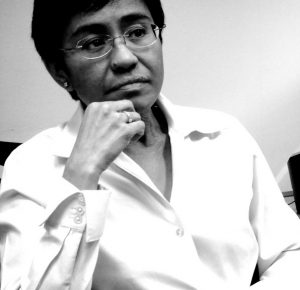 Index on Censorship has joined sixty press freedom groups and civil society organisations, journalism institutions, filmmakers, and other supporters to form a coalition in support of internationally celebrated Filipino-American journalist Maria Ressa.
Index has joined with the Committee to Protect Journalists, the International Center for Journalists , and Reporters Without Borders and many others (see below) in the launch of the #HoldTheLine campaign in support of Ressa and independent media under attack in the Philippines. Acting in coordination with Ressa and her legal team, representatives from the three groups form the steering committee, working alongside dozens of partners on the global campaign and reporting initiatives. The campaign takes its name from Ressa’s commitment to ‘hold the line’ in response to sustained state harassment and prolific online violence.
Ressa is best known for two decades covering South East Asia for CNN and founding the multi-award winning Philippines news website Rappler. On 15 June 2020, she was convicted of “cyber-libel,” alongside former Rappler colleague Reynaldo Santos Jr – a criminal charge for which they face up to six years in prison. The conviction relates to a story about corruption from 2012 – before the law was even enacted – and hung on the correction of a typo.
Ressa and Santos both posted bail, but could be imprisoned if the case is not overturned on appeal. Ressa is facing at least six other cases and charges. Guilty verdicts in all of them could result in her spending nearly a century in jail. Rappler is also implicated in most of these cases, with several involving criminal charges related to libel, foreign ownership, and taxes. The convictions are the latest offence in the Duterte government’s wider campaign to stifle independent reporting, including the recent shutdown of the main national broadcaster ABS-CBN.
“I am moved by the incredible outpouring of support we’ve received from around the globe for our campaign to #HoldTheLine against tyranny – even as President Duterte continues his public attacks on me, the legal harassment escalates, and the state-licenced and Facebook-fuelled online violence rages on. We can’t stay silent because silence is consent,” Ressa said. “We need to be outraged, to fight back with journalism. If we don’t use our rights, we will lose them. Please stand with us!”
Those interested in showing support can sign and share this petition calling for the Philippine government to drop all charges and cases against Ressa, Santos and Rappler, and end pressure on independent media in the Philippines.
The 60 founding members of the #HoldTheLine Coalition are:
The Committee to Protect Journalists (CPJ), the International Center for Journalists (ICFJ) and Reporters Without Borders (RSF), which form the steering committee; African Media Initiative; Association for International Broadcasting (AIB); Alliance for Journalists’ Freedom; Amnesty International; ARTICLE 19; Association of Caribbean Media Workers; Canadian Journalism Forum on Violence and Trauma; Centre for Freedom of the Media (CFOM); Centre for Law and Democracy; CineDiaz; The Coalition For Women In Journalism; Community Media Forum Europe (CMFE); DART Asia Pacific; The Daphne Caruana Galizia Foundation; Dart Center; Doc Society; English PEN; European Journalism Centre; First Look Media; Free Press Unlimited; Global Alliance on Media and Gender (GAMAG); Global Forum for Media Development (GFMD); Global Voices; Graduate School of Journalism, Columbia University; Index on Censorship; Institute for Regional Media and Information (IRMI); International Media Support (IMS); International Association of Women in Radio and Television (IAWRT); International News Safety Institute (INSI); International Press Institute (IPI); International Women’s Media Foundation (IWMF); James W. Foley Legacy Foundation; Judith Neilson Institute; Justice for Journalists Foundation; Media Association for Peace (MAP); Media Development Investment Fund (MDIF); Namibia Media Trust (NMT); National Union of Journalists of the Philippines (NUJP); Pakistan Press Foundation; Panos Institute Southern Africa; PEN America; Philippine Center for Investigative Journalism (PCIJ); Press Freedom Defence Fund; Project Syndicate; Public Media Alliance; Pulitzer Center on Crisis Reporting; Rappler; Rory Peck Trust; Rural Media Network Pakistan; South African National Editors’ Forum (SANEF); Storyhunter; The Signals Network; Tanzania Media Practitioners Association; Union of Journalists in Finland; World Association of Newspapers and News Publishers (WAN-IFRA); and World Editors Forum.[/vc_column_text][/vc_column][/vc_row][vc_row][vc_column][three_column_post title=”More news” category_id=”581″][/vc_column][/vc_row]
16 Jun 2020 | Magazine, Magazine Editions, Volume 49.02 Summer 2020
Journalist
Issa Sikiti da Silva is an award-winning freelance journalist who has traveled extensively across Africa. Born in Kinshasa, the capital of the Democratic Republic of Congo, he has lived in South Africa and worked as a foreign correspondent in West Africa. His work has been published in nearly 40 media outlets
Actor and playwright
Katherine Parkinson is a Bafta-award winning English actress. She has appeared in several television series, including The IT Crowd and Humans. She has also appeared in such films as How to Lose Friends & Alienate People and The Boat That Rocked, as well as on stage in various high profile West End shows. In 2019 Parkinson’s debut work as a playwright, Sitting, had its London premiere, after a month-long run at the Edinburgh Fringe
Playwright
David Hare is a playwright and film-maker. He has written over thirty stage plays which include Plenty and Pravda (with Howard Brenton). For film and television, he has written nearly thirty screenplays which include Licking Hitler, The Hours, The Reader and Denial. In a millennial poll of the greatest plays of the 20th century, five of the top 100 were his
27 Mar 2020 | News
[vc_row][vc_column][vc_single_image image=”112806″ img_size=”full” add_caption=”yes” alignment=”center”][vc_column_text]Journalists beaten by batons in India; Brazil’s president lashing out at the media; a reporter arrested in Niger, all three stories tied together by a common thread – they dared to report on the coronavirus crisis.
As the world’s attention turns to fighting the pandemic, many of the world’s leaders want to fight the media at the same time. If anything, they’re taking this opportunity with the world being distracted to ramp up efforts to silence journalists.
This is why Index has launched a map in which we document what is going on around the world. The map is a partnership with Justice for Journalists Foundation who, together with our expertise running other mapping projects, will contribute by expanding cooperation with their existing regional partners in central Asia.
While we are aware some restrictions to movement and assembly are necessary at present and that these will invariably effect how journalists to do their jobs, we expect all restrictions to be lifted once the epidemic is under control, and are tracking those restrictions and attacks to media that go far beyond what could be considered reasonable and justified.
Already the response has been incredible, though deeply unsettling too. We’ve had alerts from across the globe, from the USA through to Brazil, from countries with poor records on freedom of expression to ones with higher standards. In one day alone we mapped nine new incidents. Nine. A sad reality of the world we live in today is that media violations are far from rare, but nine in a day is pretty astonishing.
At present China leads in terms of media attacks, which isn’t surprising given the duel facts of it being the country of coronavirus origin and one of the most censored media environments in the world. China’s bid to control news of the outbreak has seen a ramping up of media censorship, as Index reported at the time. Perhaps the most troubling of all stories to emerge was last month when three Wall Street Journal reporters were kicked out of the country following the newspaper publishing an opinion piece in which China was referred to as the sick man of Asia. Foreign media presence has been drained further since then. Last week China expelled more than 13 journalists from the Wall Street Journal, the Washington Post and the New York Times and banned them from working in Hong Kong and Macau too.
If that wasn’t bad enough the Chinese government is expecting other countries to sing to their tune. When Dutch cartoonist Maarten Wolterink posted a cartoon showing a Chinese plane with a coronavirus clinging to its tailplane on 24 January, the Chinese ambassador in The Netherlands voiced his disapproval and an expectation that Dutch cartoonists would be censured if they “insulted” China. Similarly, in Denmark on 27 January a cartoon by Niels Bo Bojesen appeared in Jyllands-Posten that portrayed coronavirus particles taking the place of the stars on China’s national flag. The Chinese embassy in Copenhagen demanded a public apology. Fortunately, Danish politicians didn’t capitulate. They were vocal in their defence of the paper and the general principle of free expression.
But it’s not just China that is censoring information on the outbreak and kicking journalists out. Just yesterday news emerged that Egyptian authorities have forced Guardian journalist and former Index employee Ruth Michaelson to leave the country after she reported on a scientific study saying Egypt likely has more coronavirus cases than the official numbers. Michaelson, who has lived in and reported from Egypt since 2014, has now come to the end of the road for reporting in the country, all because of something she wrote about coronavirus.
Perhaps most alarming are the violations happening in countries that until now we have regarded as relatively free. In South Africa, for example, the government has stopped epidemiologists, virologists, infectious disease specialists and other experts from commenting on Covid-19. All requests for comment must be directed to the National Institute for Communicable Diseases. At a time when knowledge is crucial, when the internet is being flooded with disinformation, blocking access to those who are experts in the field is dangerous to say the least.
Similarly, in Slovenia the investigative journalist Blaž Zgaga has been subject to death threats and a smear campaign since submitting a request for information to the government about its management of the coronavirus crisis. Zgaga is now living in a state of fear. This in a country that ranked 34 out of 180 countries in the RSF world press freedom index 2019. Is Slovenia about to turn its back on media freedom?
All of these examples show why the map is critical. We need to let it be known to people and politicians that we are watching and that we are documenting. We need to increase awareness around the world about the current state of press freedom during the coronavirus crisis, as well as to raise awareness more broadly about the importance of media freedom and the challenges that journalists face. We need to rally behind and help journalists as much as we can during this incredibly difficult period. And, moving forward, we need to improve media freedom globally. After all, the tools used against journalists right now didn’t just emerge overnight – they’ve been finessed, tailored and expanded over the years.
These are unprecedented times and in moments of crisis our freedoms have a tendency to slide away from us. But these are also times when good, honest, trusty-worthy journalism is more important than ever. We intend to hold those in power to account and to aid those at the forefront of reporting on the coronavirus crisis.
For more information on the map and/or to report an attack, please click here.[/vc_column_text][/vc_column][/vc_row][vc_row][vc_column][/vc_column][/vc_row]
12 Mar 2020 | News, Student Reading Lists
[vc_row][vc_column][vc_column_text]In August 2019 the Indian government under Narendra Modi, leader of the the Hindu nationalist Bharatiya Janata Party, revoked Article 370 of the Indian constitution. The article had granted the state of Jammu and Kashmir the autonomy to write their own constitution and make their own laws. Since the article was revoked, residents of Jammu and Kashmir have been subjected to the world’s longest internet shutdown, a serious breach of their right to free expression and to access information. As the ban on high-speed internet continues, Index looks back on the history of freedom of expression in India, from the years following The Emergency, to the present.

Libya: Criticise & be killed, the December 1980 issue of Index on Censorship magazine
In 1975 Prime Minister Indira Gandhi was convicted of election malpractice conducted during her 1971 campaign. Despite this, she clung onto power and declared a state of emergency which lasted for 19 months, known as The Emergency. During this time, members of the political opposition were imprisoned and the press heavily censored. In this article written in 1980, the year Gandhi was re-elected, Michael Henderson questions if Indian journalists have a long enough memory and a robust enough spirit to stand up to a prime minister with a clear and recent track record of control of the press.
Read the full article[/vc_column_text][/vc_column][/vc_row][vc_row][vc_column][vc_column_text]

Black voices in South Africa, the December 1984 issue of Index on Censorship magazine
In 1984, George Theiner writes of an India still scarred by The Emergency and a visit to Index on Censorship by Mr Justice A N Grover, chairman of the Press Council of India, who took issue with the magazine’s continuing criticism of the Indian press. Theiner interviewed journalists about the future of democracy and a free press under Indira Gandhi. He found a mixture of those who were still in shock about the censorship during The Emergency, and those who were complacent in a belief that it couldn’t happen again. (The future of India under Gandhi came to be something of a moot point as, in October 1984, a few months after this article was published, she was assassinated by her own bodyguards.)
[/vc_column_text][vc_column_text][/vc_column_text][/vc_column][/vc_row][vc_row][vc_column][vc_column_text]
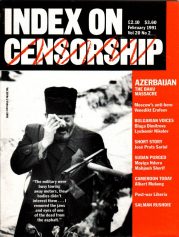
Azerbaijan: the Baku Massacre, the February 1991 issue of Index on Censorship magazine
In 1991 India had a free press… in newspapers. Television and radio were state-owned and state-exploited. Other innovative types of media became a political battleground, with opposition parties promising to release the government’s grip on a news outlet that was fast evolving. Sidharth Bhatia’s piece details the independent video magazines set up by journalists which had to be rented from a video shop. When these magazines became successful, reaching a wide audience and providing information not stifled by a state agenda, government censorship began to encroach upon them.
Read the full article [/vc_column_text][/vc_column][/vc_row][vc_row][vc_column][vc_column_text]
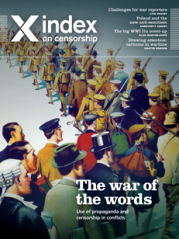
The war of the words, the March 2014 issue of Index on Censorship magazine
Prayaag Akbar examines the role the rich and powerful have in press censorship in India, but in this case it is wealthy business owners, rather than the government, who come under scrutiny. Media outlets who find themselves owned by a large business conglomerate, may then be under pressure to self-censor in order to avoid reporting negatively on the hand that feeds them. Akbar cites examples of the collision of business interests with journalistic integrity as the richest men in India buy up large portions of the national media groups.
Read the full article
[/vc_column_text][/vc_column][/vc_row][vc_row][vc_column][vc_column_text]
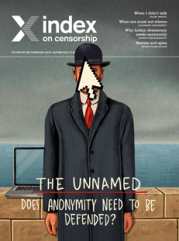
The unnamed, the September 2016 issue of Index on Censorship magazine
Is online anonymity allowing trolls to abuse women without consequences, or it is vital for the safety of those whose expression does not follow the party line? In 2016, as Twitter became more widely used in India, and issues of trolling became apparent, government ministers suggested removing the anonymity of trolls in a bid to increase accountability. Suhrith Parthasarathy reports on how state involvement with online expression could lead to the anonymity of activists being revoked to protect state interests.
Read the full article[/vc_column_text][/vc_column][/vc_row][vc_row][vc_column][vc_column_text]
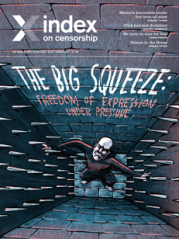
The Big Squeeze, the April 2017 issue of Index on Censorship magazine
In November 2016, a Supreme Court order made it obligatory to stand during the national anthem, which is played in Indian cinemas before the film begins, equating being patriotic with being a law-abiding citizen. Lawyer and writer Suhrith Parthasarathy examines the legal complexities of enforcing shows of patriotism in a country whose constitution guarantees freedom of expression, and speaks to people who have been subject to police interviews for choosing to stay seated.
Read the full article[/vc_column_text][/vc_column][/vc_row][vc_row][vc_column][vc_column_text]
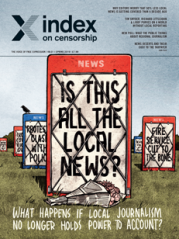
Is This All the Local News?, the April 2019 issue of Index on Censorship magazine
Rituparna Chatterjee reports on the importance of local news, and threats faced by local news journalists in India. Journalists working in rural parts of India can face pay too low to survive on, and can be susceptible to bribes from local police officers and politicians, keen to censor scandals. Chatterjee also highlights how tribal and indigenous communities can end up excluded from the national narrative of India when large media conglomerates do not report on issues in the areas they live in.
Read the full article[/vc_column_text][/vc_column][/vc_row][vc_row][vc_column][vc_column_text]
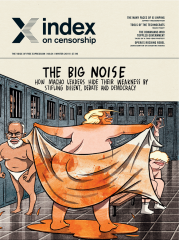
The Big Noise, the December 2019 issue of Index on Censorship magazine
The Emergency of 1975-1977 has been seen in later years as a blip in freedom of expression in India. However, since the election of Modi to prime minister in 2014, freedom of expression in India is taking a hit. Modi’s supporters are instilling fear and committing violence against those considered outsiders, often Muslims. Such violence is not being roundly condemned by their leader; his silence is taken as tacit approval. Meanwhile the internet shutdown imposed on Kashmir has not been fully lifted, an attack on access to information.
Read the full article[/vc_column_text][/vc_column][/vc_row]