19 Jun 2014 | Azerbaijan Statements, Campaigns, Digital Freedom, Digital Freedom Statements
The following is a transcript of a joint oral statement, led by ARTICLE 19 and supported by several IFEX members, that was read aloud today, 19 June 2014, at the 26th UN Human Rights Council session in Geneva:
Thank you Mr. President,
Two years ago this Council affirmed by consensus that “the same rights that people have offline must also be protected online, in particular freedom of expression”.
In 2014, the outcome document of Net-Mundial in Brazil recognised the vital role of the internet to achieve the full realisation of sustainable development goals. 31 UN Special Rapporteurs recently affirmed that guaranteeing the free-flow of information online ensures transparency and participation in decision-making, enhancing accountability and the effectiveness of development outcomes.
Development and social inclusion relies on the internet remaining a global resource, managed in the public interest as a democratic, free and pluralistic platform. States must promote and facilitate universal, equitable, affordable and high-quality Internet access for all people on the basis of human rights and net-neutrality, including during times of unrest.
The blocking of communications, such as the shutdown of social media in Malaysia, Turkey, and Venezuela is a violation of freedom of expression and must be condemned. Dissent online must be protected. We deplore the detention of Sombat Boonngamanong in Thailand, who faces up to 14 years imprisonment for using social media to urge peaceful resistance to the recent military coup in the form of a three-finger salute.
One year after the Snowden revelations, this Council must recognise that trust in the internet is conditional on respect for the rights to freedom of expression and privacy online, regardless of users’ nationality or location. Any mass (or dragnet) surveillance, which comprises collection, processing and interception of all forms of communication, is inherently disproportionate and a violation of fundamental human rights.
The targeted interception and collection of personal data must be conducted in accordance with international human rights law, as set out in the necessary and proportionate principles. Critical and intermediate infrastructure must not be tampered with for this end, nor should any system, protocol or standard be weakened to facilitate interception or decryption of data.
ARTICLE 19 urges the Human Rights Council to take action to comprehensively address these challenges.
Thank you.
Signed,
ActiveWatch – Media Monitoring Agency
Africa Freedom of Information Centre
Albanian Media Institute
Arabic Network for Human Rights Information
ARTICLE 19
Association of Caribbean Media Workers
Bahrain Center for Human Rights
Cairo Institute for Human Rights Studies
Cambodian Center for Human Rights
Canadian Journalists for Free Expression
Center for Independent Journalism – Romania
Center for Media Freedom and Responsibility
Egyptian Organization for Human Rights
Foro de Periodismo Argentino
Foundation for Press Freedom – FLIP
Freedom Forum
Human Rights Watch
Index on Censorship
Institute for the Studies on Free Flow of Information
International Press Institute
Maharat Foundation
Media, Entertainment and Arts Alliance
Media Institute of Southern Africa
Media Rights Agenda
National Union of Somali Journalists
Norwegian PEN
Pacific Islands News Association
Pakistan Press Foundation
PEN Canada
Privacy International
Reporters Without Borders
Southeast Asian Press Alliance
South East European Network for Professionalization of Media
West African Journalists Association
World Association of Community Radio Broadcasters – AMARC
Access
Alternative Informatics
Asian Forum for Human Rights and Development (FORUM-ASIA)
Association for Progressive Communications (APC)
Bangladesh Internet Governance Forum
Bangladesh NGOs Network for Radio and Communications (BNNRC)
Barys Zvozskau Belarusian Human Rights House
Big Brother Watch
Bir Duino (Kyrgyzstan)
Bits of Freedom
Bolo Bhi Pakistan
Bytes For All
Center for e-parliament Research
Centre for Internet & Society
Center for National and International Studies, Azerbaijan
Center for the Development of Democracy and Human Rights, Russia
Chaos Computer Club
CIVICUS: World Alliance for Citizen Participation
Digital Rights Foundation, Pakistan
Electronic Privacy Information Center
English Pen
European Centre for Not-for-Profit Law (ECNL)
Helsinki Citizens’ Assembly – Vanadzor
Human Rights Monitoring Institute, Lithuania
International Centre for Not-for-Profit Law (ICNL)
International Federation for Human Rights (FIDH)
Kazakhstan International Bureau for Human Rights and Rule of Law
Kenya Human Rights Commission
Liberty
OpenMedia.org
Open Net Korea
Open Rights Group
Panos Institute West Africa
Samuelson-Glushko Canadian Internet Policy & Public Interest Clinic (CIPPIC)
Simon Davies, publisher of “Privacy Surgeon”
Thai Netizen Network
Zimbabwe Human Rights Forum
2 May 2014 | News
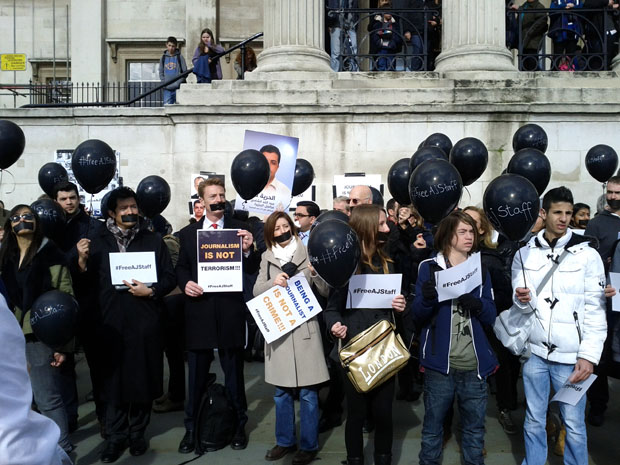
A London protest calling for the release of jailed Al Jazeera journalists in Egypt (Image: Index on Censorship)
Press freedom is at a decade low. Considering just a handful of the events of the past year — from Russian crackdowns on independent media and imprisoned journalists in Egypt, to press in Ukraine being attacked with impunity and government reactions to reporting on mass surveillance in the UK — it is not surprising that Freedom House have come to this conclusion in the latest edition of their annual press freedom report. This serves as a stark reminder that press freedom is a right we need to work continuously and tirelessly to promote, uphold and protect — both to ensure the safety of journalists and to safeguard our collective right to information and ability to hold those in power to account. On the eve of World Press Freedom day, we look back at some of the threats faced by the world’s press in the last 12 months.
1) Journalism is not terrorism…
National security has been used as an excuse to crack down on the press this year. “Freedom of information is too often sacrificed to an overly broad and abusive interpretation of national security needs, marking a disturbing retreat from democratic practices,” say Reporters Without Borders (RSF) in their recently released 2014 Press Freedom Index.
Journalists have faced terrorism and national security-related accusations in places known for their somewhat chequered relationship with press freedom, including Ethiopia and Egypt. However, the US and the UK, which have long prided themselves on respecting and protecting civil liberties, have also come under criticism for using such tactics — especially in connection to the ongoing revelations of government-sponsored mass surveillance.
American authorities have gone after former NSA contractor and whistleblower Edward Snowden, tapped the phones of Associated Press staff, and demanded that journalists, like James Risen, reveal their sources. British authorities, meanwhile, detained David Miranda under the country’s Terrorism Act. Miranda is the partner of Glenn Greenwald, the journalist who broke the mass surveillance story. Authorities also raided the offices of the Guardian — a paper heavily involved in reporting in the Snowden leaks.
2) …but governments still like putting journalists in prison
The Al Jazeera journalists detained in Egypt on terrorism-related charges was one of the biggest stories on attacks on press freedom this year. However, Mohamed Fahmy, Baher Mohamed, Peter Greste and their colleagues are far from the only journalists who will spend World Press Freedom Day behind bars. The latest prison census from the Committee to Protect Journalists (CPJ) put the number of journalists in jail for doing their job at 211 — their second highest figure on record.
In Bahrain, award-winning photographer Ahmed Humaidan was sentenced in March to ten years in prison. In Uzebekistan, Muhammad Bekjanov, editor of opposition paper Erk, is serving a 19-year sentence — which was increased from 15 in 2012, just as he was due to be released. In Turkey, after waiting seven years, Fusün Erdoğan, former general manager of radio station Özgür Radyo, was last November sentenced to life in jail. Just last Friday, Ethiopian authorities arrested prominent political journalist Tesfalem Waldyes and six bloggers and activists.
3) New media is under attack…
As more journalism is being conducted online, blogs, social and other new media are increasingly being targeted in the suppression of press freedom. Almost half of the world’s jailed journalists work for online outlets, according to the CPJ. China — with its massive censorship apparatus — has continued censoring microblogging site Sina Weibo, while also turning its attention to relative newcomer WeChat. In March, it closed down several popular accounts, including that of investigative journalist Luo Changping.
Meanwhile, Turkish Prime Minister Recep Tayyip Erdoğan has publicly all but declared war on social media, at one point calling it the “worst menace to society”. Twitter played a big role in last summer’s Gezi Park protests, used by journalists and other protesters alike. Only days ago, Turkish journalist Önder Aytaç was jailed, essentially, because of the letter “k” in a Tweet.
Meanwhile Russia has seen a big crackdown on online news outlets, while legislation recently passed in the Duma is targeting blogs and social media.
4) …and independent media continues to struggle
Only one in seven people in the world live in countries with free press. In many parts of the world, mainstream media is either under tight control by the government itself or headed up media moguls with links to those in power, with dissenting voices within news organisation often being pushed out. Brazil, for instance, has been labelled “the country of 30 Berlusconis” because regional media is “weakened by their subordination to the centres of power in the country’s individual states”. At the start of the year, RIA Novosti — known for on occasion challenging Russian authorities — was liquidated and replaced by the more Kremlin-friendly Rossiya Segodnya (Russia Today), while in Montenegro, has seen efforts by the government to cut funding to critical media. This is not even mentioning countries like North Korea and Uzbekistan, languishing near the bottom of press freedom ratings, where independent journalism is all but non-existent.
5) Attacks on journalists often go unpunished
A staggering fact about the attacks on journalists around the world, is how many happen with impunity. Since 1992, 600 journalists have been killed. Most of the perpetrators of those crimes have not been brought to justice. Attacks can be orchestrated by authorities or by non-state actors, but the lack of adequate responses by those in power “fuels the cycle of violence against news providers,” says RSF. In Mexico, a country notorious for violence against the press, three journalists were murdered in 2013. By last October, the state public prosecutor’s office had yet to announce any progress in the cases of Daniel Martínez Bazaldúa, Mario Ricardo Chávez Jorge and Alberto López Bello, or disclose whether they are linked to their work. Pakistan is also an increasingly dangerous place to work as a journalist. Twenty seven of the 28 journalists killed in the past 11 years in connection with their work have been killed with impunity. Syria, with its ongoing, devastating war, is the deadliest place in the world to be a journalist, while some of the attacks on press during the conflict in Ukraine, have also taken place without perpetrators being held accountable. That attacks in the country appear to be accelerating, CPJ say is “a direct result of the impunity with which previous attacks have taken place”.
This article was published on May 2, 2014 at indexoncensorship.org
30 Apr 2014 | Egypt, Iraq, News, Nigeria, Pakistan, Religion and Culture, Syria, Tajikistan, Turkmenistan, Vietnam
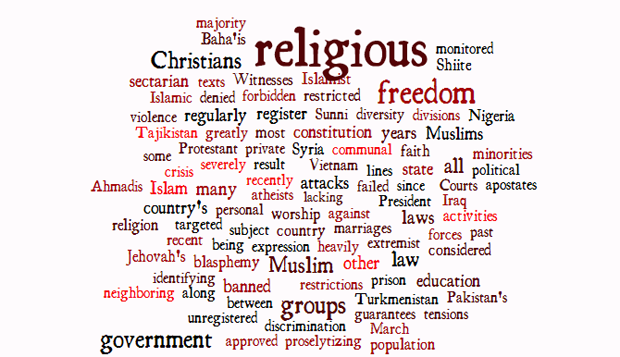
In January, Index summarised the U.S. State Department’s “Countries of Particular Concern” — those that severely violate religious freedom rights within their borders. This list has remained static since 2006 and includes Burma, China, Eritrea, Iran, North Korea, Saudi Arabia, Sudan, and Uzbekistan. These countries not only suppress religious expression, they systematically torture and detain people who cross political and social red lines around faith.
Today the U.S. Commission on International Religious Freedom (USCIRF), an independent watchdog panel created by Congress to review international religious freedom conditions, released its 15th annual report recommending that the State Department double its list of worst offenders to include Egypt, Iraq, Nigeria, Pakistan, Tajikistan, Turkmenistan, Vietnam and Syria.
Here’s a roundup of the systematic, ongoing and egregious religious freedom violations unfolding in each.
1. Egypt
The promise of religious freedom that came with a revised constitution and ousted Islamist president last year has yet to transpire. An increasing number of dissident Sunnis, Coptic Christians, Shiite Muslims, atheists and other religious minorities are being arrested for “ridiculing or insulting heavenly religions or inciting sectarian strife” under the country’s blasphemy law. Attacks against these groups are seldom investigated. Freedom of belief is theoretically “absolute” in the new constitution approved in January, but only for Muslims, Christians and Jews. Baha’is are considered apostates, denied state identity cards and banned from engaging in public religious activities, as are Jehovah’s Witnesses. Egyptian courts sentenced 529 Islamist supporters to death in March and another 683 in April, though most of the March sentences have been commuted to life in prison. Courts also recently upheld the five-year prison sentence of writer Karam Saber, who allegedly committed blasphemy in his work.
2. Iraq
Iraq’s constitution guarantees religious freedom, but the government has largely failed to prevent religiously-motivated sectarian attacks. About two-thirds of Iraqi residents identify as Shiite and one-third as Sunni. Christians, Yezidis, Sabean-Mandaeans and other faith groups are dwindling as these minorities and atheists flee the country amid discrimination, persecution and fear. Baha’is, long considered apostates, are banned, as are followers of Wahhabism. Sunni-Shia tensions have been exacerbated recently by the crisis in neighboring Syria and extremist attacks against religious pilgrims on religious holidays. A proposed personal status law favoring Shiism is expected to deepen divisions if passed and has been heavily criticized for allowing girls to marry as young as nine.
3. Nigeria
Nigeria is roughly divided north-south between Islam and Christianity with a sprinkling of indigenous faiths throughout. Sectarian tensions along these geographic lines are further complicated by ethnic, political and economic divisions. Laws in Nigeria protect religious freedom, but rule of law is severely lacking. As a result, the government has failed to stop Islamist group Boko Haram from terrorizing and methodically slaughtering Christians and Muslim critics. An estimated 16,000 people have been killed and many houses of worship destroyed in the past 15 years as a result of violence between Christians and Muslims. The vast majority of these crimes have gone unpunished. Christians in Muslim-majority northern states regularly complain of discrimination in the spheres of education, employment, land ownership and media.
4. Pakistan
Pakistan’s record on religious freedom is dismal. Harsh anti-blasphemy laws are regularly evoked to settle personal and communal scores. Although no one has been executed for blasphemy in the past 25 years, dozens charged with the crime have fallen victim to vigilantism with impunity. Violent extremists from among Pakistan’s Taliban and Sunni Muslim majority regularly target the country’s many religious minorities, which include Shiites, Sufis, Christians, Hindus, Zoroastrians, Sikhs, Buddhists and Baha’is. Ahmadis are considered heretics and are prevented from identifying as Muslim, as the case of British Ahmadi Masud Ahmad made all too clear in recent months. Ahmadis are politically disenfranchised and Hindu marriages are not state-recognized. Laws must be consistent with Islam, the state religion, and freedom of expression is constitutionally “subject to any reasonable restrictions imposed by law in the interest of the glory of Islam,” fostering a culture of self-censorship.
5. Tajikistan
Religious freedom has rapidly deteriorated since Tajikistan’s 2009 religion law severely curtailed free exercise. Muslims, who represent 90 percent of the population, are heavily monitored and restricted in terms of education, dress, pilgrimage participation, imam selection and sermon content. All religious groups must register with the government. Proselytizing and private religious education are forbidden, minors are banned from participating in most religious activities and Muslim women face many restrictions on communal worship. Jehovah’s Witnesses have been banned from the country since 2007 for their conscientious objection to military service, as have several other religious groups. Hundreds of unregistered mosques have been closed in recent years, and “inappropriate” religious texts are regularly confiscated.
6. Turkmenistan
The religious freedom situation in Turkmenistan is similar to that of Tajikistan but worse due to the country’s extraordinary political isolation and government repression. Turkmenistan’s constitution guarantees religious freedom, but many laws, most notably the 2003 religion law, contradict these provisions. All religious organizations must register with the government and remain subject to raids and harassment even if approved. Shiite Muslim groups, Protestant groups and Jehovah’s Witnesses have all had their registration applications denied in recent years. Private worship is forbidden and foreign travel for pilgrimages and religious education are greatly restricted. The government hires and fires clergy, censors religious texts, and fines and imprisons believers for their convictions.
7. Vietnam
Vietnam’s government uses vague national security laws to suppress religious freedom and freedom of expression as a means of maintaining its authority and control. A 2005 decree warns that “abuse” of religious freedom “to undermine the country’s peace, independence, and unity” is illegal and that religious activities must not “negatively affect the cultural traditions of the nation.” Religious diversity is high in Vietnam, with half the population claiming some form of Buddhism and the rest identifying as Catholic, Hoa Hao, Cao Dai, Protestant, Muslim or with other small faith and non-religious communities. Religious groups that register with the government are allowed to grow but are closely monitored by specialized police forces, who employ violence and intimidation to repress unregistered groups.
8. Syria
The ongoing Syrian crisis is now being fought along sectarian lines, greatly diminishing religious freedom in the country. President Bashar al-Assad’s forces, aligned with Hezbollah and Shabiha, have targeted Syria’s majority-Sunni Muslim population with religiously-divisive rhetoric and attacks. Extremist groups on the other side, including al-Qaeda and the Islamic State of Iraq and the Levant (ISIL), have targeted Christians and Alawites in their fight for an Islamic state devoid of religious tolerance or diversity. Many Syrians choose their allegiances based on their families’ faith in order to survive. It’s important to note that all human rights, not just religious freedom, are suffering in Syria and in neighboring refugee camps. In quieter times, proselytizing, conversion from Islam and some interfaith marriages are restricted, and all religious groups must officially register with the government.
This article was originally posted on April 30, 2014 at Religion News Service
14 Feb 2014 | Kenya, News, Politics and Society
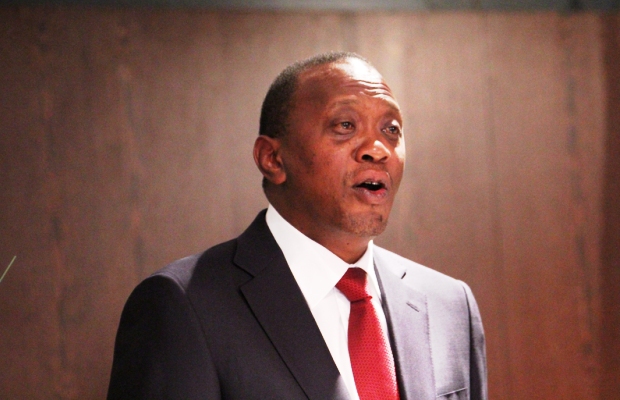
Kenyan president Uhuru Kenyatta (Image Demotix/David Mbiyu)
In 2010 the International Criminal Court (ICC) issued summons for Uhuru Kenyatta and William Ruto, among others, for their alleged role in the violence that erupted following the 2007 Kenyan General Elections. The charges include crime against humanity. Nevertheless, in the elections of 2013, Kenyatta was sworn in as president — Ruto his deputy president — after securing 50.51 percent of the vote in a highly contested but generally peaceful election.
This now means that any movement to evaluate the defendants’ criminal culpability implicates the broader state itself. With Kenyatta and Ruto heading the executive branch of government, the implications of the ICC cases cannot be overstated. But while testing the state’s eagerness to confront the legacy of 2007 these cases offer up a further test; the ability of Kenya’s media institutions, journalists and citizens to freely interrogate the proceedings. Will Kenyatta, Ruto and, by extension, the state let such scrutiny happen in public?
Kenyan legislation in this regard is coloured by tragedy. Following the attacks on Westgate Mall in Nairobi in September 2013, the state moved fast to shore up perceived gaps in legislation that could have enabled the attacks to happen. One of these “gaps” referred to the media, ushering in two pieces of legislation: the Kenya Information and Communications (Amendment) Bill (KICA) and the Media Council Bill. The former, an amendment to the 1998 law, creates a Communication and Multimedia Appeals Tribunal under the jurisdiction of the state-controlled Communications Authority. According to free speech group Article 19, the tribunal has the power “to impose hefty fines on media houses and journalists, recommend de-registration of journalists and make any order on freedom of expression”.
While raising concerns for media bodies looking to cover the ICC cases of Kenyatta and Ruto among others, the Commission for the Implementation of the Constitution (CIC), have pointed out a number of more systemic issues. The 2010 constitution drafted to address the political and ethnic divisions that led to the violence of 2007 established robust protections for freedom of expression. KICA potentially undermines these protections, as CIC explained in a statement:
“Clause 7 of the Bill creates a Communications Authority of Kenya…with some of its board members appointed through a process that solely involves the National Executive and the National Assembly…These clauses violate the provisions of Article 34(3) of the Constitution by leaving the Body responsible for licensing broadcasters under the control of two arms of government, the Executive and the National Assembly.”
Any information deemed too sensitive to be in the public domain during the individual cases draws out KICA as a potential tool for the state to restrict the media’s ability to analyse the cases in an unobstructed manner.
The punitive measures outlined in KICA are not to be sniffed at. According to Charles Onyango Obbo of the Daily Nation: “The Sh20 million penalty against a media house that violated several provisions of the new Bill or the Code of Conduct for the Practice of Journalism, is again among the highest a tribunal can hand out in Africa.” A further provision states that media houses will face punitive measures if 45 percent of their coverage is not deemed “local”. The is a potential hindrance for media bodies looking to analyse the ICC cases – how local is The Hague?
Clause (37) of KICA goes on to state that the tribunal may “accept an anonymous complaint concerning an issue of public interest”. This inability for media bodies to identify its accusers opens the process up to manipulation. Can the tribunal determine that protecting Kenyatta and Ruto is in the public interest? When members of the tribunal are selected at the discretion of the National Executive, it is a possibility.
In the context of the ICC cases, this has created a perfect storm in terms of media freedom. Media houses face disproportionate measures, while their governance is outlined by a body at the discretion of both the executive and legislative branches of government – the former facing interrogation from both the ICC and the media.
It’s too early to tell what will happen and what powers will be invoked, but there have already been warning signs. A case was thrown out after it was alleged that a key witness had received a bribe from the defendant and questions remain regarding similar allegations in the case against William Ruto. Does this represent a collective desire to withhold information? The acts of alleged bribery are by no means definitive, but to skew proceedings, it would be the place to start.
And the next step? Media bodies must surely be holding their collective breath because, while they have not used them yet, KICA offers just the tools the state may need.
This article was posted on 14 February 2014 at indexoncensorship.org