2 May 2013 | religion & culture
An arm of the US government named 15 nations as the “worst violators of religious freedom”.
The Commission on International Religious Freedom (USCIRF), an independent advisory body created by the International Religious Freedom Act to monitor religious freedom abuses internationally, released its 2013 report, which idenitifes “governments that are the most egregious violators.”
The 15 countries are Burma, China, Eritrea, Iran, North Korea, Saudi Arabia, Sudan, Uzbekistan, Egypt, Iraq, Nigeria, Pakistan, Tajikistan, Turkmenistan and Vietnam, all of which severely restrict independent religious activity and harass individuals and groups for religious activity or beliefs. These nations are classified as Tier 1 “countries of particular concern” (CPCs) in the report.
Despite its recent opening and political reforms, change in Burma have “yet to significantly improve the situation for freedom of religion and belief.” The report states that most violations occurred against minority Christian and Muslim adherents. China’s government is also cited for its ongoing severe abuses against its citizens’ freedom of thought.
The report said that Egypt’s transitional and elected governments have made progress toward religious freedom, it further highlighted the attacks that Coptic Christians have sustained in the period after the Arab Spring that brought down the Mubarak regime. “In many cases, the government failed or was slow to protect religious minorities from violence.”
The former Soviet states of Tajikistan, Turkmenistan and Uzbekistan were included for pursuing state control over religion, targeting Muslims and minorities alike. Iraq was cited for, among other things, tolerating “violent religiously motivated attacks” and Iran for “prolonged detention, torture, and executions based primarily or entirely on the religion of the accused.”
Saudi Arabia continues to suppress religious practices outside of the officially-sanctioned Wahhabi interpretation of Islam, interferes with the faith of guest workers and prosecutes individuals for “apostasy, blasphemy and sorcery”, according to the report. Pakistan has a strict blasphemy law and failure to prosecute acts of religious violence, the report said.
The situation in Sudan has deteriorated since South Sudan gained its independence. Criminalization of apostasy, the imposition of the government’s strict interpretation of Shari’ah on both Muslims and non-Muslims and attacks against Christians, were cited in the report for the decline.
The report also identified Nigeria for continuing religious violence between Muslims and Christians compounded by the government’s toleration of the sectarian attacks. North Korea’s totalitarian regime was also included for its ongoing harassment and torture of citizens based on religious beliefs.
A second tier includes Afghanistan, Azerbaijan, Cuba, India, Indonesia, Kazakhstan, Laos and Russia, where abuses of religious freedom are tolerated by the government and meet the threshold for CPC designation by the US Department of State, but don’t meet all of the standards for “systemic, ongoing, egregious” measurements.
Other countries regions being monitored included Bahrain, Bangladesh, Belarus, Ethiopia, Turkey, Venezuela and Western Europe.
19 Dec 2024 | News, Newsletters
Hello, readers. This will be our final newsletter before Index wraps up for the holiday season. It’s been quite the year for freedom of expression, and whilst it’s not easy to summarise in one email, we’ve had a go. We’ve seen severe violations by repressive governments – but we’ve also seen remarkable acts of defiance by political activists, journalists and protesters.
These acts of defiance leave room for hope. In Russia, the year started with the suspicious death of Alexei Navalny whilst in detention, arguably Vladimir Putin’s most vocal critic (you can read an obituary by journalist John Sweeney here). But it was then punctuated with the release of opposition leader Vladimir Kara-Murza in a prisoner swap in August, after relentless campaigning led by his wife, Evgenia, who we ultimately awarded in this year’s Freedom of Expression Awards.
Another huge win for international protest was the release of Iranian political activist Toomaj Salehi in December, following his death sentence being overturned in June. Of course, there are many activists who remain behind bars and Index will continue to campaign for their release. Dozens of pro-democracy campaigners in Hong Kong – the Hong Kong 47 – were given harsh prison sentences of between four and 10 years in November, whilst prominent Chinese #MeToo activist (and previous Index award winner) Sophia Huang Xueqin was sentenced to five years in June. British-Egyptian political activist Alaa Abd el-Fattah was also denied freedom, even after serving his five-year jail term.
Throughout the year, we’ve seen media workers and independent reporting targeted in the most pernicious ways, including through targeted murder, particularly in war zones such as Gaza. Palestine has now become the most dangerous place to be a journalist, and you can read Al Jazeera English journalist Youmna El Sayed’s first-hand account on the risks of covering the conflict here. Meanwhile, media workers in Sudan face similar threats and persecution with seldom international attention, in what has been described as the “forgotten war”.
Alongside the brave pursuits of journalists, regular citizens have also stood up to their governments – with varying degrees of success. Alleged fraudulent elections in Georgia, Mozambique and Venezuela have caused the public to take to the streets in defiance of corruption. Whilst peaceful protests have resulted in violent crackdowns, there is cause for hope: a citizen-led democratic activism project in Venezuela was used to capture accurate voting tallies, and could prove to be a blueprint for fighting election fraud globally in the future, reported Martin Bright. And who could forget South Korea’s “no worries if not!” moment – when president Yoon Suk Yeol’s attempt at enforcing martial law was shut down within six hours thanks to mass assembly.
As we approach 2025, an uncertain future awaits. Repressive laws in Afghanistan have caused it to become the world’s most silenced nation, particularly for women, who under terrifying Taliban morality laws can no longer speak in public. Next year, will the international community stand up for women in the country and rally against what human rights groups are calling “gender apartheid”?
In the USA, a second Trump presidency could also bring with it a chilling impact on free expression, particularly for minority groups. You can read Emma Briant’s fascinating piece on the potential effect on university free thought in the “Land of Liberty” here. Meanwhile, the overthrowing of Syrian president Bashar al-Assad’s repressive regime means thousands of political dissidents have been liberated from the dictator’s inhumane prisons – but what could a future rebel-run regime really mean for the country’s freedoms?
We’ll be back in January. In the meantime, do make sure you read our latest magazine issue, Unsung Heroes: How musicians are raising their voices against oppression. If you’d like to subscribe, we have a special offer running until 3 January – you can enjoy 30% off an annual digital subscription by using the discount code Winter24 at checkout here, meaning it costs just £12.60.
Wishing you all a restful break, and hopefully a brighter 2025.
1 Nov 2023 | Israel, Middle East and North Africa, News, Palestine
Following the brutal attacks on Israel by Hamas on 7 October, violations of free speech have occurred at such pace and scale that it has made keeping track a challenge. The situation was already difficult before that date: Israel was in the grip of a huge crisis, the country stalled by endless protests in response to the government’s attempts to neuter the Supreme Court, while Amnesty International identified “a general climate of repression” in Gaza Strip under Hamas. Since the war started, the right to freedom of expression has gone from bad to worse in both Israel and Palestine, and indeed around the world. Whilst a degree of deterioration was predictable – conflict is never the arena in which rights improve – the current state could hardly be foreseen.
Starting with media freedom, on 7 October itself, of the 1,400 people who were murdered by Hamas several were Israeli reporters on duty. Following the massacre, Israel’s response has resulted in the death of at least 5,000 (according to the latest UN figures from 23 October), again including a number of journalists. Although none of the journalists from either side of the divide were killed for what they had written, they lost their lives though their line of work, making the media landscape all the poorer.
Others have, however, been punished for their work. Journalists from outlets including the BBC, Al-Jazeera, RT Arabic and Al-Araby TV have all reported obstructions to their reporting by the Israeli military, police and others since the conflict began. On 12 October, a team of BBC Arabic reporters were dragged from their vehicle, searched and held at gunpoint by police in the Israeli city of Tel Aviv, despite their vehicle being marked “TV” and the presentation of press cards, the BBC reported. On 26 October, Lama Khater, a freelance writer with Middle East Monitor and a political activist, was arrested by the IDF in the city of Hebron, West Bank, her husband Hazem Fakhoury told CPJ. Confrontational attacks have been coupled with subtle ones: On 9 October, for example, The Jerusalem Post reported that its website was down following a series of cyberattacks. The group Anonymous Sudan claimed responsibility for the attacks, reported Axios and Time magazine.
Media freedom could deteriorate further. On 16 October, Israel proposed new emergency regulations that would allow it to block broadcasts that harm “national morale”. Officials threatened to close Al-Jazeera’s local offices under the proposed rule and to stop the global news organisation from freely reporting on the war.
With the situation on the ground increasingly difficult and with limited media from Gaza itself, the internet more broadly, and social media specifically, is a lifeline. And yet getting information within and out of Gaza has become increasingly difficult. Internet services have been disrupted by the attacks, while Palestinians and their supporters allege that social media platforms, in particular Instagram, are “shadow-banning” their content. Instagram’s owner, Meta, has denied this, but they have admitted that they inserted the word “terrorist” automatically into translated bios of Palestinian users, something they apologised for on 19 October.
Social media giant X, which has had a tumultuous ride under owner Elon Musk over the last year to say the least, has also been flooded with misinformation, as we reported on 18 October. Images have been adopted from other conflicts, fake accounts created in a smorgasbord of lies intended to sow confusion, division and hate. At a time when it could be providing an essential role in the spread of crucial information, trust is low.
As those within Israel and Palestine struggle to access reliable news, international media outlets find themselves in the middle of claims of irresponsible reporting, such as jumping too fast to conclusions over who was behind the explosion at the Al-Ahli hospital, and accusations of bias. The latter can sometimes be unhelpful noise. To instantly shout “censorship” can be erroneous. There are a host of reasons why newspapers and broadcasters might run a story or interview a person (some being mundane, merely down to the availability of one person over another). Impartiality is not a prerequisite for outlets that are not funded by taxpayers. Nor does objectivity equate to equal weight for views. Still, with a conflict as complicated as that between Israel and Palestine, as longstanding, as heated and as volatile, a plurality of views and careful attention to how information is both interrogated and reported is crucial. It’s not clear that every outlet has adhered to these fundamental principles.
As for the actual red pen, one example of direct censorship came from Yale University’s campus newspaper, the Yale Daily News, which censored a pro-Israel opinion piece by removing references to Hamas atrocities. We suspect there are others. Alas the nature of censorship and self-censorship means we don’t always know about them.
Has criticising Israel become a punishable offence for the average person? A “McCarthyite backlash” against criticism of the country’s bombardment of Gaza has been claimed by civil rights groups in the USA, as people are fired, threatened with dismissal or blacklisted from future jobs, according to the Guardian. Take one example: Michael Eisen, editor of the scientific journal eLife, was forced out of his job after reposting an article from satirical magazine the Onion with the headline: “Dying Gazans Criticized for Not Using Last Words to Condemn Hamas”. In Germany, the journalist Michael Scott Moore noted that “the tendency in Berlin right now is to squelch as much criticism of Israel as possible”, citing the arrest of a Jewish Israeli protesting the war amongst others. In the UK, home secretary Suella Braverman suggested that waving Palestinian flags and using popular pro-Palestine slogans could be illegal and a ministerial aide was sacked from his government role following his letter to the prime minister calling for a ceasefire. In Switzerland, all demonstrations related to the conflict were banned in Zurich. In Australia, New South Wales authorities vowed to stop marches from proceeding. And in Israel, in one of the more unpleasant twists, the parents of hostages, who were protesting in Tel Aviv, were spat at and abused by supporters of current leader Benjamin Netanyahu. This in addition to police saying they’ve investigated and detained more than 100 people for their social media activity and, as we reported last week, activists being arrested in Jerusalem for putting up posters with the message: “Jews and Arabs, we will get through this together.”
Staying with Israel, human rights activists worry the detentions are due to the police adopting a wider interpretation than normal of what constitutes incitement to violence. A well-known singer and influencer, Dalal Abu Amneh, was held in police custody for two days. According to Abeer Baker, her lawyer, she was accused of “disruptive behaviour” by police officers, who said her posts could incite violence, in particular one featuring an image of the Palestinian flag with the Arabic motto: “There is no victor but God.” Baker said Abu Amneh was expressing a religious sentiment, while Israeli authorities interpreted the singer’s post as a call to arms for Palestinians. This example highlights a tension right now, the question of what defines hate speech and how we balance the rights for people to protest (be it online, in the streets or through petitions) versus the rights for people to live free from fear and persecution. Some of the banners and comments made at protests have been vile. They are clearly, irrefutably hate speech and given recent events – an Orthodox Jewish man assaulted in London, a mob storming Dagestan’s airport looking for people arriving from Israel, cemeteries and synagogues set alight in Tunisia and Austria, to name just a few – one could argue incitement. Still, it is clear that there has been huge overreach. Many who have been punished for what they’ve said have been peaceful, with views that – even if you disagree with them or find them uncomfortable – should be protected.
The above is far from an exhaustive list. It could go on and on. Consider Adania Shabli, the Palestinian writer whose event at Frankfurt Book Fair was called off. Consider the Pulitzer Prize-winning novelist Viet Thanh Nguyen, whose appearance at 92NY, one of New York City’s leading cultural organisations, was pulled on the back of his criticism of Israel. Yet even this incomplete tally paints a grim picture. Free speech can be difficult and no more so than with Israel-Palestine, a conflict which is and always has been so deeply emotive and tribal. The knee-jerk response at present seems to be to silence. This is no solution. As George Orwell famously said, “If liberty means anything at all, it means the right to tell people what they do not want to hear.” This applies as much to those in Israel as it does to those in Gaza and to all of us outside. There have already been enough victims and casualties – let’s ensure free speech is not another.
31 Jan 2019 | Bahrain, Bahrain Statements, Campaigns -- Featured, Middle East and North Africa
[vc_row][vc_column][vc_column_text]
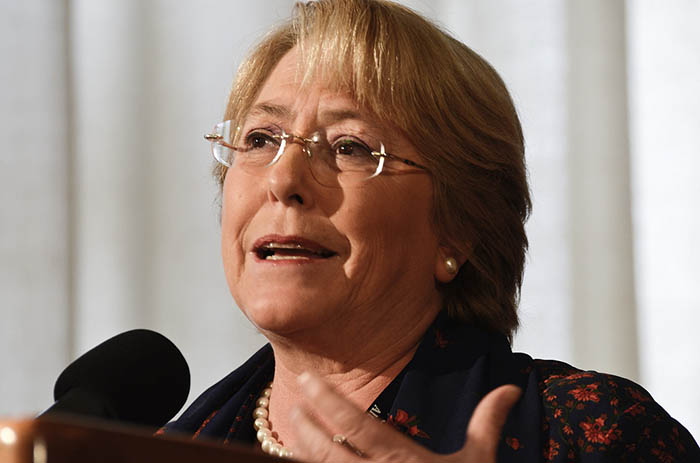
Michelle Bachelet, United Nations High Commissioner for Human Rights. Credit: UN Women / Flickr
H.E. Michelle Bachelet
United Nations High Commissioner for Human Rights
Office of the High Commissioner for Human Rights (OHCHR)
United Nations
52 Rue des Paquis
1201 Geneva, Switzerland
Your Excellency,
We, the undersigned organisations, write to you to express our concern regarding the worsening situation for civil society in Bahrain. We believe co-ordinated international action coupled with public scrutiny are imperative to address the government of Bahrain’s ongoing attacks on civil society and to hold the kingdom accountable to its commitments to international human rights laws and standards. To this end, we call upon your Office to continue to monitor the situation in Bahrain and to continue to raise concerns at the highest level, both publicly and privately, with the government, as was done by your predecessor, Zeid Ra’ad Al Hussein. We believe heightened scrutiny of Bahrain’s human rights record and its ongoing human rights violations is particularly important now that the kingdom is a Member State of the Human Rights Council.
In the past two years, the Bahraini government increased its repression of the kingdom’s remaining civil society organisations, political opposition groups, and human rights defenders. In June 2016, Bahrain’s Administrative Court forcibly dissolved al-Wefaq, Bahrain’s largest political opposition society, a ruling that was upheld in February 2018. In May 2017, a court approved the forcible dissolution of the National Democratic Action Society, also known as Wa’ad. Only a month later, the government indefinitely suspended the kingdom’s last remaining independent newspaper, Al-Wasat, continuing its repression of free expression and press freedom.
While there were hopes that the government might ease repression in the run-up to elections for the lower house of parliament on 24 November 2018, these were dashed with a series of actions and policies that effectively precluded the elections from being free or fair, and that continued the broader assault on civil society. Only weeks ahead of ahead of the elections, the country’s highest appeals court sentenced Sheikh Ali Salman, the Secretary-General of Al-Wefaq, to life in prison on spurious charges of espionage dating from 2011. The government also enacted new legislation banning all individuals who had ever belonged to a dissolved political society from seeking or holding elected office, as well as anyone who has ever served six months or more in prison. This affects a large portion of Bahrain’s population, as the kingdom currently has around 4,000 political prisoners.
Beyond rigging the election process at the expense of political opposition societies and free and fair participation, over this past year Bahrain has continued to target, harass, and imprison activists and human rights defenders for exercising their right to free expression. The government criminalised calls to boycott the elections, and, on 13 November 2018, arrested former Member of Parliament Ali Rasheed al-Asheeri for tweeting about boycotting the November elections. On 31 December 2018, Bahrain’s Court of Cassation – its court of last resort – upheld prominent human rights defender Nabeel Rajab’s five-year prison sentence on spurious charges of tweeting and re-tweeting criticism of torture in Jau Prison and the war in Yemen, drawing criticism from the Office of the High Commissioner for Human Rights. With this decision, Rajab has exhausted all legal remedies to reverse the charges and will remain in prison until 2023. He has already served a two-year prison sentence on charges related to television interviews in which he discussed the human rights situation in the kingdom.
While Bahrain has several institutions tasked with oversight responsibilities and enforcing accountability for human rights abuses, we have grave concerns over their effectiveness, their independence, and their commitment to fulfilling their mandates. Similar concerns have been raised about other Bahraini institutions – the National Institution for Human Rights (NIHR) and the Ministry of Interior Ombudsman – by the UN Human Rights Committee. In the Committee’s first evaluation of Bahrain under the International Covenant on Civil and Political Rights (ICCPR) in July 2018, it found the NIHR largely lacked sufficient independence from the government. The European Parliament has also criticised the NIHR, including in a June 2018 resolution where the body expressed “regret” for the honours it has bestowed upon the NIHR. In the resolution, the European Parliament cited the institution’s lack of independence to fulfil its duties. The Ministry of Interior (MoI) Ombudsman has received sharp criticism, including from the UN Committee Against Torture (CAT). The CAT cited the Ombudsman’s lack of independence, impartiality, and efficacy in addressing complaints submitted to the institution.
Bahrain’s national institutions not only fail to implement human rights reforms, they help perpetuate and whitewash abuses. Both the Ombudsman and NIHR have released reports that sanitise violations like police brutality, while neglecting to address or condemn violent police raids on peaceful protests.
The failure of Bahrain’s human rights institutions to address serious abuses both reflects and promotes a broader culture of impunity in the country, where the government can continue to suppress free expression and civil society.
Despite these abuses and despite concerns from UN bodies, Bahrain has not been the subject of collective action in the United Nations Human Rights Council (HRC) since a joint statement in September 2015 at HRC 30. Since then, the government has taken increased steps to limit fundamental freedoms, including restricting the rights to free expression, free assembly, free association, and free press, dissolving political opposition societies and jailing human rights defenders, religious leaders, and political figures. However, even as Bahrain has embarked on this campaign to suppress opposition and dissent, state action on Bahrain in the HRC has been limited to individual condemnations by various governments under Agenda Items 2 and 4.
Despite this lack of joint action, the Office of the High Commissioner has been consistently vocal about Bahrain’s rights abuses, and we are very appreciative of the Office’s attention over the past several years. Your predecessor raised concerns about Bahrain in his opening statements at the HRC, including at the 36th Council session, where he highlighted restrictions on civil society and the kingdom’s lack of engagement with international human rights mechanisms, and at 38th Council session, in which he reiterated past concerns and sharply criticised Bahrain for its continued refusal to co-operate with the Office of the High Commissioner and the mandates of the Special Procedures.
We believe that this UN scrutiny is now even more necessary as Bahrain assumes a seat on the Council as a Member State.
We strongly urge you to continue to monitor the situation, to publicly express your concerns to Bahraini officials, and to call on the Bahraini government to meet its international obligations, including those concerning protecting and promoting civil society. Without an independent, viable civil society in the country there can be no serious domestic pressure on the government to relax restrictions and ease repression.
We call on you to highlight Bahrain’s restrictions on civil society, targeting of human rights defenders, dissolution of political opposition, and unrelenting attacks on free expression in your opening statement at the 40th Human Rights Council session, the first session of which Bahrain is a member of the Council.
Sincerely,
Americans for Democracy & Human Rights in Bahrain (ADHRB)
Adil Soz – International Foundation for Protection of Freedom of Speech
ARTICLE 19
Bahrain Center for Human Rights
Cairo Institute for Human Rights Studies (CIHRS)
Cartoonists Rights Network International (CRNI)
Center for Media Studies & Peace Building (CEMESP)
Centre for Independent Journalism (CIJ)
Foro de Periodismo Argentino
Freedom Forum
Independent Journalism Center (IJC)
Index on Censorship
Initiative for Freedom of Expression – Turkey
Maharat Foundation
Mediacentar Sarajevo
Media Foundation for West Africa (MFWA)
Norwegian PEN
OpenMedia
Pacific Islands News Association (PINA)
PEN America
Southeast Asian Press Alliance (SEAPA)
South East Europe Media Organisation
Syrian Center for Media and Freedom of Expression (SCM)
Vigilance for Democracy and the Civic State
Asian Human Rights Commission (AHRC)
Association for Human Rights in Ethiopia (AHRE)
Bahrain Institute for Rights and Democracy
Cairo Institute to Human Rights Studies (CIHRS)
CIVICUS
European Centre for Democracy and Human Rights
Odhikar (Bangladesh)
Center for Civil Liberties (Ukraine)
Sudanese Development Initiative (Sudan)
JOINT Liga de ONGs em Mocambique
West African Human Rights Defenders Network
Latin American Network for Democracy (REDLAD)
Ligue Burundaise des Droits de l’homme ITEKA
Organisation Tchadienne Anti-Corruption (OTAC)[/vc_column_text][/vc_column][/vc_row][vc_row][vc_column][vc_basic_grid post_type=”post” max_items=”4″ element_width=”6″ grid_id=”vc_gid:1549278314945-d1d5bcda-455e-2″ taxonomies=”716″][/vc_column][/vc_row]
