18 Apr 2017 | Awards, Awards Update, News, Youth Board
[vc_row][vc_column][vc_column_text]
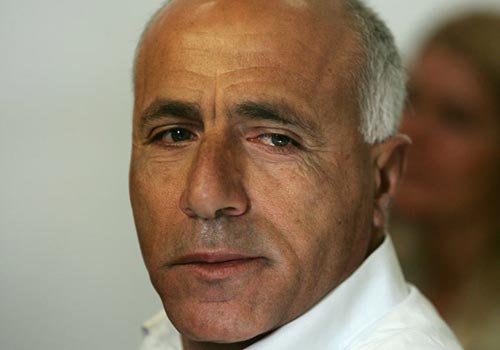
Mordechai Vanunu
Mordechai Vanunu was granted Index on Censorship’s Special Award in 2004 for his work as a whistleblower on Israel’s nuclear programme. While working as a nuclear technician for the Israeli government in the 1980s he was sentenced to 18 years in prison for exposing their possession of nuclear weapons to the Sunday Times.
In April 2004 he was released and has since been fighting for his right to leave Israel – the foundational condition of Vanunu’s release from prison was a prohibition on leaving the country. In addition, he is prohibited from contacting embassies or having any interaction with foreigners that has not been pre-approved by Israeli officials. Shortly after his release he unsuccessfully applied for asylum in Norway, Ireland and Sweden. He has been rejected asylum status numerous times since it is not legally possible to apply for asylum in a country without physically being there. Essentially, so long as the prohibition on leaving Israel remains, he cannot meaningfully seek asylum.
Israel’s High Court has had a central role in determining Vanunu’s fate since 2004. In 2008 24 influential Norwegian lawyers signed the “Norwegian Lawyer’s Petition for Vanunu”. In September of the same year the eighth petition calling for Vanunu’s conditions to be lifted was rejected by the High Court. And less than 2 months ago Vanunu was convicted of violating the terms of his release by meeting with two US citizens in 2013 without permission from the authorities. He is to appear in court for sentencing this month.
This is only the latest struggle in the past 30 years of Vanunu’s life, after he first leaked photos of Isreali nuclear production plants to the Sunday Times in 1986. Vanunu’s struggle for freedom has not gone unnoticed by the world. He has been nominated for the Nobel Peace Prize every year since 1987. In 2010 the International League for Human Rights sent open letters to Benjamin Netanyahu seeking Vanunu’s free release. In 2015 Vanunu said that he had no desire nor even any means of spilling more secrets on Israel’s nuclear programme. He stated that he simply wants to join his wife, theology professor Kristin Joachimsen, in Norway. In the same year the Campaign for Nuclear Disarmament wrote to the Guardian calling for a vigil to be held outside of the Israeli Embassy in London in honour of Vanunu’s birthday.
However, there may be hope. In October 2015 Vanunu appealed the terms of his release to the Israeli Supreme Court, and in January this year he shared on Facebook that the Supreme Court would rule on his appeal in the coming month. On March 3, 2017, Vanunu wrote: “We are now waiting for the Supreme Court decision, it could be anytime soon. And it could be good or nothing, I am used to all this for 31 years, 1986-2017. Freedom must come.”
Fionnuala McRedmond is a member of Index on Censorship’s Youth Advisory Board. She graduated last June from the University of Cambridge with a degree in Classics. She is now studying for a MSc in Political Theory at the London School of Economics.[/vc_column_text][/vc_column][/vc_row][vc_row][vc_column width=”1/2″][vc_single_image image=”85476″ img_size=”full” alignment=”center” onclick=”custom_link” link=”https://www.indexoncensorship.org/2016/11/awards-2017/”][/vc_column][vc_column width=”1/2″][vc_column_text]
Index on Censorship Freedom of Expression Awards
Seventeen years of celebrating the courage and creativity of some of the world’s greatest journalists, artists, campaigners and digital activists
2001 | 2002 | 2003 | 2004 | 2005 | 2006 | 2007 | 2008 | 2009 | 2010 | 2011 | 2012 | 2013 | 2014 | 2015 | 2016 | 2017[/vc_column_text][/vc_column][/vc_row][vc_row][vc_column][vc_basic_grid post_type=”post” max_items=”12″ style=”load-more” items_per_page=”4″ element_width=”6″ grid_id=”vc_gid:1492506170040-ab008603-fefe-8″ taxonomies=”2329, 180″][/vc_column][/vc_row]
2 Mar 2017 | Digital Freedom, Europe and Central Asia, Mapping Media Freedom, News, Sweden
[vc_row][vc_column][vc_column_text]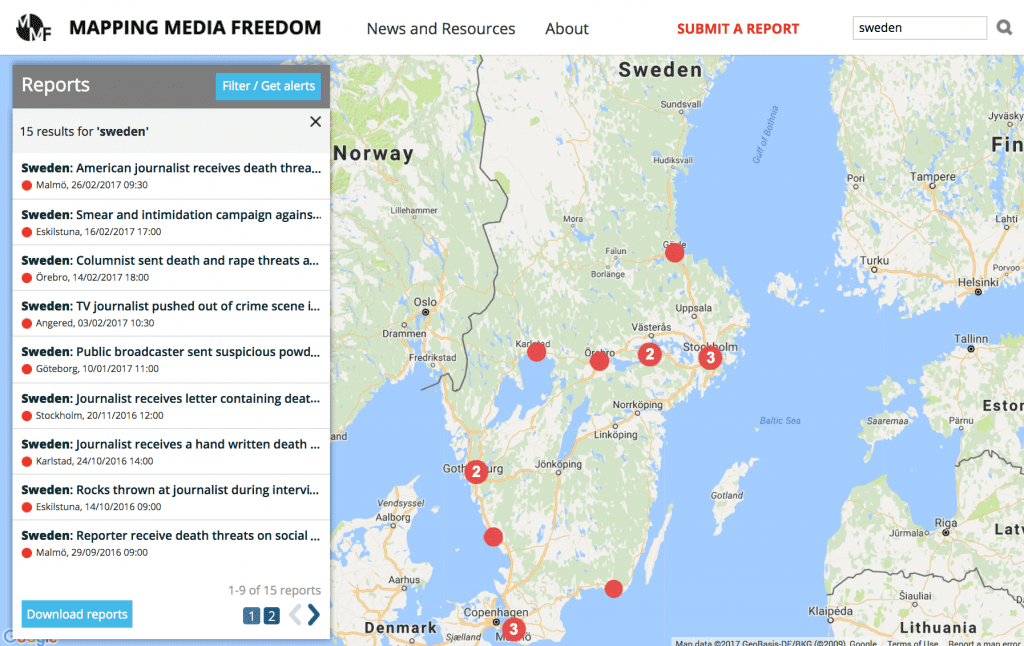
With a well-developed public service TV and Radio sector, press subsidies and political stability, being a journalist in Sweden is a touch easier than many other places around the world. Sweden is also relatively good at protecting journalists, and though they have had their disagreements, the state and political parties are broadly supportive of open, well-funded journalism. As a foreign correspondent, it is also a refreshingly easy country to work in, with people usually willing and ready to talk to the press.
A spectre that has haunted Swedish journalism for decades is anti-democratic extremism, a phenomenon given new impetus by the rise of mainstream nationalist politics in recent years. Journalists have been labelled as “cultural Marxists” and members of the so-called pk-elit, shorthand for the politically correct elite, by members of old white power organisations and the newer alt-right movements alike.
Much of the far-right view Sweden’s generally liberal newspapers and its public broadcasters as part of a shadowy agenda that is failing to report on the real issues, covering up crimes by immigrants and mounting a propaganda campaign against nationalist movements. As well as specific journalists, hatred of the media, in general, is widespread. The result is an ongoing campaign of intimidation and death threats.
Local journalists at Nerikes Allehanda, the local newspaper for the town of Örebro in central Sweden, were recently issued with death threats after reporting on Peter Springare, a local policeman who had posted on social media about immigrants causing crime in the city on 3 February. Springare was hailed as a brave whistleblower, but reporters and the newspaper’s leader writer received a wide range of abuse for discussing both the correctness and ethics of his statements. Shortly before Christmas, journalist Robert Laul received death threats after criticising controversial right-wing journalist Niklas Svensson’s reporting of undocumented migrants.
Similarly, white powder – which turned out to be harmless – was sent to Janne Josefsson, a Swedish investigative journalist based at public broadcaster SVT in Gothenburg last month. Authorities had to evacuate the entire studio building, severely disrupting the work of SVT’s news teams. The package also contained an anonymous death threat. Josefsson and his colleagues at the Uppdrag Granskning investigative show are known for reporting on all aspects of Swedish society, from the far right to organised crime, and are no strangers to intimidation.
The Swedish journalists’ union has documented how attacks on journalists are on the rise. This is troubling for a country that has long cast itself as a refuge for persecuted media workers from Russia, East Africa and elsewhere. In spring 2016 a survey of members of Swedish Radio’s journalistic corps and reporters at the association of newspaper publishers TU found that one in three had been subject to some kind of threat in the previous year.
Although a great number of those threats came from the populist right and more established neo-Nazis, journalists in Sweden have also been harassed by both criminal gangs and radical Islamist groups in recent months. In the town of Gävle north of Stockholm for example, Anna Gullberg from local paper Gefle Dagblad received a death threat in response to the paper’s investigation of a radical mosque, with the perpetrator finally sentenced last week.
These threats are more serious than the torrent of abuse and the attempts to undermine journalistic integrity on Twitter felt by reporters around the world. In Sweden, it is not difficult to find out where people live or locate their social media profiles. As a result, many journalists have been forced to either apply for the removal of their personal details from public databases or move home. A Swedish tradition that places journalists prominently at the heart of an open society with relative respect for difference of opinion is under serious threat.
Lisa Bjurwald, a media commentator, author and part owner of industry news site Medievärlden has warned that “journalists avoid writing about racist political parties and neo-Nazi groups for example because they can’t deal with the storm and volume of hate mail” in a recent newspaper interview.
The underlying questions though are how many of these alleged threats carry any risk, and does it really matter if they do? Journalists in Sweden increasingly feel as if their safety is routinely threatened as part of their work, however genuine the threat may be.
In the sea of online abuse there may only be a handful of real, tangible threats, but knowing what is casual intimidation or egotistical posturing and what is a genuine risk to the safety of journalists and their families is almost impossible. In 2015 Niklas Orrenius, one of Sweden’s leading reporters and the star journalist at newspaper Dagens Nyheter, temporarily left the country with his family after a series of threats connected to his coverage of an anonymous far-right blogger. A well-known racist activist had photographed himself outside the front door to Orrenius’ apartment and uploaded the picture to the web with a promise to come back.
With threats like this, most journalists are understandably unwilling to call the bluff of Sweden’s armchair warriors.
[/vc_column_text][vc_row_inner equal_height=”yes” content_placement=”middle” css=”.vc_custom_1488908025353{margin-top: 25px !important;margin-bottom: 25px !important;background-color: #dd3333 !important;}” el_class=”text_white”][vc_column_inner width=”1/2″][vc_custom_heading text=”Defend Media Freedom” font_container=”tag:p|font_size:28|text_align:left” use_theme_fonts=”yes” link=”url:https%3A%2F%2Fwww.indexoncensorship.org%2Fdefend-media-freedom-donate-index%2F|||”][vc_column_text]SUPPORT INDEX ON CENSORSHIP
Reporters working to share the truth are being harassed, intimidated and prosecuted – across the globe.[/vc_column_text][/vc_column_inner][vc_column_inner width=”1/2″ css=”.vc_custom_1488908111801{background-image: url(https://www.indexoncensorship.org/wp-content/uploads/2013/08/newspapers.jpg?id=50885) !important;background-position: center !important;background-repeat: no-repeat !important;background-size: cover !important;}”][/vc_column_inner][/vc_row_inner][vc_column_text]
Click on the bubbles to view reports or double-click to zoom in on specific regions. The full site can be accessed at https://mappingmediafreedom.org/
[/vc_column_text][/vc_column][/vc_row][vc_row][vc_column][vc_basic_grid post_type=”post” max_items=”4″ element_width=”6″ grid_id=”vc_gid:1488908132919-7c688c97-6409-9″ taxonomies=”9008, 6564″][/vc_column][/vc_row]
20 Feb 2017 | News, Youth Board
[vc_row][vc_column][vc_column_text]Index on Censorship has recruited a new youth board to sit until June 2017. The group is made up of young students, journalists and legal professionals from countries including India, Hungary and the Republic of Ireland.
Each month, board members meet online to discuss freedom of expression issues around the world and complete an assignment that grows from that discussion. For their first task the board were asked to write a short bio and take a photo of themselves holding a quote that reflects their belief in free speech.
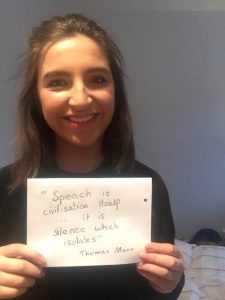 Fionnuala McRedmond – Dublin
I graduated last June from the University of Cambridge with a degree in classics. I am now studying for a MSc in political theory at the London School of Economics. I was an active student journalist during my time at Cambridge, and it was there that I first developed an interest in the struggles of censorship and speech across the globe. The propensity for governments to censor speech and ideas is not a modern phenomenon. In ancient Rome book burning was not unheard of, and Cicero once expressed the all too familiar idea: “it is not permitted to say what one thinks… it is obviously permitted to keep silent.” Then, as much as now, free speech was the cornerstone of a healthy society. And then, as much as now, speech was censored by tyrannical power. I am particularly interested in the relationship between censorship and identity. In the past, and even more so now, people have been denied the right to share their words and ideas on the basis of ethnic, religious and political identity. Work by groups like Index on Censorship is crucial in protecting people’s right to speak, no matter who they are. I hope to better understand and develop these ideas with the Index on Censorship youth board.
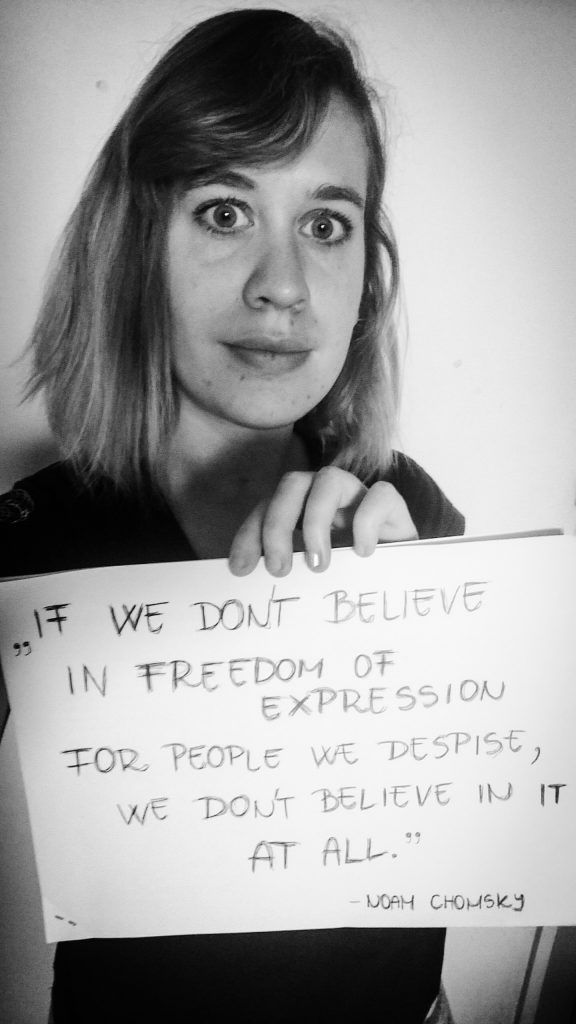 Júlia Bakó – Budapest
I am a Hungarian journalist, student and activist currently living in Budapest. After finishing my first degree in journalism, I have started studying international relations.
As a journalist and as someone who is deeply committed to human rights I am naturally drawn to freedom of expression and freedom of press issues. During the last couple of years I have worked with several NGOs and other organisations like Transparency International, Amnesty International, OSCE and Atlatszo.hu. I have dealt with corruption cases as an investigative journalist, I have studied human rights monitoring and – partly because of my studies, but mostly because of my personal interest and commitment – I have tried to explore freedom of expression and other issues not just in my own country, but all over the world, to find patterns, similarities and possible measures that could be taken either on a national or international level.
The quote I chose about freedom of expression says something what we sometimes tend to forget about. Being able to express our own opinions, however right they may seem to us, should never stop us from fighting for the rights of others to be able to act the same way, even though their opinions seem fundamentally different sometimes. Granting the chance to express opinions we do not agree with is what is able to create the diversity of thought, the debate about social issues and with that democracy itself.
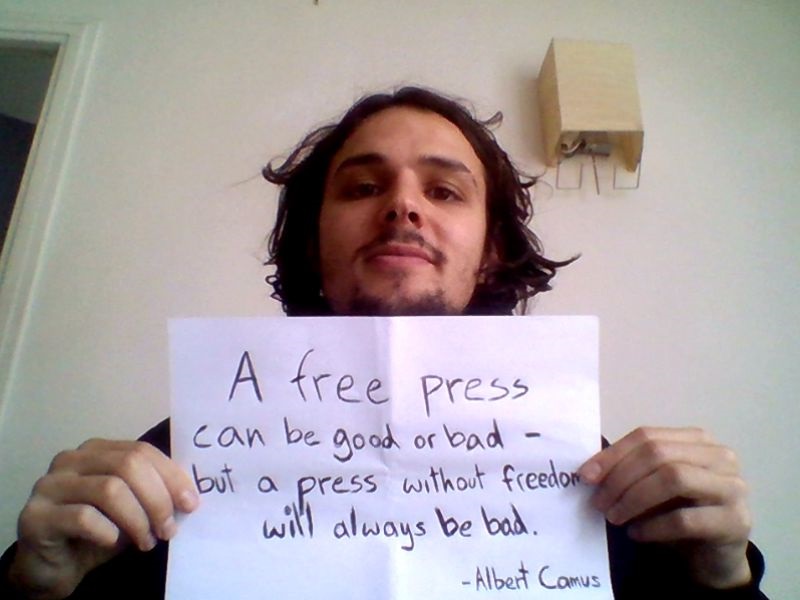 Samuel Earle – Paris
I currently live in Paris, where I am a freelance writer and English teacher.
I became interested in freedom of expression while studying politics at university – first at undergraduate and then at MSc level – and that continues today through my interest in journalism. What’s clear to me is that although freedom of expression is always valuable, the challenges it faces globally are never the same.
In the west, I think there is a complacency concerning freedom of expression: that stopping censorship is assumed to be enough. But I believe that in societies as unequal as our own, and where market forces reign, the value of freedom of expression can be diminished – as shown, for example, by the fake-news phenomenon.
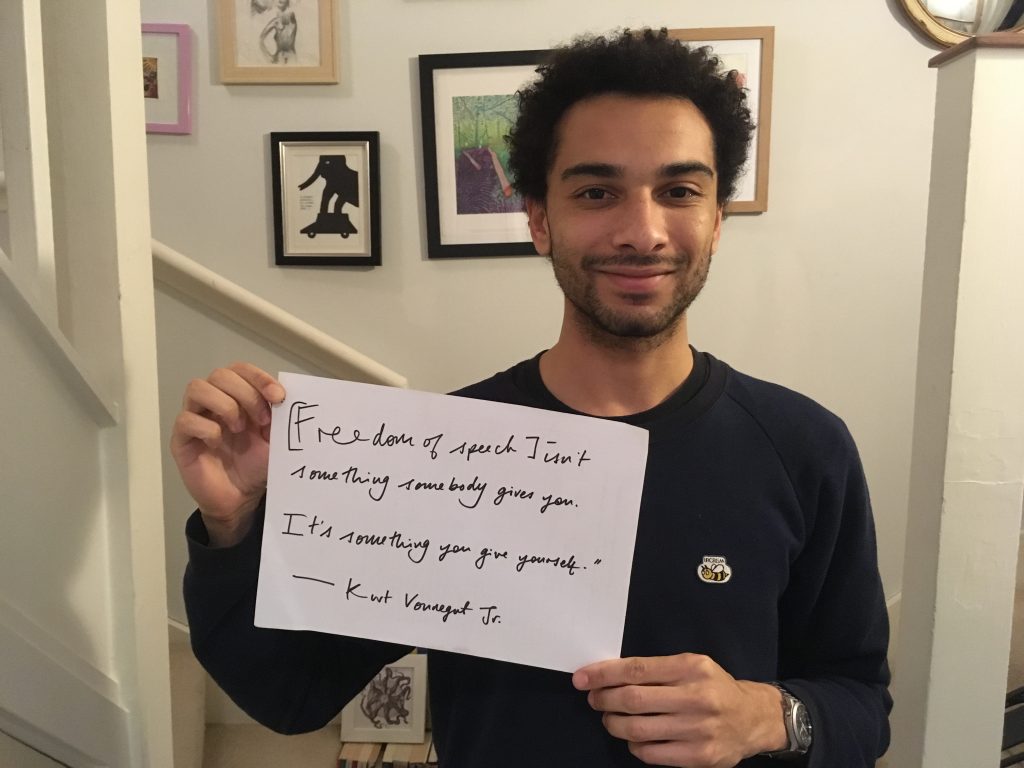 Samuel Rowe – London
I am currently a postgraduate law student, having studied literature as an undergraduate in the UK and the USA. I hope to become a public law barrister, specialising in media and information law and human rights. Like the character in Kurt Vonnegut’s Hocus Pocus, I believe that the right to freedom of speech is innate. It is not a commodity; it is not something to be bargained with. My interest in issues surrounding freedom of speech directed my undergraduate dissertation, which focused on the western surveillance state. This sort of covert action can have the effect of creating an environment of self-censorship, and often has a disproportionate impact on marginalised communities. I looked at methods of resistance (of which there are many) to see how groups maintained freedom of speech under the gaze of the state. The suppression of freedom of speech is hardly a novel phenomenon and mass surveillance is just one way in which it is currently under threat. From White House officials calling disagreeable information “fake news” to irresponsible no platforming in universities, this is an era in which the limits and value of freedom of speech are being questioned. I believe that without freedom of speech, there can be no full interrogation of the evils which face us. And without interrogation, we risk losing sight of the full scope those evils might pose.
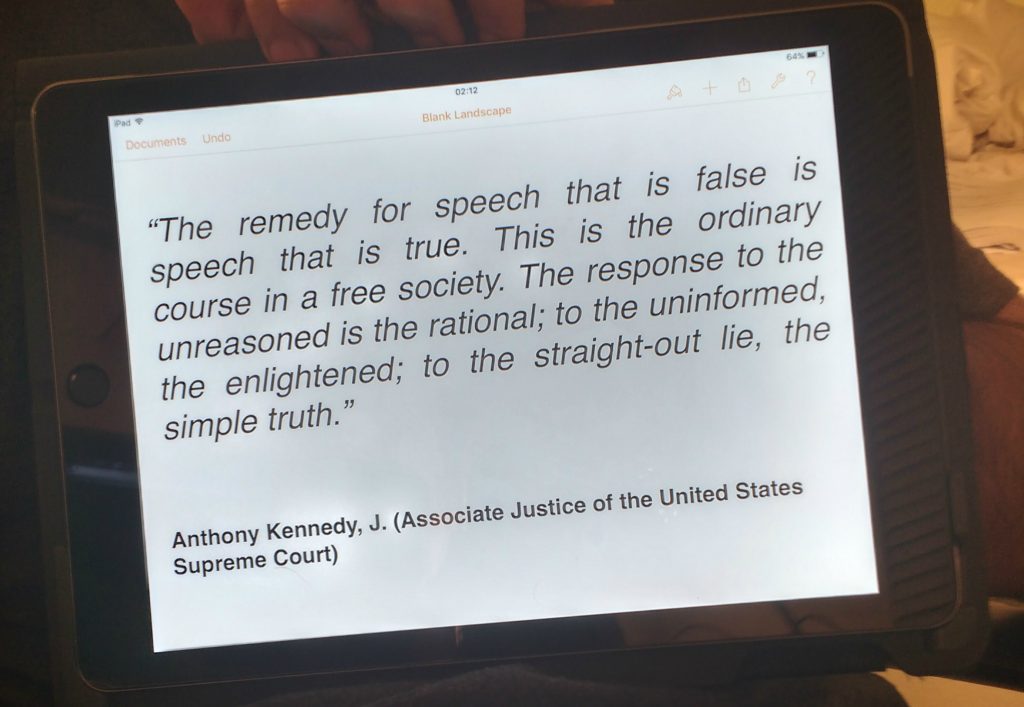 Tarun Krishnakumar – New Delhi
In recent times, there has been much concern expressed about the proliferation of “fake” news online and the impact it can have on democratic processes, politics and the public at large. These concerns have stirred various stakeholders – including governments, news media and internet intermediaries – into action. For instance, the German government recently declared fake news from Russia to be a significant threat to its upcoming elections. In a similar vein, internet giants like Google and Facebook – likely in the wake of unfavourable political outcomes – have been clamouring to show that they are willing to clamp down on content that is false or misleading.
In response to these developments, the quote I’ve selected manifests what, I feel, should be the appropriate response to fake speech: more “non-fake” speech – and not more regulation. While many justifications to clamp down on fake news may be well-intentioned, the history of regulating speech has shown us that inserting an intermediary into a conversation creates unintended and harmful consequences for free speech. Often this manifests as overt censorship while, in other cases, it is the creation of private arbiters of what may or may not be said on a platform – a more covert and creeping harm. Given the subjectivity in judging what news is “fake”, the debate also presents an excuse for regimes to tighten existing censorship controls or establish new ones.
The internet has given everyone an opportunity to have an equal say. This must be preserved at all costs. Fake news must be countered not through bans, blocking or regulation but by targeting the societal information asymmetries that allow it to flourish and creating conditions that facilitate society to produce more speech that is not “fake”. Policy efforts should focus on educating readers and providing them the tools to judge content for themselves – thereby minimising the effect of false or misleading content. For this, what is necessary is a culture of being exposed to a balanced diet of diverse content. When governments peddle nationalistic, religious, or political rhetoric in educational curricula and skew facts, little do they realise that they are creating the very conditions that allow “fake” news to flourish and have the harmful impacts that they complain of.
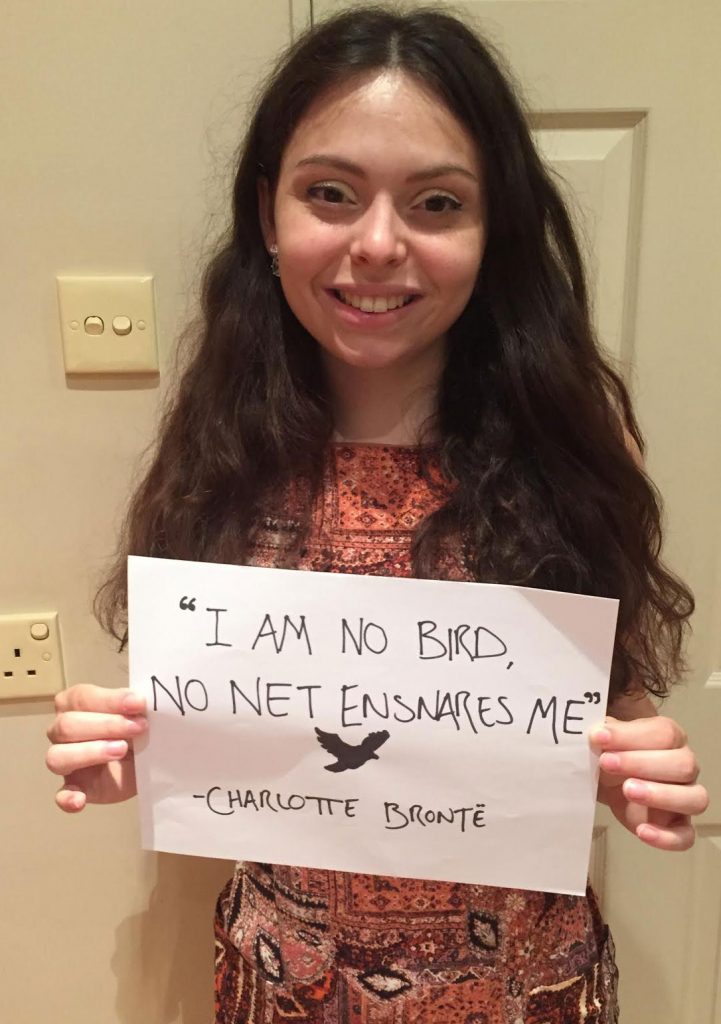 Sophia Smith-Galer – London
I’m a MA student studying broadcast journalism at City University in London. I studied Spanish and Arabic previously at Durham University and I’m particularly interested in how artists and writers overcome challenges to their freedom of expression in Latin America and the Middle East. As a singer I have always been intrigued by the imagery of a caged bird that sings despite its entrapment; Charlotte Bronte instead uses this metaphor to show how independent Jane Eyre has become by the end of the eponymous novel. Humans have always connected birds with freedom, or lack of – just look at Twitter’s logo – and so the quote really resonated with me.
Freedom of expression is particularly important to me as several countries that speak both of the languages I have dedicated years of study to continue to be plagued by tyrants and censors. I’m particularly interested addressing censorship in Latin America and the Middle East, especially with regard to the arts, as I’m also a classical singer and keen art historian.
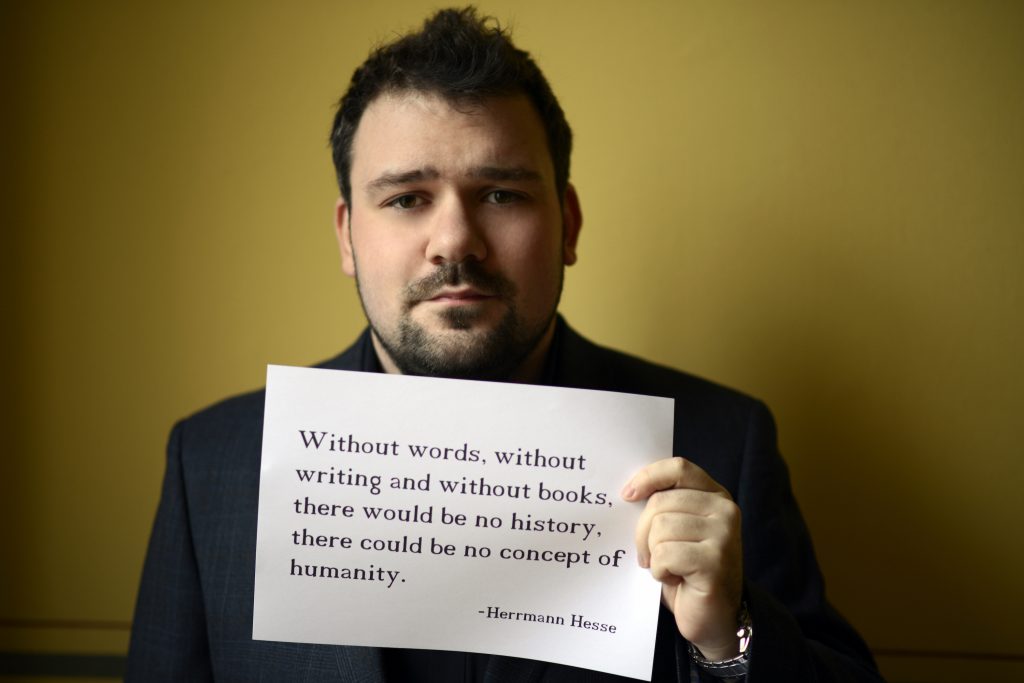 Constantin Eckner – St Andrews
I am originally from Germany. I graduated from University of St Andrews with an MA degree in modern history. Currently, I am a PhD candidate specialising in human rights, asylum policy and the history of migration. Moreover, I have worked as a writer and journalist since I was 17 years old, covering a variety of topics over the years. Longer stays in cities like Budapest and Istanbul have raised my awareness for pressures exerted upon freedom of expression.
I chose this particular quote, because Hermann Hesse emphasised the importance of the written word and how it had an impact on the concept of humanity. In his time, Hesse was conscious that without writing it was not possible to express thoughts and spread ideas. Therefore, all those who fought the existence of the written word threatened humanity which was a frightening thought for a humanist like Hesse.
In a perfect world, every human being would live without fear of state censorship and potentially facing repercussions for the words they write—or for the pictures they draw, for the photos they shoot, for music they play.
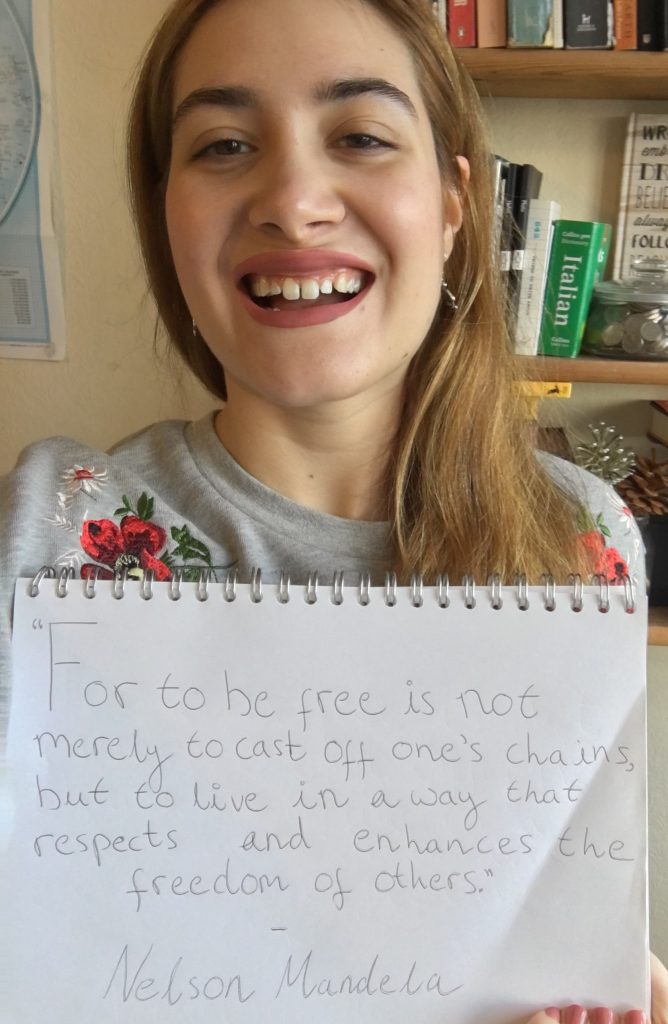 Isabela Vrba Neves – Stockholm
I’m half Brazilian and half Czech, raised in Sweden, but currently living in London where I work in communications for a mental health charity. I‘m also a Latin America correspondent for the International Press Foundation (IPF), a platform where young journalists get to write about stories that matter the most to them. It was during my time at Kingston University, studying journalism and French, when my interest in censorship and freedom of expression first emerged.
During my undergraduate studies I learned how important a free press is for a working democracy. It is a platform bringing together multiple voices, by sharing news, ideas and holding those in power to account. However, many journalists around the world suffer repression for simply doing their job and for using their right to free speech.
For me, Nelson Mandela‘s quote represents the importance of respecting and listening to each other, even with different views, but also highlighting the voices of those who are forced into silence.
Interviewing journalists from Venezuela and Pakistan, who face these types of constraints, has made me more engaged in sharing stories concerning freedom of expression, not only by journalists, but also by artists and activists. In the future, as a journalist, I want to focus on freedom of expression and by being part of the youth advisory board, I will be able to expand my knowledge and have great conversations with other young people who are passionate for justice and social change.[/vc_column_text][/vc_column][/vc_row][vc_row full_width=”stretch_row_content”][vc_column][three_column_post title=”More from the youth advisory board” category_id=”6514″][/vc_column][/vc_row]
24 Jan 2017 | Albania, Belarus, Europe and Central Asia, Mapping Media Freedom, News, Sweden, Turkey
[vc_row][vc_column][vc_column_text] [/vc_column_text][vc_column_text]
Each week, Index on Censorship’s Mapping Media Freedom project verifies threats, violations and limitations faced by the media throughout the European Union and neighbouring countries. Here are five recent reports that give us cause for concern.
On 18 January a Turkish court ordered the arrest of three journalists on charges of “membership in an armed terror group,” T24 reported.
These journalists include Ömer Çelik, former news editor of DİHA daily; Tunca Öğreten, former editor of Diken news portal, and BirGün daily staff member Mahir Kanaat.
They were detained on 25 December 2016 with three others; Derya Okatan, managing editor for the ETHA news agency; DİHA reporter Metin Yoksu, and Yolculuk newspaper managing editor Eray Saygın.
After 24 days, the court ruled to release Yoksu, Sargın and Okatan on probation terms. Under the order they are barred from international travel and will have to regularly check in with their local police station.
Pre-trial custody can last up to 30 days under Turkey’s emergency rule, which was implemented on 20 July 2015 following a coup attempt.
On 25 December 2016, pro-government Sabah daily announced that the journalists would be detained in connection to email correspondence of Berat Albayrak, Turkey’s energy minister and the son-in-law of the country’s President Recep Tayyip Erdoğan that were leaked to the media.
The arrests bring the number of journalists in Turkish prisons to 151.
The Gothenburg offices of Swedish public service TV and radio, SVT, were evacuated on Tuesday 10 January after a suspicious package containing white powder and written threats was sent to staff member Janne Josefsson, the broadcaster reported.
SVT reported that “the letter was opened and the contents spread on a coffee machine and stairs”.
SVT Chief Executive Hannah Stjärne commented on the incident: “This threat has disabled a socially important journalistic operation for several hours and is a blow to the open society which we must protect.”
Police have begun an investigation into the source of the threat. The powder was later found to be harmless.
Russian-Israeli blogger Aleksandr Lapshin was detained in Minsk on 15 January 2016, shortly after entering Belarus, Euroradio.fm reported. The detention was requested by Azerbaijan, which is seeking to have the blogger extradited.
Lapshin lives in Moscow and is wanted in Azerbaijan for visiting the disputed region of Nagorno-Karabakh and for criticising Azerbaijani policies on his blog.
A representative for Belarus’s Prosecutor General said it was studying Azerbaijan’s extradition request.
The Committee to Protect Journalists has called on Belorussian authorities to release the blogger without condition and allow him to return home.
Two media directors, Armand Shullaku and Alfred Lela, lost their jobs on 12 January after owners changed the “editorial orientation” of their outlets in favour of the government, ZeriaMerikas.es reported.
Shkullaku, who was the director of the news channel ABC News in Tirana, said his employment contract was not renewed for January 2017 and that he believed that the owner of the TV station changed its editorial line so that it now supports the government. “The owner told me that in his opinion, the channel needed a new managerial and editorial approach,” he said.
Lela, former director of the newspaper Mapo, said that the owner of the outlet had also declared his support for Prime Minister Edi Rama and that his contract, which ended on 31 December, was not renewed for that reason. “I was offered a new contract on condition I respected the new editorial affiliation and I refused,” he told Voice of America Albanian language service.
Lulzim Basha, the leader of the opposition Democratic Party, wrote on his Facebook page that the dismissal of these two journalists means businesses and media have joined the government against the people.
On 12 January an Istanbul Prosecutor asked for a nine-year sentence in the case of prominent journalist Hasan Cemal, reported Hurriyet Daily News.
Cemal is being charged for “making the propaganda of terrorist organisations” and “praising crime and criminals”.
On 1 September, 2016 Cemal was part of a group of nine editors who took part in the Editor For The Day campaign launched in support of the closed pro-Kurdish daily Özgür Gündemy, Bianet reported.[/vc_column_text][vc_column_text]
Click on the bubbles to view reports or double-click to zoom in on specific regions. The full site can be accessed at https://mappingmediafreedom.org/
[/vc_column_text][/vc_column][/vc_row][vc_row][vc_column][vc_basic_grid post_type=”post” max_items=”4″ element_width=”6″ grid_id=”vc_gid:1485247537834-0f5818db-acf6-3″ taxonomies=”6564″][/vc_column][/vc_row]
