30 Jan 2014 | News, Religion and Culture
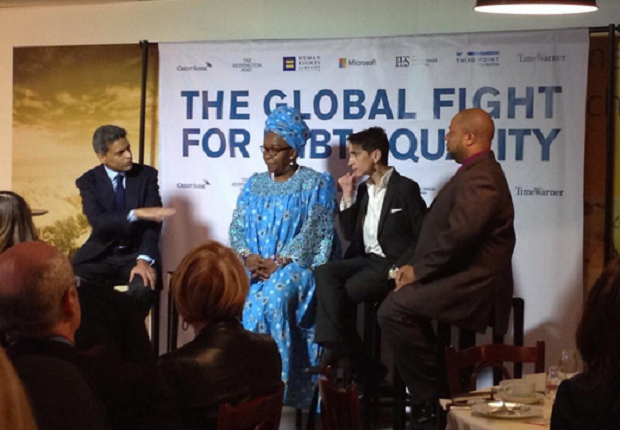
Fareed Zakaria (left) chaired two panels of LGBT activists at Davos. The first (above) consisted of Alice Nkom, Masha Gessen and Dane Lewis (Image: Twitter/@m_delamerced)
A panel of LGBT activists used the World Economic Forum last week to scrutinise recent homophobic laws passed by the Nigerian President, Goodluck Jonathan, despite rumours prior to the event suggesting it would be Putin who, for obvious reasons, would come under attack at the discussion.
Those taking part were flown into the event from around the world; Russian and American journalist Masha Gessen, Cameroonian lawyer Alice Nikom and J-FLAG Executive Director Dane Lewis were all present, as well as Human Rights Campaign President Chad Griffin, and Republican mega-donors Paul Singer and Dan Loeb.
Opening the breakfast discussion the UN High Commissioner for Human Rights Navi Pillay said: “Two weeks ago President Jonathan of Nigeria signed into law a bill that criminalises, among other things, gay wedding celebrations, any public display of any same-sex affection, as well as the operating of gay clubs, businesses or organisations, including human rights organisations that focus on protecting the rights of LGBT people.”
Held rather ironically across the street from a discussion the Nigerian President himself was currently attending, Griffin followed suit: “Just to be clear what he signed, so everyone understands it in this room, it was already illegal to be LGBT but he further legalised it. You can be in prison for 14 years for simply being a gay person.
“Each one of you here would be subject to arrest because you’re in this room today: you’d go to prison for ten years. That’s what’s happening right now in that country and I bet you most people in that room don’t know what he’s just done.”
Putin’s name did manage to crop up in conversation and, not surprisingly, it was Gessen who had something to say.
She believes the Kremlin legitimately felt the LGBT community was the one minority it could beat up without fearing a backlash from the rest of the world- how wrong they were. The international reaction may have been slow to take off, she said, but the strong global response has come as a real shock to the Russian government.
“There is a reason why we talk about human rights and there is a reason why we talk about the protection of minorities, because minorities often do have to be protected from the majority, that’s the point,” Gessen said.
The ski resort of Davos, Switzerland welcomes around 2,500 of the world’s top business leaders, politicians, intellectuals and journalists each year to talk business. The singling out of countries or politicians for criticism during the conference is unheard of, according to Politico, which referred to the forum as a “week of political calm”.
This year’s conference came under the banner The Reshaping of the World: Consequences for Society, Politics and Business. Singer and Loeb, who organised the panel, reshaped the theme into a discussion about global sexuality and equality.
Loeb said: “We’re at the World Economic Forum. They say we’re here to make the world a better place. I think we need to take care of the injustices imposed on others in our efforts to make the world a better place.”
Griffin closed the talk by looking at the future of LGBT discussions at Davos, emphasising what an incredible start the first attempt at grabbing the world’s attention at the World Economic Forum was. But there were wishes that the intimate breakfast event would one day “be in the building across the street”.
Watch the full video of the discussion here.
This article was published on 30 January 2014 at indexoncensorship.org
13 Jan 2014 | Europe and Central Asia, European Union, Politics and Society
This article is part of a series based on our report, Time to Step Up: The EU and freedom of expression
Collectively, the European Union of 28 member states has an important role to play in the promotion of freedom of expression in the world. Firstly, as the world’s largest economic trading block with 500 million people that accounts for about a quarter of total global economic output, it still has significant economic power. Secondly, it is one of the world’s largest “values block” with a collective commitment to the Universal Declaration of Human Rights, the International Covenant on Civil and Political Rights and perhaps more significantly, the European Convention on Human Rights. The Convention is still one of the leading supranational human rights treaties, with the possibility of enforcement and redress. Finally, Europe accounts for two of the five seats on the UN Security Council (Britain and France), so has a crucial place in the global security framework. The EU itself has limited foreign policy and security powers (although these powers have been enhanced in recent years), leaving significant importance to the foreign policies of the member states. Where the EU acts with a common approach it has leverage to help promote and defend freedom of expression globally.
How the European Union supports freedom of expression abroad
The European Union has a number of instruments and institutions at its disposal to promote freedom of expression in the wider world, including its place as an observer at international fora, its bilateral and regional agreements, the European External Action Service (EEAS) and geographic policies and instruments including the European Neighbourhood Policy (ENP) and the European Neighbouring and Partnership Instrument (ENPI). The EU places human rights in its trade and aid agreements with third party countries and has over 30 stand-alone human rights dialogues. The EU also provides financial support for freedom of expression through the European Development Fund (EDF), the Development Co-operation Instrument (DCI), the European Instrument for democracy and human rights (EIDHR) and the European Endowment for Democracy (EED). The EU now also has a Special Representative for Human Rights. Since 1999, the EU has published an annual report on human rights and democracy in the world. The latest report, adopted in June 2012, contains a special section on freedom of expression, including freedom of expression and “new media”. It recalls the EU’s commitment to “fight for the respect of freedom of expression and to guarantee that pluralism of the media is respected” and emphasises the EU’s support to free expression on the internet.
The European Union has two mechanisms to financially support freedom of expression globally: the European Instrument for democracy and human rights (EIDHR) and the European Endowment for Democracy (EED). The latter was specially created after the Arab Spring in order to resolve specific criticism of the EIDHR: that it didn’t support political parties, non-registered NGOs and trade unions and could not react quickly to events on the ground. The EED is funded by, but is autonomous from, the European Commission, with support from member states and Switzerland. The aims of the EED, to provide rapid and flexible funding for pro-democratic activists in authoritarian states and democratic transitions, is potentially a “paradigm shift” according to experts that will have to overcome a number of challenges, in particular a hesitation towards funding political parties and the most active and confrontational of human rights activists. The EU also engages with the UN on human rights issues at the Human Rights Council (HRC) and in the 3rd Committee of the General Assembly. The EU, as an observer along with its member states, is one of the more active defenders of freedom of expression in the HRC. Promoting and protecting freedom of expression was one of the EU’s priorities for the 67th Session of the UN General Assembly (September 2012-2013). The European Union was also instrumental in the adoption of a resolution on the “Safety of Journalists” (drafted by Austria) in September 2012. The European Union is most effective at the HRC where there is a clear consensus among member states within the Union . Where there is not, for instance on the issue of blasphemy laws, the Union has been less effective at promoting freedom of expression.
The EU and its neighbourhood
The EU has had mixed success in promoting freedom of expression in its near neighbourhood. Enlargement has clearly been one of the European Union’s most effective foreign policy tools. Enlargement has had a substantial impact both on the candidate countries’ transition to democracy and respect for human rights. With enlargement slowing, the leverage the EU has on its neighbourhood is under pressure. Alongside enlargement, the EU engages with a number of foreign policy strategies in its neighbourhood, including the Eastern Partnership and the partnership for democracy and shared prosperity with the southern Mediterranean. This section will look at the effectiveness of these policies and where the EU can have influence.
The EU and freedom of expression in its eastern neighbourhood
Europe’s eastern neighbourhood is home to some of the least free places for freedom of expression. The collapse of the former Soviet Union and the enlargement of the European Union has significantly improved human rights in eastern Europe. There is a marked difference between the leverage the European Union has on countries where enlargement is a real prospect and the wider eastern neighbourhood, where it is not, in particular for Russia and Central Asia. In these countries, the EU’s influence is more marginal. Enlargement has clearly had a substantial impact both on the candidate countries’ transition to democracy and their respect for human rights because since the Treaty of Amsterdam, respect for human rights has been a condition of accession to the EU. In 1997, the Copenhagen criteria were outlined in priorities that became “accession partnerships” adopted by the EU and which mapped out the criteria for admission to the EU. They related in particular, to freedom of expression issues that needed to be rectified. With the enlargement process slowing since the “big bang” in 2004, and countries such as Ukraine and Moldova having no realistic prospect of membership regardless of their human rights record, the influence of the EU is waning in the wider eastern neighbourhood.
After enlargement, the Eastern Partnership is the primary foreign policy tool of the European Union in this region. Launched in 2009, the initiative derives from the EU’s Neighbourhood Policy (ENP), which is specific about the importance of democracy, the rule of law and respect for human rights. In this region, the partnership covers Armenia, Azerbaijan, Belarus, Georgia, Moldova and Ukraine. Freedom of expression has been raised consistently during human rights dialogues with these six states and in the accompanying Civil Society Forum. The Civil Society Forum has also been useful in helping to coordinate the EU’s efforts in supporting civil society in this region. Although it has never been the main aim of the Eastern Partnership to promote freedom of expression, it has had variable success in promoting this right with concrete but limited achievements in Belarus, the Ukraine, Georgia and Moldova; with a more ineffectual role being seen in Azerbaijan.
In recent years, since the increased input of the EEAS in the ENP, the policy has become more markedly political, with a greater emphasis on democratisation and human rights including freedom of expression after a slow start. In particular, freedom of expression was raised as a focus for the ENP after its review in 2010-2011. This is a welcome development, in marked contrast to the technical reports of previous years. This also echoes the increased political pressure from member states that have been more public in their condemnation of human rights violations, in particular regarding Belarus. Belarus is one Eastern Partnership country where the EU has exerted a limited amount of influence. The EU enhanced its pressure on the country after the post-presidential election clampdown beginning in December 2010, employing targeted sanctions and increasing support to civil society. This has arguably helped secure the release of some of the political prisoners the regime detained. Yet the lack of a strong sense of strategy and unity within the Union has hampered this new pressure to deliver more concrete results. Likewise, the EU’s position on Ukraine has been set back by internal divisions, even though the EU’s negotiations on the Association Agreement included specific reference to freedom of expression.
In Azerbaijan, the EU’s strategic oil and gas interests have blunted criticism of the country’s poor freedom of expression record. Azerbaijan holds over 89 political prisoners, significantly more than in Belarus, yet the EU’s institutions, individual member states and European politicians have failed to be vocal about these detentions, or other freedom of expression violations. In the EU’s wider neighbourhood outside the Eastern Partnership, the EU has taken a less strategic approach and accordingly has been less successful in either raising freedom of expression violations or helping to prevent them.
The European Union’s relationship with Russia has not been coherent on freedom of expression violations. While the institutions of the EU have criticised specific freedom of expression violations, such as the Pussy Riot sentencing, they were slow to criticise more sustained attacks on free speech such as the clampdown on civil society and the inspections of NGOs using the new Foreign Agents Law. The progress report of EU-Russia Dialogue for Modernisation fails to mention any specific freedom of expression violations in Russia. The EU has also limited its financial involvement in supporting freedom of expression in Russia, unlike in other post-Soviet states. The EU is not united on this criticism: individual European Union member states such as Sweden and the UK are more sustained in their criticisms of Russia’s free speech violations, whereas other member states such as Germany tend to be less critical. It is argued that Russia’s powerful economic interests have facilitated a significant lobbying operation including former politicians that works to reduce criticism of Russia’s freedom of expression violations.
In this region, the European Union’s protection of freedom of expression is weakest in Central Asia. While the EU has human rights dialogues with Kazakhstan, Kyrgyzstan, Tajikistan, Turkmenistan and Uzbekistan, it has not acted strategically to protect freedom of expression in these countries. The EU dramatically reduced its leverage in Uzbekistan in 2009 by relaxing arms sanctions with little in return from the Uzbek authorities, who continue to fail to abide by international human rights standards. Arbitrary arrests, beatings and torture at the hands of the security services, as well as unfair trials of the regime’s critics are all commonplace. The European Parliament’s special rapporteur report of November 2012, took a tough stance on human rights in Kazakhstan, making partnership conditional on respect for Article 10 rights. But, this was undermined by High Representative Baroness Ashton’s visit to the country in November 2012, where she failed to raise human rights violations at all.
This lack of willingness to broach freedom of expression issues continued during Baroness Ashton’s first official visit to four of the five Central Asian republics: Kyrgyzstan, Uzbekistan, Tajikistan and Kazakhstan. In Kyrgyzstan she additionally attended an EU-Central Asia ministerial meeting, where the Turkmen government (one of the top five most restrictive countries in the world for freedom of expression) was represented. Baroness Ashton’s lack of vocal support for human rights was condemned by local NGOs and international watchdogs.
24 Dec 2013 | Comment, News, Politics and Society, Religion and Culture, United Kingdom
Human Right’s lawyer, Keir Starmer, who has just completed a five year stint as Director of Public Prosecutions for the Crown Prosecution Service, has been active in drawing up guidelines for sensitive areas of criminal law.
Starmer attended a recent roundtable of arts executives Index on Censorship organised with Tate Britain. It was part of our conference Taking the Offensive: Defending artistic freedom of expression in the UK. Having heard for himself that self-censorship in UK museums, galleries and theatres is widespread, triggered by a complex range of pressures including the fear of prosecution and police intervention, Starmer advocated for the usefulness of CPS guidelines for artist expression.
The story of how CPS guidelines came into being started shortly after Starmer joined the CPS as the DPP in 2008. It deals with one of the most morally sensitive areas of criminal law, that of assisted suicide. In the case of 23-year-old rugby playing student Daniel James, Starmer used his discretion not to prosecute Daniel’s parents for accompanying their son to the Dignitas clinic in Switzerland, where he died with them at his side.
Subsequently, Debbie Purdy, who suffers from MS, approached the DPP to find out if her husband would be prosecuted if he assisted her suicide. Her argument was that if he would be prosecuted, then, in order to protect him, she would have to travel to Switzerland by herself while she was still physically able to make the journey. Effectively she would be shortening her life to avoid incriminating her husband. In response Starmer decided to draw up public facing guidelines laying out the factors the CPS would take into account to decide whether or to prosecute. There would undoubtedly be evidence against Mr Purdy to prosecute but would it be in the public interest to do so?
This year, Starmer drew up guidelines for the social media in response to a tidal wave of cases and excessive prosecutions arising from tweets and Facebook comments, including Paul Chambers’, the defendant in the Twitter joke trial. The guidelines indicate that the bar is set high – that only tweets that are “more than grossly offensive” and or “made in cases of considerable sensitivity” — should be prosecuted. Starmer quoted the case of a tweet left on the tribute page to April Jones, saying it would be likely to be prosecuted. The guidelines indicate that freedom of expression is well protected by the law, and the police are not going to get involved with every spate of offensive and abusive comments that litter the internet. As Starmer said – “you don’t need a law to protect expression that everyone agrees with”.
From a policing perspective the area of culture is uncharted. There is currently no guidance for policing cultural events, apart from a mention in Association of Chief Police Officers guidance regarding charging for costs associated with policing of music festivals and football matches. The job of deciding if a work could be in breach of the law – for example child protection, obscenity legislation, race and religious hatred or public order – is done by the police, without guidance. Compare this to the amount of guidance around policing of protest, where on every page the right to protest is repeated and stressed, and has to be taken into account at every stage of policing.
No DPP can reassure an anxious artist director that a particular piece of art work is not going to be prosecuted, though Starmer did receive several letters asking for that reassurance. But the CPS could produce guidelines for the arts and this is something that Starmer personally advocates, both as part of his general evangelism for the clarity and efficiency that guidelines achieve, and as a practical way to tackle self-censorship.
The guidelines would likely take account of the location and context of the artwork, the motivation and intention of the artist and how anyone involved in the making of the work had been treated, were permissions given, with particular scrutiny around the involvement of children and animals. They would also, and this would be very interesting part of the exercise, look at the public interest of prosecution, which would inevitably involve a debate about the wider social benefit of art that challenges taboos and pushes boundaries, including where offence is caused.
Taking the social media guidelines as a model, it is reasonable to assume that the guidelines would set a high threshold and that the legal framework would in the main support the artist’s right to free expression. This common law approach is one of several rulings in support of freedom of expression is cited:
“Satirical, or iconoclastic, or rude comment, the expression of unpopular or unfashionable opinion about serious or trivial matters, banter or humour, even if distasteful to some or painful to those subjected to it should and no doubt will continue at their customary level…” In Chambers v DPP [2012] EWHC 2157 (Admin), the Lord Chief Justice
If the guidelines were to similarly set a high threshold for artistic freedom of expression, it could go some way to dispel the fear of prosecution and it should give a clear steer to the police when dealing with art that causes offence. In turn this would clarify the position of the arts executives when work is contested by audience, press or police and enable them to better defend their choices in the heat of a crisis.
It would also mean that people making decisions about what art goes into our public spaces could differentiate between legal and social boundaries of what is sayable. The latter are more complex, mutable and volatile and in certain cases are patrolled by special interest groups, who actively want to silence artists whose work offends or challenges, often promoting the right not to be offended.
With the Common Law ruling in mind, arts guidelines as social media guidelines would not recognise the right not to be offended, though they do acknowledge that communication that is grossly offensive has in the end to be dealt with on a discretionary basis, quoting Lord Bingham “There can be no yardstick of gross offensiveness otherwise than by the application of reasonably enlightened, but not perfectionist, contemporary standards to the particular message sent in its particular context. The test is whether a message is couched in terms liable to cause gross offence to those to whom it relates.” This would seem to suggest that there is a right not to be grossly offended.
So in the end we have come full circle, back to that idea that each case has to be taken as individual, and that the DPP would be called on to exercise their discretion about whether to prosecute. But having said that the idea of guidelines is certainly very interesting and would at least put a clear line in the sand, in territory that is currently completely uncharted.
This article was originally posted at indexoncensorship.org
12 Aug 2013 | In the News
#DONTSPYONME
Tell Europe’s leaders to stop mass surveillance #dontspyonme
Index on Censorship launches a petition calling on European Union Heads of Government to stop the US, UK and other governments from carrying out mass surveillance. We want to use public pressure to ensure Europe’s leaders put on the record their opposition to mass surveillance. They must place this issue firmly on the agenda for the next European Council Summit in October so action can be taken to stop this attack on the basic human right of free speech and privacy.
(Index on Censorship)
AUSTRALIA
Party profile: The Pirate Party
The Pirate Party of Australia will be fielding eight Senate candidates at the upcoming federal election.
(World News Australia)
BAHRAIN
Teacher ‘should have faced trial’
An American kindergarten teacher, who was deported for having links with radical opposition groups, should have been put on trial, according to political societies.
(Gulf Daily News)
CHINA
Popular China bloggers should ‘promote virtues’
Chinese Internet celebrities have been told to “promote virtues” by a leading official, state media said Sunday, after a singer sparked a free speech debate by venting about bombing government offices.
(Yahoo)
GLOBAL
The Pirate Bay Launches Censorship-Dodging Web Browser
Notorious torrent-sharing site The Pirate Bay is 10 years old today, and they got you a little something. They launched PirateBrowser, a custom Firefox browser that skirts Internet censorship and lets you access the Pirate Bay from anywhere. We should at least send them a card or something.
(Geekosystem)
INDIA
Stand up for freedom of expression: Anand Patwardhan
Acclaimed documentary filmmaker AnandPatwardhan believes civil society groups in Gujarat must unite to defend the right to free expression, especially of oppressed sections.
(Times of India)
Freedom of Expression: Indians are Becoming Increasingly Intolerant
Instead of nurturing the spirit of debate, we have become aggressive, bigoted and abusive
(Forbes India)
RUSSIA
Russia asked by IOC about gay propaganda law
Mr Rogge said in Moscow that Russian written reassurances over the Winter Olympics in Sochi needed clarification. “We don’t think it is a fundamental issue, more a translation issue.”
(Radio New Zealand)
SOUTH AFRICA
Fear of offending betrays hard-won rights
When President Jacob Zuma and the ANC calls on “intellectuals” not to be “antagonistic”, it raises several questions, says Judith February and Richard Calland.
(St Kitts News)
ST KITTS
Press Freedom and Freedom of Information Act
Press freedom and Freedom of Information Act are like two wings on which transparency, accountability and openness in government rises to the needs of democracy and good governance.
(St Kitts News)
SWITZERLAND
The power of pictures
Swiss photographer Christian Lutz began a reportage on the International Christian Fellowship (ICF) more than two years ago after gaining explicit approval from the founder of the community, its managers and event organisers. But more than 20 legal complaints stopped the publication of Lutz’s book, In Jesus’ Name.
(Swiss Broadcasting Corporation)
UNITED STATES
‘Boobies,’ the courts and free speech
The courts must protect the rights of students to express themselves on social and political issues.
(Los Angeles Times)
Political signs are free speech, not a blight on suburban lawns
While many consider political signs ugly and annoying, they are free speech at its purest. In case after case, courts have struck down efforts to limit this most basic form of political speech. In 1994, the U.S. Supreme Court ruled unanimously in City of Ladue et al. v. Gilleo that curbs on political lawn signs were unconstitutional.
(Syracuse.com)
Previous Free Expression in the News posts
Aug 9 |Aug 7 | Aug 6 | Aug 5 | Aug 2 | Aug 1 | July 31 | July 30 | July 29 | July 26 | July 25 | July 24 | July 23 | July 22 | July 19 | July 18 | July 17
