Four citizen journalists have been killed in Syria, despite the recent ceasefire. Ahmed Abdallah Fakhriyeh, Samir Shalab Al-Sham Abu Mohamed, Alaa Al-Din Hassan Al-Douri and Khaled Mahmoud Kabbisho were killed in the last week. Fakhriyeh was shot dead on his way to film the arrival of Syrian army in a the village of Dmeir on 14 April. On the same day Al-Sham, who worked for the Syrian News Network, died shortly after a mortar round hit the building he was filming in on Tuesday. On 17 April, activist Kabbisho was summarily executed after being questioned in the North West of the country. It is reported his head was crushed by a tank. Leading rights activist Al-Douri was hit by a bullet at a roadblock to the North-West of Hama. His body was handed over to his family on Tuesday (17 April), and is believed to show signs of torture.
A TV cameraman has been shot dead near the Lebanon–Syria border. Ali Shaaban, from Lebanese TV channel Al-Jadeed, is believed to have been in northern Lebanese region of Wadi Khaled when Syrian soldiers opened fire on a car carrying Al-Jadeed staff. Shaaban’s colleague Hussein Khreiss said that the soldiers fired at the car, even though the crew made it clear they were not military. Prime Minister of Lebanon Najib Mikati deplored the incident, and said he would ask Syria to investigate the shooting.
A Syrian citizen journalist who has been detained by authorities since Wednesday has reportedly been tortured during his arrest. Ali Mahmoud Othman, who ran the media centre in Baba Amr where Marie Colvin and Remi Ochlik were killed, was arrested and initially detained at a military intelligence unit in Aleppo. Over the weekend, he was transferred to Damascus. Sunday Times photographer Paul Conroy told Channel 4 news that Othman had been tortured during his detention. The continuing campaign against local and international press in Syria is believed to be an attempt to “systematically dismantle” the anti-regime “citizen journalist network”.
Recognising artists, filmmakers and writers whose work asserts artistic freedom and battles against repression and injustice
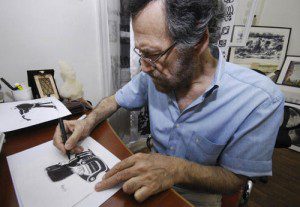
Accepting the award Ali Ferzat said:
Artists are an integral part of any popular revolt. Their work encourages people to participate and take part in the revolution. Artists come from among the people and express their hopes, dreams and struggles.
When an artist becomes the living conscience of his people, he assumes an immense responsibility: everyone looks up to him. The artist needs to keep a compass in his heart and mind to be faithful to his people’s needs. That compass is the affection people have for the artist and the fact they trust him to deliver their human and national message to the world.
For any artist, his compass should be the degree to which people accept and identify with his work, the extent to which he is considered their living conscience; a lamplighter who shines a light on love, humanity and freedom when times are dark and difficult.
Artists know they are following the correct track when the international community and organisations honour their work and acknowledge it, they know they are on the right path towards love, peace and freedom.
Click here to see the full shortlist for the Arts Award