2 Aug 2017 | Index in the Press
Most of the activists who embraced the calls for freedom that resonated across Syria in 2011 were imprisoned, killed or forced into exile before anyone even knew their names. One whose reputation had become known beyond Syria’s borders was Bassel Khartabil Safadi, an Internet pioneer who embodied the hopes of a new generation that technology could be leveraged to build a fairer world. Read the full article
2 Aug 2017 | Index in the Press
A Syrian internet freedom activist was executed soon after he disappeared from prison in late 2015, his wife and supporters say they have learned. Bassel Khartabil’s wife said he was killed in October 2015 after receiving a death sentence. Read the full article
2 Aug 2017 | Campaigns -- Featured, Statements, Syria
[vc_row][vc_column][vc_column_text]
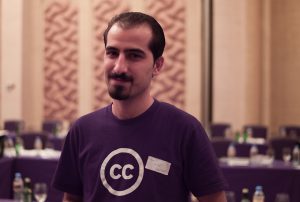
Bassel Khartabil (Photo: Courtesy MIT Media Lab)
The family of Bassel Khartabil, a Syrian-Palestinian software engineer and free speech activist, confirmed that he had been subjected to an extrajudicial execution in October 2015. The undersigned human rights organisations condemn the extrajudicial execution of Khartabil and call for an investigation into the circumstances surrounding his death.
On 1 August 2017, Noura Ghazi Safadi, Khartabil’s wife, announced on Facebook that her husband has been killed. She wrote: “Words are difficult to come by while I am about to announce, on behalf of Bassel’s family and mine, the confirmation of the death sentence and execution of my husband Bassel Khartabil Safadi. He was executed just days after he was taken from Adra prison in October 2015. This is the end that suits a hero like him.”
On 15 March 2012, Military Intelligence arrested Bassel Khartabil and held incommunicado for eight months before moving him to Adra prison in Damascus in December 2012. During this time he was subjected to torture and other ill-treatment. He remained in Adra prison until 3 October 2015, when he managed to inform his family that he was being transferred to an undisclosed location. That was the last time his family heard from him.
His family subsequently received unconfirmed information that he may have been transferred to the military-run field court inside the Military Police base in Qaboun in Damascus. These courts are notorious for conducting closed-door proceedings that do not meet minimum international standards for a fair trial.
Before his arrest, Bassel Khartabil used his technical expertise to help advance freedom of speech and access to information via the internet. He has won many awards, including the 2013 Index on Censorship Digital Freedom Award for using technology to promote an open and free internet, and was named one of Foreign Policy magazine’s Top 100 Global Thinkers of 2012 “for insisting, against all odds, on a peaceful Syrian revolution.”
Since his detention, human rights groups at a national, regional and international level campaigned for his immediate and unconditional release. On 21 April 2015, the United Nations Working Group on Arbitrary Detention declared his detention a violation of the International Covenant on Civil and Political Rights, and called for his release, yet the Syrian authorities still refused to free him.
The signatory organizations express the deepest sorrow at the death of Bassel Khartabil and believe that his arrest and subsequent execution are a direct result of his human rights work and his efforts to promote freedom of speech and access to information.
We urge the Syrian authorities to:
- Immediately disclose the circumstances of the execution of Bassel Khartabil;
- End extrajudicial executions, enforced disappearance, arbitrary arrests, and torture and other ill-treatment;
- Release all detainees in Syria held for peacefully exercising their legitimate rights to freedom of expression and association.
Signed:
1. Access Now
2. Amnesty International (AI)
3. Arab Digital Expression Foundation (ADEF)
4. Arabic Network for Human Rights Information (ANHRI)
5. Article 19
6. Association for Progressive Communications (APC)
7. Cairo Institute for Human Rights Studies (CIHRS)
8. CIVICUS: World Alliance for Citizen Participation
9. Electronic Frontier Foundation (EFF)
10. English PEN
11. Euromed Rights
12. Front Line Defenders (FLD)
13. FIDH, within the framework of the Observatory for the Protection of Human Rights Defenders
14. Gulf Centre for Human Rights (GCHR)
15. Hivos International
16. Index on Censorship
17. Iraqi Network for Social Media (INSM)
18. Lawyers’ Rights Watch Canada (LRWC)
19. Maharat Foundation
20. Metro Centre to Defend Journalists in Iraqi Kurdistan
21. Palestinian Center for Development and Media Freedoms (MADA)
22. PAX for Peace
23. PEN International
24. Reporters without Borders (RSF)
25. Sisters’ Arab Forum for Human Rights (SAF)
26. SKeyes Center for Media and Cultural Freedom
27. Social Media Exchange (SMEX)
28. Syrian Centre for Democracy and Civil Rights
29. Syrian Center For Legal Studies and Researches
30. Syrian Center for Media and Freedom of Expression (SCM)
31. Syrians for Truth and Justice (STJ)
32. Syrian Network for Human Rights (SNHR)
33. Vigilance for Democracy and the Civic State
34. World Organisation Against Torture (OMCT), within the framework of the Observatory for the Protection of Human Rights Defenders[/vc_column_text][/vc_column][/vc_row][vc_row][vc_column][vc_basic_grid post_type=”post” max_items=”12″ style=”load-more” items_per_page=”4″ element_width=”6″ grid_id=”vc_gid:1501752858054-88ccde4a-8e21-0″ taxonomies=”5407″][/vc_column][/vc_row]
2 Aug 2017 | Campaigns, Campaigns -- Featured, Digital Freedom, Digital Freedom Statements, Middle East and North Africa, Statements, Syria
[vc_row][vc_column][vc_column_text]
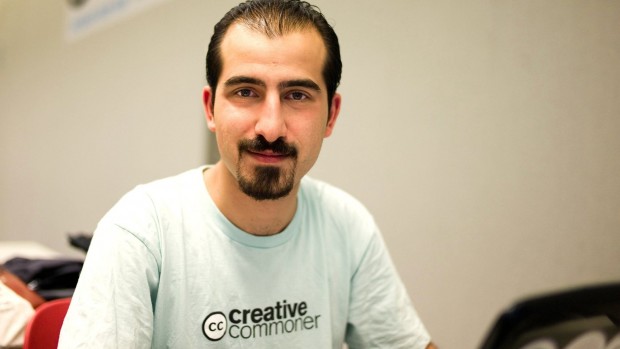
2013 Freedom of Expression Digital Activism Award-winning Bassel Khartabil.
Index on Censorship mourns the death of 2013 Freedom of Expression Digital Activism Award-winning Bassel Khartabil, who had been held Syrian prisons since 2012. His execution by the Syrian government was announced by his wife, Noura Ghazi Safadi, on Tuesday 1 August 2017.
“Bassel was a true inspiration and hero for us all. Index joins with outraged members of the international community to mourn the death of Bassel, who lived and died for his belief in freedom of speech, transparency and a free internet. We extend our deepest condolences to his family,” Melody Patry, head of advocacy, Index on Censorship said.
A Syrian-born Palestinian digital activist, Khartabil (aka Bassel Safadi) worked to build a career in software and web development. Before his arrest, he used his technical expertise to help advance freedom of speech and access to information via the internet. Among other projects, he founded Creative Commons Syria, a non-profit organisation that enables people to share artistic and other work using free legal tools. Khartabil’s digital work is still advancing knowledge: colleagues produced a 3D model of the ancient Palmyra ruins destroyed by Isis using data collected by Khartabil before his detention.
In 2010, Khartabil started Syria’s first hackerspace, Aiki Lab, in Damascus. It was a base from which he helped advance the open source movement in Syria. Khartabil is also known for his work on free culture projects such as Mozilla Firefox, and was an avid contributor and editor to Wikipedia. Prior to his arrest, he was working on software to enable the free flow of information in a country where online communications and networks were closely monitored by the government.
Because of his efforts using technology to promote an open and free internet — especially in Syria, where online censorship is rife — Khartabil won the 2013 Index on Censorship Digital Freedom Award. In 2012, Foreign Policy magazine named him as one of the top 100 global thinkers. In 2015, the Massachusetts Institute of Technology offered him a research scientist position in the Media Lab’s Center for Civic Media.
Detention and death sentence
Syria’s military intelligence illegally detained Khartabil on March 15, 2012. He was held incommunicado in detention for eight months and was subjected to torture and other ill-treatment. He faced military field court proceedings for his peaceful activities in support of freedom of expression. A military judge interrogated Khartabil for a few minutes on December 9, 2012, but he had heard nothing further about his legal case, he told his family later. In December 2012 he was moved to ‘Adra prison in Damascus, where he remained until October 3, 2015, when he was transferred to an undisclosed location. On 12 November 2015, Khartabil’s wife, Noura Ghazi Safadi, reported rumours that her husband had been sentenced to death by the military courts, although the Assad regime never confirmed or denied the reports.
According to anonymous sources, Khartabil’s wife was told that after his disappearance he was tried by a military field court in the military police headquarters in al-Qaboun, which sentenced him to death. Military field courts in Syria are exceptional courts with secret, closed-door proceedings that do not meet international fair trial standards. Defendants have no legal representation, and the courts’ decisions are binding and not subject to appeal. People brought before such courts who were later released have said that proceedings are perfunctory, often lasting only minutes.
Throughout his detention, many human rights groups have campaigned for his release. On 21 April 2015, the United Nations Working Group on Arbitrary Detention declared his detention a violation of the International Covenant on Civil and Political Rights and called for his release.
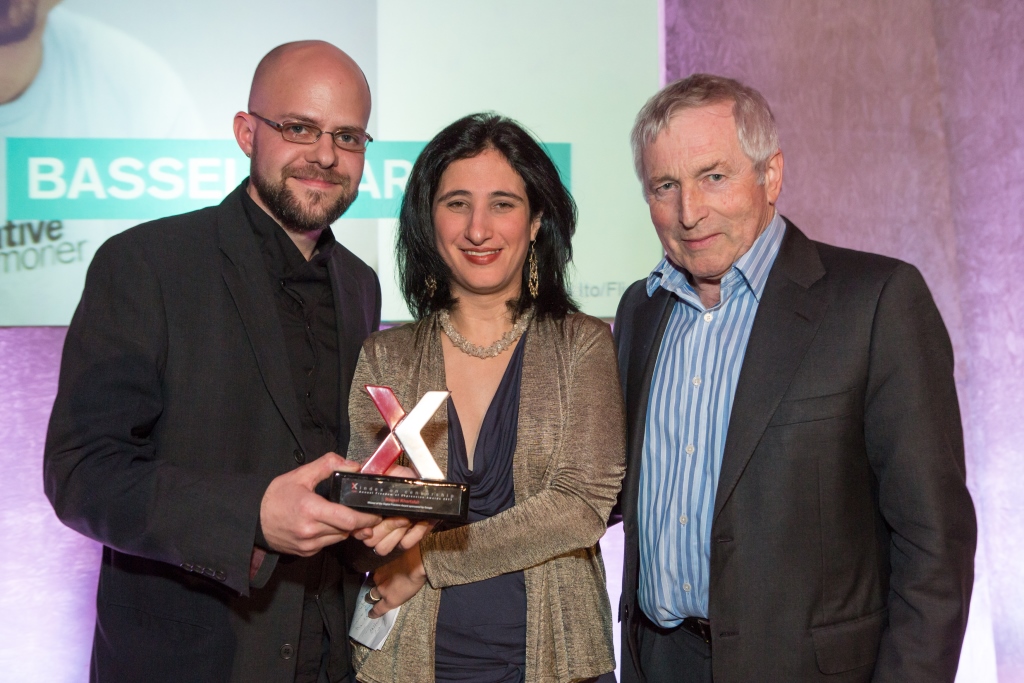
Bassel Khartabil, winner of the 2013 Freedom of Expression Digital Activism Award, was in prison when he won the award. His friends accepted the award on his behalf. From left: Jon Phillips, Dana Trometer and then-chair of Index on Censorship Jonathan Dimbleby.
[/vc_column_text][/vc_column][/vc_row][vc_row][vc_column][vc_basic_grid post_type=”post” max_items=”12″ style=”load-more” items_per_page=”4″ element_width=”6″ grid_id=”vc_gid:1501751147046-a67ad965-0f9f-8″ taxonomies=”5407″][/vc_column][/vc_row]
