16 Dec 2013 | News
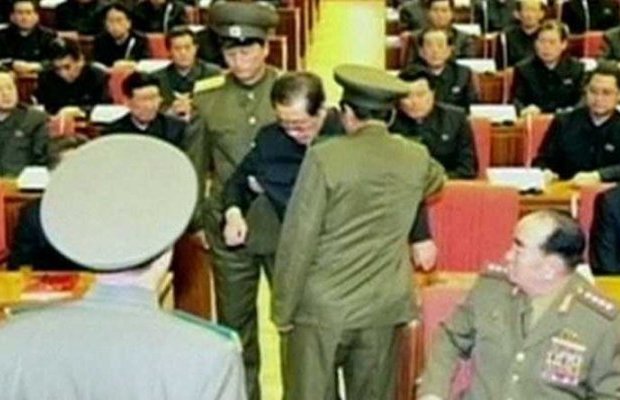 North Korea has expanded its deletion of a few hundred online articles mentioning Jang Song Thaek, the executed uncle of Kim Jong Un, to all articles on state media up to October 2013, numbering in the tens of thousands.
“It’s definitely the largest ‘management’ of its online archive North Korea has engaged in since it went online. No question,” Frank Feinstein, North Korea news analyst, told this writer on Sunday (15 December).
The Korean Central News Agency (www.kcna.kp), the state’s main organ, started publishing in its current online form on 1 January, 2012, and had some 39,000 Korean-language articles by mid-December 2013, with many translated into other languages. “Now however there are now no articles in the archive from prior to October 2013, with everything numbered to around 35,000 – or to October this year – gone,” said Feinstein, director of KCNA Watch, which analyses North Korean media for keywords and converts that into visual data to gauge reporting trends. Similar proportions of deletions were true for Korean Workers’ Party paper Rodong Sinmun and www.uriminzokkiri.com.
Just four days passed from the arrest Kim Jong Un’s uncle Jang, which was televised across North Korea, to his execution on 12 December 12. Thereafter the expurgation of any mention of Jang from the state news files took just hours. Following outages that to seemed affect several state online news sources, of some 550 Jang-related Korean articles on www.kcna.kp, Feinstein estimated that by late Friday, “every single one has either been altered, or deleted, without exception”. This included the most anodyne reports such as a 5 October KCNA story about Kim Jong Un visiting a hospital under construction now reads: “He personally named it ‘Okryu Children’s Hospital’ as it is situated in the area of Munsu where the clean water of the River Taedong flows.” But the original had continued: “He was accompanied by Jang Song Thaek, member of the Political Bureau of the CC, the WPK and vice-chairman of the NDC, and Pak Chun Hong, Ma Won Chun and Ho Hwan Chol, vice department directors of the CC, the WPK.”
Other examples are at the KCNA Watch site, and as also observed by North Korea watcher, Martyn Williams at www.northkoreatech.org.
What’s new about the North’s retrospective media management is its scale and that it’s doing it online, before a global audience. “This is North Korea censoring itself to the world – not just to its own citizens…Personally, I can’t believe they could think they’d get away with this sort of revisionism,” said Feinstein.
Nonetheless, the North can sustain its digital Ministry of Truth antics on the World Wide Web by preventing its output from being indexed. ‘It already works on KCNA – Google can’t index it at all. You can’t even link to an article on KCNA,’ said Feinstein, pointing to Google’s entire, paltry record of KCNA’s office in Pyongyang via this link.
It’s not clear even if South Korean intelligence or news agency Yonhap can archive KCNA’s database in its live form. “While North Korea doesn’t understand much about how to successfully operate online, they do understand this much.”
One theory contends that the North publishes different propaganda for internal and external consumption. For sure, North Korean people can only access news produced by the North Korean state, accessing www.kcna.kp through the country’s intranet, but more likely from the state TV, radio or newspapers on station platform hoardings of which obviously none enable access to digital or visual archives. TV has also been noted as adjusted, with a documentary first shown on 7 October 2013 being reshown on 7 December with Jang cut out of shots by adjusted focus and framing.
The upshot is this: “Our party, state, army and people do not know anyone except Kim Il Sung, Kim Jong Il and Kim Jong Un,” according to the sole English-language article left on KCNA that mentions Jang, a vicious 2,750-word denouncement from 13 December 13. The piece calls Jang “impudent, arrogant, reckless, rude and crafty,” “despicable human scum … worse than a dog,” who, backed by “ex convicts”, had plotted to destroy the economy before “rescuing” the country by military coup and billions earned from hoarded precious metals.
“They are serious about removing him from history,’ said Feinstein, except for passages such as “the era and history will eternally record and never forget the shuddering crimes committed by Jang Song Thaek, the enemy of the party, revolution and people and heinous traitor to the nation,” which concludes the KCNA piece. Meanwhile, “Rodong Simnun no longer knows Jang as anything other than a traitor,” tweeted Korea historian and linguist, Remco Breuker.
Traffic to www.kcna.kp has never been higher, even than for the death of Kim Jong Il, as people now follow stories to the source and are captivated by the apparent novelty of North Korea having an online presence, and one that uses such bizarre language. “Once they find KCNA, there’s no going back.” KCNA’s legitimacy as an analytical source for the North Korean state’s views is oft obscured by its saltier reportage.
Outside news sources are also sensationalist. While most Pyongyang watchers agree Jang was shot dead, Taiwanese news reported he’d been eaten by 120 dogs in front of Kim Jong Un and 300 government ministers in an hour-long death. Feinstein also pointed to a globally syndicated article before Jang’s trial that precipitously claimed www.kcna.kp had cleared out all Jang articles, when in fact articles mentioning Jang were still up. Basically, KCNA “has a bad search function”, said Feinstein.
While the case provides a tantalising view of what the Soviets might have done in the Internet age, it has also pushed out of the headlines another North Korea story, the release of American tourist Merrill Newman who had been held in North Korea since October on charges of “espionage” relating to his military service in Korea during the 1950-1953 war. Newman, who had gone to North Korea as a tourist, said he had not understood quite how far the North Korean state does not consider the war to be over – something arguably partly attributable to the US media barely ever mentioning the conflict, despite the country still being not at peace with North Korea.
Ironically, KCNA Watch has been blocked in South Korea since 25 October. Visitors to the site hit a Korea Communications Standards Commission (KSCS) blocking screen that says “connection to this website you tried to access is blocked as it provides illegal/hazardous information,” under the 1948 National Security Act, which restricts anti-state acts or material that endanger national security, including all printed and online matter from Pyongyang. Civilians seeking to analyse KCNA material in South Korea need official clearance, with the data viewed under armed guard and deleted immediately afterwards, said Feinstein. The block extends to foreign embassies in Seoul and is under increasing criticism as a blanket weapon for stifling dissent. In August the UN special rapporteur on human rights Margaret Sekaggya called it “seriously problematic for the exercise of freedom of expression”.
Sybil Jones
13 Dec 2013 | Europe and Central Asia, News, Russia
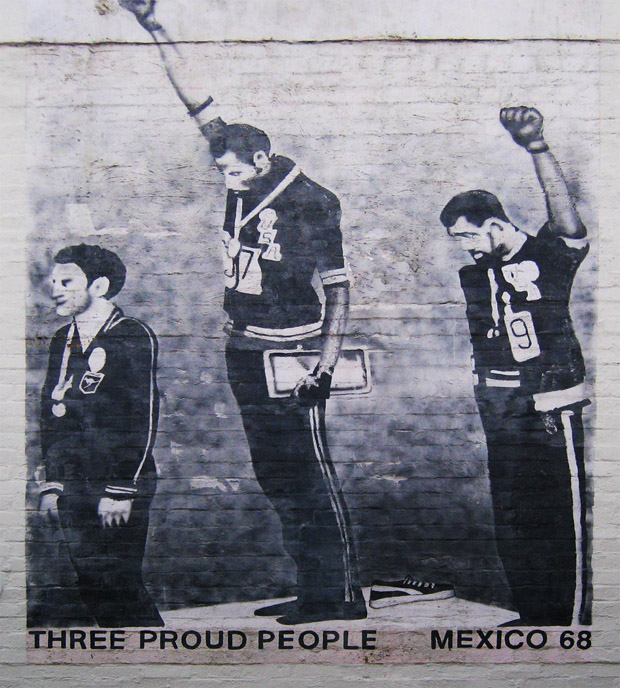
Grafitti of Tommie Smith, John Carlos and Peter Norman showing solidarity for the civil rights movement at the Mexico City Olympics in 1968 (Image: Newtown graffiti/Wikimedia Commons)
Athletes preparing to head off to Sochi Winter Olympics in February, have been reminded that they are barred from making political statements during the games.
”We will give the background of the Rule 50, explaining the interpretation of the Rule 50 to make the athletes aware and to assure them that the athletes will be protected,” said IOC President Thomas Bach in an interview earlier this week. Rule 50 stipulates that ”No kind of demonstration or political, religious or racial propaganda is permitted in any Olympic sites, venues or other areas.” Failure to comply could, at worst, mean expulsion for the athlete in question.
Political expression is certainly a hot topic at Sochi 2014. The games continue to be marred by widespread, international criticism of Russia’s human — and particularly LGBT– rights record. The outrage has especially been directed at the country’s recently implemented, draconian anti-gay law. Put place to “protect children”, it bans “gay propaganda”. This vague terminology could technically include anything from a ten meter rainbow flag to a tiny rainbow pin, and there have already been arrests under the new legislation.
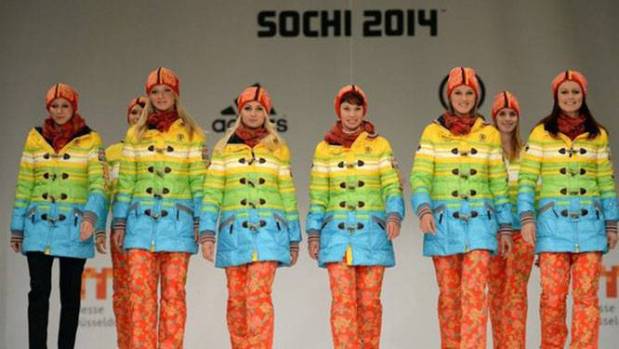
The confusion continued as the world wondered how this might impact LGBT athletes and spectators, or those wishing to show solidarity with them. Russian authorities have for instance warned of possible fines for visitors displaying “gay propaganda”. Could this put the Germans, with their colourful official gear, in the firing line? (Disclaimer: team Germany has denied that the outfits were designed as a protest.)
On the other hand, Russian president Vladimir Putin has promised there will be no discrimination at the Olympics, and IOC Chief Jaques Rogge, has said they “have received strong written reassurances from Russia that everyone will be welcome in Sochi regardless of their sexual orientation.”
On top of this, the IOC also recently announced that there will be designated “protest zones” in Sochi, for “people who want to express their opinion or want to demonstrate for or against something,” according to Bach. Where these would be located, or exactly how they would work, was not explained.
But while the legal situation in Russia adds another level of uncertainty and confusion regarding free, political expression for athletes, rule 50 has banned it for years. And for years, athletes have taken a stand anyway.
By far the most famous example came during the 1968 Olympics in Mexico City — American sprinters Tommie Smith and John Carlos, on the podium, black gloved fists raised in solidarity with the ongoing American civil rights movement. The third man on the podium, Australian Peter Norman, showed his support by wearing a badge for the Olympic Project for Human Rights. All three men faced criticism at the time, but the image today stands out as one of the most iconic and powerful pieces of Olympic history.
However, the history of Olympians and political protest goes further back than that. An early example is the refusal of American shotputter Ralph Rose to dip the flag to King Edward VII at the 1908 games in London. It us unknown exactly why he did it, but one theory is that it was an act of solidarity for Irish athletes who had to compete under the British flag, as Rose and others on his team were of Irish descent.
The Cold War years unsurprisingly proved to be a popular time for athletes to put their political views across. When China withdrew from the 1960 Olympics in protest at Taiwan, then recognised by the west as the legitimate China, taking part. The IOC then asked Taiwan not to march under the name ‘Republic of China’. While considering boycotting the games, the Taiwanese delegation instead decided to march into the opening ceremony with a sign reading “under protest”.
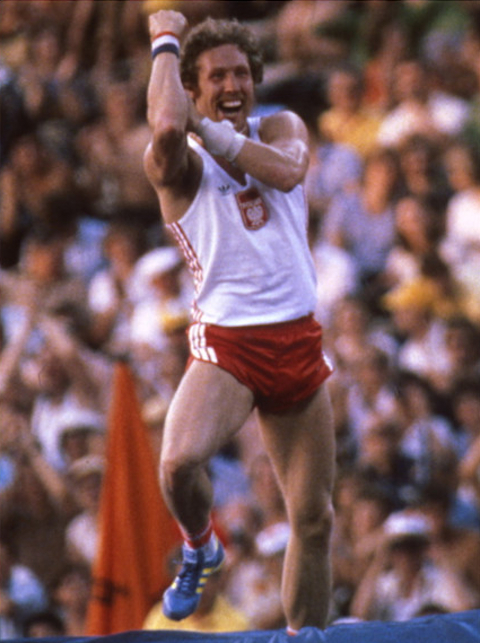
The same year as the Smith and Carlos protest, a Czechoslovakian gymnast kept her face down during the Soviet national anthem, in protest at the brutal crackdown of the Prague Spring earlier that year. And that was not the only act of defiance against the Soviet Union. During the controversial 1980 Moscow Olympics, boycotted by a number of countries over the USSR invasion of Afghanistan, the athletes competing also took a stand. The likes of China, Puerto Rico, Denmark, France and the UK marched under the Olympic flag in the opening ceremony, and raised it in the medal ceremonies. After winning gold, and beating a Soviet opponent, Polish high jumper Wladyslaw Kozakieicz also made a now famous, symbolic protest gesture towards the Soviet crowd.
But there are also more recent examples. At Athens 2004, Iranian flyweight judo champion Arash Miresmaeili reportedly ate his way out of his weight category the day before he was set to fight Israeli Ehud Vaks. “Although I have trained for months and was in good shape, I refused to fight my Israeli opponent to sympathise with the suffering of the people of Palestine” he said. A member of the South Korean football team which beat Japan to win bronze at the 2012 London Olympics, celebrated with a flag carrying a slogan supporting South Korean sovereignty over territory Japan also claims.
When the debate on political expression comes up, the argument of “where do we draw the line” often follows. If the IOC is to allow messages of solidarity with Russia’s LGBT population, should they allow, say, a Serbian athlete speak out against Kosovan independence? Or any number of similar, controversial political issues? Is it not easier to simply have a blanket band, and leave it at that?
The problem with this is, as much as the IOC and many other would like it, the Olympics, with all their inherent symbolism, simply cannot be divorced from wider society or politics. The examples above show this. With regards to Sochi in particular, the issue is pretty straightforward — gay are human rights. Some have argued we should boycott a Olympics in a country that doesn’t respect the Universal Declaration on Human Rights, or indeed the Olympic Charter. This is not happening, so the very least we can is use the Olympics to shine a light on gay rights in Russia. At its core, the Olympics are about the athletes — they are the most visible and important people there. It remains to be seen whether any of them will take a stand for gay rights, outside cordoned-off protest areas, in the slopes and on the rink, where the spotlight shines the brightest. And if they do, they should have our full support.
This article was posted on 13 Dec 2013 at indexoncensorship.org
13 Aug 2013 | In the News
#DONTSPYONME
Tell Europe’s leaders to stop mass surveillance #dontspyonme
Index on Censorship launches a petition calling on European Union Heads of Government to stop the US, UK and other governments from carrying out mass surveillance. We want to use public pressure to ensure Europe’s leaders put on the record their opposition to mass surveillance. They must place this issue firmly on the agenda for the next European Council Summit in October so action can be taken to stop this attack on the basic human right of free speech and privacy.
(Index on Censorship)
CANADA
Censorship Can’t be Our Default Internet Setting
Who should decide what websites you can access online? The answer is obvious: You.
(Huffington Post)
CHINA
What a murder mystery reveals about Chinese censorship
At first glance, the only thing out of place in the photograph of a dim, dingy bedroom in Kabul, Afghanistan, released last week by Xinhua, China’s state-controlled news agency, is the giant fluorescent bulb hanging inexplicably below a gilded, five-branch chandelier. It is not: the room is a crime scene, the place where, this past Thursday, an attack left three Chinese nationals dead and two more people missing.
(The New Yorker)
How Censorship Hurts Chinese Internet Companies
Beijing’s block of Facebook, YouTube, and Twitter has allowed domestic equivalents to grow. But by shunning global markets, their long-term outlook is uncertain.
(The Atlantic)
INDIA
Indian court orders Facebook, Google to offer plans for protecting children
The New Delhi High Court has given Facebook and Google one month to submit suggestions on how minors can be protected online in India.
(Index on Censorship)
Freedom of Expression: Indians are Becoming Increasingly Intolerant
Instead of nurturing the spirit of debate, we have become aggressive, bigoted and abusive
(Forbes India)
TAIWAN
Censorship quietly flourishes amid outrage
Taiwan’s once-famously freewheeling press is becoming more reliant on China as cross-strait cultural and media exchanges grow
(Index on Censorship)
UKRAINE
TVA channel still off the air, censorship suspected
Nearly three weeks after local TVA channel was forced to suspend its broadcast, a group of 28 deputies from local councils of Chernivtsi Oblast asked the National Council on Television and Radio Broadcasting to intervene.
(Kyiv Post)
UNITED KINGDOM
Artificially inadequate: we should never let machines rule on censorship
One of the great irritations about freedom of speech is that the people who demand it most are the ones who deserve it least. The very worst, I reckon, are the oxygen thieves who demand complete freedom for themselves but try to silence others.
(TechRadar)
UNITED STATES
The Business of Financing Hate Groups: Legal to Censor, but Unwise
It’s so tempting to go for the easy answer. Credit card companies are private businesses. They generally have the right, including possibly the First Amendment right, to refuse to deal with anyone. (Exceptions might include a collusive financial blockade of any group, which could violate antitrust law, and of course there are anti-discrimination laws.) That should apply all the more to bigots, right?
(ACLU)
Strip Club Owner Brings Epic Free Speech Fight To The US Supreme Court
The owner of an Albany, N.Y. strip club called Nite Moves has hired one of America’s best free speech lawyers to help him convince the Supreme Court that taxes on lap dances should be illegal, The Daily Gazette reports.
(Business Insider)
Previous Free Expression in the News posts
Aug 12 |Aug 9 |Aug 7 |
Aug 6 | Aug 5 | Aug 2 | Aug 1 | July 31 | July 30 | July 29 | July 26 | July 25 | July 24 | July 23 | July 22 | July 19 | July 18 | July 17
26 Jun 2013 | In the News
INDEX POLICY PAPER
Is the EU heading in the right direction on digital freedom?
While in principle the EU supports freedom of expression, it has often put more emphasis on digital competitiveness and has been slow to prioritise and protect digital freedom, Brian Pellot, digital policy advisor at Index on Censorship writes in this policy paper
(Index on Censorship)
AZERBAIJAN
Tensions between two natural allies
Protesters face an extra three months in prison without trial. Padraig Reidy reports. Members of Azerbaijan’s N!DA Civic movement have been held since the end of March this year. It was confirmed this week that their pre-trial detention is to continue for another three months.
(Index on Censorship)
EUROPEAN UNION
Free expression guidelines a crucial opportunity for EU
As the European Commission opens a consultation on its planned freedom of expression guidelines, Index on Censorship is publishing a public note setting out what it sees as the key principles that must underpin such guidelines.
(Index on Censorship)
INDIA
Tensions between two natural allies
The doctrine of prior restraint and the more potent contempt of court provisions have the potential to disturb the relationship between the judiciary and media
(The Hindu)
ISRAEL
Bill making libel against IDF a crime ‘highly problematic’
The Knesset’s Constitution, Law and Justice Committee on Monday debated the so-called “Jenin-Jenin bill,” which suggests making libelous statements or accusations against the Israel Defense Forces in the media would become a criminal offense.
(Israel Hayom)
LIBYA
Libyan political party officials could face death penalty over election posters
Libyan judicial authorities should immediately drop all criminal charges that violate freedom of speech over election poster cartoons against two Libyan National Party officials, Human Rights Watch said today. Under the laws being applied in this case, the men could face the death penalty over posters their party displayed during the 2012 election campaign for the General National Congress.
(IFEX)
PAKISTAN
‘Solid’ culture policy can help defeat terrorism
The Culture Journalists Forum (CJF) on Monday demanded of the PTI-led Khyber Pakhtunkhwa government to announce a ‘solid and clear’ culture policy, allocate funds for the promotion of art and culture in the province and set up a transparent censorship board to check production of substandard and vulgar Pashto CDs.
(Dawn)
NORWAY
Freedom of Expression Grant to Far-Right Blogger Stirs Debate in Norway
Culture Minister Hadia Tajik supports Freedom of Expression grant for the controversial blogger Peder Nøstvold Jensen, best known by the nickname Fjordman.
(The Nordic Page)
SPAIN
Spain’s Google privacy case “an interference with the freedom of expression”
Should search engines be forced to block results that link to newspaper articles? No, the Advocate General of the European Court of Justice said earlier today, deciding Google need not block “legal and legitimate information that has entered the public domain”. Brian Pellot writes
(Index on Censorship)
TAIWAN
Taiwan: Internet Policy Reforms Spark Fears of Censorship
This spring, the Taiwanese government has proposed multiple amendments to existing laws that could impact free expression online, sparking concern among Taiwanese netizens. While many are comparing the amendments to Chinese-style speech control, others have noted the influence of the United States on the legislation.
(Global Voices Online)
TURKEY
Turkey protests restrict Erdogan’s foreign activism
Expert: Ankara still may act in key regions, including Gaza; twenty arrested in latest raid in Turkey.
(The Jerusalem Post)
EU agrees to reopen Turkey membership talks
The EU agreed to reopen long-stalled talks on Turkey’s EU membership on Tuesday, but not until a later date due to concerns from Germany that it could send the wrong message to Ankara after its tough crackdown on anti-government protests.
(France 24)
UKRAINE
Femen and Facebook in ‘Pornography’ Row over Topless Pictures
Radical feminist group Femen has had two of its Facebook pages blocked by the social networking site because of nudity. The Facebook censors went into action because of the large number of images of Femen activists taking part in topless demonstrations.
(International Business Times)
UNITED STATES
The chilling effects of surveillance
Revelations contained in documents recently leaked to the Guardian by whistleblower Edward Snowden have placed the United States front and centre in the ongoing global debate around mass surveillance.
(Al Jazeera)
Edward Snowden: history will be kind to him
Daniel Ellsberg, the leaker of the Pentagon Papers 40 years ago, was smeared and denounced at the time
(The Guardian)
Have you noticed growing assaults on free speech? Here? And here? And here?
Revelations contained in documents recently leaked to the Guardian by whistleblower Edward Snowden have placed the United States front and centre in the ongoing global debate around mass surveillance.
(Investor’s Business Daily/a>)
Abortion Opponents: ‘Buffer Zones’ At Abortion Clinics Violate Free Speech
The Supreme Court has said it will reconsider the constitutionality of protest zones
(US News and World Report)
Previous Free Expression in the News posts
June 25 | June 24 | June 21 | June 20 | June 19 | June 18 | June 17