Is China’s foreign policy shaped by national public opinion or is the government shaping public opinion to justify its foreign policy?
An interesting new analysis by the Brookings Institute has it that the government is manipulating nationalist sentiment to justify its own foreign policy decisions.
“On foreign policy issues, the Chinese public relies overwhelmingly on the official media for daily information, and the Chinese Communist Party (CCP) and the government plays a central role in determining what information will be available to the public. The Propaganda Department of the CCP is the political center for ideological control and news censorship. It has almost absolute authority over what the public will read and see through its control of the sources of information.”
On key foreign news stories, such as the Egyptian riots, media must use Xinhua wire reports. When the story is even more sensitive, such as disputes in the South China Sea even Xinhua is not to be trusted, it says. All media must use reports straight from the State Council itself.
The angle is carefully chosen to garner the desired response, according to the Institute.
“For example, Chinese media reports on the domestic turbulence in Libya and Syria in 2011 rarely focuses on the governments’ authoritarian records, human rights violations, or corruption. Instead, following China’s foreign policy principles, Chinese media spent most volume on the negative aspects of domestic instability and the danger of foreign intervention.”
The web, while having a little more leeway, is also heavily screened.
“Most discussion on the internet in China is carefully screened, and much of it is pre-approved, by the government―including inflammatory comments and nationalistic criticisms about foreign policy issues. If it wished to, therefore, the government could shape and influence the direction of the internet content and netizens’ discussions to tone down nationalistic sentiment. The fact that it does not in many cases raises the question not about its ability, but its intentions.”
As examples of how it has manipulated foreign news in the past, it picks out the Dalai Lama’s visit to the US in 2010 and American arms sales to Taiwan in the same year. The government knew about the visit and the sales months before, “yet when they were officially announced, Beijing responded in a ferocious manner. Harsh official statements were applauded and echoed by an even more agitated public, which in its more extreme examples called for sanctions on American companies and even a military confrontation with the United States.”
It could have handled the issues in a much more conciliatory way, it argues.
“The fact that it did not revealed several things,” it says. Firstly, it was enjoying its bigger role on the international stage due to its economic growth. And, “it saw public opinion as a useful tool to show Washington how angry the Chinese people are and how severe the consequences could be. Beijing might have a point when saying it had to answer to the public sentiment at home, but such a sentiment was at least in part its own creation to begin with. Public opinion was more instrumental than original in this case.”
The Chinese government appeals to nationalism as a way to “reaffirm its legitimacy in the eyes of the people,” given there are no free and fair elections in the country. It’s also a tool to bargain “concessions from foreign governments.”
Don’t jump too quickly to say Beijing is listening to its people, it warns. It’s much more likely that the people have been manipulated into saying what Beijing wants them to say.
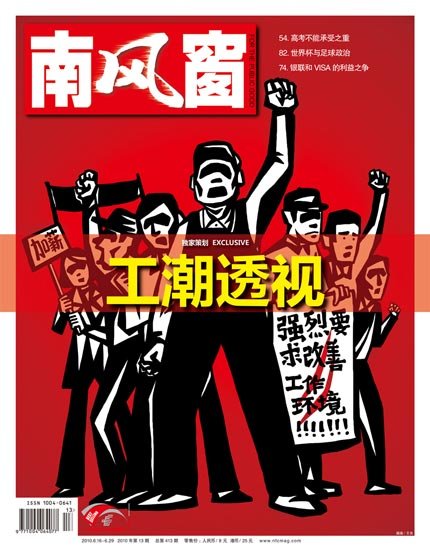
The suspension of one of China’s top editors, Zhao Lingmin, who has worked for seven years at one of the major magazines in the industry, Window on the South, has gripped the Chinese press who are concerned that media freedoms are being curbed.
Zhao spoke exclusively to Index on Censorship. She noted that even in the haven of China’s most liberal media, the southern province of Guangdong, where Window on the South is based, media regulations are tightening. “Looking at the individual cases, it seems definite that the press here is not as free as before”, Zhao said.
Window on the South is under the control of the local propaganda bureau of Guangdong. Every province in China has a propaganda bureau with its own level of severity when it comes to controlling media. For a long time the south had exemplified how liberal Chinese media could be –– Barack Obama gave an exclusive interview to a paper in the region upon his visit in 2009.
What got Zhao Lingmin in hot water? She was responsible for an article called “China Has Risen, We Must Say Goodbye to the Foreign Policy of Revolution”, which took the words of a Taiwan historian to explain the Xinhai Revolution of 1911 and presented Sun Yat-sen, the founder of modern China, as a warmonger. The Communist Party has always maintained Sun Yat-sen as a figure who supported communism and started what communists now term as the beginning of “New China”, a definitive break from the past. In all communist history, Sun Yat-sen is lauded as a “Founding Father” figure even though he was a Nationalist. Smearing him, or perceived smearing, is not a smart move.
Even though it’s something that Zhao had been prepared for — she knew the risks of working in the media in China —this time it’s serious. Even before she was suspended, there were changes within the editorial department. “Our magazine has persistently cultivated an independent spirit. But the editor-in-chief was replaced by someone who headed a newspaper in nearby Dongguan, and didn’t know much apart from Dongguan. This is the first time that both the editor-in-chief and the president (previously Chen Zhong) of the magazine were both selected by the top.”
The other thing that Zhao Lingmin was punished for was to interview a Taiwanese historian, Tang Chi-hua. When the article was published she was told that it had “fundamental problems.” Zhao does not agree with this point of view, obviously. She says the majority of intellectuals in Mainland China agreed with what the Taiwanese professor said.
However, the Guangdong Propaganda Department didn’t see it that way. Zhao needs to be reinstated before long, but she is optimistic about one thing: “I have only left temporarily. My name is still on the masthead.” There is hope, after all.
Zhao spoke exclusively to Index on Censorship. She noted that even in the haven of China’s most liberal media, the southern province of Guangdong, where Window on the South is based, media regulations are tightening. “Looking at the individual cases, it seems definite that the press here is not as free as before”, Zhao said.
Window on the South is under the control of the local propaganda bureau of Guangdong. Every province in China has a propaganda bureau with its own level of severity when it comes to controlling media. For a long time the south had exemplified how liberal Chinese media could be –– Barack Obama gave an exclusive interview to a paper in the region upon his visit in 2009.
What got Zhao Lingmin in hot water? She was responsible for an article called “China Has Risen, We Must Say Goodbye to the Foreign Policy of Revolution”, which took the words of a Taiwan historian to explain the Xinhai Revolution of 1911 and presented Sun Yat-sen, the founder of modern China, as a warmonger. The Communist Party has always maintained Sun Yat-sen as a figure who supported communism and started what communists now term as the beginning of “New China”, a definitive break from the past. In all communist history, Sun Yat-sen is lauded as a “Founding Father” figure even though he was a Nationalist. Smearing him, or perceived smearing, is not a smart move.
Even though it’s something that Zhao had been prepared for — she knew the risks of working in the media in China, where she has worked for seven year —this time it’s serious. Even before she was suspended, there were changes within the editorial department. “Our magazine has persistently cultivated an independent spirit. But the editor-in-chief was replaced by someone who headed a newspaper in nearby Dongguan, and didn’t know much apart from Dongguan. This is the first time that both the editor-in-chief and the president (previously Chen Zhong) of the magazine were both selected by the top.”
The other thing that Zhao Lingmin was punished for was to interview a Taiwanese historian, Tang Chi-hua. When the article was published she was told that it had “fundamental problems.” Zhao does not agree with this point of view, obviously. She says the majority of intellectuals in Mainland China agreed with what the Taiwanese professor said.
However, the Guangdong Propaganda Department didn’t see it that way. Zhao needs to be reinstated before long, but she is optimistic about one thing: “I have only left temporarily. My name is still on the masthead.” There is hope, after all.
Of all the contentious cultural material China’s censors could crack down on, an inoffensive 1990s boy band ballad seems like an odd option.
China’s Ministry of Culture this week issued a new blacklist of 100 songs including the innocuous I Want it That Way by the Backstreet Boys, Katy Perry’s Last Friday Night and Beyonce’s Run the World (Girls). Although the majority of the blacklisted tunes came from Taiwan or Hong Kong, Lady Gaga leads the pack with a total of six banned tracks: The Edge of Glory, Hair, Marry the Night, Americano, Judas and Bloody Mary. Music websites must remove by 15 September or face prosecutions.
There is still no word on whether Guangzhou’s very own Back Dorm Boys have also been blacklisted.