3 Mar 2023 | FEATURED: Francis Clarke, News, Ukraine
You are handed a piece of paper as you enter the room. Move around, come up close, move away, sit down, do what you want; it instructs. All it asks is you be present together (and, naturally in the modern age, turn off your mobile phone).
Eventually everybody pulls up a chair, but the conformity of the audience doesn’t extend to the performance. A mixture of song, dance, poetry and performance art, Bunker Cabaret is a creative explosion.
Performed at Somerset House in Central London by the Hooligan Art Community, Bunker Cabaret is billed as an “exploration of love versus totalitarianism, and the personal conflicts of making art in time of war.” Formed in Kyiv in 2019, two of its male actors, Sam Kyslyi and Danylo Shramenko, developed scenes in a bomb shelter in the city, which would become the inspiration for the show. Leaving Ukraine, they were joined later by other members including Mirra Zhuchkova, who earlier escaped to Germany.

Photo by Steve Tanner
Bunker Cabaret opens with Kyslyi stood on a bed of fairy lights, interspersing elegant dancing with shadow boxing. The fusing of beauty with brutality, which one would imagine was how the seeds of the show were sown, is evident.
The audience is dropped into an animated conversation between Kyslyi and Shramenko. Almost childlike, it’s a game of “guess this noise”, which seems innocent enough until the correct answers compose of weaponry and warcraft. The lived experience of being trapped in a war zone is conveyed by the ability to note the difference in sound between a MiG-29 and a MiG-31.
A series of monologues are performed, including from Zhuchkova. Hers are dreamlike, almost abstract (and nightmarish), perhaps reflecting the pain of being torn away from home, and the hope of one day returning. The sound of fireworks punctuates the end of her final speech, with a strong, unifying gesture for each person in the audience. Kyslyi’s monologues are more real and descriptive of his experience, often resulting into a burst of song at the end.
Loud traffic passes outside the large windows of the room, where people could easily peek inside. This seems like a conscious decision, and like the instructions given at the start, the audience and environment play a part of the performance just as much as the actors in the room.
Ukrainian artists have been targeted since the Russian occupation and assault began. The attacks on Kyiv killed Artem Datsyshyn, the principal dancer of the National Opera of Ukraine, and the famous actress Oksana Shvet. Musicians, painters and photographers are among those killed so far; an attempt to erase Ukraine’s cultural and artistic contributors.
Despite being under attack, closed Ukrainian cultural institutions have started to programme again. Several branches of the National Art Gallery in Lviv reopened, as well as The Theater on Podil in Kyiv. Still, the circumstances for art and artists in Ukraine remains challenging.
Bunker Cabaret is not a conventional performance, but neither are the circumstances that brought it to Somerset House. It’s a paean to the fortitude of art in the hardest of conditions.
Bunker Cabaret is currently on a UK tour. Dates and ticket details are here.
24 Feb 2023 | Ruth's blog
One year ago we all watched in horror as Putin’s Russia initiated an all out invasion of Ukraine. The people of Ukraine did nothing to initiate this war, they did not choose violence, but every family is now paying the price for this Putin’s aggression. Ukrainian families are divided, spread throughout Europe. People are traumatised, they have lost loved ones and too many live under perpetual fear of the next Russian onslaught.
The UN believes that over 8,000 Ukrainian civilians have been killed in the last year, with thousands more hurt as the Russians bombard urban areas. And as they defend themselves against Russian aggression every person able to fight has joined the military – everyone is on the frontline.
I make no apologies for standing with the people of Ukraine, for supporting Nato’s efforts to support the Ukrainian military as they seek to defend their people and their homes. As US president Joe Biden made clear this week this war is now the frontline in the battle of autocrats versus democrats. And I, like you, am a democrat.
Twelve months on there are so many stories, of death, of heartbreak but also of inspirational acts from people who never expected to be on the frontline. As ever it is their stories which we should tell, it’s their pain we should mark and their losses which we share. It is their stories which should feature this week and every week – until Ukraine is free.
In the midst of war, however, it is easy to forget the dissidents, the people who are adamant that Putin doesn’t act in their name, the people whose actions will hopefully one day lead to peace. In the heat of war, whilst living under an authoritarian regime, it requires a significant level of bravery to speak out – to challenge your government, to oppose military action. Today’s stats tally 19,586 people who have been arrested across the Russian Federation for protesting the war.
Index was founded to provide a platform for Soviet dissidents over 50 years ago at the height of the Cold War. Our raison d’etre is to provide a voice for the persecuted, a place where the brave and the disillusioned can tell their stories, to help dissidents who live in authoritarian regimes. The last year has taken my team and I full circle, reminding us of our roots and ensuring that we keep striving to promote and protect the right of freedom of expression in totalitarian regimes.
Today we remember those that have paid the ultimate sacrifice to defend their country, the civilians who have been caught in the crossfire and those brave dissidents who in the direst of circumstances keep trying to speak truth to power.
Slava Ukraini
27 Jan 2023 | FEATURED: Martin Bright, Index Arts, News, Russia, Ukraine, Uzbekistan, Uzbekistan
The title of the play Crimea, 5am refers to the time in the morning the authorities choose to raid the homes of activists in the Russian-occupied territory. It is a time of fear and horror for the Crimean Tatars whose voices make up the text of this verbatim play, taken from the testimonies of the men now held in Putin’s prisons and the families waiting at home for them.
Crimea 5am brings to life one of the lesser-known aspects of the brutal war in Ukraine, which began not in February 2022 but in March 2014. It draws on the oral history of the suppression of the Tatar Muslim minority, who returned to the peninsula in the 1990s following independence after years of exile from their homeland.
Much of what we know of life in Crimea since 2014 has come from activists turned citizen journalists. This is one of the reasons the Russian authorities have cracked down so hard on Tatars, characterizing them either as political extremists or Islamist terrorists linked to the group Hizb-ut-Tahrir.
Two examples from the play show how ordinary Tatars went from being activists, to journalists to dissidents in the face of Russian repression.
Tymur Ibrahimov, 38, moved back to Crimea from Uzbeksitan at the age of six in 1991 after the death of his father. In the play, his wife Diliara, explains his transformation from computer repairman to enemy of the state: “It used to be different, until 2014, you know, back then he would make home videos, he would take pictures of nature, like, of the bees and butterflies on flowers, just like that. It all changed in 2015 and he began making footage of what was going on in Crimea. That is, all the searches, court hearings, “Crimean Solidarity” meetings.” For the crime of recording the resistance of his people Tymur was sentenced to 17 years in prison.
Narminan Memedeminov, 39, also moved back to Crimea from Uzbekistan in 1991. After graduating in economics he became involved in human rights activism and media coordinator for the Crimean Solidarity movement. “Here’s an example: I went and took a video of somebody helping out a prisoner’s family, like, basic stuff, they would take the child to the hospital, help them hang the wallpaper, fix the plumbing, send off the parcels to the detention centre and so on… And in the end, everybody involved was at risk: those who took videos, those who helped, those who did anything at all.”
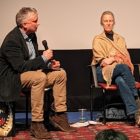
Index editor at large Martin Bright (left) taking part in a post-play discussion.
The stories have been brought together by two Ukrainian writers, Natalia Vorozhbyt and Anastasiia Kosodii and the project is backed by the Ukrainian Institute and the Ukrainian Ministry of Foreign Affairs as a way of bringing the situation to international attention. I had the privilege of watching a reading of of the play at the Kiln Theatre, Kilburn in London last week with professional actors alongside non-professional activists and supporters. Directed by Josephine Burton and produced by Dash Arts, the play focuses on the domestic lives of the families of the Tatar political prisoners and particularly the women.
Burton told Index that until the 2022 Russian invasion of Ukraine, Crimea has drifted from international attention. “Helped by a media blackout, we forgot that the peninsula has been occupied by Russians for almost nine years now and its Tatar community oppressed,” she said. “Determined to fight this silence, the community has relentlessly documented this oppression – filming and uploading searches, arrests and court cases of its people by the Russian Security Forces. And for this act, these “Citizen Journalists” have been arrested themselves and given insanely long sentences, some for up to 20 years in penal colonies.”
Crimea 5am focuses on the everyday lives of Tatar dissidents, drawn from many hours of recordings with the families of 11 political prisoners. “It builds a beautiful and powerful portrait of a community, ripped apart by this tragedy, but also woven with stories of love and resilience through the prism of the wives left behind. It is this mix of tenderness and humour alongside the unfathomable darkness which enables its impact. We the audience become invested in their lives and feel the impact of their tragedy deeply.”
Dash Arts is looking for further opportunities to perform Crimea 5am: https://www.dasharts.org.uk/
25 Jan 2023 | FEATURED: Jemimah Steinfield, News
In the aftermath of her murder in 2017, the family of Maltese journalist Daphne Caruana Galizia found themselves embroiled in a nasty battle with a London law firm. Dubbed a “one-woman Wikileaks” for her exposures of corruption among Malta’s elite Caruana Galizia had faced 42 civil libel cases and five criminal libel cases while alive. These cases passed posthumously to her family. One of them came from a company that had headquarters in London, meaning they could bring legal action there.
“It was like falling further into a pit,” her son Matthew told me over the phone from Malta. “I never imagined I’d be battling these [legal threats]. Everything that could happen to make the situation worse did happen,” he said.
The UK’s libel laws are notoriously open to abuse (as was reported by openDemocracy yesterday) – and London law firms have been at the beck and call of the powerful worldwide. Cases like Caruana Galizia’s have a name – SLAPPs. An acronym for “strategic lawsuits against public participation”, these heavy-handed legal actions seek to intimidate and deter journalists. Their purpose is not to address genuine grievances but to drain targets of as much time, money and energy as possible in an effort to silence them – and to dissuade other journalists from similar investigations.
The laws are also known to be claimant-friendly, especially those in England and Wales where the burden of proof required from a publisher is enormous, often impossible, effectively meaning the accused is guilty until proven innocent. It’s this quirk, combined with exorbitant fees for both parties, which has made London a SLAPPs breeding ground. A 2020 survey of reporters across 41 countries found the UK was the source of 31% of legal threats against journalists. The USA, by contrast, accounted for 11%, and all EU countries combined for 24%.
But the loopholes in UK law might be closing, finally starving firms that have grown fat on oligarchs’ money. A set of reforms were announced last summer that seek to limit the impact of SLAPPs. The reforms are twofold: first, stop cases before they get to court through a series of tests. Do they go against activity in the public interest, for example? If so, throw them out. Next, cap fees for those cases that do make it through.
Half a year on we are still waiting for reforms that, frankly, can’t come fast enough. SLAPPs have long cast a dark shadow over the UK’s media and publishing landscape. 2022 alone saw the climax of big legal actions against Guardian and Observer journalist Carole Cadwalladr, who was taken to court by multimillionaire Brexit backer Arron Banks as a result of a comment she made on a TEDTalk in Canada, FT journalist Tom Burgis, author of Kleptopia: How Dirty Money is Conquering the World, which led to defamation charges by Kazakh mining giant ENRC, and former Reuters journalist Catherine Belton, who was sued over a number of matters in her book Putin’s People: How the KGB took back Russia and then took on the west, by multiple Russian billionaires, including Roman Abramovich.
Neither Burgis’ nor Belton’s cases made it to a full trial. Burgis’ was dismissed by a judge, while Belton settled after revisions were made to her book. Cadwalladr was less lucky. A trial at London’s High Court took place. At the time she said she feared losing her home and bankruptcy. She managed to crowdfund nearly £600,000 to cover costs, and the judgement ruled in her favour in June (although Banks has since been granted permission to appeal).
Yet even these victories are Pyrrhic ones. In a testimony given in the UK’s House of Commons after his case was dropped, Burgis said: “There is money that will not be got back that could have been spent on other books.”
He added:
“There is always a danger, as I know from conversations with colleagues, that you become an expensive and problematic journalist. In an era when the newspaper business model remains broke and oligarchs are amassing more and more wealth, this inequality of arms is extraordinary.”
Out of the spotlight plenty more battle away, ones with far less funding and backing. Journalists at Swedish business and finance publication Realtid, for example, were recently sued in London in connection with their investigation into the financing of energy projects involving a Swedish businessman. Faced with the prospect of financial ruin, just last week, on 13 January, it was announced that they had settled out of court, on condition that they published an apology.
It’s not just the personal toll on these journalists that is deeply concerning; it’s the industry-wide cost. Fear of legal threats is as damning as the threats themselves. Like the guillotine in revolutionary France, it hovers overhead. Do you meet with the whistleblower whose story might land you a Pulitzer, but also might land you in court? I’ve spoken to editors at desks who have become too scared to touch certain topics; a single strongly-worded letter from a minted London law firm is all it takes to spike an article. A top journalist in the UK, now in his 60s who has reported all over the world, told me that he’s never operated in a more fearful media environment than this. Covering your back is exhausting and the risk of humiliation high too. It demands nerves of steel and a sizeable chunk of liability insurance to boot. Young journalists, small media outfits and freelancers are basically counted out.
How many stories have never seen the light and what information are British readers being deprived of? Speaking at a House of Lords Committee back in April, Thomas Jarvis, legal director at Harper Collins, said the publisher regularly avoids publishing information in books in the UK that would be included in international editions because “the risk of publication in the UK is far greater”. This came from the publisher behind both Belton and Burgis’ books, with a proven record to take risks.
Burgis told me that he feels “incredibly lucky to have been backed so bravely” by his publishers. At the same time he’s angry about “all the information of vital public interest that gets suppressed because there is often today such inequality of arms between journalists (incredibly poor) and the powerful (increasingly rich).”
There’s now a real opportunity for change. The war in Ukraine catapulted SLAPPs to the forefront. With some cases being brought by oligarchs and kleptocrats with links to Putin, there has never been a less fashionable time to be a claimant. The UK also has a new head of state and a new prime minister. What better way to show their commitment to democracy than by closing the legal loopholes.
The tide has been turning against SLAPPs for some time. In early 2021, the UK Anti-SLAPP Coalition emerged, made up of NGOs, individual campaigners and lawyers, co-founded and led by Index. It helped pave the wave for the proposed legislation. Through the coalition’s efforts and a changing international landscape British MPs have started to take SLAPPs seriously. So why not push this legislation across the finish line? Today it stubbornly remains just a proposal, rather than a reality. And, speaking to Gill Phillips, director of editorial legal services at the Guardian, she confirmed some of my fears if it does get passed – namely the devil will be in the detail – and the detail has yet to be finessed. No “definition” of public interest, for example, has been provided. Nor is there a clear definition of what constitutes a SLAPP. This might appear like semantics, but in the case of Cadwalladr the judge didn’t deem the case as SLAPP, a judgment that perplexed many.
Still, all those involved in the Coalition welcomed the proposals when they were first mooted, as did Matthew Caruana Galizia.
“What the government is doing is putting a flag up a pole” he said. He thinks the proposals are good and if passed will improve the situation. He adds though that “we can go further”.
“I say ‘we’ not as a UK citizen – I’m a citizen of Malta – but ‘we’ because ‘we’ all suffer as a result of what the British courts allow. They’ve become a platform to stop investigative journalism.”
Let’s dismantle this platform in 2023. It’s high time to end the trial of media freedom.
