1 Mar 2017
[vc_row equal_height=”yes” css=”.vc_custom_1487955099221{margin-right: -15px !important;margin-left: -15px !important;}”][vc_column css=”.vc_custom_1487955108553{margin-right: 15px !important;margin-bottom: 15px !important;margin-left: 15px !important;background-color: #ffffff !important;}”][vc_custom_heading text=”DEFEND MEDIA FREEDOM” font_container=”tag:h1|text_align:center” use_theme_fonts=”yes”][vc_custom_heading text=”SUPPORT INDEX ON CENSORSHIP” font_container=”tag:h1|text_align:center” use_theme_fonts=”yes”][vc_column_text]
Reporters working to share the truth are being harassed, intimidated and prosecuted – across the globe.
Index on Censorship is a nonprofit fighting against these corrosive attacks on press freedom.
Index documents threats to media freedom in Europe via a monitoring project and campaigns against laws that stifle journalists’ work.
[/vc_column_text][/vc_column][/vc_row][vc_row][vc_column width=”1/3″][staff name=”Mapping Media Freedom” title=”Documenting threats to the press in Europe and neighbouring countries” profile_image=”85817″]Mapping Media Freedom – a major Index on Censorship project and a joint undertaking with the European Federation of Journalists, partially funded by the European Commission – covers 42 countries, including all EU member states, plus Bosnia, Iceland, Kosovo, Macedonia, Montenegro, Norway, Serbia, Turkey, Albania along with Ukraine, Belarus, Russia, and Azerbaijan. The platform was launched in May 2014 and has recorded over 3,900 incidents threatening media freedom.
“The precarious state of press freedom across the globe is underlined by the volume of verified incidents added to Mapping Media Freedom in 2017. The spectrum of threats is growing, the pressure on journalists increasing and the public right to transparent information is under assault. People who are simply trying to do their job are being targeted like never before. These trends do not bode well for 2018.” — Joy Hyvarinen, Index on Censorship head of advocacy[/staff][/vc_column][vc_column width=”1/3″][staff name=”Changes to the Official Secrets Act” title=”Proposals to update spy laws a threat to journalism” profile_image=”81191″]Proposed legislation that could see journalists and whistleblowers sentenced up to 14 years for leaking official documents has no place in a democracy. The proposals were drawn up by the Law Commission as part of a review of the Official Secrets Act and would cover any data that affects the UK’s national and international interests, including economic interests. The public’s right to know about the Brexit negotiations, for instance, could be put into jeopardy if these proposals were brought into force.
“It is unthinkable that whistle blowers and those to whom they reveal their information should face jail for leaking and receiving information that is in the public interest. It is shocking that so few organisations were consulted on these proposed changes.” — Jodie Ginsberg, CEO, Index on Censorship[/staff][/vc_column][vc_column width=”1/3″][staff name=”Section 40, Crime and Courts Act” title=”Section 40 would allow the corrupt to silence investigative journalists” profile_image=”85827″]Section 40 is part of the Crime and Courts Act 2013, which deals with a whole range of issues but also implemented some of the recommendations contained in the Leveson Report into phone hacking by newspapers. Index on Censorship strongly opposes the introduction of section 40.
Section 40 addresses the awarding of costs in a case where someone makes a legal claim against a publisher of “news-related material”. The provision means that any publisher who is not a member of an approved regulator at the time of the claim can be forced to pay both sides’ cost in a court case — even if they win.
“If such laws were introduced in another country, British politicians would be speaking out against such shocking media censorship.” — Rachael Jolley, editor, Index on Censorship magazine[/staff][/vc_column][/vc_row][vc_row equal_height=”yes” css=”.vc_custom_1474531377622{margin-right: -15px !important;margin-left: -15px !important;}”][vc_column width=”1/3″ el_class=”text_white” css=”.vc_custom_1487957370833{margin-right: 15px !important;margin-bottom: 15px !important;margin-left: 15px !important;background-color: #f21400 !important;}”][vc_column_text]
A gift of £20
ensures a verified attack is mapped publicly
[wpedon id=100537]
[/vc_column_text][/vc_column][vc_column width=”1/3″ el_class=”text_white” css=”.vc_custom_1487957380442{margin-right: 15px !important;margin-bottom: 15px !important;margin-left: 15px !important;background-color: #f21400 !important;}”][vc_column_text]
A gift of £100
enables an official report to pressure governments
[wpedon id=100538]
[/vc_column_text][/vc_column][vc_column width=”1/3″ el_class=”text_white” css=”.vc_custom_1487957389388{margin-right: 15px !important;margin-bottom: 15px !important;margin-left: 15px !important;background-color: #f21400 !important;}”][vc_column_text]
A gift of £1000
supports extensive fieldwork to identify and confirm reported violations
[wpedon id=100539]
[/vc_column_text][/vc_column][/vc_row][vc_row css=”.vc_custom_1474531692548{margin-top: 30px !important;margin-bottom: 30px !important;}” el_class=”mw700″][vc_column][vc_column_text]
UK donors can also give to Index on Censorship by making a bank transfer.
Sort Code: 16-58-10 Account number: 20110063
Outside the UK and cannot access Paypal? Please email [email protected]
[/vc_column_text][vc_column_text]
If you are a US donor and would like more information about tax deductible charitable giving to Index, please contact [email protected]. Index works with CAF American Donor Fund.
[/vc_column_text][/vc_column][/vc_row][vc_row equal_height=”yes” content_placement=”middle” css=”.vc_custom_1487172040880{margin-top: 15px !important;margin-right: 0px !important;margin-bottom: 15px !important;margin-left: 0px !important;background-color: #ee3424 !important;}” el_class=”text_white”][vc_column width=”1/2″ css=”.vc_custom_1478508145989{padding-top: 60px !important;padding-bottom: 60px !important;background: #000000 url(https://www.indexoncensorship.org/wp-content/uploads/2012/01/art-and-the-law-banner.jpg?id=80742) !important;background-position: center !important;background-repeat: no-repeat !important;background-size: cover !important;}”][vc_row_inner][vc_column_inner][/vc_column_inner][/vc_row_inner][/vc_column][vc_column width=”1/2″ css=”.vc_custom_1474534568795{padding-top: 0px !important;padding-bottom: 0px !important;}”][vc_custom_heading text=”Sponsor the Awards” font_container=”tag:h2|font_size:24|text_align:left” use_theme_fonts=”yes”][vc_column_text]If you would be interested in sponsorship – including sponsorship of our Digital and Arts Awards – please contact Helen Galliano – [email protected][/vc_column_text][/vc_column][/vc_row][vc_row equal_height=”yes” content_placement=”middle” css=”.vc_custom_1487172040880{margin-top: 15px !important;margin-right: 0px !important;margin-bottom: 15px !important;margin-left: 0px !important;background-color: #ee3424 !important;}” el_class=”text_white”][vc_column width=”1/2″ css=”.vc_custom_1487609489413{padding-top: 60px !important;padding-bottom: 60px !important;background: #ffffff url(https://www.indexoncensorship.org/wp-content/uploads/2016/11/2017-awards-logo-white.jpg?id=85472) !important;background-position: center !important;background-repeat: no-repeat !important;background-size: contain !important;}”][vc_row_inner css=”.vc_custom_1487609333823{background-position: center !important;background-repeat: no-repeat !important;background-size: contain !important;}”][vc_column_inner][/vc_column_inner][/vc_row_inner][/vc_column][vc_column width=”1/2″ css=”.vc_custom_1474534568795{padding-top: 0px !important;padding-bottom: 0px !important;}”][vc_custom_heading text=”Freedom of Expression Awards 2017″ font_container=”tag:h2|font_size:24|text_align:left” use_theme_fonts=”yes” link=”url:https%3A%2F%2Fwww.indexoncensorship.org%2F2016%2F11%2Fawards-2017%2F|||”][vc_column_text]Celebrate the courage and creativity of some of the world’s greatest journalists, artists, campaigners and digital activists[/vc_column_text][/vc_column][/vc_row]
28 Feb 2017 | Index Reports, Mapping Media Freedom, Press Releases
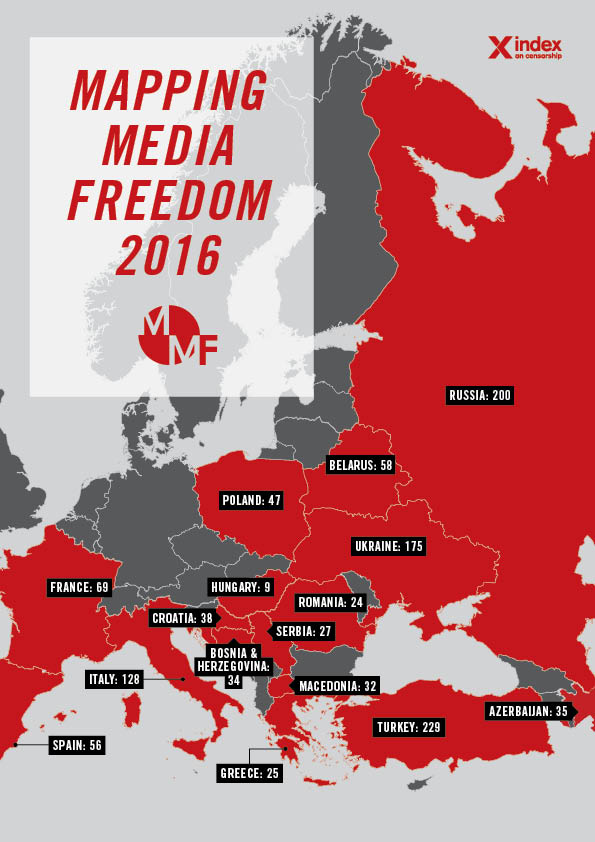 Freedom of expression campaign group Index on Censorship launches Media Freedom Month in March with the release of its annual report into media freedom in Europe. The report shows journalists face regular harassment, legal sanctions and even jail for doing their job – even in supposed democracies. Index’s Media Freedom Month aims to raise awareness of and funding for its work campaigning on press freedom.
“Right now, journalists and journalism are threatened from all directions: UK journalists who travel to the US are being told they need to hand over their mobile phone contacts and Facebook passwords. US journalists are being labelled as peddlers of ‘fake news’ over any articles the President dislikes and reporters across Europe face a host of laws that hamper their ability to work,” said Index chief executive Jodie Ginsberg.
Media Freedom Month will begin with the launch on Tuesday of the latest Mapping Media Freedom report on Europe and will end with an exclusive study of media freedom in the United States that goes well beyond the current focus on Donald Trump and his relationship with the press.
“A country without a free media is not a free country: Journalism provides a vital check on corruption and abuse of power and we must fight to protect it,” said Ginsberg.
Between 1 January and 31 December 2016, Mapping Media Freedom’s network of correspondents, partners and other journalists submitted a total of 1,387 verified threats to press freedom in 42 European countries.
“The precarious state of press freedom across the globe is underlined by the volume of verified incidents added to Mapping Media Freedom in 2016. The spectrum of threats is growing, the pressure on journalists increasing and the public right to transparent information is under assault. People who are simply trying to do their job are being targeted like never before. These trends do not bode well for 2017,” Hannah Machlin, Mapping Media Freedom project officer, said.
Some of the major themes in the data – and which journalists should be wary of in 2017 – include:
- Violence from right-wing groups
- Dangers faced when reporting on protests and demonstrations organised across the political spectrum
- Impunity: Physical attacks on journalists not properly investigated; government officials intimidating reporters without fear of punishment
- Difficulties reporting on refugees, including being denied access and violence
- Silencing journalists by arresting them on ties to terrorist or extremist groups
- Criminalised libel laws subjecting media outlets to high fines
- Economic difficulties leading to the closure or restructuring media outlets and buyouts by wealthy businesspeople, often leading to job cuts and dismissals
- State of emergency laws being used to detain journalists without charge
- Death threats and smear campaigns disseminated online
The 2016 report is available in web and pdf format at https://mappingmediafreedom.org/plus/
For more information, please contact Hannah Machlin, Mapping Media Freedom project officer at [email protected]
About Mapping Media Freedom
Mapping Media Freedom – a major Index on Censorship project and a joint undertaking with the European Federation of Journalists and Reporters Without Borders, partially funded by the European Commission – covers 42 countries, including all EU member states, plus Bosnia, Iceland, Kosovo, Macedonia, Montenegro, Norway, Serbia, Turkey, Albania along with Ukraine, Belarus and Russia in (added in April 2015), and Azerbaijan (added in February 2016). The platform was launched in May 2014 and has recorded over 2,700 incidents threatening media freedom.
About Index on Censorship
Index on Censorship is a freedom of expression charity that campaigns against censorship and promotes free expression worldwide. Founded in 1972, Index has published some of the world’s leading writers and artists in its award-winning quarterly magazine, including Nadine Gordimer, Mario Vargas Llosa, Samuel Beckett and Kurt Vonnegut. It also has published some of the greatest campaigning writers from Vaclav Havel to Elif Shafak.
15 Feb 2017 | Magazine, News, Uzbekistan
[vc_row][vc_column][vc_column_text]
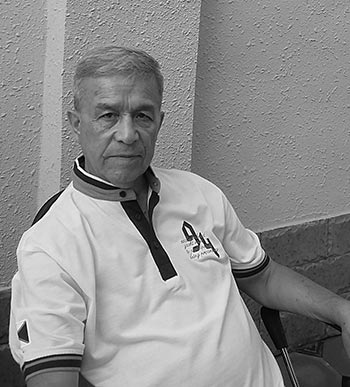
Writing for Index on Censorship magazine’s autumn 2015 issue, writer Mamadali Makhmudov explored how his life had been upended by censorship in his native Uzbekistan. Arrested twice and imprisoned for 14 years, he was released in 2013 after an international outcry. He continues to be blacklisted and his works are silenced. Now, after the death of his wife, with his health failing, Makhmudov writes to bring us up to date on the frozen situation for freedom of expression for him and his country.
[/vc_column_text][vc_column_text]
Mamadali Makhmudov
In 1943, my father Mahmud Ahmad-oghli, before he left for Great Patriotic War, said the following words to my mother, Saodat Izbosar-qizi: “Take care of my son. I will go to fight against Russian invaders on the German side…” I was a little baby then. But on my passport my age was written incorrectly: December 12, 1940. Place of birth: Boghdon village in Forish District (this name given by Tamerlane was actually named after Paris). The village I was born is situated at the foot of Nurota Mountains.
My father was a mountain-bek. Russian invaders hanged my grandfather Ahmad Aksakal in Narvon village in 1936. This is the detailed story: During its invasion of Boghdon, the wild enemy killed men, raped women, and pulled babies out of women’s wombs. That time, Ahmad Aksakal, together with his supporters, got ready to fight at Otuchganqoya rock. Using a trick, he brought the enemy (400 Russians) to the ambush at the dark ravine and suddenly attacked them, killing part of the enemy. He took 300 hundred Russians as hostages. My grandfather was so furious that he made the enemy to crack each other’s genital organs with stone. He burned them in front of the people, saying they are “unclean blood”. Now, there are three “Russian Hills” in Boghdon.
Though I know that in Judaism, Christianity and Islam, it’s not good to have bitter indignation at someone, I have a very strong desire for revenge. I finished an elementary school in Boghdon with such feelings. Later I studied at the Uchquloch gold mine (14 km far from our village) until the eighth grade.
It was my childhood dream to become a writer. I had a poor living condition, but I used to ask for books by helping people around me. Despite a hard life, I found time to read books. The works by European writers such as Shakespeare, Byron, Goethe, Hugo, Scott, translated from Russian into Uzbek, were my favorite books. May God forgive me, but I sometimes I had to deceive my mother and went to the graveyard, bush or ravines to read books till late evening.
In 1959-1961, I served in the army in Ukraine as a tank commander. In 1962, together with my crew, I went to Russia’s Efremov City in Tula region and worked at a chemistry plant construction. From there I was sent to chemical and automobile industry training in Voronezh for one year. Then I returned to Efremov and worked as mechanic’s assistant.
[/vc_column_text][vc_row_inner][vc_column_inner width=”1/4″][vc_icon icon_fontawesome=”fa fa-quote-left” color=”black” size=”lg” align=”right”][/vc_column_inner][vc_column_inner width=”3/4″][vc_column_text]
May God forgive me, but I sometimes I had to deceive my mother and went to the graveyard, bush or ravines to read books till late evening.
[/vc_column_text][/vc_column_inner][/vc_row_inner][vc_column_text]
In 1964, I came back to my homeland. I worked at Chrchiq Chemical Plant as mechanic for almost three years. Simultaneously, I finished evening courses for 10th and 11th grades. In 1966, I entered the Tashkent State University’s Faculty of Journalism. Because of a tough life, I had to study by correspondence. I worked for several newspapers in Guliston, Forish and Pakhtakor Districts as a proofreader and editor.
In 1968, the editor-in-chief of Saodat magazine, the poetess Zulfia, invited me to Tashkent and I have lived there since then.
When I was an eighth-grade schoolboy, I had a clear idea in my mind: “I will fight against Russian invaders not with a gun, but with a pen!” I think my mother, born in Kattaturk village in Samarkand, had encouraged me for such an idea. She once said to me: “Your grandpa Ahmad Aksakal often said the following: ‘Turkistan became a property for Russia. Day and night, they chased after our wealth, divided one nation into five different nations, and gave them five strange names and Cyrillic alphabet…’ You, sonny, should measure up to your grandpa!”
Based on my unchangeable faith and credo, I started writing short stories (Brook and Poplar, Horse, Hawthorn, etc.) to reveal the invader’s main purpose and ideology. They became sensation and were published in many newspapers and magazines, as well as in a collection called My Boghdon in 1971.
A power of liberty able to sweep Russian invaders from Central Asia came out that time, putting Moscow in anxiety and panic. Therefore, the Kremlin started its own propaganda against it. The propaganda was full of lie and slander (whoever believes Russia and China will never be able to correct that mistake). Russia called the freedom seekers “bosmachi” and tried to quickly get rid of them. To stand for it, I wrote my novel called Foggy Days (The Wolf of Boghdon), which also was warmly received by wide public.
Before my work appeared publicly, the USSR falsely described in historical books that “Russia annexed Central Asia.” I wrote it in my novel called Immortal Rocks, published in Sharq Yulduzi magazine in 1981. I wrote that Russia invaded Turkestan in exchange for the blood of millions of people.
For this work, I was dismissed from my work at the Writers’ Union. They took away all copies of the magazine. And I was in the black list of KGB for a long time. If Mr. Sharof Rashidov did not help me through Brezhnev, I would never come out of the prison.
Later, the novel was published in Germany, Turkey and France. I worked as the Secretary of the Writers’ Union and Chairman of Cultural Foundation. My friends know me as a person who fought for liberty.
When dependent nations gained independence thanks to Gorbachyov, a Communist, pro-Russian, ignorant and dictator became our ruler. He (Karimov) left a country full of corruption, with poor economy, agriculture, industry. He turned Uzbekistan into a big prison. He arrested freedom lovers and honest business people. Ethical norms were completely violated in the country. Eight million people left the country because of oppression, hunger and persecution. On fabricated charges (they put heroin, leaflets in my workplace and house) I was sentenced to 17 years in prison for allegedly being a member of Erk Party. I wrote several novels and short stories in the prison, but they took my work away. I hardly was able to get some parts of my novels such as Oynur, Oq Gul, and Bo’z Bo’ri. In 2013, when I was released with the help of US Secretary of State Hillary Clinton and European humanitarian organizations, I rewrote those books.
Oynur and Oq Gul are about that black history of the USSR and KGB. Bo’z Bo’ri is about the Arab invasion of Turon, their ruthless attacks, destructions of intelligentsia and other oppression. It’s about Muqanna, who bravely fought against those invaders. These books, along with my other articles and essays, are published on websites based in Europe, Canada and the United States.
I lost my health in prison, where hundreds of people die. I have had three heart attacks. I have ulcer in my stomach and my eyes have some other problems (cataract). I have six stones in my kidney. In short, I am in a poor health condition.
First of all, I need to have a stimulator installed in my heart. But I have no money for that, since we barely survive. Within 17 years, my family has been in debt. Despite working for state organisations for 40 years I receive a pension of just 179,000 UZS. And I even had to struggle for that for seven months. I don’t have enough means to buy medicine either. My books are not published in my own country. I am a banned author and I am always under surveillance.
When I was released, some humanitarian organizations in Europe and U.S., PEN Club and my friends supported me and we could get rid of 70% of our debt. Recently, my spouse Gulsara Mahmud died of heart attack. We are again in debt now.
Life is difficult. Nevertheless, I am writing the truth, only truth.
[/vc_column_text][/vc_column][/vc_row]
9 Feb 2017 | Mapping Media Freedom, News, Youth Board
[vc_row][vc_column][vc_column_text]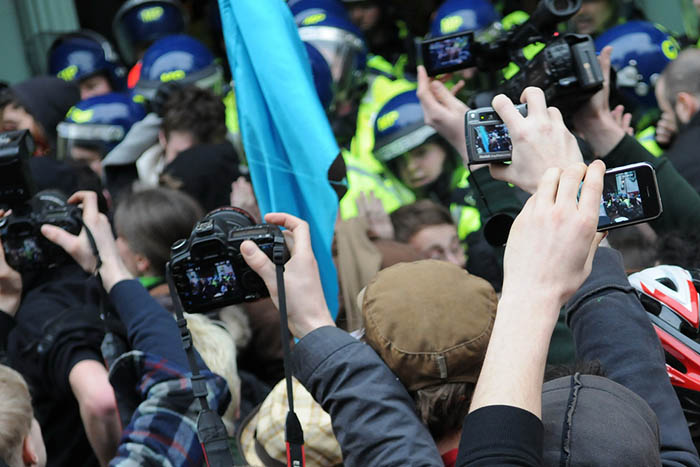
To highlight the most pressing concerns for press freedom in Europe in 2017, members Index’s outgoing youth board review the year gone by with some of our Mapping Media Freedom correspondents.
Youth board member Sophia Smith Galer, from the UK, spoke to Ilcho Cvetanoski, Mapping Media Freedom correspondent for Croatia, Montenegro, Bosnia and Macedonia.
 According to Cvetanoski, a lot has improved in the region over the last 15 years. The era during which journalists were targeted and killed is long passed, but the media is still dogged by censorship and political divides. In fact, journalists are regularly threatened and vilified by political elites, often denounced as foreign mercenaries, spies and traitors. Cvetanoski reports that this has led to “physical threats, the atmosphere of impunity, media ownership and also verbal attacks amongst the journalists themselves”. He notes that techniques pressuring journalists have changed from “blatant physical assaults to more subtle ones”.
The breaking up of the former Yugoslavia has undoubtedly been a historical burden on Bosnia and Herzegovina and Croatia. Cvetanoski describes this legacy as having left “deep scars in every aspect of the people’s lives, including the lives and the work of journalists”. Media workers are still remembered as having once been tools of the state. Nowadays, the opposite is happening; they’re being criticised by political elites as enemies of the state simply for scrutinising politicians’ behaviour.
It’s unsurprising that this has left many journalists in the region politicised, undermining professionalism and trust in the media. Conservative politicians court sympathisers in the media so that they can manipulate the angle and content of stories that are run. The fact that journalist salaries are low and that the economic situation is poor overall further imperils journalistic integrity in the face of bribes.
If the situation remains as it is – with limited and highly controlled sources for financing the media, a poor political culture and low media literacy among citizens – then Cvetanoski holds little hope for the future of press freedom in the region. News consumers aren’t equipped with the literacy levels to distinguish between professional versus sensational journalism, nor are the sources of media funding transparent or appropriate. “In this deadlock democracy, the first victims are the citizens who lack quality information to make decisions.”
Mapping Media Freedom is helping to change this. Making journalists feel less alone and offering a space for them to report threats to press freedom ensures that the hope for a free press throughout Europe is kept alive.
The youth board’s Constantin Eckner, from Germany, spoke with Zoltán Sipos, the MMF correspondent for Hungary, Romania and Bulgaria.
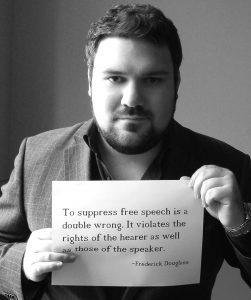 As MMF illustrates, journalists in all three countries have to deal with constant pressure from authorities and various degrees of censorship. In 2016, 42 incidents were reported in Hungary, 21 in Romania and 7 in Bulgaria.
Index on Censorship’s regional correspondent Zoltán Sipos, who is also the founder and editor of Romania’s investigative outlet Átlátszó Erdély, points out that the Hungarian government and its allies within the country follow a sophisticated plan to neutralise critical media outlets. Several newspapers that struggled financially have been purchased by rich business people or media moguls in recent history. “Just like in regards to any other part of society, prime minister Viktor Orbán seeks for a centralisation of the media industry,” Sipos says.
Yet, instead of simply controlling the media, Orbán and the reigning party Fidesz intend to use established outlets and broadcasters to construct narratives in favour of their agendas. Only a handful of independent outlets remain in Hungary.
In November 2016, Class FM, Hungary’s most popular commercial radio channel, was taken off the air. The Media Council of Hungaryʼs National Media refused to renew its licence as Class FM was owned by Hungarian oligarch Lajos Simicska, whose outlets became very critical towards the government after a quarrel between him and Orbán.
The authorities in Romania and Bulgaria might not follow a well-wrought plan, but the situation for critical journalists is as severe. “The main problem is that most outlets can’t generate enough revenue from the market,” Sipos explains. “These outlets found themselves under constant pressure, as powerful business people are willing to purchase them and use them to promote their own political agendas.” Ultimately, this issue leads to the demise of independent reporting and weakens voices critical of the ruling parties and influential political players.
Sipos concludes that “these three countries have little to no tradition of independent journalism.” Although death threats towards, or even violence against journalists do not exist, the working conditions for critical reporters are difficult.
He recommends the investigative outlets Bivol.bg from Bulgaria, atlatszo.hu and Direkt36.hu from Hungary as well as RISE Project and Casa Jurnalistului from Romania as bastions of independent journalism. A few mainstream outlets that conduct critical reporting are 444.hu, index.hu, HotNews.ro and Digi24.
Layli Foroudi, a youth board member from the UK, interviewed Mitra Nazar, MMF correspondent for Serbia, Kosovo, Slovenia and the Netherlands.
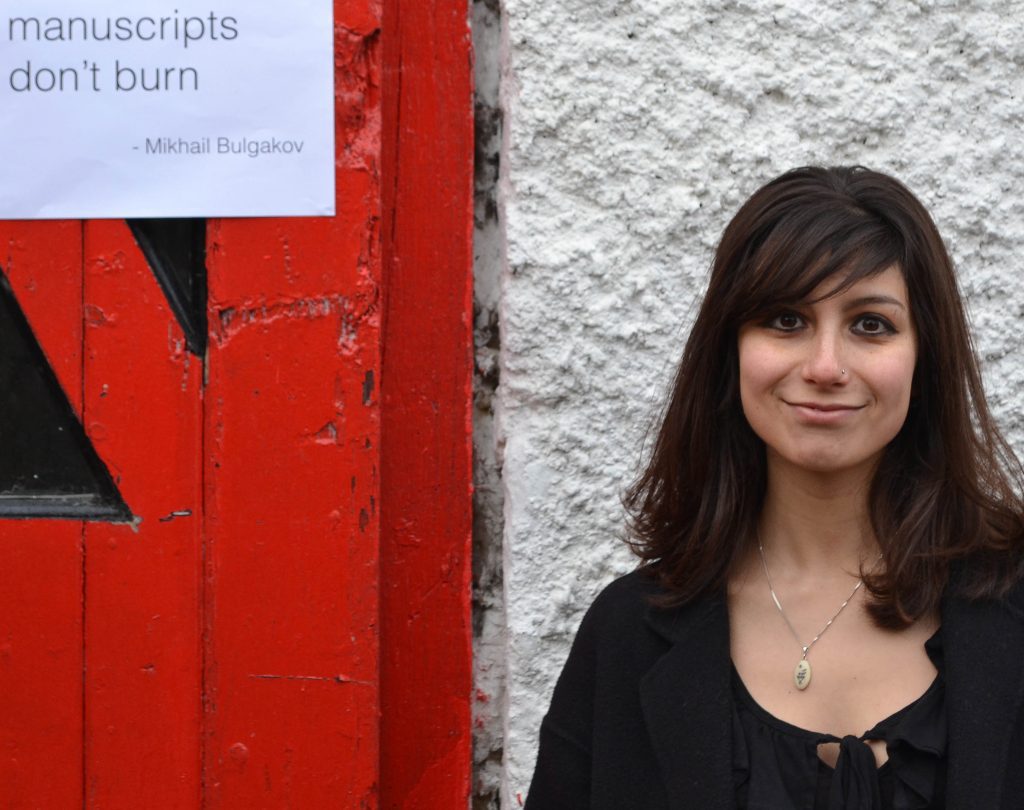 A Dutch national based in Belgrade, Serbia and the Netherlands are Nazar’s natural beats, and she also monitors media freedom in the nearby Balkan states of Slovenia and Kosovo.
This year, Serbia has been the most intense of the four countries to cover. Serbian journalists have been subject to physical attacks and the government has maintained a smear campaign against independent media outlets in the country.
“This is a very organised campaign,” explains Nazar, “they’re being called foreign spies and foreign mercenaries.”
The “foreign spy” accusation has a real effect on the personal safety of journalists, whose pictures are often published alongside such accusations in the pro-government media. Nazar, who wrote a feature on the subject, says that this can cause such journalists to be branded as unpatriotic and anti-Serbian: “When the government accuses journalists of being “foreign spies”, it gives the impression that these independent journalists are against Serbia as a country.”
The ruling party of Serbia even went so far as to organise a touring exhibition called Uncensored Lies, where the work of independent media was parodied in an attempt to prove that the government does not censor, however, the exhibition also served to discredit these publications by calling the content “lies”.
“Can you imagine the ruling party organises an exhibition discrediting independent media,” says Nazar, shocked, “this is not indirect censorship, it is directly from the government.”
The media landscape in the Netherlands does not experience direct state-sponsored censorship, but there are other challenges. The Netherlands ranks 2nd in the 2016 RSF World Press Freedom Index, but Nazar has still reported a total of 49 incidents since the Mapping Media Freedom project started, from police aggression against journalists, to assaults on reporters during demonstrations, to broadcasters being denied access to public meetings.
For 2017, she is interested in looking into how the Dutch media deals with the rise of the far right and a growing anti-immigrant sentiment, especially in the upcoming elections which will see controversial far-right candidate Geert Wilders stand for office.
Last year, a Dutch tabloid De Telegraaf published an article about the arrival of refugees to the Netherlands with a sensational headline that generated a lot of debate in the Dutch media, which Nazar says is becoming increasingly politicised and polarised.
For Nazar, there is a line to be drawn with what legacy media outlets should and should not publish. “That line is representing and following the facts,” she says, “if you publish a headline that says there is a “migrant plague”, that is beyond facts – it is a political agenda.”
The youth board’s Ian Morse, from the USA, interviewed Vitalii Atanasov, the MMF correspondent for Ukraine.
In just the past two months in Ukraine, journalists have been assaulted, TV stations have been banned and governments on both sides of the country’s conflict with Russia have sought to limit public information and attack those who publicise.
Vitalii Atanasov is the correspondent who reported these incidents to the Mapping Media Freedom project. Drawing on sources from individual journalists to large NGOs, Atanasov monitors violations of media plurality and freedom in Ukraine for the project. To verify a story, he sometimes contacts media professionals directly, or crowdsources through social media, as he finds that all journalists publicise cases of violation of their rights, attacks, and incidents of violence.
“Some cases are complicated, and the information about them is very contradictory,” Atanasov tells Index. “So I’m trying to trace the background of the conflict that led to the violation of freedom of expression and media.”
Many of the violations that occur in Ukraine are either individual attacks on media workers by separatists in the east or Ukrainian officials attempting to control the media through regulation and licensing.
Of about a dozen and a half reports since he began working with MMF, Atanasov says many reports stick out, such as the “blatant” attempts of authorities to influence the work of major TV channels such as Inter and 1+1 channels. Most recently, Ukraine banned the independent Russian station Dozhd from broadcasting in Ukraine. While TV has recently been the target, problems with media freedom have come from almost everywhere.
“The sources of these threats can be very different,” Atanasov says, “for example, representatives of the authorities, the police, intelligence agencies, politicians, private businesses, third parties, criminals, and even ordinary citizens.”
Atanasov and MMF build off the work of other groups working in Ukraine, such as the Institute of Mass information, Human Rights Information Center, Detector Media, and Telekritika.ua.
Click on the bubbles to view reports or double-click to zoom in on specific regions. The full site can be accessed at https://mappingmediafreedom.org/
[/vc_column_text][/vc_column][/vc_row][vc_row][vc_column][vc_basic_grid post_type=”post” max_items=”4″ element_width=”6″ grid_id=”vc_gid:1486659943480-96bea7cd-9879-6″ taxonomies=”6514, 6564″][/vc_column][/vc_row]
