11 Apr 2014 | Digital Freedom, News

(Illustration: Shutterstock)
State surveillance has been much publicised of late due to Snowden’s revelations, but allegations against the NSA and GCHQ are only one aspect of the international industry surrounding wholesale surveillance. Another growing concern is the emergence and growth of private sector surveillance firms selling intrusion software to governments and government agencies around the world.
Not restricted by territorial borders and globalised like every other tradable commodity, buyers and sellers pockmark the globe. Whether designed to support law enforcement or anti-terrorism programmes, intrusion software, enabling states to monitor, block, filter or collect online communication, is available for any government willing to spend the capital. Indeed, there is money to be made – according to Privacy International, the “UK market for cyber security is estimated to be worth approximately £2.8 billion.”
The table below, collated from a range of sources including Mother Jones, the Electronic Frontier Foundation, Bloomberg, Human Rights Watch, Citizen Lab, Privacy International and Huffington Post, shows the flow of intrusion software around the world.
| Surveillance Company |
Country of Origin |
Alleged Countries of Use |
| VASTech |
South Africa |
Libya (137) |
| Hacking Team |
Italy |
Azerbaijan (160), Egypt (159), Ethiopia (143), Kazakhstan (161), Malaysia (147), Nigeria (112), Oman (134), Saudi Arabia (164), Sudan (172), Turkey (154), Uzebekistan (166) |
| Elbit Systems |
Israel |
Israel (96) |
| Creative Software |
UK |
Iran (173) |
| Gamma TSE |
UK |
Indonesia (132) |
| Narus |
USA |
Egypt (159), Pakistan (158), Saudi Arabia (164) |
| Cisco |
USA |
China (175) |
| Cellusys Ltd |
Ireland |
Syria (177) |
| Adaptive Mobile Security Ltd |
Ireland |
Syria (177), Iran (173) |
| Blue Coat Systems |
USA |
Syria (177) |
| FinFisher GmbH |
Germany |
Egypt (159), Ethiopia (143) |
Note: The numbers alongside the alleged countries of use are the country’s ranking from 2014 Reporters without Borders World Press Freedom Index 2014.
While by no means complete, this list is indicative of three things. There is a clear divide, in terms of economic development, between the buyer and seller countries; many of the countries allegedly purchasing intrusion software are in the midst of, or emerging from, conflict or internal instability; and, with the exception of Israel, every buyer country ranks in the lower hundred of the latest World Press Freedom Index.
The alleged legitimacy of this software in terms of law enforcement ignores the potential to use these tools for strictly political ends. Human Rights Watch outlined in its recent report the case of Tadesse Kersmo, an Ethiopian dissident living in London. Due to his prominent position in opposition party, Ginbot 7 it was discovered that his personal computer had traces of FinFisher’s intrusion software, FinSpy, jeopardising the anonymity and safety of those in Ethiopia he has been communicating with. There is no official warrant out for his arrest and at the time of writing there is no known reason in terms of law enforcement or anti-terrorism legislation, outside of his prominence in an opposition party, for his surveillance. It is unclear whether this is part of an larger organised campaign against dissidents in both Ethiopia and the diaspora, but similar claims have been filed against the Ethiopian government on behalf of individuals in the US and Norway.
FinFisher GmbH states on its website that “they target individual suspects and can not be used for mass interception.” Without further interrogation into the end-use of its customers, there is nothing available to directly corroborate or question this statement. But to what extent are private firms responsible for the use of its software by its customers and how robustly can they monitor the end-use of its customers?
In the US Electronic Code of Federal Regulations, there is a piece of guidance entitled Know Your Customer. This outlines steps to be undertaken by firms to identify what the end-use of its products is. This is a proactive process, placing the responsibility firmly with the seller to clearly identify and act on abnormal circumstances, or ‘red flags’. The guidance clearly states that the seller has a “duty to check out the suspicious circumstances and inquire about the end-use, end-user, or ultimate country of destination.”
Hacking Team has sold software, most notably the Remote Control System (RCS) to a number of countries around the world (see above). Citizen Lab, based out of the University of Toronto, has identified 21 countries that have potentially used this software, including Egypt and Ethiopia. In its customer policy, Hacking Team outlines in detail the lengths it goes to verify the end-use and end-user of RCS. Mentioning the above guidelines, Hacking Team have put into practice an oversight process involving a board of external engineers and lawyers who can veto sales, research of human rights reports, as well as a process that can disable functionality if abuses come to light after the sale.
However, Hacking Team goes a long way to obscure the identity of countries using RCS. Labelled as untraceable, RCS has established a “Collection Infrastructure” that utilises a chain of proxies around the world that shields the user country from further scrutiny. The low levels of media freedom in the countries purportedly utilising RCS, the lack of transparency in terms of the oversight process including the make-up of the board and its research sources, as well as the reluctance of Hacking Team to identify the countries it has sold RCS to undermines the robustness of such due diligence. In the words of Citizen Lab: “we have encountered a number of cases where bait content and other material are suggestive of targeting for political advantage, rather than legitimate law enforcement operations.”
Many of the firms outline their adherence to the national laws of the country they sell software to when defending their practices. But without international guidelines and alongside the absence of domestic controls and legislation protecting the population against mass surveillance, intrusion software remains a useful, if expensive, tool for governments to realise and cement their control of the media and other fundamental freedoms.
Perhaps the best way of thinking of corporate responsibility in terms of intrusion software comes from Adds Jouejati of the Local Coordination Committees in Syria, “It’s like putting a gun in someone’s hand and saying ‘I can’t help the way the person uses it.’”
This article was posted on 11 April, 2014 at indexoncensorship.org
8 Apr 2014 | About Index, Campaigns, Press Releases
A NEW CHAMPION FOR FREE EXPRESSION
Index announces new CEO
Index on Censorship, the organization that advocates for freedom of expression and against censorship throughout the world, is delighted to announce the appointment of our new Chief Executive Officer, Jodie Ginsberg.
Jodie, who takes up her post next month (mid-May), comes from the think-tank, Demos. A former London Bureau Chief for Reuters, Jodie worked for more than a decade as a foreign correspondent and business journalist. She was previously Head of Communications for Camfed, a non-profit organisation working in girls’ education.
The Chair of Index, David Aaronovitch, said; “Index is an indispensible organization and I am really pleased to have someone of Jodie’s experience and talents coming to us. Index’s work defending freedom of expression on- and off-line is more important than ever in the face of growing censorship in many countries around the world from Turkey to Russia, from Azerbaijan to India to China. I am sure Jodie will build on the great work of her predecessor Kirsty Hughes and all the Index staff, and lead Index into new and important campaigns.”
Jodie Ginsberg said: “Defending freedom of expression is not an easy task but it is a vital one. If we want to live in a world where everyone is free to speak, write, publish or perform without fear of persecution then we need to champion those rights every day. I’m thrilled to be leading an organisation with such an amazing track record in defending free expression and can’t wait to start working with our incredible roster of supporters and contributors.”
Outgoing CEO, Kirsty Hughes, said: “I am delighted that Jodie will lead Index in its vital campaigning work around the world. I wish her all success in this vital and exciting challenge.”
Press enquiries to [email protected]
21 Mar 2014 | Awards, News

From upper left: Shahzad Ahmad, Rahim Haciyev, Shu Choudhary, Mayam Mahmoud. (Photos: Alex Brenner for Index on Censorship)
This year’s Freedom of Expression Awards 2014 were awarded to a diverse group of remarkable individuals and organisation from the young female Egyptian Rapper to a Pakistani internet campaigner, from an Indian digital pioneer to an Azerbaijani newspaper.
The Freedom of Expression Awards 2014 took place this evening at the Barbican Centre in London and saw 18 year old, Egyptian rapper, Mayam Mahmoud win the Arts Award; Pakistani internet freedom fighter, Shahzad Ahmad pick up the Advocacy Award; Shu Choudhary, the Indian journalist who has created an egalitarian news platform receive the Digital Activism Award; and the Azeri newspaper, Azadliq, win the Journalism Award.
The Freedom of Expression Awards recognise the bravest journalists, artists and activists from around the world. From Edward Snowden to FreeWeibo and David Cecil to Colectivo Chuhcan, their remarkable true stories remind us that the right to free expression must be defended at all costs. Index is proud to bring these voices to London and shine a light on their work for the world to see.
Index Arts award: Mayam Mahmoud, Egyptian Hip-hop Artist

Mayam Mahmoud, Egyptian Hip-hop Artist, accepting her award (Photo: Alex Brenner for Index on Censorship)
A finalist on Arab’s Got Talent, hijab wearing Egyptian rapper Mayam Mahmoud uses hip-hop to address issues such as sexual harassment and to stand up for women’s rights in the country that, after the hope of Tahrir Square, is slipping back into authoritarianism.
Google Digital Activism award: Shubhranshu Choudhary, Indian Journalist
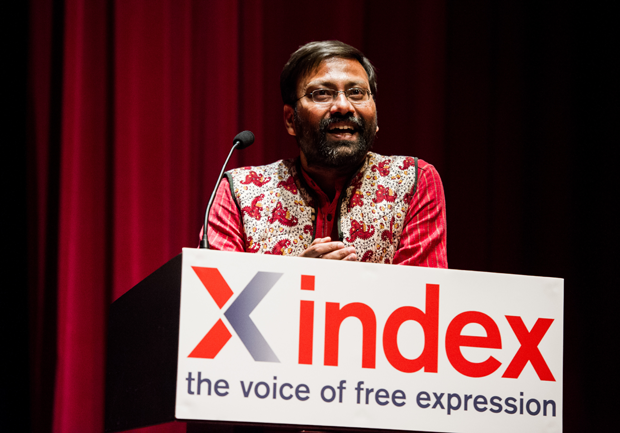
Shubhranshu Choudhary at the Index awards (Photo: Alex Brenner for Index on Censorship)
Shubhranshu Choudhary is the brains behind CGNet Swara, a mobile-phone based news service that allows some of India’s poorest citizens to upload and listen to hyper-local reports in their own dialect, no smartphone required! CGNet Swara is both circumventing India’s strict radio licencing laws and creatively providing an outlet for those overlooked people on the wrong side of the digital divide.
The Guardian Journalism award: Azadliq, Azerbaijani independent Newspaper
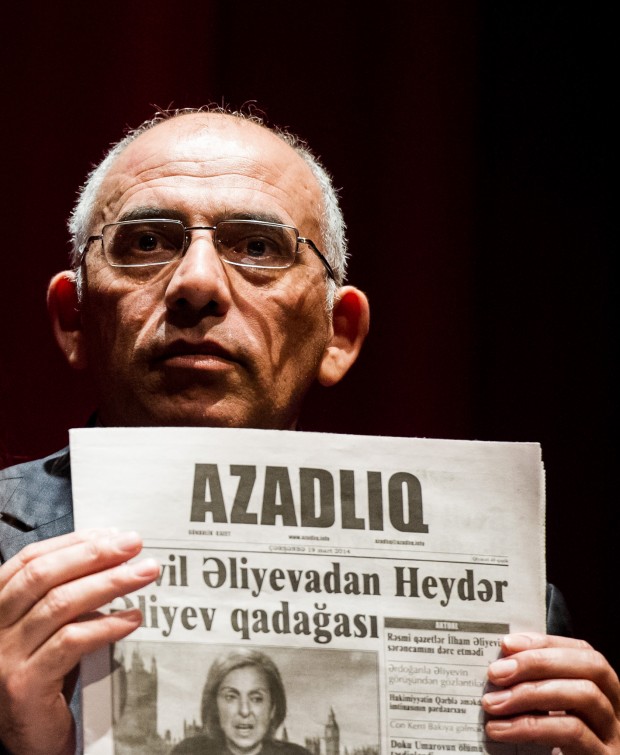
Rahim Haciyev, deputy editor-in-chief of Azerbaijani newspaper Azadliq (Photo: Alex Brenner for Index on Censorship)
One of the last independent media outlets in Azerbaijan, Azadliq has continued to report on government corruption and cronyism in spite of increasing pressures and a financial squeeze enforced by the authorities.
Doughty Street Advocacy award: Shahzad Ahmad, Pakistani Campaigner

Shahzad Ahmad at the Index awards (Photo: Alex Brenner for Index on Censorship)
Shahzad Ahmad leads the fight against online censorship in Pakistan. He has sued the Pakistani government over their suspected use of surveillance software, FinFisher, and he is suing the government over its ongoing blocking of YouTube which is depriving his people of one of the world’s most popular video channels.
#IndexAwards2014: The Doughty Street Advocacy Award winner Shahzad Ahmad from Index on Censorship on Vimeo.
20 Mar 2014 | Awards, Azerbaijan News, News
Rahim Haciyev, deputy editor-in-chief of Azerbaijani newspaper Azadliq (Photo: Alex Brenner for Index on Censorship)
One of the few remaining independent media outlets in Azerbaijan, the newspaper Azadliq has continued to report on government corruption and cronyism in spite of an increasing financial squeeze enforced by the authorities.
Accepting the award on behalf of Azadliq is the paper’s Editor-in-Chief Rahim Haciyev.
Azadliq newspaper was set up in 1989 by Azerbaijan Popular Front Party, the main opposition organization (in the mid of 90s APFP stopped funding Azadliq and it became an independent newspaper). The first editor-in-chief of the newspaper was a famous journalist Najaf Najafov. Azadliq newspaper has always been a paper admired by free and freedom-loving people. A key motto of the paper was ‘serving the truth’. This was a main reason of constant pressure and attacks on the newspaper. In 2006, the newspaper was evicted from the office located in the city centre. It had been relocated into three small rooms at “so-called” state-financed publishing house.
Harsh repressions have been started against the newspaper staff. Later on, a chief editor and the staff member of the newspaper, poet-satirist were imprisoned with fabricated charges after court decision. The kidnapping and beating of a newspaper staff followed by similar incident when an Azadliq journalist was returning back from fulfilling his job duties and was beaten in the evening. Two journalists were stabbed for their critical articles. Last year, a court had fined the newspaper 65,000 euros. The newspaper website which had 9 million visitor IPs in 2013, was a target to severe attacks. Circulation of the newspaper is only 8000 copies.
Nevertheless, our newspaper has an enormous impact on public opinion. Even by your (Western) standards, this small circulation makes the government dis-comfortable who is doing everything to shut down the paper. It reminds us a quote from Shakespeare’s Hamlet: “To be or not to be?” With this dilemma the newspapers is moving towards its 25th jubilee. Despite all the repressions, unbelievable difficulties and problems, the newspaper team is determined to continue this sacred job – serving the truth. Because this is meaning of what we do and the meaning of our lives!
Thank you for your attention and support. In addition, I would like to thank the international democratic community and the democratic community of our country who support the newspaper and let me express our special thanks to our loyal readers.
— Rahim Haciyev, Editor-in-Chief, Azadliq
This article was originally posted on 20 March 2014 at indexoncensorship.org
