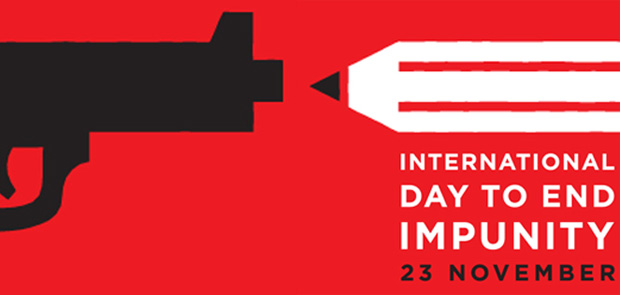
Tomorrow is International Day To End Impunity. “When someone acts with impunity, it means that their actions have no consequences” explains IFEX, the global freedom of expression network behind the campaign. Since 1992, 600 journalists have been killed with impunity — that is 600 lives taken with all or some of those culpable not being being held responsible. Countless others — writers, activists, musicians — have joined their ranks, simply for exercising their right to freedom of expression.
This year has only added to the grim statistics. By the middle of January, six journalists had already been murdered. We are now getting close to the end of 2013, and 73 more journalists and two media workers have suffered the same fate — 48 in cases directly connected to their work, 25 with motives still unconfirmed. Out of these, 15 were killed without anyone — perpetrators or masterminds — convicted.
Russia is notorious for its culture of impunity. In July this year, Akhmednabi Akhmednabiev, a Russian journalist reporting on human rights violations in the Caucasus, was shot dead. In 2009 he had been placed on an “execution list” on leaflets distributed anonymously, and had in the past also received death threats. In January he survived an assassination attempt which local authorities reportedly refused to investigate. His case is still classed as murder with impunity.
Pakistan is also an increasingly dangerous place to work as a journalist. Twenty seven of the 28 journalists killed in the past 11 years in connection with their work have been killed with impunity. In the last year alone, seven journalists have been murdered. Express Tribune journalist Rana Tanveer told Index he has received death threats and been followed for reporting on minority issues. In October, Karak Times journalists Ayub Khattak was gunned down after filing a report on the drugs trade.
In July, Honduran TV commentator Aníbal Barrow was kidnapped together with his family and a driver. The others were released, but after two weeks, Barrow’s body was found floating in a lagoon. He was the second journalists with links to the country’s president Porfirio Lobo Sosa — they were close friends — to have been killed over the past two years. Four members of the criminal group “Gordo” were detained in connection with the case, but at one point, there were at least three other suspects on the run.
In September, Colombian lawyer and radio host Édison Alberto Molina was shot four times while riding on his motorcycle with his wife. His show “Consultorio Jurídico” (The Law Office), aired on community radio station Puerto Berrío Stereo, and often took on the topic of corruption. The Inter American Press Association in October called on authorities to open “a prompt investigation into the murders” of him and news vendor and occasional stringer José Darío Arenas, who was also killed in September.
Meanwhile in Mexico, a country for many synonymous with impunity for crimes against the media, three journalists were murdered in 2013. The state public prosecutor’s offices has yet to announce any progress in the cases of Daniel Martínez Bazaldúa, Mario Ricardo Chávez Jorge and Alberto López Bello, or disclose whether they are linked to their work. Notorious criminal syndicate Zetas took responsibility for the murder of Martínez Bazaldúa and warned the police about investigating the case. He was a society photographer and student, only 22 at the time of his death. Chavez Jorge, founder of an online newspaper, disappeared in May and his body was found in June, but in August the state attorney’s office said they did not have a record of his death. López Bello was a crime reporter who had published stories on the drugs trade.
This year, 20 journalists — from Naji Asaad in January to Nour al-Din Al-Hafiri in September — have also lost their lives covering the ongoing tragedy of the Syrian civil war. Their loved ones, like those of all the civilians killed, will have to wait for justice.
It is also worth noting that while an unresolved or uninvestigated murder is the most serious and devastating manifestation of impunity, it is not the only one. Across the world, journalists are being attacked and intimidated without consequences. In August there was a two-hour long raid on the home of Sri Lankan editor and columnist Mandana Ismail Abeywickrema, who recently started a journalists’ trade union. Despite her receiving threats related to her work prior to the attack, it was labelled a robbery by the police. Bahraini citizen journalist Mohamed Hassan experienced similar incident, also in August, when he was arrested and his equipment seized during a night-time raid. His lawyer Abdul Aziz Mosa was also detained and his computer confiscated, after tweeting about his client being beaten. In October, a group of Azerbaijani journalists were attacked by a pro-government mob while covering an opposition rally in the town of Sabirabad. One of the journalists, Ramin Deko, told Index of regular threats and intimidation.
International Day To End Impunity is a time to reflect on these staggering figures and the tragic stories behind them. More importantly, however, it represents an opportunity to stand up and demand action. Demand that Russia’s President Vladimir Putin, Mexico’s President Enrique Peña Nieto, Pakistan’s President Mamnoon Hussain and the rest of the world’s leaders provide justice for those murdered. Demand an end to the culture of impunity in which journalists, writers, activists, lawyers, musicians and others can be intimidated, attacked and killed simply for daring to speak truth to power. Visit the campaign website to see how you can take action.
Bryan faces a charge of ‘hooliganism’ after he was arrested while filming a Greenpeace protest on an Arctic Ocean oil rig.
Hooliganism is defined in article 213 of the Russian criminal code as “a gross violation of the public order which expresses patent contempt for society, attended by violence against private persons or by the threat of its use, and likewise by the destruction or damage of other people’s property”
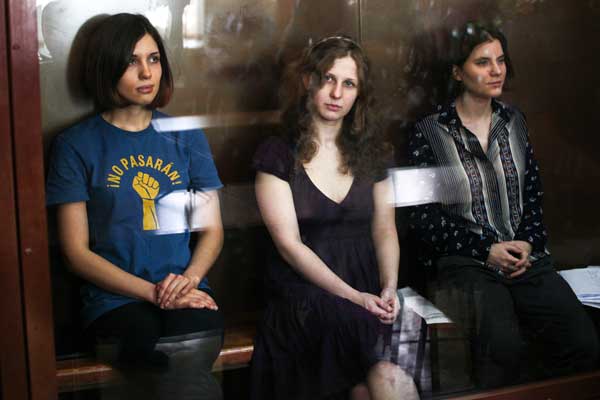
Bryon could end up with a two-year sentence should he be convicted. That’s what Nadezhda Tolokonnikova, Maria Alekhina and Ekaterina Samutsevic of Pussy Riot received after they were convicted of “hooliganism motivated by religious hatred” in October 2012. Samutsevic has been released on bail, but Alekhina and Tolokonnikova remain in prison. There were fears for the wellbeing of Tolokonnikova recently after authorities could not confirm her whereabouts in the course of a prison transfer.
In the past week, artist Pyotry Pavlensky was charged with hooliganism for nailing his scrotum to Red Square, in what he said was a protest against political apathy.
Azerbaijan meanwhile, defines it as “deliberate actions roughly breaking a social order, expressing obvious disrespect for a society, accompanying with application of violence on citizens or threat of its application, as well as destruction or damage of another’s property…”
In May of this year, Azerbaijani activist Ilkin Rustamzadeh was sentenced to two months pre-trial detention for a hooliganism charge after he allegedly took part in a “Harlem Shake” video. Rustamzadeh, who had been active in calling for investigations into the deaths of young soldiers in Azerbaijan’s army, denied ever having taken part in the videos.
Before that, in 2009, Azerbaijan had jailed two young activists for hooliganism after they posted a video on YouTube satirising the government’s expenditure on importing donkeys from Germany.
It was suggested that the donkey import was a cover for money laundering. Shortly after the video was posted, the activists, Emin Milli and Adnan Hadjizadeh, were attacked in a Baku cafe. They were blamed for the fight and sentenced two and a half years and two years respectively.
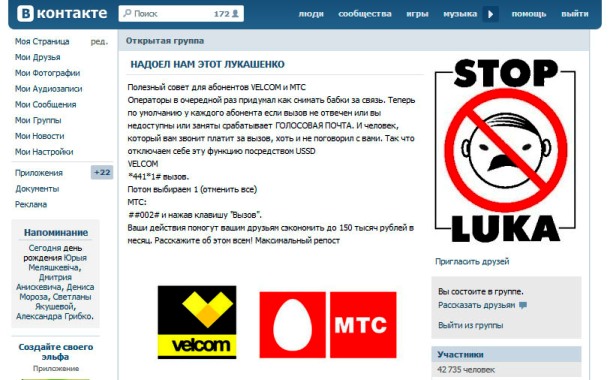
In Belarus, Alexander Lukashenko’s regime frequently uses hooliganism charges to harass journalists and activists. Lukashenko is so paranoid about dissent that he at one point banned clapping in public, so its unsurprising that moderators of online anti-government groups get arrested. In August 2012, Pavel Yeutsikheieu and Andrei Tkachou, administrators of the “We are fed up with Lukashenko” group on Russian social network VKontakte, were both given short prison sentences for “minor hooliganism”.
In the old Soviet Union, inconvenient people were often declared mad and locked up by the authorities. Now, they’re classified as hooligans.
Last year’s Internet Governance Forum in Baku, Azerbaijan proved controversial due to the choice of host. This year’s event, in Bali, Indonesia was bound to be contentious, after Edward Snowden’s leaks on the US’s PRISM programme. PRISM and TEMPORA (the UK system of mass surveillance) were a lightening rod for general discontent from activists who feel an increasing sense of ill ease over the state of internet freedom. Many of the sessions were bad-tempered affairs with civil society rounding on the perceived complacency of government officials from democracies who refused to state their opposition to mass state surveillance in clear enough terms.
US rep use the phrase “alleged US intelligence practices” and then continue by saying: “everyone does it” #IGF2013SV#IGF2013
At an event hosted by the Global Network Initiative, Index on Censorship, andPakistan’s Centre for Social and Policy Analysis, a US government official was heckled by the audience when he attempted to justify PRISM as an anti-terrorism measure. Of particular concern for delegates was a sense that PRISM is now being used by less democratic and authoritarian states to justify their own surveillance systems. The Chinese were quick to point out the ‘double standards’ of the US at this workshop, following it with appalling doublespeak to gloss over their poor domestic record on human rights violations. A point I challenged them on in no uncertain terms.
WOW China is actually lecturing the US on #prism THIS IS SO DEPRESSING #igf2013
Participants in the workshop from across the globe from Pakistan to South Africa stated their concern that a race to the bottom is beginning with new surveillance capacities being debated in countries such as Russia, New Zealand and the UK. Other areas of concern at the workshop included the increasing use of filters at ISP level (in particular in Indonesia where a significant number of ISPs are adopting filtering) and the pressure now felt by Telcos from states who are imposing burdensome requirements to filter content. One worrying prospect is that the ITU will succumb to a push to ensure Telcos do not distribute ‘blasphemous’ content which could lead to the full Balkanisation of the internet.
Although the outlook is bleak, civil society is pushing back at corporations and governments. Bytes for All in Pakistan has done impressive work in chronicling censored online content. A number of coalitions strengthened at the IGF with closer co-operation between international NGOs to take on mass state surveillance. This weekend, a number of US NGOs will rally in Washington DC against the PRISM programme with thousands expected to take to the streets. Index on Censorship’s #DontSpyOnMe petition of 7,000 signatures was this week sent to Lithuanian President Dalia Grybauskaitė, who currently hold the Presidency of the Council of the EU, and Herman van Rompuy, President of the European Council. The EU heeded our calls to discuss mass surveillance at the Council of Ministers meeting – a big success. The pressure on corporations is being felt too, Telcos came under particular fire for their willingness to install surveillance equipment in their networks. Yet, many are beginning to speak publicly over the pressures they feel from states and the need for transparency so their users are at least aware of the surveillance they may be subject to and so can adjust their behaviour accordingly. Meanwhile, Google launched new tools to illustrate the threats the internet faces. The Digital Attack Map is a realtime website displays DDOS attacks and where they originate from – useful in tracking attacks on civil society websites from state-run or criminal botnets. Google also launched a project to provide free, secure web hosting for internet activists under attack.
One of the strengths of the IGF is the broadness of the workshop programme. From the challenges felt by the disabled online, minority rights online, through to bridging the ‘digital divide’ between the rich and poor both internationally and internally within even wealthier countries, the IGF covered a significant amount of ground. Yet, one of the big challenges to the IGF is how to engage a wider section of civil society. While the IGF was better attended by delegates from South-East Asia, fewer delegates from Europe and the Middle East were visible during this IGF. This remains a challenge to the organisers, with too much interaction from those physically present at the conference and too little from the many remote participants, many of whom couldn’t afford the air fare to Bali but have much to contribute. Bridging this divide will be important in the future.
The tone of this IGF was set by the Snowden revelations. The US and other Western democracies were on the back foot, in stark contrast to their confident promotion of net freedom in Baku. Without openess, increased transparency and an end to mass surveillance it’s hard to see how they will regain their moral authority, leaving a huge vacuum at the heart of these debates. A vacuum that others – in particular China – are willing to fill. The battle to keep the multistakeholder, open internet free from top-down state interference is on-going. The IGF should give once confident advocates of net freedom serious pause for thought.
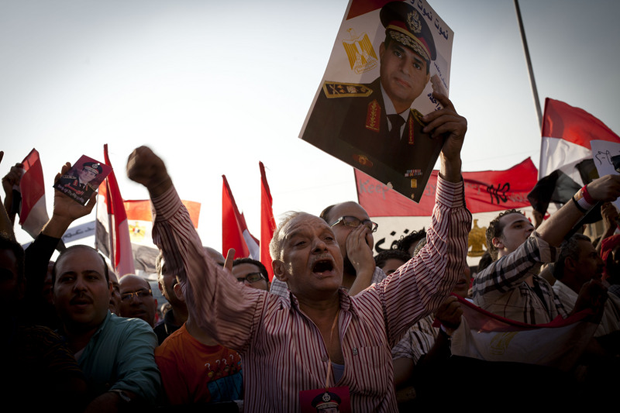
A protester holds a portrait of General Abdel Fattah al-Sisi during protests in July. (Shawkan / Demotix)
While the situation in Egypt is complex and unpredictable, there can be little doubt that General Abdel Fattah al-Sisi and his men are in charge of a country in deep crisis. On several occasions, they have handled this crisis with violent crackdowns that have attracted widespread, international condemnation. It appears they are now looking for some outside help to polish up their image as protectors of the state.
Industry publication AdAge reported last week that Egypt’s interim military government is seeking support from western public relations companies.
“The government (…) is in talks with a handful of firms that have strong public-affairs capabilities in the U.S. and Europe, and has issued at least one global RFP out of London, according to people familiar with the matter”, the publication said.
But with PR being a quickly growing industry, and a sea of options out there, it can be difficult to even know where to start browsing. Egypt, however, is not the first country to seek the help and guidance of western PR.
We have put together a list of companies that are not strangers to working for regimes with questionable human rights records.
London-based Bell Pottinger, once described as a ‘firm synonymous with this international spin’ has worked with everyone from Bahrain to Belarus, Sri Lanka and Yemen. But a word of advice, their services don’t come cheap. In 2012 it was reported that Bahrain’s royal family have spent £7.5 million on contracts with the firm. On the other hand, whereas American PR firms have to declare their dealings with foreign governments to American authorities, such regulations do not exist in the UK.
Where is the first place people go for information on a country, if not the world’s favourite user-generated encyclopedia? With Egypt’s current Wikipedia page not necessarily painting the military government in the best light, it’s helpful to know that Washington-based company Qorvis have reportedly helped clients like Saudi Arabia polish up theirs. For people seeking more in-depth knowledge, the firm has also been known to place favorable reports regarding their clients.
Mainstream media is one of the best ways to advertise your country as the new it-holiday destination or a booming business hotspot, or even get a policy point across. A PR firm can help you do that. London-based Ketchum was credited with placing Vladimir Putin’s much read recent New York Times op-ed on Syria. Could they make a ‘23 Ways You Know You Definitely Haven’t Staged A Coup’ Buzzfeed piece a reality?
Sometimes, it can be equally important to get stories removed from the media. In that case, Dragon Associates could be an alternative. They were credited with having a critical comment piece about their clients Bahrain removed from the Guardian website, ahead of the country’s controversial Formula One Grand Prix race.
There are also options outside the US and the UK – Azerbaijan’s government has worked with Berlin-based Consultum Communications. In 2011, a prestigious gala event in celebration of the 20th anniversary of Azerbaijan’s independence was held in the German capital. Attendees included former Foreign Minister Hans-Dietrich Genscher and former Economics Minister Michael Glos – both board members of Consultum.
Then again, it might be nice to go for someone with historical ties to Egypt, like the PLM Group. The joint venture between the Podesta Group and Livingston Group in 2007 signed a deal with then-president Hosni Mubarak’s government to “provide general, high-level strategic advice relative to the Egyptian image among American decision-makers.”
And if that’s not familiar enough, how about hiring a company that will come to you? British Grayling took over an office in Belarus, the country regularly labelled ‘Europe’s last dictatorship’, and in the face of public pressure refused to close it down.