29 Nov 2013 | Academic Freedom, News, United Kingdom
In bid to address the issues surrounding people with extremist views giving talks at British campuses, Universities UK recently released new guidelines on external speakers. “Universities have to balance their obligation to secure free speech with their duties to ensure that the law is observed — which includes promoting good campus relations and maintaining the safety and security of staff, students and visitors,” says the body, which represents vice-chancellors.
This is not the first time they have spoken out about the topic. However, a set of guidelines from 2011 reads: “It is the law alone which can set restrictions on freedom of speech and expression and on academic freedom — it is for the law and not for institutions or individuals within institutions to set the boundaries on the legitimate exercise of those rights”. It appears they are calling for somewhat stricter regulation this time around. The current guidelines are also more in line with the view of the National Union of Students, which maintains that “(…) many students’ unions may wish to go further than the law on securing ‘freedom from harm’ when restricting some speaker activity.” The NUS’ own “No Platform” policy, banning certain speakers from their events, puts this theory into practice.
This is one of those topics that seems to come up at fairly regular intervals, and the outline of the debate is familiar by now. One side argues that speakers with outwardly hateful or discriminatory views don’t deserve a platform through which to legitimate them; while the other side argues that to deny them this is to deny them the right to freedom of expression, which also extends to those with whom we disagree. The following speakers have been responsible for at one point reigniting the debate, each in their own way.
1) Nick Griffin
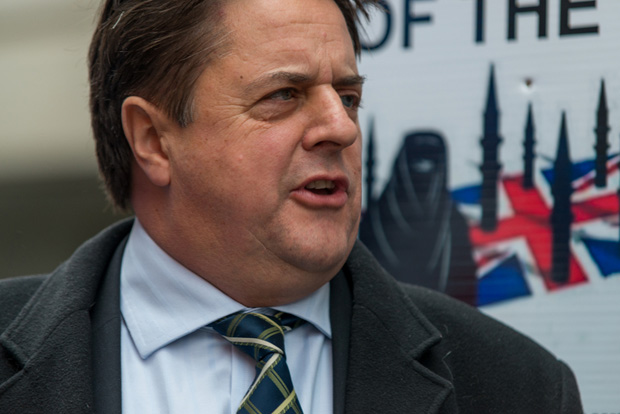
Nick Griffin outside the Old Bailey court on the first day of the trial of the murder of Lee Rigby (Image: Velar Grant/Demotix)
The most famous case in recent years was the 2007 appearance of BNP leader Nick Griffin (and Holocaust-denying historian David Irving) at an Oxford Union debate on free speech. The invitation caused massive uproar, with protesters picketing the event. “It is not just an Oxford issue, this will have ramifications for other places where the BNP are active… this is going to give legitimacy and credibility to their views,” said Student Union President Martin McClusky at the time. “I find the views of the BNP and David Irving awful and abhorrent but my members agreed that the best way to beat extremism is through debate,” argued Oxford Union president Luke Tryl. This is not only time the Nick Griffin has caused controversy as a potential university speaker. Trinity College Dublin cancelled plans to include him in a debate immigration, saying “it could not guarantee the safety and wellbeing of staff and students”.
2) Mufti Ismail Menk
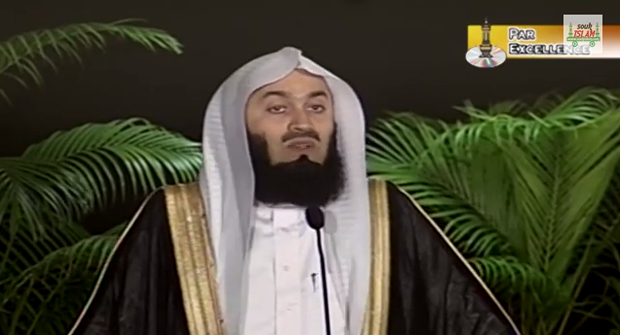
Mufti Ismail Menk giving a lecture (Image: soukISLAM/YouTube)
Islamic preacher Mufti Ismail Menk spoke at Liverpool University earlier this month. He has previously stated that gay people are “filthy” and “worse than animals”. The event was initially reported to be part of a longer tour stopping at Glasgow, Leeds, Liverpool, Leicester, Cardiff and Oxford universities. However, all except Liverpool, where he was hosted by the Islamic Society, revoked their invitation or said he had not been officially invited in the first place. Liverpool responded that it is “not the role of the university to censor people’s views”.
3) Mohamed El-Nabawy
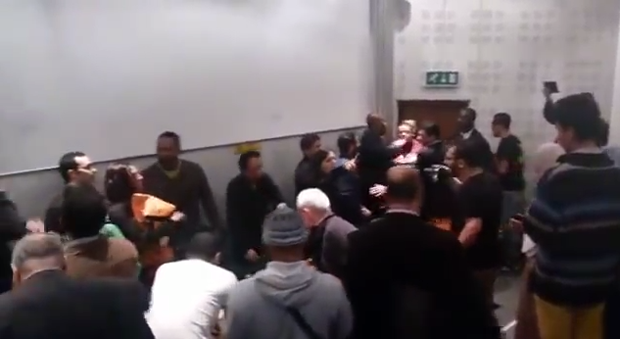
A video captured the protest that erupted when Mohamed El-Nabawy was due to speak at SOAS (Image: YouTube)
A representative of Tamaroud, the grassroots movement which played a significant role in the ousting of Egypt’s Muslim Brotherhood-backed elected government, was chased away by angry protesters prior to a scheduled talk at London’s School of Oriental and African Studies (SOAS). The protesters, who were not students, chanted and brandished posters associated with the Muslim Brotherhood at the open lecture. SOAS security had to escort El-Nabawy off campus using an emergency exit . A spokeswoman for the Palestinian Society, which had organised the talk, said: “In the pursuit of freedom of speech and expression, some people may find some of the views expressed at our events objectionable.”
4) David Gale
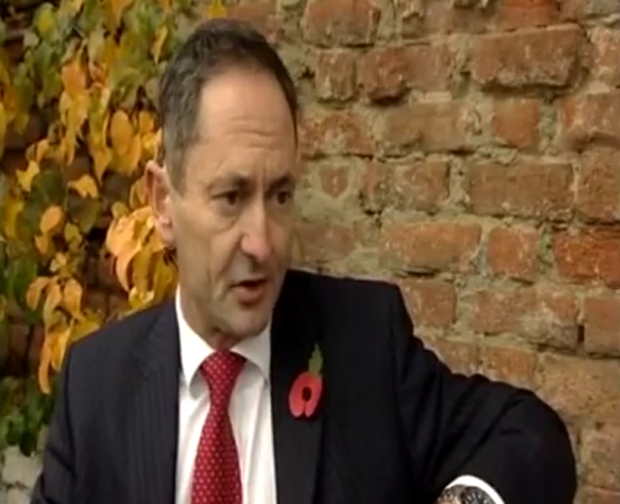
David Gale on the BBC’s Sunday Politics Show (Image: UKIPDerby/YouTube)
In 2012 the Student Union at the University of Derby banned David Gale, UKIP’s candidate for Police and Crime Commissioner, from taking part in a Q&A session at the university. The Union has a no platform policy for “individual(s) who they believe to be a member of a group with racist, fascist or extremist views”, a category the Union believed was applicable to UKIP . UKIP leader Nigel Farage weighed in on the issue at the time, saying: “It is frightening that a Derby student body is so frightened of free speech and public opinion.”
5) George Galloway
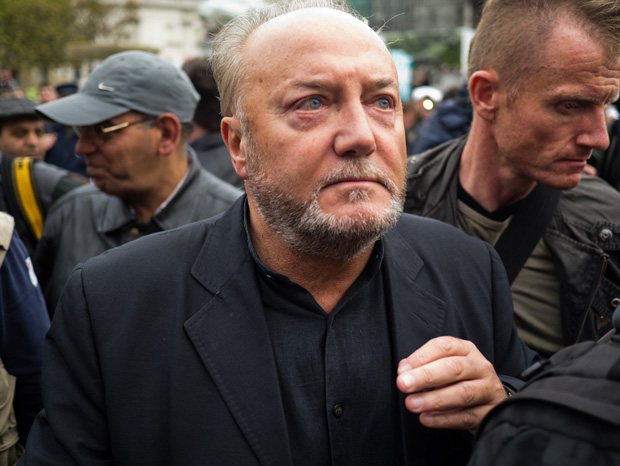
George Galloway attends an anti-war rally in 2011 (Image: Paul Soso/Demotix)
In March, George Galloway was set to speak at an event organised by the University of Chester Debating Society. However, the invitation was revoked by the Student Union, acting in line with the NUS’ No Platform policy on Galloway. This move came after the Respect Party MP was involved in a string of controversial incidents, including refusing to debate with an Israeli student at an Oxford University panel discussion. Galloway’s camp have called the policy “idiotic, anti-democratic and politically-motivated”.
6) Julie Bindel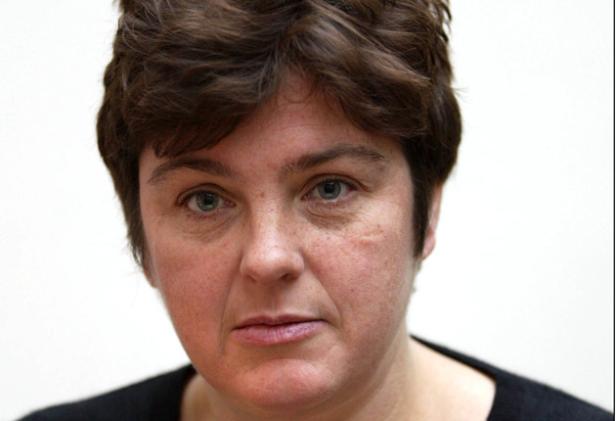
In September, the Debating Union at Manchester University (MDU) invited feminist writer and campaigner Julie Bindel to speak at their discussion on pornography. A number of people objected due to Bindel’s reported views about transexual people, which have led to the NUS implementing a No Platform policy for her. Some transexual students and their supporters “felt Julie Bindel’s transphobic statements and views made them both unwelcome at the event, and unsafe on campus, as it seemed that transphobia was being allowed and possibly encouraged,” said Loz Webb, the university’s Trans* representative. Despite this, MDU refused to replace Bindel, though she eventually chose to drop out after receiving death threats.
This article was originally posted on 29 Nov 2013 at indexoncensorship.org
21 Nov 2013 | News, United Arab Emirates
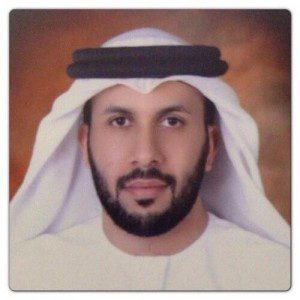
Waleed al-Shehhi (Image @uae_detainees)
The measure of an effective police state is one where violence is used sparingly and fear is saturated across the population. A regime attempting to achieve this is in the United Arab Emirates (UAE), where a series of show trials and convictions against online activists highlight an authoritarian regime’s attempts to quell growing dissent among a repressed citizenry.
On Monday, 18 Nov, Waleed al-Shehhi was sentenced to two years in prison and fined 500,000 dirhams (£84,600) for using Twitter to question the handling of a political trial by authorities. He was convicted of violating the Cybercrimes Decree, which was passed in November 2012 and outlaws the use of information technology to, among other things, criticise actions of the state.
The cybercrimes decree has been decried as a piece of legislation that restricts free speech. It does not function as a piece of legislation, however, but as a strategically deployed tool to warn citizens of topics that are not acceptable discussion points. In the case of Waleed al-Shehhi, the redline topic was his questioning of authorities’ failure to investigate allegations of torture against political prisoners.
Al-Shehhi is the second person to be convicted of violating the cybercrimes decree, with the first, Abdulla al-Hadidi, recently released after serving a 10-month prison sentence. In the case of al-Hadidi, he was convicted of ‘spreading false information’ about a trial of political dissidents from which foreign media and international human rights groups were barred from attending. The redline topic in this instance was the spreading of information the state wished to keep secret; namely, the torture of political prisoners and details of a trial described by the International Commission of Jurists as “manifestly unfair”.
In both cases the online activists have been convicted of discussing a political trial. In the same way that the cybercrimes decree has been used strategically, authorities have accused those deemed most likely to be the source of a challenge to their autocratic power of seditious crimes.
After a petition was sent to the president in March 2011 calling for an accountable parliament, authorities prosecuted 5 liberal activists for insulting the rulers. After this, there was a trial of 94 political activists accused of attempting to ‘seize power’. There is also an ongoing trial of 30 Egyptians and Emiratis accused of establishing an illegal branch of the Muslim Brotherhood. Each trial has been marred by accusations of torture, arbitrary detention and a severe lack of due legal process.
However, as the Emirati authorities are finding out, the problem with arresting online and political activists is that with each unfair trial several, new Twitter accounts pop up to criticise the state. Whilst many citizens will be frightened of criticising authorities, there are others who remain steadfast in their commitment to expose the inequities of the state. Although the internet faces many challenges in meeting its emancipatory expectation, for those who are using it to challenge authoritarian regimes it remains a platform that their oppressors cannot fully co-opt. The UAE is trying hard to stamp out even the mildest form of dissent, but the paradigmatic shortcomings of a pre-internet police state theory have rendered their efforts a failure. As Dr. Christopher Davidson, author of After the Sheikhs, says: “the recent introduction of very punitive anti-free speech legislation, often specific to difficult-to-censor cyber activities such as social media, is being used to put people off spreading wider discussion of these human rights abuses in an arena that the authorities are ultimately unable to police”.
Active Twitter hash-tags ensure that debate of repression in the UAE remains vibrant. There is already an active discussion about the imprisonment of Waleed al-Shehhi and an 18-month long discussion calling for political prisoners to be freed continues unabated. As long as authorities allow citizens free access to social media websites their legislative attempts to silence dissent are likely to be futile. Indeed, should the day come when they deem it necessary to block such platforms, it could spark widespread civil disobedience in a country that has largely avoided the upheaval of the Arab Spring.
This article was originally posted on 21 Nov 2013 at indexoncensorship.org
18 Nov 2013 | Palestine
A Palestinian news agency closed down in the Gaza Strip for allegedly fabricating reports regarding Hamas and their support for pro-Morsi Egyptian Islamist groups is to reopen after four months.
The decision to allow work once again at the offices of Ma’an News Agency, the largest independent TV, radio and online media group in the West Bank and Gaza Strip, was the result of a meeting between the Hamas leader President Haniyeh and those of Palestinian factions on Saturday. According to Khaled al-Batsh, leader of the Islamic Jihad Movement, the meeting was called by Haniyeh to deliberate issues in the Gaza Strip, including potential reconciliation among Palestinian political factions. The Palestinian president Mahmoud Abbas’s Fatah movement was not represented at the meeting.
A spokesman for Hamas, Ehab Ghissin, stated that Haniyeh “gave his instructions for the Ministry of Information to open the agency’s bureau” as long as Ma’an abides by professionalism and accuracy in its work.
The office of Ma’an was closed down in July after publishing reports suggesting Hamas was involved in supporting terror groups opposed to Egypt’s new regime. Citing Israeli sources the article stated the Hamas government gave refuge to fugitive leaders of the Egyptian Muslim Brotherhood in a Gaze hotel. After the meeting President Haniyeh spoke of the importance of a positive relationship between Egypt and Palestine, emphasising that Hamas is a national movement that does not depend on external organisations.
The decision to reopen the news office in Gaza was welcomed by Ma’an General Director, Raed Othman. “Ma’an aims to provide its media services to all Palestinians everywhere,” he said, adding that the news organisation will attempt to increase its activity in the area in the coming weeks.
The Saudi Arabian news channel Al-Arabiya was also shut down for the same reason and at the same time as Ma’an. Despite discussion during Saturday’s meeting to reopen Al-Arabiya too, the organisation remains closed in the Gaza Strip. The news channel has openly stated it was in favour of the removal of President Morsi from power.
7 Nov 2013 | Africa, News
1) Angola
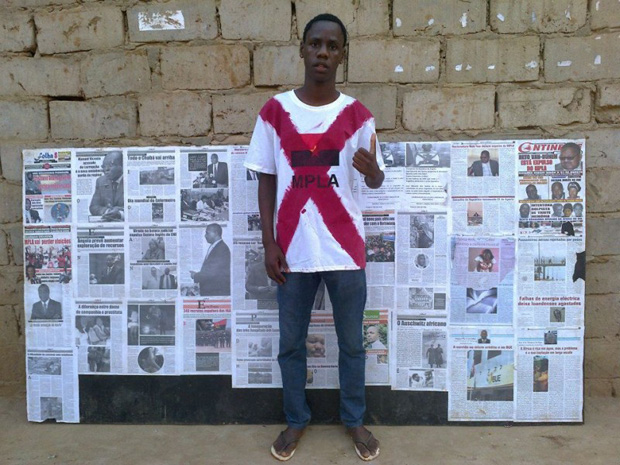
Manuel Chivonde Nito Alves was held in solitary confinement for printing t-shirts. Image from his Facebook page.
Angolan 17-year-old Manuel Chivonde Nito Alves went on hunger strike on Tuesday, following his arrest on 12 September for printing t-shirts with the slogan “Out Disgusting Dictator”. The message was aimed at the country’s President Jose Eduardo dos Santos, who has held power in since 1979. The shirts were to be worn at a demonstration in the capital Luanda, highlighting corruption, forced evictions, police violence and lack of social justice under dos Santos’ regime. Nito Alves has been charged with “insulting the president”, and has now spent almost two months in detention – parts of it in solitary confinement. His family were barred from seeing him, and three weeks went by before he was allowed to speak to a lawyer. The hunger strike is in protest at his “unjust and inhumane treatment”.
2) Belarus
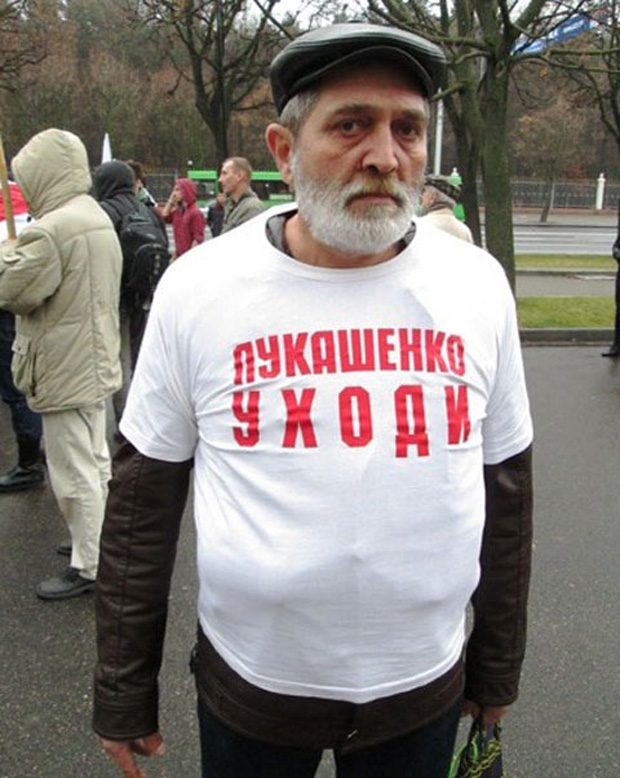
Yury Rubstow wearing the t-shirt that landed him in prison. (Image Viasna Human
Rights Centre)
On Monday, Belarusian opposition activist Yury Rubstow was sentenced to three days in jail for wearing a t-shirt with the slogan “Lukashenko, go away” on the front, and “A four-time president? No. This is not a president but an impostor tsar” on the back.” The message was aimed at the country’s dictator Alexander Lukashenko, during an opposition protest march. He was found guilty of disobedience to police officers under Article 23.4 of the Civil Offenses Code.
3) Swaziland
In 2010, Sipho Jele, a member of Swaziland’s People’s United Democratic Movement, was arrested for wearing a t-shirt supporting the party during a May Day parade. He was arrested under the country’s Suppression of Terrorism Act, and died in custody. The police said he had hanged himself, while the party say the police of killed him.
4) Egypt
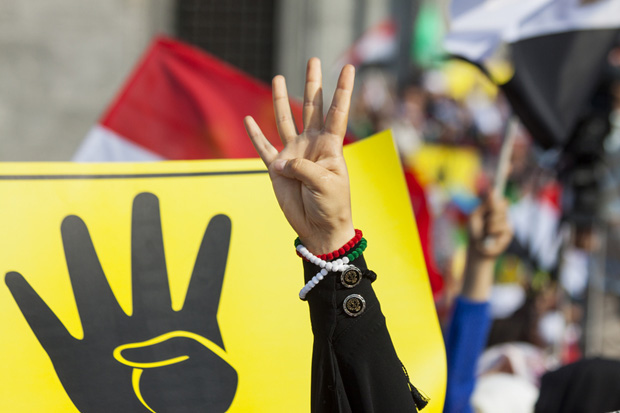
The Rabaa symbol displayed at a protest in Turkey (Image Bünyamin Salman/Demotix)
In September, three Egyptian men were arrested for wearing t-shirts emblazoned with the Rabaa symbol. A hand holding up four fingers, it is widely used by those opposing Egypt’s interim military-backed government, and the coup that ushered in in. Mohamed Youssef, the country’s kung fu champion, was also suspended by the national federation for wearing a similar t-shirt during a medal ceremony.
5) Hong Kong
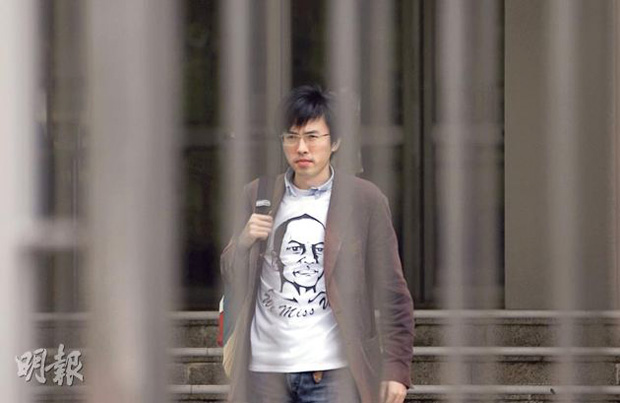
Avery Ng wearing the t-shirt he threw at Hu Jintao. Image from his Facebook page.
An activist from Hong Kong was arrested last December for throwing a t-shirt at former Chinese president Hu Jintao during an official visit almost six month earlier, on 1 July. League of Social Democrats Vice Chairman Avery Ng threw a t-shirt with a drawing of the late Chinese dissident Li Wangyang, a Tiananmen Square activist who died under suspicious circumstances only weeks before the visit. Ng was charged “with nuisance crimes committed in a public place”.
6) Malaysia
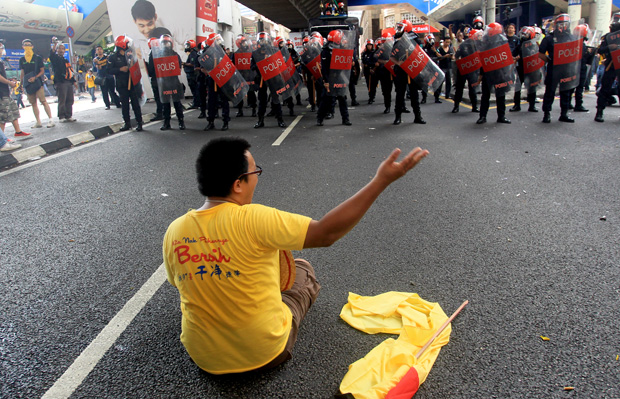
Malaysian protester wearing a Bersih shirt. (Image Syahrin Abdul Aziz/Demotix)
In June 2011, Malaysian police arrested 14 opposition activists for wearing t-shirts promoting a rally in Kuala Lumpur calling for election reform. The shirts carried the slogan “bersih” which means “clean”, and is the name of one of the groups behind the protest. Authorities claimed the demonstration was an “attempt to create chaos on the streets and undermine the government”, and they were therefore within their rights to arrest the protesters. They also confiscated t-shirts from the group’s headquarters.
7 & 8) The US
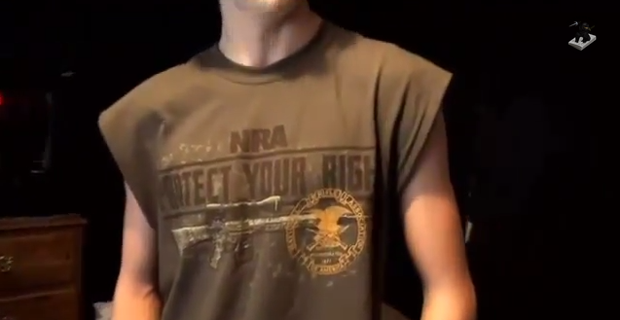
Jared Marcum wearing his NRA t-shirt in a TV report. (Image Youtube)
A 14-year-old student from West Virginia was in April suspended from school and subsequently arrested for refusing to remove a t-shirt supporting the pro-gun National Rifle Association. Jared Marcum was charged with “obstructing an officer” and faced a $500 fine and up to one year in prison.
On the flip side, a Tennessee man was arrested for wearing a t-shirt in support of stricter gun control laws. Stanley Bryce Myszka was wearing a shirt that read “Has your gun killed a kindergartener today?” at a shopping centre, following the shooting at Sandy Hook Elementary School. He was approached by security guards, who called the police when he when he refused to remove the shirt. He was also banned from the shopping centre for life.
9) United Kingdom
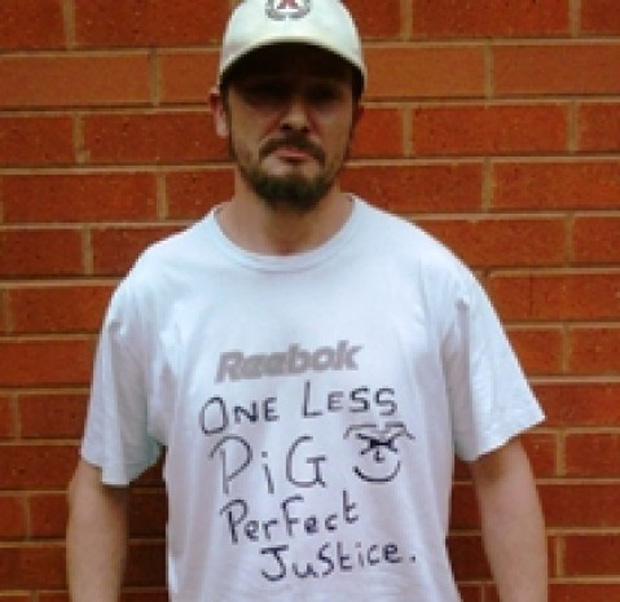
The front of Barry Thew’s t-shirt. (Image Greater Manchester Police)
A Manchester man was in October 2012 sentenced to eight months in prison in part for wearing a t-shirt emblazoned with offensive comments referencing the murders of two policewomen. Barry Thew had written “One less pig; perfect justice” on the front of his t-shirt and “killacopforfun.com haha” on the back. While four months of the sentence was handed down for breach of a previous suspended sentence, he was charged on a Section 4A Public Order Offence for the t-shirt incident.
