30 Oct 2013 | Egypt, News, Religion and Culture
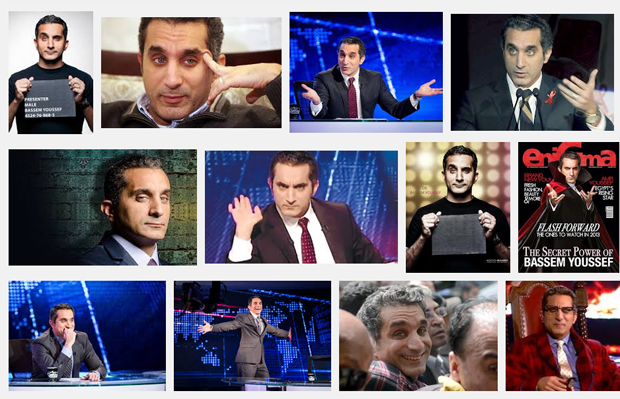
After months away from the small screen, TV satirist Bassem Youssef is back on the air but it is uncertain how long he’ll stay. After a four month absence (Youssef’s disappearance coincided with the overthrow of Egypt’s first democratically-elected President by a military coup) he returned to the airwaves last Friday with a new episode of his weekly TV show Al Bernameg (The Programme). The episode sparked a new wave of controversy, reflecting the deepening divisions in Egyptian society.
Just 48 hours after the show was broadcast, the Public Prosecutor ordered an investigation into a legal complaint against Youssef, one of several filed by citizens angered by his mockery of the military chief. Others were upset by jibes he made at the former ruling Islamists. Youssef has been accused of “inciting chaos, insulting the military and being a threat to national security.”
Youssef is no stranger to controversy. He caused a stir when he mocked the now deposed Islamist President Mohamed Morsi on his show, broadcast on the independent channel CBC. At the time, several lawsuits were filed against him by conservative Islamist lawyers who accused him of “insulting Islam and the President” and Youssef consequently faced a probe by the Public Prosecutor. The charges against him were dropped several months later however. President Morsi was careful to distance himself from the legal complaints filed against Youssef, insisting that he “recognised the right to freedom of speech.” While the lawsuits did little to harm Youssef (in fact, they actually contributed to boosting his popularity and improving the ratings of the show), they did damage the image of the ousted President, who was harshly criticised for “intimidating and muzzling the press.” A couple of months before his removal from office, Morsi was accused by critics of “following in the footsteps of authoritarian Hosni Mubarak and of using repressive tactics to silence dissent.”
Now, under the new military-backed interim government, Youssef finds himself in hot water again. This time the TV comedian, known as Egypt’s Jon Stewart, is in trouble for poking fun at leaked comments by the Defence Minister, General Abdel Fattah al-Sisi, suggesting that the General would “find partners in the local media willing to collaborate to polish the image of the military.” In recent months, Youssef has maintained an objective and neutral position vis a vis the events unfolding in Egypt. In his articles published in the privately-owned Al Shorouk daily, he has expressed concern over the brutal security crackdown to disperse two pro-Morsi sit ins in Cairo on August 14, in which hundreds of Muslim Brotherhood supporters died. But he has also been careful to criticise the attacks on churches (often blamed on Islamists) following the coup.
Friday’s episode, which marked the start of a new season for the show, focused in part on the blind idolisation of al-Sisi by many Egyptians since the coup. The word coup was never once mentioned on the programme. In one scene, Youssef is seen putting his hand over the mouth of one of his assistants in an attempt to silence him as he utters the now-taboo word. In recent weeks, calls have grown louder for the General to run in the country’s next presidential election and a group of adoring fans has even begun collecting signatures for his candidacy.
The fact that Youssef is being prosecuted again after what many Egyptians consider was a “second revolution” signals that the June 30 revolt that ousted the Islamist President has failed to usher in a new era of greater press freedom .The lawsuits serve as a chilling reminder of the dangerous polarisation in the country, which some analysts warn may push it into civil war and chaos. While Youssef did take part in the June 30 protests that toppled Morsi, he has clearly decided not to take sides in this hostile environment. In an article published days before the show, he noted that many Egyptians advocate for free speech and democracy “as long as it is in their favor” but turn against you the minute your opinions differ from theirs. Aware that his episode had ruffled feathers, he sought to ease tensions with a message on Twitter that reminded his viewers, fans and critics alike, that at the end of the day, this is just “another episode in a TV show.”
This article was originally posted on 30 Oct 2013 at indexoncensorship.org
28 Oct 2013 | Egypt, News

An image from Ghada Wali’s Film Ikhwany
A London gallery has found itself in a censorship dispute, after deciding not to exhibit 12 prints satirising Egypt’s Muslim Brotherhood and jailed former president Mohamed Morsi.
In The City, an exhibition dealing with the four Arab cities of Alexandria, Algiers, Baghdad and Nablus, is currently taking place at the P21 Gallery. Twelve posters by Egyptian artist and graphic designer Ghada Wali, making up the piece Film Ikhwany, were supposed to be part of the Alexandria portion. Using images of Mohamed Morsi on a series of film posters, it aims to deny the “‘Brotherhoodisation’ of Egypt”.
However, four days before the opening on 26 September, curator Danah Abdulla was told by the gallery that the prints were not to be exhibited after all. She was told they had taken legal counsel and that the images were deemed “too risky”. She was asked to find new pieces to go in their place.
When she challenged the decision, she was told the work was too politicised and did not fit in with the rest of the exhibition. This came after the images had been used in press releases. When she kept pushing the issue, it was suggested she alter the posters to remove text that could be perceived as controversial.
“I was told the gallery was not a political space, but they have had two extremely political exhibitions in the past,” she said, referring to their recent one dealing with the Syrian civil war. “This exhibition is not purely political, it is about the city, therefore you do touch on the politics. I’m not going to pretend the city is unicorns and ponies.”
“The work is opinion, it’s not fact. Everything is opinion, it’s not stating anything factual. It’s freedom of expression, plain and simple, so I didn’t really understand why they were so worried about the work,” she explained.
The designer Ghada Wali said she wanted to shed light on the political struggle in Egypt through her work, but never though it would be deemed too risky to exhibit in the UK, where freedom of expression is valued and protected.
“At the end of the day, I am a free artist; I sense what I want to communicate in my artworks and which angle to tackle. This is art after all, it is not science and not literature that can be proved wrong. In Egypt, where the political agony is actually happening, I still can never be deprived of displaying my pieces. Yes, my designs can be sprayed by brotherhood supporters because they disagree with me, however I can never find an official entity crossing out my work.”
She added: “As an artist, I believe that my work has to play around the edges of the issue. My core belief as a person and my mission as an artist is to tackle a real issue. However, maybe drawing around a real issue nowadays is perceived as ‘risky’?”
The images have since been displayed London’s Hardy Tree Gallery as a solo show, with the title “The Censored”.
“It’s not to embarrass the [P21] gallery. It’s to say this [censorship] is happening here in London, and it shouldn’t happen,” concluded Abdulla.
Index has made repeated attempts to contact P21, but so far have not revceived a response to our questions.
UPDATE:
P21 responded with a statement saying the works did not adequately support the exhibition narrative, and there were worries they would “negatively impact the exhibition, the P21 Gallery and the other 11 designer’s exhibiting works.” They added that there were concerns about the level of attention the curator appeared to be placing on Film Ikhwany, as well as “about the Gallery being used for an offshore political agenda with indications that the graphic designer in Egypt was influencing the exhibition via the curator.”
They also said a number of alternative options were offered to and discussed with Danah Abdulla, including postponing the show, contact the designer directly to find a solution and exhibiting other works by the designer in future shows.
Find the rest of Film Ikhwany below, courtesy of Ghada Wali:


This article was originally posted on 28 Oct 2013 at indexoncensorship.org
23 Oct 2013 | News, Pakistan, Religion and Culture
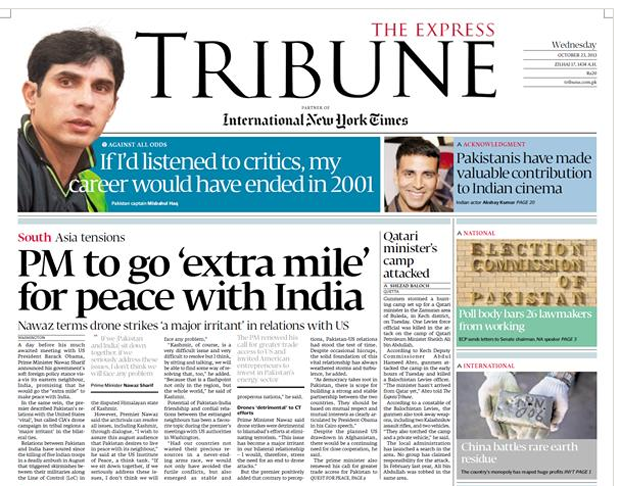
It’s been over two weeks now that Rana Tanveer, a reporter in Lahore at the English daily, Express Tribune, has not gone to work.
Early this month, he received a one-page letter, in the Urdu language, terming him an apostate and accusing him of writing in favour of Ahmadis and Christians.
“It warned me to stop writing ‘against’ Islam and seek ‘forgiveness’ from God,” he said over the phone from his home in the Punjab province.
It further warned him that if he did not desist, he would be killed — since that is the punishment of a person declared an apostate.
“I can’t work like this; no reporter can, if he cannot roam about freely,” said Tanveer.
Initially, he did not take the letter too seriously, but a week after he received the letter, he felt he was being followed on a motorbike. “It’s a scary experience,” he conceded, adding: “I made a few turns just to be sure that this was not a figment of my imagination, but the man on the motorbike persisted. I knew then that this was no joke and I had to do something.”
His seniors at work advised him to at least file a complaint with the police, which he did, but he did not name anyone “due to security reasons”.
“My editor told me to keep a low profile and not to report on minority issues for a while, and if I had to, it would go without by byline,” said the journalist.
Farahnaz Zahidi, features editor in the same paper as Tanveer’s feels very strongly about one’s byline being taken away. “As a journalist, perhaps the biggest satisfaction in this otherwise perilous and often under-paid profession is one’s by-line; it also lends credibility.”
However, she added, by shooting the messenger, society loses out. “The right to information is threatened when media persons threatened.”
Tanveer finds a plethora of minority rights abuses strewn around his city but says few journalists feel inclined to take up these issues.
“Mine seems to be a lone battle,” he said. “I am often scorned by my colleagues for reporting ‘chooras’ (derogatory term used for Christians, also among the poorest sections of society and consigned to menial janitorial jobs) and ‘Qadianis’ (also a derogatory name for those belonging to the Ahmadi faith, declared non-Muslims by state in 1974),” he said.
But it’s not indifference to these rights issue alone that keeps journalists from reporting on them. Senior journalist and communication expert, Babar Ayaz, says it is also quite dangerous to write about “the victimisation of Ahmadis, Christians or Hindus”.
Nevertheless, he added: “Journalists have to write what is right. Threats and killings are hazards of this job living in an increasingly intolerant society.”
He remembered when he wrote a piece on the attack on the massacre of Ahmadis in Lahore [in May 2010], he received a couple “abusive phone calls”. He also received some angry messages on a chapter in his book titled: What’s Wrong With Pakistan? The book, which was published in August criticises Islamic laws in Pakistan.
“But we are small fry,” said Ayaz. “When Nawaz Sharif expressed condolence on the killings of ‘our Ahmadis bhais [brothers]’ some mullahs said that by calling them ‘bhai’ he had committed a sin. The extremists have no logic but they have muscle power,” he added.
According to Aamer Mahmood, who heads the press section of the Ahmadiyya Jammat, and is in regular touch with several journalists: “The fear among them is palpable. While many empathise with us for the way our rights are trampled, they say their hands are tied. Some are scared of the wrath of the extremists; others fear they will lose their jobs.”
“It is indeed becoming more dangerous to write on these issues, in any language,” agreed Kamila Hyat, a rights activist and former editor of English daily The News. “I believe that while sections of the English language press remain relatively liberal, more and more are succumbing to the bias and intolerance we see everywhere,” she pointed out.
“The manner in which the ‘agenda’ for news is set, notably by the electronic media, also shoves minority issues to the sidelines, and intolerant mindsets exist everywhere — even among the educated,” she said.
With seven journalists having lost their lives since January this year, according to the 2013 Impunity Index report by the Committee to Protect Journalists (CJP), just last year, Pakistan which was ranked tenth, has moved two spots up at eighth position for the worst place for the press. Further, it has been declared more dangerous than Russia, Brazil, Nigeria and India.
According to the CJP, 28 Pakistani journalists have been murdered since 1992 in connection with their work, 27 of whom were killed with impunity. The deaths of 24 additional killed during the same period cannot be confirmed as “targeted.”
“Doing journalism in Pakistan is not easy, which is ranked the third most dangerous country for reporting after Syria and Egypt,” observes Mazhar Abbas, former secretary general of the Pakistan Federal Union of Journalists, a formidable voice fighting for the rights of journalists. While journalists continue reporting despite threats particularly those working in the Federally Administered Tribal Area (FATA), Balochistan and even in the southern port city of Karachi, Abbas said, reporters from the Punjab province seemed comparatively safer.
But not anymore, it seems.
Abbas said every threat should be taken seriously. “The letter to Tanveer could be an individual act or from a group. The government and administration need to probe this matter and find out about the person who sent this letter in the first place. Journalists reporting on sensitive issues should do so responsibly; their reports should be factually correct with minimum expression that can lead to stoking up controversy.”
This article was originally posted on 23 Oct 2013 at indexoncensorship.org
18 Oct 2013 | About Index, Events, Volume 42.03 Autumn 2013
The following speech by Sarah Brown, education campaigner for A World at School, was delivered at the launch event for the autumn issue of Index on Censorship magazine.
I am delighted to be at Lilian Baylis Technology School – I went to school in North London, but my first flat was just down the road from here – I know how hard everyone at this school has worked for it become the first in Lambeth to get an outstanding in its Ofsted and now stands out as ‘outstanding in all aspects’ in the top 10% in the country. Being named for a pioneering woman who nurtured some amazing talent in the theatre, opera and ballet worlds leaving her mark across London gives the school a lot to live up to, but clearly nurturing some amazing talent here of its own these days.
Index on Censorship’s magazine that we are launching here tonight also serves to highlight some talented voices, and some very courageous ones too. Like all of the magazine editions which came before it, it is distinguished by both the quality of its writing and the bravery of its stance. But this one is particularly important to me for the priority it has placed on the voices of women. From pioneering feminists writing about women’s safety in India to the stories of female resistance and of hope from the Arab Spring, this magazine is giving a megaphone to the people whose contribution is so often marginalised, ignored, or eliminated altogether.
In the spirit of Index on Censorship’s core values, the power of our voice is the theme of my remarks tonight. And I want to start by updating a feminist slogan that lots of women who have done pioneering work on role models have been using for years now. Their view is ‘if she can see it, she can be it’. In other words, if you have a visible role model you are much more likely to keep fighting to get past all of the hurdles that are still too often put in the way of girls and women, just as they are for people who are disabled, or LGBT or BAME, or hold a forbidden political viewpoint in the harshest of regimes around the world.
‘If you can see it, you can be it’ – I very much think that’s true – the importance of strong visible women role models. Even my own sense of what is possible for me has certainly been determined by watching women – whether my own mother learning and leading throughout her life, from running an infant’s school in the 70’s in the middle of Africa, completing her PhD a few years go in her seventies and even now I am struggling to keep up her as she launches a new project leading the research on a study of quilt-makers (mostly women) and the stories they tell. Other role models from me have ranged from the icons of my teenage years from poet and rock artist Patti Smith to writer Jill Tweedie to American feminist Gloria Steinum. Today my work leads me to meet such a range of inspirational women leaders from Graca Machel to Aung San Suu KyI to President Joyce Banda of MalawI to young women like AshwinI Angadi, born blind in a poor rural community in India she fought for her education, graduated from Bangalore university with outstanding grades, gave up her job in IT to campaign for the rights of people with disabilities, and I find myself alongside at the UN last month.
So I agree that visibility counts, but if I think of my role models they are all women who never give up raising their voices – who make a career literally of speaking up. And I want to update that old slogan with a rather more disturbing thought and suggest tonight that if you can hear her, you will fear her.
Let me explain what I mean.
From Nigeria to Egypt to Yemen and Afghanistan to the richest countries of the West, we are seeing the rise of targeted attacks focused on women who use their voice to speak out for other women. Sometimes these attacks are physical, and I will talk about them more in a moment. But here in the UK there has been a spate of attacks which are verbal and online, and which are perpetrated by men who fear women’s power.
From the disgusting rape threats directed at Caroline Criado-Perez for daring to suggest a woman should remain on British bank notes to the horrendous and sexualised verbal violence meted out to Mary Beard after she appeared on question time to model Katie Piper finding her online voice speaking up for the stigma of disfiguration in a defiant response to the acid attack on her, and the creation of her defiant new beauty at the hands of her NHS surgeon. And of course, the all too prevalent victims of domestic violence who get a collective voice through women’s aid and the main refuges around the UK – who speak up more when they see it can even happen to a goddess like Nigella.
It is clear that the public square – and too often the private home – simply doesn’t provide a safe environment for Britain’s women.
If anybody doubts how bad things have got, I’d encourage you to go and take a look at Laura Bates’ work with the Everyday Sexism Project, an online directory of harassment, discrimination and abuse submitted by over 50,000 women who are shouting back. It paints a picture of a Britain in which violence and the threat of violence against women is so routine, women had almost ceased to notice it as a crime and an outrage, until a platform came along that gave their problem visibility and, with it, importance.
So I want to suggest that a public square which is so hostile to women that they do not feel they can participate in it without inviting overwhelming abuse is, itself, a form of censorship. It might not be the same process as smashing up a newspaper office or burning a book or even shooting teenage girls on a school bus, but the effect is the same: that of silencing a voice which has a right to be heard.
And if you want further evidence of how hearing how women’s voices can terrify those who risk losing their power, just consider how the worst misogynists in the world were afraid of just three words.
The words I’m talking about weren’t said by somebody famous. They weren’t said by somebody powerful. They hadn’t even been planned before they were uttered. But they awoke the world.
Malala YousafzaI as a schoolgirl from rural Pakistan published her youthful diary detailing how life had changed for girls after the Taliban took over her mountain town. She and her friends Shazia and Kainat spent the next few years campaigning for girls to be allowed to return to school, although they knew how dangerous speaking out against the Taliban could be. Malala even talked in interviews about how they might try to kill her for it.
Just over a year ago, this worst imagining happened and Malala was targeted by a Taliban assassin. He boarded the school bus, identified Malala and shot her in the head, and injured Shazia and Kainat sitting either side of her. As the footage of Malala’s airlift to safety was broadcast young women used just three words to claim their solidarity and support with her “I am Malala’. She and her two friends are all now safely in the UK continuing their education, and as the worlds’ gaze has given them some safety the campaign continues with a growing movement of young people all of whom are role models for every child around the world, whether in school or waiting for the dream to come true and the opportunity to learn coming to them too.
It was such a powerful reminder of a question I first asked myself some time ago:
Why is the most terrifying thing for the Taliban a girl with a book? Or for that matter the terrifying group in Nigeria – Boko Haram – who are firebombing schools and dormitories while students sleep. Boko Haram – the name literally means – western education is evil.
These terrorists know, better than we do, that a girl with an education is the most formidable force for freedom in the world. A girl who can read and write and argue can be brutalised and oppressed, she can be bought and sold, discriminated against and denied her rights. But she cannot, in the end, be stopped.
Girls like Malala, Kainat, Shazia and others in the end, will prevail.
And that is why they hate them so.
And so it seems to me if a girl like Malala, on her own, can inspire so much fear, then imagine what she could do if backed by a movement of hundreds of millions. That is why I believe that the efforts to achieve global education are at the heart of how we unlock the potential of every young citizen. As children learn, they achieve understanding, tolerance, opportunity and the chance to contribute to a better world. Reaching girls is at the heart of this – we need to do so much better for girls.
Right now, there are 57 million children missing from school. That’s 57 million of our younger selves missing out on the education which could transform not just their lives, but the world. 31 million are girls, and of those at school, many many millions are not learning, and girls are just not getting the same number of school years as their own brothers – to the detriment of everyone.
New research has shown that providing universal education in developing countries could lift their economic growth rates by up to 2% a year and the results are starkest of all when it comes to educating girls.
All the evidence shows that for every extra year of education you give a girl, you raise her children’s chances of living past five years old, because educated mums are more likely to immunise their kids and get them the health care they need. Educated girls are more likely to stay AIDS-free and are less vulnerable to sexual exploitation by adults. They marry later, have fewer children and are more likely to educate their children in turn. Perhaps most importantly of all, education increases a girl’s chance of well-paid employment in later life and the evidence suggests that female earners are more likely to spend their wages to the benefit of their children and community than traditional male heads of the household.
And the benefits, of course, don’t always stay just on a local community level, but can sometimes have national and even global implications too. Because if you look at women who have been in leading positions in every continent around the world – from Sonia GandhI to Graca Machel to Dilma Rousseff to Joyce Banda, they all have one thing in common. They all have an above average level of education. And that’s why one of my new mantras is women who lead, read.
If we want better politics, a politics of pluralism and freedom of expression around the world, then it begins with empowering women – and that begins with educating them.
So there are plenty of good reasons to invest in education and learning for every child – but the best bit is that we’ve already promised to. We are not advocating for a new pledge, simply for the fulfilment of one already made. In the year 2000 world leaders committed to getting every child in school by 2015 as part of a series of ambitious targets called the millennium development goals. World leaders have already signed the contract, now they just need to deliver the goods.
So for me the argument about whether we should invest in education to get the 57 children missing from school into the classroom is a bit of a no brainer – and for me there is no question that closing the gender gap in education should be the priority. As soon as people hear the facts, they tend to stop asking whether we should do it and start to focus on whether we can.
That’s a fair question and people will always want to probe whether we can make a difference to decisions taken hundreds of thousands of miles away. It’s a question I ask myself a lot too. But I take heart from two things. Firstly, we know that progress is possible even on seemingly very big problems because we have made it before. You can look at the big changes in the last century or so – from the end of slavery, achieving the vote for women, the end of apartheid – all started as impossible calls for change, but change came. Enough voices gathered together calling for the same thing – even a politician can’t fail to hear the call then, or if minded to change anyway can do so with a strong mandate behind him or her. Even campaigns I have contributed- that we may all have contribute to – from drop the debt to make poverty history to the maternal mortality campaign brought big changes – but I have heard first-hand what happens at the start – “it is too big an ask, it can’t be done in the time, it is too costly” – well enough free voices calling for action and – give it a little bit of time and a whole lot of noise – change comes. Less than ten years ago over 500,000 women were dying in pregnancy and childbirth unwitnessed, unacknowledged unnoticed by political leaders who held the power to save these lives. Today thanks to the collective voices of those who cared enough – through the white ribbon alliance and others, that number is a whopping 47% lower, and the work to reduce it further continues at the highest levels, and out in the more remote rural areas where the message needs to be carried far and wide to reach every woman at risk.
A 47% drop in the number of mothers dying. That’s not just a number – that means there are thousands of dads living with the love of their lives when they would otherwise have a broken heart nobody else could possibly mend. Thousands of big brothers and sisters who didn’t need to fear that in gaining a new member of the family they risked losing an old one. And thousands of babies being nursed to sleep tonight by the person who loves them most in the world and who has survived to love them as they grow. So this stuff works: campaigning is the key for all of us lucky enough to use our voices.
And on education, I am hopeful we can get even further than we have with the maternal mortality campaign, and achieve all of our goals by 2015. I know that sounds incredibly ambitious – because it means getting 57 million children into school in less than two years. Gordon and I have decided to devote the next years of our lives to this and we intend to be judged by our results. Increasing awareness is great – but if the numbers of children getting a high quality education does not increase in leaps and bounds in the years to come then we collectively will have failed.
Thankfully, we have a lot of help. When Gordon was appointed the United Nations’ Secretary General’s Special Envoy on education, the weight of the UN system was added to our cause. Business leaders have come on board to the Global Business Coalition for Education that I am fortunate to chair, and I am pleased that religious leaders have agreed to form a faith coalition to mobilise the faith communities as has happened so powerfully for debt relief and make poverty history in the past. Most significantly, younger people are lining up at as ambassadors, spokespersons, online champions and community mobilisers – the 600 strong youth leaders from the digital platform A World at School who assembled at the un on Malala Day in July, are all now engaging with their networks, supported by NGOs from around the world. The digital platform is growing rapidly, and the consistent messages, the constant call for action and the rising volume are starting to make a difference. From Syrian refugee children needing a place at school this autumn to young girls wanting to study before they marry in Yemen, Nigeria, Bangladesh to child workers who have never been inside a classroom, the momentum for them is growing.
This grand confluence of forces is powered by the single most important driver of change – every individual who cares enough to take up an action – whether just a tweet or post, or more. It includes you.
Because if we can’t mobilise millions of so-called ordinary people to do hundreds of extraordinary things, the governments of the world will conclude that the pledge they made to get every child into school can be allowed to quietly slip away, the pledge for gender equality ignored, the pledge that every child can be safe from violence, from trafficking and from finding their own voice just disappears. That would be a tragedy not just for the millions of children whose lives continue to be destroyed, but for the notion of progress itself.
If we can’t even rely on our leaders to do that which they have promised to do, can we rely on them to do all that we need them to do? I don’t want my children to grow up in a generation of cynics, a whole group of people who think that promises don’t get kept and politics doesn’t really work. I want them to see and to know that if we make a promise – particularly a promise to a child – we keep it. That when we see an injustice, we right it. That when we are presented with an opportunity we seize it. And that when we have the chance to change the world there is nothing we won’t do to see that potential fulfilled.
That, for me, is the ambitious spirit of activism which Index on Censorship embodies, and the one which we must now bring to bear in ensuring that the girls and women of the world learn first how to read, and then how to lead. This is the chance of our generation and I hope you, like me, think it is one we must grasp with both hands.
This speech transcript was originally posted on 18 Oct, 2013 at indexoncensorship.org
