14 Jun 2013 | Comment, Europe and Central Asia, News
Russia’s new blasphemy law is censorship under the guise of protection for believers, says Padraig Reidy
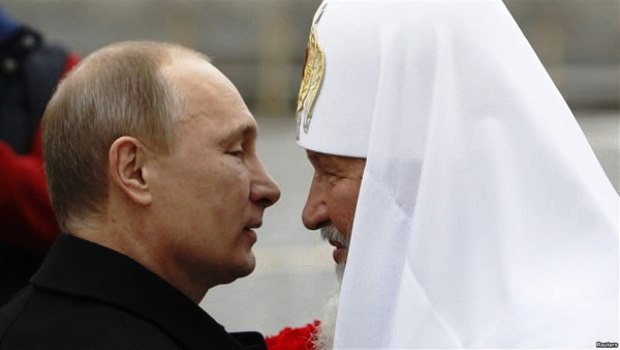
In his speech on Russia’s Constitution Day in December 2012, Vladimir Putin bemoaned the decline of spiritual values.
“Today, Russia suffers an apparent deficit of spiritual values,” said Putin, as his Orthodox ally Patriarch Kirill nodded along.
The former KGB man continued: “We must wholeheartedly support the institutions that are the carriers of traditional values.”
So far, so Mother Russia.
What was interesting was that the president went on to say that it would be “amoral” to create laws governing spirituality. Putin commented ““Any attempts of the government to intervene with people’s beliefs are effectively a sign of totalitarian rule. It’s absolutely out of the question. It’s not our way.”
This would seem at odds with this week’s passing of a new blasphemy law, which will impose prison sentences and fines on people convicted of “public actions expressing clear disrespect for society and committed with the goal of offending religious feelings of the faithful”.
But it is in fact very much in the mould of the current trend for religious defamation law.
Traditionally, blasphemy was the crime of causing offence to God himself; now it is recast as causing offence to believers. Blasphemy laws are here to protect us. Look back at the testimony durings Pussy Riot’s trial, and again and again you hear the stories of poor innocent believers who were shocked by the women’s behaviour; even if the Patriarch and the president had wished to forgive the punk group, they had to think of the poor pious babushkas who had been rocked to the very core by an act that some admitted to not actually having witnessed.
Shamefully, Ireland has led the way in this trend. The Irish Defamation Act of 2009 established definitions and punishments for blasphemy where none had previously existed (in spite of the fact that the 1937 constitution recognised blasphemy as a crime, it did not define what blasphemy was, and thus, there had never been a conviction for blasphemy, or even a full trial, in the country).
The Irish law defines religious defamation as any action likely to cause “outrage among a substantial number of the adherents of [a] religion”, with fines of up to e25,000 payable by those found guilty.
The wording of the Irish bill was used as a template in the Organisation of Islamic Conference’s attempts to get the UN to recognise religious defamation as a crime.
Of course, the old-fashioned definitions of blasphemy still exist: in Egypt this week, writer Amer Saber was given a five-year sentence for “contempt of religion” for authoring a short story collection called “Where is God?”. And in Syria, a teenager was reportedly shot in front of his family merely for uttering the name of Muhammad. The abuses of blasphemy law in Pakistan are only too well known.
But the justification for blasphemy laws, as with many other censorious impulses, is increasingly tied up in the idea that people should be protected from offence, from controversy, even from being challenged.
Perhaps the most offensive notion is that we cannot deal with ideas, even aggressively expressed ideas, that we disagree with. Government’s such as Putin’s are all too happy to shut down free speech and repackage censorship as benign protection.
11 Jun 2013 | In the News
CANADA
Rob Ford wins partial costs in wake of failed libel suit
Boardwalk Pub restaurateur George Foulidis must pay mayor and Bruce Baker $137,000, judge ruled Monday. (Toronto Star)
CHINA
Beyond the Great Firewall: How and What China Censors
China’s lack of transparency has long posed a daunting challenge to outside observers trying to understand what the government’s interests, goals, and intentions are. Gary King, a Professor in Government at Harvard University, has provided telling new insights into these questions with his research on the government’s censorship of social media websites. (The Diplomat)
EGYPT
Maspero in crisis: report
The AFTE also claimed former head of the state-run TV sector Essam El-Amir resigned last December because of intervention in the coverage of the presidential palace clashes. (Daily News Egypt)
HONG KONG
Yes, Free Speech Is Big in Hong Kong—Because They Must Constantly Defend It
Hong Kong has a strong tradition of free speech.” That’s how Edward Snowden, the 29-year-old leaker who slammed National Security Agency surveillance as an “existential threat to democracy,” described his decision to flee to China. (New Republic)
RUSSIA
Accusations of censorship as more exhibitions are shut down at Perm festival
The White Nights festival in Perm has come under pressure after four of its exhibitions have been closed, seemingly at the request of unhappy local politicians. In response, Marat Guelman, one of the festival’s organisers has accused critics of political game-playing. (Calvert Journal)
UNITED STATES
Should the Lubbock AJ host Blogs?: Freedom of Speech Issues
In the spring of 2012 I was invited to begin a blog hosted on the Lubbock AJ on-line site. Having been drawn into the arena of public debate during the effort to close the city’s Health Department I felt that such an opportunity to encourage civic involvement was a good idea.
(Lubbock Avalanche-Journal)
‘Free Speech’ Doesn’t Include Showing Dead Fetus Posters to Kids
The Supreme Court refused to hear the appeal of an anti-abortion protestor who claimed his free speech was violated by the state of Colorado. By declining to hear the case, the Court allowed a lower court ruling barring certain types of anti-abortion protests in public areas to stand, which, on its surface, might sound like a good thing. But the truth’s a little messier.
(Jezebel)
As libel trial losers battle $1M legal bill, FBI probes claimed mid-trial DUI set-up of their lawyer
The trial in a defamation case between two radio shock jocks in Florida has been over for months. But there’s no end in sight to continuing issues involving the law firms for both sides, the Tampa Bay Times reports.
(ABA Journal)
A twist in the tale of the Christian valedictorian
You’ve probably heard about the South Carolina high school valedictorian who tore up his prepared speech at graduation ceremonies and instead recited the Lord’s Prayer, to cheers and applause. But there is a twist in the tale of Roy Costner IV, who has become a poster boy for Christian conservatives.
(Los Angeles Times)
VIETNAM
Vietnam bans action movie despite removal of violent scenes
Vietnam latest action movie about gang fights in Ho Chi Minh City’s Chinatown has been officially banned after the censors disapproved of the new, censored version. (Thanh Nien)
10 Jun 2013 | Middle East and North Africa
Buffeted by internal and external forces, the Jordanian government’s recent move against hundreds of websites underscores the fragile nature of free expression in the country. Ramsey George reports
The country has seen an explosion of news sites that cover local politics and have become a thorn in the side of the government. A well-educated population and clever manoeuvres from the government have helped keep the political and social situation calm. At the same time, Jordan’s internet, media and cultural scenes have been growing — upsetting a delicate balance in the country.
Over the past several years, the government has repeatedly tightened efforts to censor and police the internet. Media observers see these actions as being in direct response to the rise of political news sites and expanding social media use among Jordanians.
Three high-profile cases have highlighted the Jordanian government’s attitude toward freedom of expression. Jamal al-Muhtasib was detained in 2012 for political reasons after posting an article about corruption. Mwafaq Mahadin and Sufyan al-Tell have been pursued by state prosecutors for publicly criticising Jordan’s foreign policy. While the cases were initially dismissed, all three face renewed charges and are back in court.
Related: Jordan blocks over 200 ‘unlicensed’ websites
Middle East and North Africa
Free speech in post-Gaddafi Libya | Social media grows across the Gulf | Free speech in Tunisia: New year, same fears | What future for free speech in the new Egypt?
Recently, amendments made to the Kingdom’s notorious press and publications law have demonstrated the state’s intentions. The amendments have forced sites to register, purchase a license from the press and publications department and assign an editor-in-chief who is a member of the Jordan Press Association (JPA). Moreover, the amendments hold new websites responsible for any “inappropriate” comments left on their platforms, and give the government permission to force the deletion of comments deemed “irrelevant” to a particular article. These requirements severely restrict news websites from joining the media landscape in Jordan and impact the ability of existing sites to function. Additionally, the amendments to the press and publications require significant resources from the government to enforce.
News sites would also have to store comments and user information for at least six months. Meanwhile, the government has also declared its intentions to formulate a new telecommunications law that would force Internet Service Providers (ISPs) to block pornography sites, or any material the government believes to be in contradiction to the country’s moral fabric.
In 2010, the government attempted to block over 50 news sites throughout government buildings, citing a 30-day official study that claimed public sector employees were wasting three hours per day surfing such sites. This policy was coupled with the introduction of a controversial Cyber Crimes draft law that included articles targeting news sites, including the ability to impose fines on media outlets publishing articles deemed to be “defamatory” or allow the authorities to raid offices and confiscate computers.
After pressure from interest groups that included bloggers, cyber activists and journalists, these articles were removed from the law, and the government’s policy of blocking news sites was reversed. Nevertheless, the Jordanian government has continued to find new ways to restrict and regulate new media in the country–especially in the post-Arab Spring era.
The context of these moves must also be considered, and there is perhaps nothing more that stands out as a contributing factor the state’s newfound direction than the advent of the Arab Spring and the lingering presence of domestic discontent. Jordanians, for instance, have taken to Facebook and Twitter to form new groups and hashtags, while using these platforms to mobilize people, create discussion, launch protests, or simply voice discontent with the economic, social and political status quo. By some estimates, there are over 2.4 million Facebook users in Jordan, and this includes a quarter million new users in the past six months alone. With some of the biggest Jordanian pages and groups on Facebook being media related or political in nature, both the usage and user base on Facebook alone has changed dramatically since the Arab Spring began, with Jordanians finding a new political voice, and articulating it online.
Ramsey George is a co-founder of 7iber.com, a citizen media platform based in Amman, Jordan.
7 Jun 2013 | In the News
AZERBAIJAN
Europe criticizes Azeri leader over Internet defamation law
European institutions criticized Azeri President Ilham Aliyev yesterday for signing legislation making defamation over the Internet a criminal offence punishable by imprisonment as the country prepares for an autumn presidential election.
(Free Malaysia Today)
EGYPT
Columnist sentenced to prison for libel
Writer Osama Ghareeb did not know he had already been sentenced to one year in prison by a Cairo court until being summoned to Moqattam Police Station on Wednesday, according to the writer’s Twitter account. (Daily News Egypt)
GLOBAL
Gallery: Five free expression exiles
IFEX marks World Refugee Day, 20 June 2013, with profiles of five people living in exile for practicing the right to free expression through their professions (IFEX)
INDIA
Safeguards needed to protect privacy, free speech in India: HRW
The Indian government should enact clear laws to ensure that increased surveillance of phones and the Internet does not undermine rights to privacy and free expression, Human Rights Watch said today. (Business Standard)
Standing up to censorship central
A recent judgment on the airing of ‘low value’ television programming misinterprets the proportionality doctrine and raises the question: should the state be giving advice to adults? (The Hindu)
MALAWI
(Censorship Board Says Does Not Regulate Material On the Internet
The Malawi Censorship Board has said it does not censor materials on the Internet because it is not mandated to do so.(AllAfrica.com)
NEW ZEALAND
Racial stereotypes pervade
It was interesting watching the response last week after cartoonist Al Nisbet was allowed to draw cartoon stereotypes in the Marlborough Express about Maori and Pacific Islanders. (Auckland Now)
SINGAPORE
Web ‘blackout’ in Singapore to protest new online rules
Over 130 Singaporean bloggers blacked out their homepages Thursday to protest new licencing rules for news websites they say will muzzle freedom of expression. (NDTV)
TURKEY
Protests expose the extent of self-censorship in Turkish media
Only days after Turkish Prime Minister Recep Tayyip Erdogan called social media “the worst menace to society”, the country arrested 25 social media users in Izmir for allegedly “spreading untrue information” on Twitter. Sara Yasin gives a rundown on Turkey’s Twitter phobia. (Index on Censorship)
Turkey’s prime minister vows to continue Gezi Park development
Despite mass protests, Recep Tayyip Erdogan to push ahead with construction, saying it will make Istanbul more beautiful (The Guardian)
UKRAINE
Censorship by violence
One of my friends recently told me a story about the son of her friends. He had to be taken to a psychologist after watching news on TV about a mother killing her child. (Kyiv Post)
UNITED STATES
Documents: U.S. mining data from 9 leading Internet firms; companies deny knowledge
The National Security Agency and the FBI are tapping directly into the central servers of nine leading U.S. Internet companies, extracting audio and video chats, photographs, e-mails, documents, and connection logs that enable analysts to track foreign targets, according to a top-secret document obtained by The Washington Post. (Washington Post)
Drawing Line On Free Speech
The freedom to say what we think, no matter how repugnant to others, is one of the greatest glories of our system of government. It also is the foundation supporting our other liberties. (The Intelligencer)
Lindsey Graham Hates Free Speech
Are we starting to get under the skin of U.S. Sen. Lindsey Graham (RINO-S.C.)? At first glance it would appear that way … Graham, a frequent target of this website’s criticism (due to his frequent awfulness), suggested this week that bloggers don’t deserve one of the most basic freedoms guaranteed to all Americans under the U.S. Bill of Rights.
(Fits News)
IRS Attorney Carter Hull Sent Targeted Letters to ACLJ Tea Party Clients from Washington, D.C.
The Wall Street Journal reports that transcripts of interviews by congressional staffers point the finger to IRS attorneys in Washington, further confirming that the targeting of conservative groups originated by the IRS in Washington, D.C. and that it was not the mistake of a couple of rogue, low level IRS agents in one Cincinnati office as the Obama Administration and the IRS continue to claim. (ACLU)
New York Post hit with libel lawsuit over ‘Bag Men’ Boston bombings cover
Two Massachusetts residents sue New York Post on claims it falsely portrayed them as suspects in Boston Marathon attack (The Guardian)
ZAMBIA
Kasonokomona Wins First Round of Court Battle
Zambian activist Paul Kasonkomona has won an important first round in his court battle. In an interview on Zambian television in April he called for the recognition of gay and lesbian rights, as well as the rights of sex workers. He was arrested after the interview and charged under section 178(g) of the Zambian Penal Code. (AllAfrica.com)
