31 Jan 2014 | Comment
This article was originally published in the Daily Telegraph, 31/01/14

It’s easy to be glib about social media. Page upon page of selfies, pleas for attention from celebrities, misogynist trolls and angels-on-pinhead arguments.But as the
Telegraph’s recent research shows, the Chinese authorities take the web very seriously indeed.Weibo,
China’s equivalent of Twitter, is a huge platform, with over 200 million users. And for a while, it functioned freely, or as freely as anything does in China. It was, of course, monitored, and thousands of people were employed to post pro-government opinions and stories on the network.But the old-style censorship didn’t seem to be working as well as it should. Partly because it was just too obvious. In March 2012,
rumours spread that the son of a Communist Party Official had been involved in a fatal crash while driving his Ferrari. As people discussed the story, they suddenly found that the word Ferrari had been blocked. For many, this made it clear that someone powerful had something to hide, and people openly wrote about their frustration with the system.Shortly afterwards, Weibo introduced new contracts concerning conduct. Anonymity went out the window. Spreading ‘umours’ became an offence. High profile users were put on alert – if a story you shared went viral, you were personally responsible. On a platform dependent on sharing, this was bound to cause people to think twice before sending their messages out to the world. And on a reactive, interactive and instantaneous platform like Weibo or Twitter, that slowing of pace is lethal. It would appear that Weibo is in danger of becoming boring. Just how the authorities want.Could this happen elsewhere? Look at the debate in the UK: every week a fresh cry goes up for something to be ‘done’ about Twitter trolls, often beyond the existing laws that govern free speech and communication – with the ending of anonymity being a particularly popular (and ill thought out) demand. While these calls may be well-meaning, they are part of a broader uncertainty about how to deal with the fact people now have an unprecedented ability to publish to the world.
The Chinese government (and others, such as the highly tech-savvy Iranians) will tell you that this comes with an unprecedented ability to monitor and censor. As China becomes more and more powerful, its model of web censorship, both internal and external, could become the norm.
31 Jan 2014 | Digital Freedom, News, United Nations

(Image: Pseudopixels/Shutterstock)
If you live in Cuba, Iran or Sudan, and are using the increasingly popular online education tool Coursera, you are likely encounter some access difficulties from this week onwards. Coursera has been included in the US export sanctions regime.
The changes have only come about now, as Coursera believed they and other MOOCs — Massive Open Online Courses — didn’t fall under American export bans to the countries. However, as the company explained in a statement on their official blog: “We recently received information that has led to the understanding that the services offered on Coursera are not in compliance with the law as it stands.”
Coursera, in partnership with over 100 universities and organisations, from Yale to the Korea Advanced Institute of Science and Technology to the Word Bank, offers online courses in everything from Economics and Finance to Music, Film and Audio — free of charge. Over four million students across the world are currently enrolled.
“We envision a future where everyone has access to a world-class education that has so far been available to a select few. We aim to empower people with education that will improve their lives, the lives of their families, and the communities they live in,” they say.
But this noble aim is now being derailed by US economic sanctions policy. People in Cuba, Iran and Sudan will be able to browse the website, but existing students won’t be able to log onto their course pages, and new students won’t be allowed to sign up. Syria was initially included on the list, but was later removed under an exception allowing services that support NGO efforts.
Amid clear-cut cases of censorship, peaceful protesters being attacked and journalists thrown in jail, it is easy forget that access — or rather lack of it — also constitutes a threat to freedom of expression. Lack of access to freedom of expression leads to people being denied an equal voice, influence and active and meaningful participation in political processes and their wider society.
In these connected times, it can be a simple as being denied reliable internet access. Coursera is trying to tackle this problem. They “started building up a mobile-devices team so that students in emerging markets — who may not have round-the-clock access to computers with internet connectivity — can still get some of their coursework done via smartphones or tablets,” reported Forbes.
But this won’t be of much help to students affected by the sanctions, as their access is being restricted not by technological shortcomings, but by misguided policy. Education plays a vital part in helping provide people with the tools to speak out, play an active part in their society and challenge the powers that be. Taking an education opportunity away from people in Cuba, Iran and Sudan is another blow to freedom of expression in countries with already poor records in this particular field.
Furthermore, these sanctions are in part enforced in a bid to stand up for human rights. This loses some of its power, when the people on the ground in the sanctioned countries are being denied a chance to further educate themselves, gaining knowledge that could help them be their own agents of change and stand up for their own rights.
Ironically, this counterproductive move comes not long after a Sudanese civil society group called for a change to US technology sanction.
“We want to be clear that this is not an appeal to lift all sanctions from the Sudanese regime that continues to commit human rights atrocities. This is an appeal to empower Sudanese citizens through improved access to ICTs so that they can be more proactive on issues linked to democratic transformation, humanitarian assistance and technology education — an appeal to make the sanctions smarter,” said campaign coordinator Mohammed Hashim Kambal.
Digital freedom campaigners from around the world have also spoken against the US position
Coursera says they are working to “reinstate site access” to the users affects, adding that: “The Department of State and Coursera are aligned in our goals and we are working tirelessly to ensure that blockage is not permanent.”
For now, students in Iran, Cuba and Sudan could access Coursera through a VPN network.
Hopefully this barrier to freedom of expression in countries where it is sorely needed, will soon be reversed.
This article was posted on 31 January 2014 at indexoncensorship.org
22 Jan 2014 | Middle East and North Africa, News, Sudan
The campaign video features stories from Sudanese citizens negatively affected by the US sanctions
A group of Sudanese independent civil society members this week launched a campaign under the banner “The Sudanese Initiative to Lift US Technology Sanctions from Sudan”.
The campaign aims to educate the Sudanese public and American policy-makers about the negative impact of US sanctions on the free access to information communication technologies (ICTs) and the internet in Sudan. The launch marks a year-long advocacy effort that has included talks with US-based civil society groups and the US State Department.
The demands of the campaign is that the US government revisits its sanctions regime on Sudan, on the grounds that current sanctions negatively impact Sudanese citizens’ access to ICTs in a number of sectors, including educational institutions, pro-democracy civil society and humanitarian efforts that utilise geographic information system (GIS) technology.
Although the US announced a partial lifting of sanctions relating to educational exchange in early 2013, this targets research and the free flow of information, not personal use of communication technologies.
The objective of the campaign is to give a voice to, and learn from, the stories of a range of Sudanese citizens negatively affected by these US sanctions. In the campaign video, educators, students, crisis mappers, civil society members and technology professionals recount how US sanctions are limiting their free access to knowledge and information online.
Mohammed Hashim Kambal, the campaign’s coordinator, says: “Through talking to Sudanese citizens belonging to a wide variety of sectors it is clear that US sanctions not only hampers access to independent information but also access to knowledge and to aspects of the internet related to crowdsourcing and crisis mapping.”
He stresses, however: “ We want to be clear that this is not an appeal to lift all sanctions from the Sudanese regime that continues to commit human rights atrocities. This is an appeal to empower Sudanese citizens through improved access to ICTs so that they can be more proactive on issues linked to democratic transformation, humanitarian assistance and technology education — an appeal to make the sanctions smarter”.
For example, the Sudanese pro-democracy civil society is facing great limitations from the government and the Humanitarian Aid Commission (that oversees the work of NGOs), linked to accepting foreign funding. It is impossible to directly crowdfund from Sudanese diaspora groups because of US sanctions that don’t permit the transfer of funds to or from Sudan. They therefore have to organise crowdfunding in cooperation with active members the diaspora, who in turn collect funds and send them by hand to Sudan — a process that takes time and effort.
Additionally, crisis mapping, which was very useful during the last floods in August 2013, is limited in Sudan. Crisis mappers are not able to access or purchase tools and/or applications made by American companies, such as Google (including People Finder and Google Crisis Map) or products by Esri, an American company that specialises in GIS technology.
No Sudanese inside the country can purchase original software online. Regular citizens, as well as universities, rely heavily on pirated software that cannot be updated online automatically and is often ridden with malware.
Computer science students have reported that they are unable to obtain their certificates after taking and passing online courses affiliated with US institutions such, MITx. The reason given is that certificates are not issued for countries under comprehensive US sanctions, such as Sudan, Iran, Syria, and Cuba. Additionally, online educational websites, such as Khan Academy, Google Scholar and Audacity remain blocked to users in Sudan.
Conversations with American civil society working on net freedom, about the impact of the US sanctions has yielded positive reactions but no changes in US policy yet. In early December 2013 The New America Foundation’s Open Technology Institute issued a research paper on the topic, and recommended that the US “updates” its sanctions policy to, ”reflect the need for access to personal communications technology”.
The paper concluded that, “U.S. sanctions remain outdated” in acknowledging the role of ICTs in “enabling access to information, free expression, and political dialogue”. They also added the such sanctions “in some cases effectively aid repressive regimes that seek to control access to information within their borders with negative consequences on the civilian population.”
The Open Technology Institute’s research described the sanctions on Sudan to be “the least mature” as compared to other countries, especially Iran, which bares a lot of resemblance to Sudan in terms of political context. After Iran’s “ Green Revolution” in 2009, the US government revised its sanctions on Iran twice, once in 2010 and again in 2013, dropping restrictions on ICTs and issuing detailed instructions to US technology companies clarifying what is permitted for export to Iran and what isn’t.
There’s no reason why Sudan’s technology sanctions should be lagging behind countries like Iran and Syria. It’s time the US revisits its sanctions regime on Sudan, and shows more consideration for the importance of free access to ICTs, information and knowledge on the internet.
This article was posted on 22 January 2014 at indexoncensorship.org
21 Jan 2014 | Middle East and North Africa, News
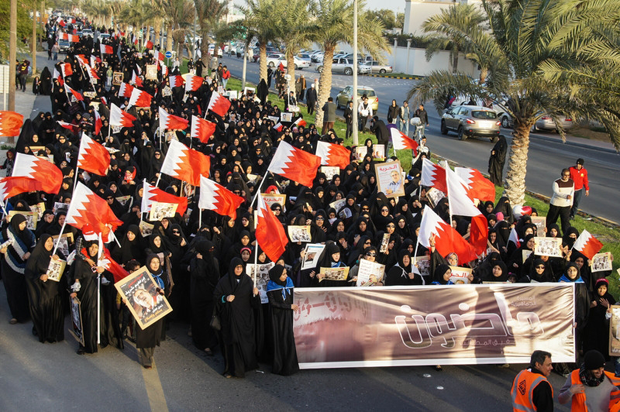
A pro-democracy protest in Bahrain, where activists have been jailed for inciting protests through their online activities (Photo: Moh’d Saeed / Demotix)
One hundred and forty characters are all it takes.
Twitter users from Marrakech to Manama know—call for political reforms, joke about a sensitive topic, or expose government abuse and you could end up in jail. Following the overthrow of Muammar Qaddafi and Zine el-Abidine Ben Ali, authorities in Libya and Tunisia unblocked hundreds of websites and dismantled the state surveillance apparatus. But overall, internet freedom in the region has only declined in the three years since the Arab Spring as authoritarian leaders continue to crack down on any and all threats to their ever-tenuous legitimacy.
As the online world has become a fundamental part of Arab and Iranian societies, leaders are waking up to the “dangers” of social media and placing new restrictions on what can be read or posted online. This shift has been most marked in Bahrain, one of the most digitally-connected countries in the world. After a grassroots opposition group took to the streets to demand democratic reforms, authorities detained dozens of users for Twitter and Facebook posts deemed sympathetic to the cause. Similarly, several prominent activists were jailed on charges of inciting protests, belonging to a terrorist organization, or plotting to overthrow the government through their online activities.
Conditions in Egypt—where social media played a fundamental role in mobilising protesters and documenting police brutality—continued to decline over the past year. In only the first six months of Mohammad Morsi’s term, more citizens were prosecuted for “insulting the office of the president” than under Hosni Mubarak’s entire 30-year reign. Cases have now been brought against the same bloggers and activists that were instrumental in rallying the masses to protest against Mubarak (and later Morsi) in Tahrir Square, while countless others were tortured by Muslim Brotherhood thugs or state security forces.
Even in the moderate kingdoms of Morocco and Jordan, state officials are looking to extend their existing controls over newspapers and TV channels to the sphere of online media. Ali Anouzla, a website editor in Morocco, faces terrorism charges in the latest attempt by the state to silence him and his popular online newspaper, Lakome. Access to independent journalism is even worse in Jordan, where over 200 news sites have been blocked for failing to obtain a press license. The government instituted burdensome requirements in a bid to deter any views that counter the state-sponsored narrative.
If governments are beginning to pay attention, it is because online tools for social mobilisation and individual expression are having a profound impact. Social media accounts were set up for every candidate in Iran’s 2013 presidential elections, despite the fact that Twitter, Facebook, and YouTube are all blocked within the country. In Saudi Arabia – which now boasts the highest Twitter and YouTube usage per capita of any country in the world – social media has been used to promote campaigns for women’s right to drive, to highlight the mistreatment of migrant workers, and to debate sensitive subjects such as child molestation. Citizen journalism was vital in documenting chemical weapons use in Syria, and a new online platform alerts local residents of incoming scud missiles. Nonetheless, Iran, Saudi Arabia, and Syria rank as some of the least free countries in the world in terms of internet freedom according to Freedom House’s Freedom on the Net study.
Remarkably, the country that has made the most positive strides over the past three years, was once among the most repressive online environments in the region – Tunisia. Protest videos from the town of Sidi Bouzid led to an intense crackdown on online dissidents by the Ben Ali regime. Digital activists even enlisted the help of Anonymous, the hacktivist group, to rally international media attention, provide digital security tools, and bring down government websites. Since then, Tunisian authorities have ceased internet censorship, reformed the regulatory environment, and ceded control of the state-owned internet backbone. Tunisia is now the only country in the region to have joined intergovernmental group the Freedom Online Coalition.
So while the snowball effect of social media contributed to the overthrow of several despots, many of the region’s internet users conversely find themselves in more restrictive online environments than in January 2011. Authoritarian governments now know exactly what the face of revolution looks like and, over the past three years, have shown their commitment to counter the internet’s potential to empower citizens and mobilise opposition. Users in liberal democracies may joke about the insignificance of “liking” a post on Facebook or uploading a video to YouTube, but in a region where your social media activity can make you an enemy of the state, 140 characters can lead to serious repercussions.
This article was posted on 21 January 2014 at indexoncensorship.org
