31 Oct 2014 | Europe and Central Asia, News, Turkey
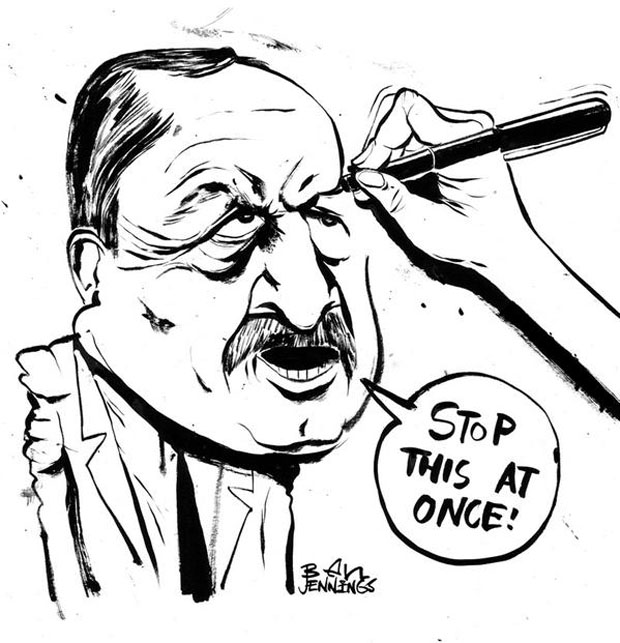
Cartoonists like Ben Jennings rallied around Musa Kart when he faced jail over a caricature of Turkey’s President Erdogan (Credit: Ben Jennings)
Not long ago Turkish cartoonist Musa Kart faced the prospect of spending nine years behind bars, simply for doing his job.
Taken to court by the Turkey’s President (and former Prime Minister) Recep Tayyip Erdogan himself, Kart last week stood trial for insult and slander over a caricature published in newspaper Cumhuriyet in February. Commenting on Erdogan’s alleged hand in covering up a high-profile corruption scandal, the cartoon depicted him as a hologram keeping a watchful eye over a robbery.
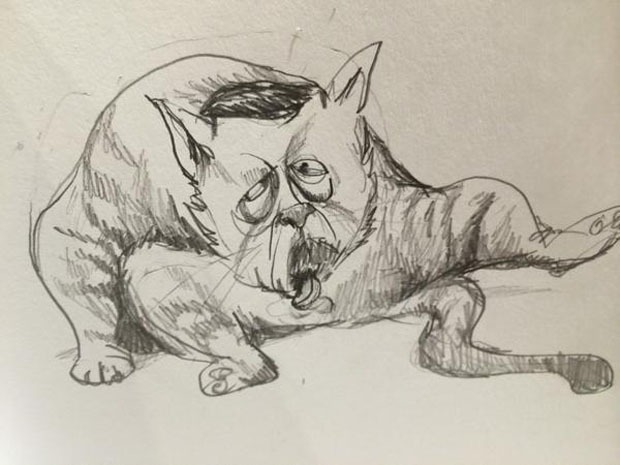
While Kart was finally acquitted last Thursday, his case was just starting to hit international headlines — in no small part due to the swift reaction from colleagues around the world. In the online #erdogancaricature campaign initiated by British cartoonist Martin Rowson, his fellow artists shared their own drawings of the president. With Erdogan reimagined as everything from a balloon, to a crying baby, to Frankenstein’s monster, the show of solidarity soon went viral.
“This campaign has showed me once again that I m a member of world cartoonists family. I am deeply moved and honoured by their support,” Kart told Index in an email.
Kart has been battling the criminal charges since February. His defiance was clear for all to see when he told the court on Thursday that “I think that we are inside a cartoon right now”, referring to the fact that he was in the suspect’s seat while charges against people involved in the graft scandal had been dropped.
He remains defiant today: “Erdogan would have either let an independent judiciary process to be cleared or repressed his opponents. He chose the second way,” he said. “It’s a well known fact that Erdogan is trying to repress and isolate the opponents by reshaping the laws and the judiciary and by countless prosecutions and libel suits against journalists.”
This isn’t the first time Kart has run into trouble with Erdogan. Back in 2005, he was fined 5,000 Turkish lira for drawing the then-prime minister as a cat entangled in yarn. The cartoon represented the controversy that surrounded Turkey’s highest administrative court rejecting new legislation that Erdogan had campaigned on.
“I have always believed that cartoon humour is a very unique and effective way to express our ideas and to reach people and it contributes to a better and more tolerant world,” he explained when questioned on where he finds the strength to keep going.
It remains unclear whether the story ends with this latest acquittal decision. While the charges against Kart were dropped earlier this year, an appeal from Erdogan saw the case reopened. “Erdogan’s lawyers will…take the case to the upper court,” he said.
Kart’s experience is far from unique; free expression is a thorny issues in Erdogan’s Turkey. In the past year alone, authorities temporarily banned Twitter and YouTube and introduced controversial internet legislation. Meanwhile journalists, like the Economist’s Amberin Zaman, have been continuously targeted, as Index on Censorship’s media freedom map shows.
Kart is not optimistic about the future of press freedom in his country: “Unfortunately, day by day, life is getting harder for independent and objective journalists in Turkey.”
This article was originally posted on 31 October at indexoncensorship.org
24 Oct 2014 | Europe and Central Asia, News, Turkey
When Turkish political cartoonist Musa Kart faced nine years in prison for “insulting” President Recep Tayyip Erdogan, his colleagues from across the world fought back in the best way they know how — by drawing their own #erdogancaricature.
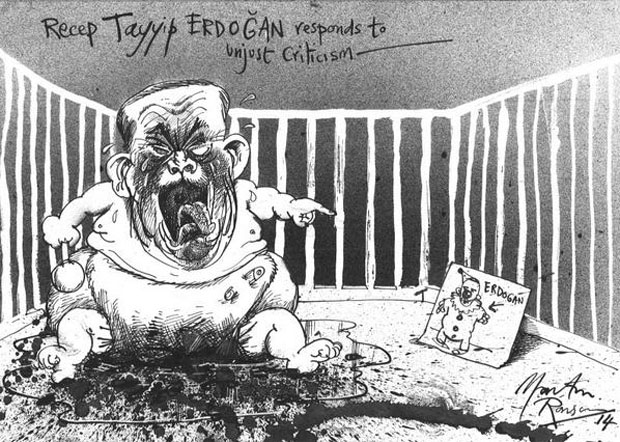
By: Martin Rowson
The online campaign was started on Thursday by Martin Rowson, cartoonist for The Guardian, The Independent and Index on Censorship among others, as Kart was scheduled to appear in court.
Erdogan himself filed the complaint against Kart over a cartoon published in the daily Cumhuriyet on 1 February 2014 showing the then prime minister as a hologram watching over a robbery. This was a reference to his alleged involvement covering up a high-profile graft scandal.
Erdogan claimed Kart was guilty of “insulting through publication and slander,” reports Today Zaman. And while the court initially ruled that there were no legal grounds for action, this decision was revoked following complaints from Erdogan’s lawyer. Kart was also fined in 2005 for drawing Erdogan as a cat.
In court on Thursday, Kart stated: “Yes, I drew it [the cartoon] but I did not mean to insult. I just wanted to show the facts. Indeed, I think that we are inside a cartoon right now. Because I am in the suspect’s seat while charges were dropped against all the suspects [involved in two major graft scandals]. I need to say that this is funny.”
He was finally acquitted, but many of his fellow cartoonists has already shared their artistic interpretations of Erdogan and the case.
By: Morten Morland
By: Ben Jennings
“I was alerted to Musa Kart’s plight by the excellent Cartoonists’ Rights Network International (CRNI) and previously, when an Iranian cartoonist was sentenced to 40 lashes, a bunch of us got together to draw the offended politician who’d had him arrested, the sentence was commuted,” Martin Rowson told Index via email.
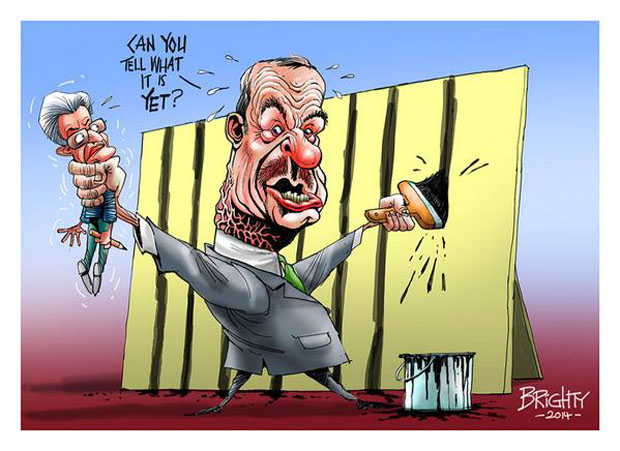
By: Steve Bright
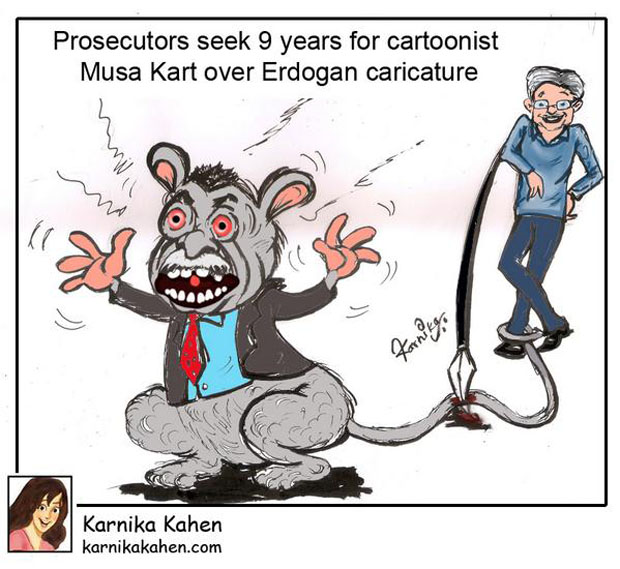
By: Kanika Mishra
“It seems this kind of international bullying by cartoon does have an effect, as even the chippiest despot out there can usually detect a batsqueak of the shamefulness of not being able to take a joke. In Musa Kart’s case, the threat of up to nine years in prison was such an outrageous abuse of power I didn’t wait for anyone else to organise this and simply put out a call via Twitter for cartoons of Erdogan to show solidarity. No idea if it had any effect on the court (I doubt it) though it may put Erdogan off the idea of taking the case to a higher court. I hope so. And I hope it gave Musa Kart a feeling that he wasn’t on his own in there. Basically, this is cartoonists playing the Spartacus card, because if one of us, anywhere, is persecuted for laughing at power, we all are,” said Rowson.
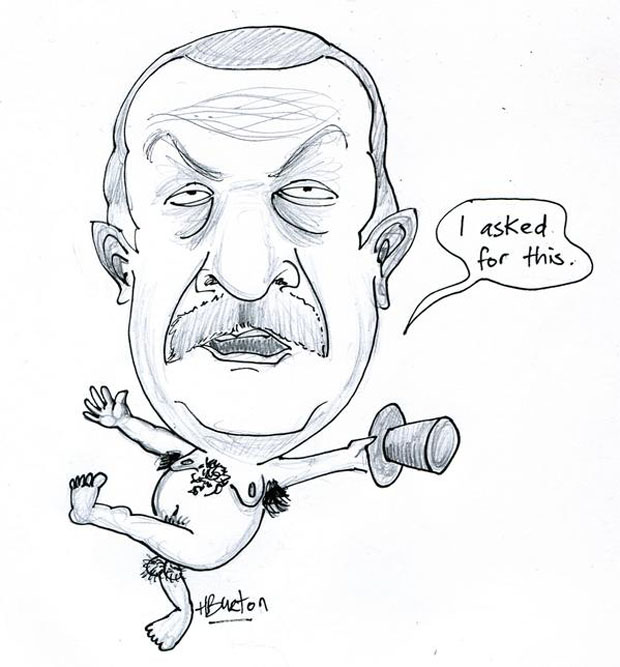
By: Harry Burton
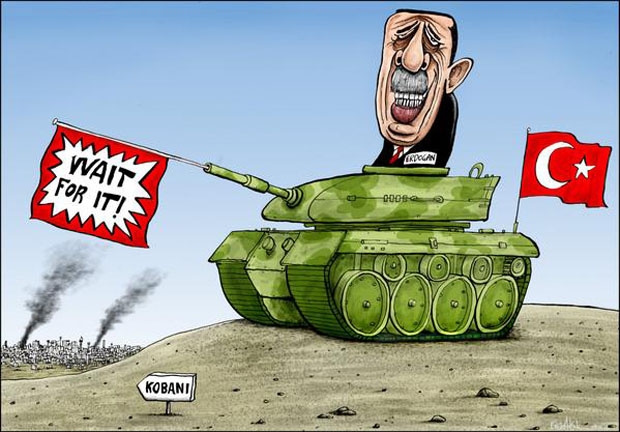
By: Brian Adcock
“Cartoonists are often the last bastion of free speech in repressive regimes and equally valued for telling the truth as it is, in democratic societies too; some consider their work to be of just as much value, if not more, as journalists, and many respected for the courage and ability to often say and report what others cannot, or fear to do, alongside the just as valued use of satire to reveal a truth which otherwise might not see the light of day,” Patricia Bargh from CRNI explained to Index in an email.
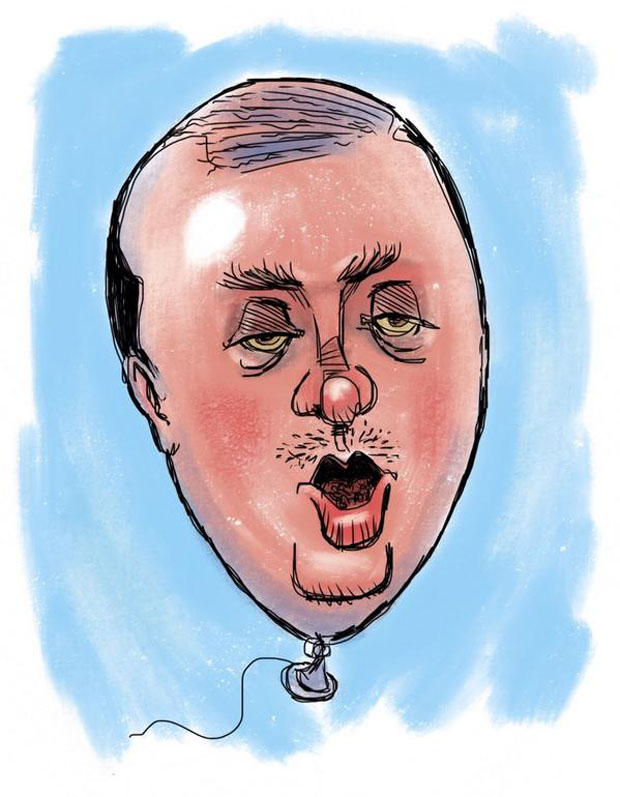
By: Mike Roberts
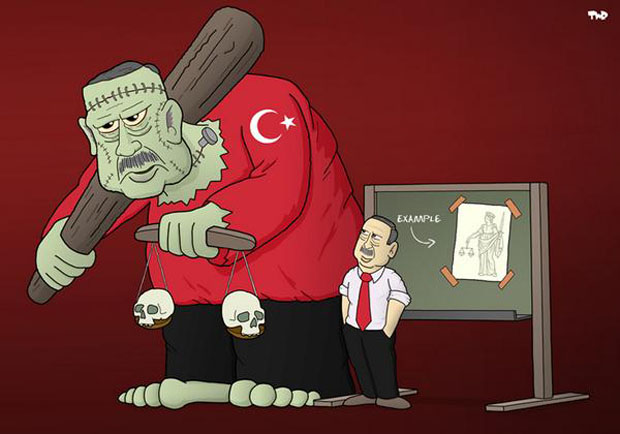
By: Tjeerd Royaards
“Thus as societies we should value and protect their right to do what they do, and if they know there is an organisation out there who will take up their case, should they be targeted, we hope that gives them the confidence to continue to on and assists them in their valuable work too,” Bargh added.
This article was originally posted on 20 October at indexoncensorship.org
18 Sep 2014 | Armenia, Azerbaijan, Azerbaijan News, News, Turkey
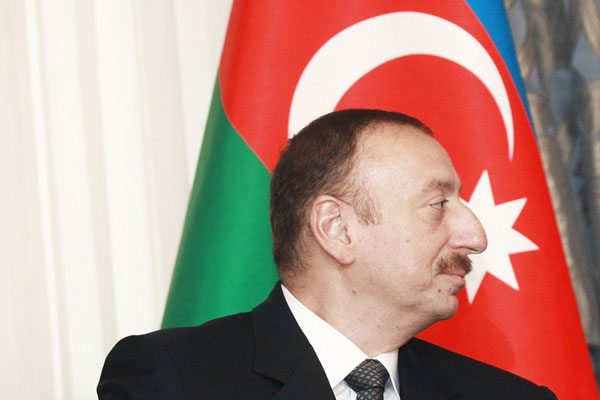
On 5 September, Azerbaijaini president Ilham Aliyev addressed the Nato summit at the Celtic Manor golf resort in Newport, Wales.
It was an unspectacular speech from an unspectacular autocrat. As he often does, he talked about the amount of money Azerbaijan was spending abroad, Azerbaijan’s rapid economic development, Azerbaijan’s role as a bridge between east and west, and Azerbaijan’s continuing dispute with Armenia.
The dispute between the two countries over the territory of Nagorno-Karabakh, which has gone on pretty much since the break-up of the Soviet Union, flared as recently as this summer, when fourteen Azerbaijani troops were killed in clashes with their Armenian counterparts. It was easy to miss this, considering events in other parts of the former Soviet Union. As seems usual in international conflict now, neither side made any gain and both sides claimed victory.
A few weeks after that skirmish, and just before his Nato address, Aliyev met recently-elected president (formerly prime minister) Recep Tayyip Erdogan of Turkey. Aliyev is keen to build an alliance with Turkey, and clearly sees common cause in a shared dislike of Armenia. After the meeting, the Azerbaijani leader tweeted that “Turkey has always pursued an open policy on the issue of the Armenian-Azerbaijani conflict over Nagorno-Karabakh, has always stood by Azerbaijan, stood by truth, justice and international law.” He went on:
This was interesting, in that Erdogan did not seem to mention any discussion of the Armenian genocide in his press briefing after the meeting. In fact, the Turkish president has been perceived as attempting to soften the Turkish state’s hardline denial of the incidents of 1915, when one million Armenians suffered deportation and death at the hands of the Ottoman Empire, the predecessor of modern Turkey.
In April, on the 99th anniversary of the beginning of the ethnic cleansing of Armenians, Erdogan released a statement saying: “Millions of people of all religions and ethnicities lost their lives in the first world war. Having experienced events which had inhumane consequences – such as relocation – during the first world war should not prevent Turks and Armenians from establishing compassion and mutually humane attitudes towards one another.”
The Justice and Development (AK) party leader went on to express condolences to the descendants of people who had died “in the context of the early 20th century”.
Now, this isn’t quite an apology; it’s barely even an apology at upset caused. It’s closer to the “mistakes were made” formulation, which is designed not so much to pass the buck as fire the buck into the heart of the sun in the hope that no one will ever have to deal with it again, particularly not the person whose buck it is in the first place.
But in the context of Turkey, where not long ago talking about the Armenian genocide could get you killed, it’s as good as you’re going to get for now.
So why would Aliyev raise the genocide issue this month? Perhaps he is nervous that Turkey, a major ally in the Nagorno-Karabakh dispute, is going soft on Armenia. This year’s detente between Turkey and Armenia continued when Armenia’s foreign minister Eduard Nalbandian attended Erdogan’s presidential inauguration at the end of August.
Nalbandian, in return, formally offered Erdogan an invitation to Armenia’s genocide commemorations next year, repeating an invitation first extended a few months ago by the country’s president Serzh Sargsyan. Any newfound good relations between Armenia and Turkey would severely weaken Azerbaijan’s territorial argument, or more accurately, weaken its ability to make the argument forcefully in the international arena. Turkey’s dispute with Armenia, after all, is mainly historic, and Erdogan, having seemingly consolidated his own power base outside of both the secular “deep state” and the Islamic Gülen movement to which many assumed he owed his success, now has a free hand on shaping foreign policy. Azerbaijan’s dispute with Armenia is current and, Aliyev hopes, immediate.
And so Azerbaijan has chosen to try to reignite the issue for its own ends. Meanwhile, in his own country, human rights abuses continue, with reports last week that Leyla Yunus, Director of the Institute for Peace and Democracy, was in ill health after prison beatings.
In spite of all this, Azerbaijan will continue to attempt to buy respectability. Next June, Baku will hold the first “European Games”, backed by the European Olympic Committee, featuring such irrelevancies as three-a-side basketball and beach soccer. It is not exactly the real thing, but then, post-Soviet Azerbaijan is a country built of facades; facades of modernity and wealth and progress and “democracy”. Facades that hide an underlying ugliness.
This article was posted on Thursday 18 Sept 2014 at indexoncensorship.org
15 Aug 2014 | Europe and Central Asia, News, Turkey
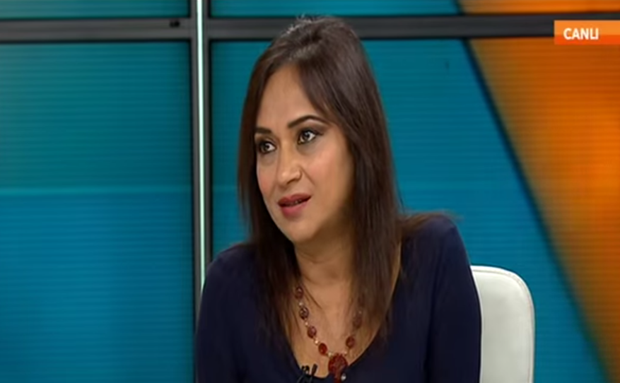
Amberin Zaman during a TV appearance (Image: serm canker/YouTube)
“A militant in the guise of a journalist, a shameless woman.” “Know your place.” “[Y]ou insult at a society of 99 percent Muslims.”
The comments from Recep Tayyip Erdogan — Turkey’s newly elected president and outgoing prime minister — were heard across the world. While he did not mention a name, it was the clear the woman in question was Amberin Zaman, a journalist for The Economist and Taraf. Erdogan’s tirade came during a campaign rally last Thursday in the city of Malatya, ahead of Sunday’s presidential vote. Zaman had expressed opinions critical of Erdogan during a TV discussion the night before.
Erdogan continued during a rally in Ankara on Saturday, calling her a “despicable woman” and saying she had insulted Islam. She has also been targeted online by Erdogan supporters, in what the Organisation for Security and Cooperation in Europe (OSCE) has labelled a “widespread smear campaign“.
“The pro-Erdogan camp emboldened by his very public insults against me continue to mob lynch me via the social media,” Zaman told Index on Censorship. “My Twitter feed is flooded with threats and profanities. Being called an enemy of Islam in a Muslim country, when radical groups like IS have Turkish members who are active Twitter users, puts me at physical risk and hobbles my work.”
She says she was unable conduct interviews on the streets on election day, “for fear of being recognised and attacked”.
This is not the first time Zaman has been targeted for speaking out against Turkish authorities. She was fired last year from Haberturk over articles critical of the government, and she was also one of the journalists reportedly wiretapped with the approval of Erdogan. As she said at a recent Index event on digital freedom, she is attacked online daily by pro-government trolls.
But Zaman is not the only member of the Turkish media under threat. According to recent figures there are 40 journalists behind bars in the country, making it one of the world’s worst jailers of press. Since 1992, 14 journalists have been murdered with impunity. Turkey stands at 154th out of 180 countries in the latest Reporters Without Borders Press Freedom Index, and its ranking has deteriorating over the past years.
In addition to Zaman’s case, there have been a number of other attacks on press freedom just over the past few days, as reported by the Index media mapping tool among others. Enis Berberoglu, editor-in-chief of Hurriyet, resigned on 8 August. The paper has denied that it was as a result of political pressure. However, in his attacks on Zaman during the Malatya rally, Erdogan specifically mentioned the owners of the TV channel she was on, Dogan Holding. Hurriyet is also owned by Dogan.
“The consensus is that he was pushed out but his departure coincided with the elections so it didn’t get the attention it deserved. But it is a further sign that media bosses will continue to cave in to power. It’s a tragic comment on the state of the Turkish media,” says Zaman.
The same day as Berberoglu’s resignation, investigative journalist Mehmet Baransu was beaten by police. The day after he was detained for tweeting about the incident, and about the Istanbul public prosecutor. There have also been reports that the Cihan news agency was restricted from covering the presidential election, with police ordered to keep journalists out of polling sites across the country.
The election also put the spotlight on issues surrounding biased media coverage in favour of Erdogan; something that was highlighted by observers after the vote. Zaman says it is difficult to measure the impact of the poor state of media freedom on the election and its outcome — Erdogan won comfortably after one round. But it was not, she says, “a level playing field”.
“Erdogan has indirect control over a broad swathe of media outlets, most crucially of television. So the opposition candidates received scant coverage, and the little they got in pro-government was more of a smear campaign to which they were unable to effectively respond. Intimidation of the media and of media bosses has created an environment of self-censorship where journalists fear losing their jobs,” she explains.
“Even the mildest criticism is no longer tolerated. It’s stifling.”
Despite the attacks from Erdogan and his supporters, Zaman says she is “very heartened by the thousands of messages of support I have received, including from pious Muslims”.
The Women’s Equality Monitoring Group, whose membership includes female journalists, academics and writers has called on Erdogan to apologise.
“Making a female journalist a target by calling her shameless for simply performing her job was the last link in a chain of sexist stances,” they said. “This attack was also an attempt to silence the few remaining critical voices in the media, which has been silenced with bribery, censorship and self-censorship.” The Economist have stated that they “stand firmly” by Zaman.
“I am not alone,” she said.
But as Erdogan has indicated intention to expand the powers of the presidency, Zaman is not optimistic about the future.
“Should he continue to run the government as he announced he would it is horrible news for journalists. Things can only get worse not better.”
This article was posted on August 15, 2014 at indexoncensorship.org