8 Jan 2026 | Belgium, Europe and Central Asia, Hungary, News
It should now be clear to everyone that the year 2026 will be marked by the march of the far right further into the mainstream of European politics. Each of the major European powers now has an ultra-nationalist party capable of taking at least a share of power in a democratic election. In Italy it has already formed the government.
What’s more, these Far Right revivalists claim they are defending the key enlightenment value of free speech – although they can be highly selective in its application.
The movement is driven by its hostility towards a well-defined common enemy, not Russia or China, but the European project itself. “The real threat does not come from Moscow or Beijing or from troll farms in St Petersburg. It comes from Brussels.” This, in a nutshell, was the message of the Battle for the Soul of Europe, a conference organised in the Belgian capital in December by MCC Brussels, a thinktank devoted to the downfall of the European Union.
MCC stands for Mathias Corvinus Collegium, a Hungarian institution with close links to Viktor Orbán (Corvinus himself was a 15th century expansionist king of Hungary). Politico has described the organisation as, “The EU’s most prominent hard-right pressure group.” The speaker was Norman Lewis, a visiting fellow at MCC Brussels and a former director of management consultants PwC, who perfectly embodies the ease with which the corporate world can embrace so-called National Conservatism.
The repeated message at Battle for the Soul of Europe was clear and coherent, if somewhat monotonous: European civilisation is under threat from the combined forces of mass immigration and wokery. Patriots of sovereign nations need to wake up and fight for the Christian values of the West and make peace with Russia. Just a week after the conference, US President Donald Trump made it clear that his national security strategy is based on precisely the same principles.
Many participants felt their voices were being silenced by the liberal European establishment.
Virginie Joron, MEP for the French far-right party Rassemblement National (National Rally) expressed her horror that, in her view, the Macron government was planning to label disinformation and “malicious advertising” with the help of the NGO Reporters Without Borders (RSF) and she said felt this was an attempt to target French TV channels sympathetic to the far right. Joron’s views reflect a feud going back several years. In 2024, RSF claimed there were concerted attempts to discredit them – for defending French law on fact-based broadcasting – led by the right-wing media group Vivendi with the support of far-right politicians.
Joron went on to attack Google, George Soros and the EU’s planned Centre for Democratic Resilience as part of a wider threat to free speech disguised as initiatives to tackle fake news. She claimed there now exists a cartel of authorised speech run by Brussels and militant NGOs. “No to the Macron-Brussels globalist Ministry of Truth,” she said, in a final rhetorical flourish.
If this weren’t hyperbolic enough, the French MEP was followed on stage by Adam Starzynski, the editor of Visegrad 24, an online pro-Orbán, pro-Trump news outlet. Starzynski claimed the censorship of stories about Hunter Biden, the son of the former US President Joe Biden, represented “the suppression of news on a whole new scale.” But he did not stop there, for Starzynski, UK far-right anti-immigration activist and convicted criminal Tommy Robinson was a dissident figure in the fight for free-speech rights.
Almost to a man and woman (and there were certainly no non-binary categories here), there was a disciplined “line to take”. The one dissenting voice at the conference, Vaclav Klaus, had been a genuine dissident during the Cold War and later became Prime Minister and President of the Czech Republic. Klaus has impeccable anti-European credentials and began by saying that Brussels was “everything a democrat should disagree with”. He added that it had been a tragic mistake to confuse Europe with the European Union. For him, Europe was just a conglomeration of nation states which sometimes had common interests.
But he took issue with the very concept of the conference: “There is not a common history of Europe,” he said. People should not artificially invent a European “soul”.
The new European Far Right baulk at being called “fascists”. But this is something of a distraction. Most are happy to be considered “hard right” or “patriotic right” or “National Conservative”.
They are for the most part, united and disciplined, where their liberal opponents are confused and disorganised. Their message is simple, clear and seductive. And now it has the backing of the White House it cannot be ignored.
19 Jun 2020 | Volume 49.02 Summer 2020
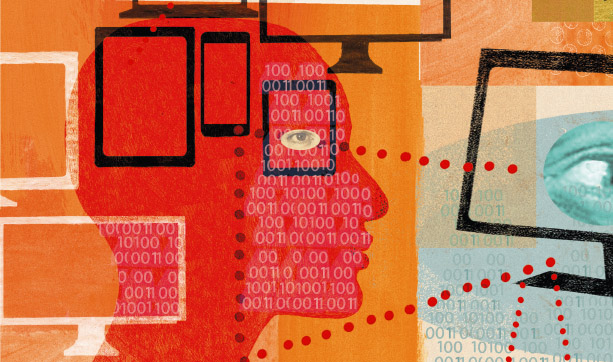
CREDIT: Donna Grethen/Ikon
In some ways, it’s a good thing there are no parties at the moment, I would be the person trapping you in the corner, explaining the difference between centralised and decentralised Bluetooth contact-tracing apps, and why de-centralised is better for your privacy, and why some governments are so keen to use the other kind to get more data.
If you’re lucky, we might move the conversation on to how weird it is that Google and Apple are co-operating to design their own, decentralised, privacy-protecting, software for contact-tracing apps – and how it’s even weirder that the two tech giants are effectively forcing governments around the world to use that system.
They want their app to work properly on Apple or Android phones (i.e. most smartphones), because an effective app needs about 80% of smartphone users to run it.
I mean, Silicon Valley protecting our privacy against our own governments? Unprecedented times, indeed.
At this point, let’s suppose that I pause to sip my beer and you make your escape. If we were both using a contact-tracing app, the fact we’d been close together would already have been logged.
We might never have to share that information, especially if neither of us is diagnosed with Covid-19 in the near future, but our social connections have become fodder for state surveillance in a way that would be anathema in normal circumstances.
In South Korea, contact tracing has been very effective at containing Covid-19, but it also publicised the locations of Seoul nightclubs where recent infections took place, which led to the stigmatising of the gay community.
While I have reservations about particular uses of technologies, I accept that our social connections have become the vector for a nasty virus.
I would welcome an efficient system of contact tracing, which means one run by humans even though that makes it even more intrusive.
Coronavirus is a shared problem that needs shared solutions, and I have voluntarily signed up for other apps that request much more personal information to help researchers under-stand and track the pandemic.
But remember the wise words of former Chicago mayor Rahm Emmanuel (and Winston Churchill, and Niccolo Machiavelli): “Never let a good crisis go to waste.”
More importantly, remember that those in power have already remembered that. Measures being taken now to fight a deadly virus might turn out to be handy for other purposes later. Further research that could be useful for future pandemics- who could object to that?
You can read the whole of this article in our Summer 2020 issue, available by print subscription here and by digital subscription here.
17 Jun 2020 | Magazine, Magazine Contents, Volume 49.02 Summer 2020
[vc_row][vc_column][vc_custom_heading text=”With contributions from Katherine Parkinson, David Hare, Marina Lalovic, Geoff White and Timandra Harkness”][/vc_column][/vc_row][vc_row][vc_column][vc_column_text]
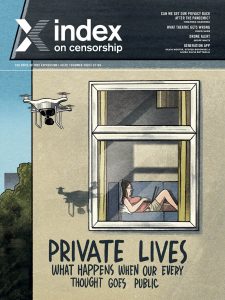 The Summer 2020 issue of Index on Censorship magazine looks at just how much of our privacy we are giving away right now. Covid-19 has occurred at a time when tech giants and autocrats have already been chipping away at our freedoms. Just how much privacy is left and how much will we now lose? This is a question people in Turkey are really concerned about, as many feel the home was the last refuge for them for privacy, but now contact tracing apps might rid them of that. It’s a similar case for those in China, and the journalist Tianyu M Fang speaks about his own, haphazard experience of using a contact tracing app there. We also have an article from Uganda on the government spies that are everywhere, plus tech experts talking about just how much power apps like Zoom and tech like drones have.
In our In Focus section, we interview journalists in Serbia, Hungary and Kashmir who are trying to report the truth in places where the truth can be as dangerous, if not more, than Covid-19. And we have an interview with and poet from the playwright David Hare.
We have a very special culture section in this issue. Three playwrights have written short plays for the magazine around the theme of pandemics. V (formerly Eve Ensler), the author of The Vagina Monologues, takes you to the aftermath of a nuclear disaster; Katherine Parkinson of The IT Crowd writes about online dating during quarantine; Lebanese playwright Lucien Bourjeily is inspired by recent events in his country in his chilling look at protest right now.
[/vc_column_text][/vc_column][/vc_row][vc_row][vc_column][vc_custom_heading text=”Special Report”][vc_column_text]
Back-up plan by Timandra Harkness: Don’t blindly give away more freedoms than you sign up for in the name of tackling the epidemic. They’re hard to reclaim
The eyes of the storm by Issa Sikiti da Silva: Spies are on the streets of Uganda making sure everyone abides by Covid-19 rules. They’re spying on political opposition too. A dispatch from Kampala
Zooming in on privacy concerns by Adam Aiken: Video app Zoom is surging in popularity. In our rush to stay connected, we need to make security checks and not reveal more than we think
Seeing what’s around the corner by Richard Wingfield: Facial recognition technology may be used to create immunity “passports” and other ways of tracking our health status. Are we watching?
Don’t just drone on by Geoff White: If drones are being used to spy on people breaking quarantine rules, what else could they be used for? We investigate
Sending a red signal by Tianyu M Fang: When a contact tracing app went wrong a journalist was forced to stay in their home in China
The not so secret garden by Tom Hodgkinson: Better think twice before bathing naked in the backyard. It’s not just your neighbours that might be watching you. Where next for privacy?
Hackers paradise by Stephen Woodman: Hackers across Latin America are taking advantage of the current crisis to access people’s personal data. If not protected it could spell disaster
Italy’s bad internet connection by Alessio Perrone: Italians have one of the lowest levels of digital skills in Europe and are struggling to understand implications of the new pandemic world
Less than social media by Stefano Pozzebon: El Salvador’s new leader takes a leaf out of the Trump playbook to use Twitter to crush freedoms
Nowhere left to hide by Kaya Genç: Privacy has been eroded in Turkey for many years now. People fear that tackling Covid-19 might take away their last private free space
Open book? by Somak Ghoshal: In India, where people are forced to download a tracking app to get paid, journalists are worried about it also being used to access their contacts
[/vc_column_text][/vc_column][/vc_row][vc_row][vc_column][vc_custom_heading text=”In Focus”][vc_column_text]
Knife-edge politics by Marina Lalovic: An interview with Serbian journalist Ana Lalic, who forced the Serbian government to do a U-Turn
Stage right (and wrong) by Jemimah Steinfeld: The playwright David Hare talks to Index about a very 21st century form of censorship on the stage. Plus a poem of Hare’s published for the first time
Inside story: Hungary’s media silence by Viktória Serdült: What’s it like working as a journalist under the new rules introduced by Hungary’s Viktor Orbán? How hard is it to report?
Life under lockdown: A Kashmiri Journalist by Bilal Hussain: A Kashmiri journalist speaks about the difficulties – personal and professional – of living in the state with an internet shutdown during lockdown
The truth will out by John Lloyd: Journalists need to challenge themselves and fight for media freedoms that are being eroded by autocrats and tech companies
Extremists use virus to curb opposition by Laura Silvia Battaglia: Covid-19 is being used by religious militia as a recruitment tool in Yemen and Iraq. Speaking out as a secular voice is even more challenging
[/vc_column_text][/vc_column][/vc_row][vc_row][vc_column][vc_custom_heading text=”Culture”][vc_column_text]
Masking the truth by V: The writer of The Vagina Monologues (formerly known as Eve Ensler) speaks to Index about attacks on the truth. Plus a new version of her play about living in a nuclear wasteland
Time out by Katherine Parkinson: The star of The IT Crowd discusses online dating and introduces her new play, written for Index, that looks at love and deception online
Life in action by Lucien Bourjeily: The Lebanese director talks to Index about how police brutality has increased in his country and how that informed the story of his new play, published here for the first time
[/vc_column_text][/vc_column][/vc_row][vc_row][vc_column][vc_custom_heading text=”Index around the world”][vc_column_text]
Putting abuse on the map by Orna Herr: The coronavirus crisis has seen a huge rise in media attacks. Index has launched a map to track these
[/vc_column_text][/vc_column][/vc_row][vc_row][vc_column][vc_custom_heading text=”Endnote”][vc_column_text]
Forced out of the closet by Jemimah Steinfeld: As people live out more of their lives online right now, our report highlights how LGBTQ dating apps can put people’s lives at risk
[/vc_column_text][/vc_column][/vc_row][vc_row][vc_column width=”1/3″][vc_custom_heading text=”Subscribe”][vc_column_text]In print, online, in your mailbox, on your iPad.
Subscription options from £18 or just £1.49 in the App Store for a digital issue.
Every subscriber helps support Index on Censorship’s projects around the world.
 SUBSCRIBE NOW[/vc_column_text][/vc_column][vc_column width=”1/3″][vc_custom_heading text=”Read”][vc_column_text]The playwright Arthur Miller wrote an essay for Index in 1978 entitled The Sin of Power. We reproduce it for the first time on our website and theatre director Nicholas Hytner responds to it in the magazine
READ HERE[/vc_column_text][/vc_column][vc_column width=”1/3″][vc_custom_heading text=”Listen”][vc_column_text]In the Index on Censorship autumn 2019 podcast, we focus on how travel restrictions at borders are limiting the flow of free thought and ideas. Lewis Jennings and Sally Gimson talk to trans woman and activist Peppermint; San Diego photojournalist Ariana Drehsler and Index’s South Korean correspondent Steven Borowiec
LISTEN HERE[/vc_column_text][/vc_column][/vc_row]
30 Mar 2020 | Magazine, Magazine Contents, Volume 49.01 Spring 2020
[vc_row][vc_column][vc_custom_heading text=”With contributions from Ak Welsapar, Julian Baggini, Alison Flood, Jean-Paul Marthoz and Victoria Pavlova”][/vc_column][/vc_row][vc_row][vc_column][vc_column_text]
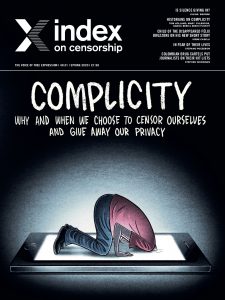 The Spring 2020 issue of Index on Censorship magazine looks at our own role in free speech violations. In this issue we talk to Swedish people who are willingly having microchips inserted under their skin. Noelle Mateer writes about living in China as her neighbours, and her landlord, embraced video surveillance cameras. The historian Tom Holland highlights the best examples from the past of people willing to self-censor. Jemimah Steinfeld discusses holding back from difficult conversations at the dinner table, alongside interviewing Helen Lewis on one of the most heated conversations of today. And Steven Borowiec asks why a North Korean is protesting against the current South Korean government. Plus Mark Frary tests the popular apps to see how much data you are knowingly – or unknowingly – giving away.
In our In Focus section, we sit down with different generations of people from Turkey and China and discuss with them what they can and cannot talk about today compared to the past. We also look at how as world demand for cocaine grows, journalists in Colombia are increasingly under threat. Finally, is internet browsing biased against LBGTQ stories? A special Index investigation.
Our culture section contains an exclusive short story from Libyan writer Najwa Bin Shatwan about an author changing her story to people please, as well as stories from Argentina and Bangladesh.
[/vc_column_text][/vc_column][/vc_row][vc_row][vc_column][vc_custom_heading text=”Special Report”][/vc_column][/vc_row][vc_row][vc_column][vc_column_text]Willingly watched by Noelle Mateer: Chinese people are installing their own video cameras as they believe losing privacy is a price they are willing to pay for enhanced safety
The big deal by Jean-Paul Marthoz: French journalists past and present have felt pressure to conform to the view of the tribe in their reporting
Don’t let them call the tune by Jeffrey Wasserstrom: A professor debates the moral questions about speaking at events sponsored by an organisation with links to the Chinese government
Chipping away at our privacy by Nathalie Rothschild: Swedes are having microchips inserted under their skin. What does that mean for their privacy?
There’s nothing wrong with being scared by Kirsten Han: As a journalist from Singapore grows up, her views on those who have self-censored change
How to ruin a good dinner party by Jemimah Steinfeld: We’re told not to discuss sex, politics and religion at the dinner table, but what happens to our free speech when we give in to that rule?
Sshh… No speaking out by Alison Flood: Historians Tom Holland, Mary Fulbrook, Serhii Plokhy and Daniel Beer discuss the people from the past who were guilty of complicity
Making foes out of friends by Steven Borowiec: North Korea’s grave human rights record is off the negotiation table in talks with South Korea. Why?
Nothing in life is free by Mark Frary: An investigation into how much information and privacy we are giving away on our phones
Not my turf by Jemimah Steinfeld: Helen Lewis argues that vitriol around the trans debate means only extreme voices are being heard
Stripsearch by Martin Rowson: You’ve just signed away your freedom to dream in private
Driven towards the exit by Victoria Pavlova: As Bulgarian media is bought up by those with ties to the government, journalists are being forced out of the industry
Shadowing the golden age of Soviet censorship by Ak Welsapar: The Turkmen author discusses those who got in bed with the old regime, and what’s happening now
Silent majority by Stefano Pozzebon: A culture of fear has taken over Venezuela, where people are facing prison for being critical
Academically challenged by Kaya Genç: A Turkish academic who worried about publicly criticising the government hit a tipping point once her name was faked on a petition
Unhealthy market by Charlotte Middlehurst: As coronavirus affects China’s economy, will a weaker market mean international companies have more power to stand up for freedom of expression?
When silence is not enough by Julian Baggini: The philosopher ponders the dilemma of when you have to speak out and when it is OK not to[/vc_column_text][/vc_column][/vc_row][vc_row][vc_column][vc_custom_heading text=”In Focus”][vc_column_text]Generations apart by Kaya Genç and Karoline Kan: We sat down with Turkish and Chinese families to hear whether things really are that different between the generations when it comes to free speech
Crossing the line by Stephen Woodman: Cartels trading in cocaine are taking violent action to stop journalists reporting on them
A slap in the face by Alessio Perrone: Meet the Italian journalist who has had to fight over 126 lawsuits all aimed at silencing her
Con (census) by Jessica Ní Mhainín: Turns out national censuses are controversial, especially in the countries where information is most tightly controlled
The documentary Bolsonaro doesn’t want made by Rachael Jolley: Brazil’s president has pulled the plug on funding for the TV series Transversais. Why? We speak to the director and publish extracts from its pitch
Queer erasure by Andy Lee Roth and April Anderson: Internet browsing can be biased against LGBTQ people, new exclusive research shows[/vc_column_text][/vc_column][/vc_row][vc_row][vc_column][vc_custom_heading text=”Culture”][vc_column_text]Up in smoke by Félix Bruzzone: A semi-autobiographical story from the son of two of Argentina’s disappeared
Between the gavel and the anvil by Najwa Bin Shatwan: A new short story about a Libyan author who starts changing her story to please neighbours
We could all disappear by Neamat Imam: The Bangladesh novelist on why his next book is about a famous writer who disappeared in the 1970s[/vc_column_text][/vc_column][/vc_row][vc_row][vc_column][vc_custom_heading text=”Index around the world”][vc_column_text]Demand points of view by Orna Herr: A new Index initiative has allowed people to debate about all of the issues we’re otherwise avoiding[/vc_column_text][/vc_column][/vc_row][vc_row][vc_column][vc_custom_heading text=”Endnote”][vc_column_text]Ticking the boxes by Jemimah Steinfeld: Voter turnout has never felt more important and has led to many new organisations setting out to encourage this. But they face many obstacles[/vc_column_text][/vc_column][/vc_row][vc_row][vc_column width=”1/3″][vc_custom_heading text=”Subscribe”][vc_column_text]In print, online, in your mailbox, on your iPad.
Subscription options from £18 or just £1.49 in the App Store for a digital issue.
Every subscriber helps support Index on Censorship’s projects around the world.
SUBSCRIBE NOW[/vc_column_text][/vc_column][vc_column width=”1/3″][vc_custom_heading text=”Read”][vc_column_text]The playwright Arthur Miller wrote an essay for Index in 1978 entitled The Sin of Power. We reproduce it for the first time on our website and theatre director Nicholas Hytner responds to it in the magazine
READ HERE[/vc_column_text][/vc_column][vc_column width=”1/3″][vc_custom_heading text=”Listen”][vc_column_text]In the Index on Censorship autumn 2019 podcast, we focus on how travel restrictions at borders are limiting the flow of free thought and ideas. Lewis Jennings and Sally Gimson talk to trans woman and activist Peppermint; San Diego photojournalist Ariana Drehsler and Index’s South Korean correspondent Steven Borowiec
LISTEN HERE[/vc_column_text][/vc_column][/vc_row]
