19 Oct 2015 | About Index, Campaigns, Counter Terrorism, mobile, Statements
In its new extremism strategy, the government is proposing measures that will criminalise legitimate speech and shrink the space for open debate throughout society. There is already a wealth of legislation that deals with criminal offences, including the Terrorism Act and the Public Order Act, and there is no need for new laws that will seriously harm everyone’s right to freedom of expression in this country.
“We are concerned that the extremism strategy outlined this morning has the potential to massively damage the reputation of the British educational establishment – universities in particular which should be the home of debate and academic academic inquiry. This will have the effect of ramping up a climate of fear where both lecturers and students are afraid to speak,” said Jodie Ginsberg, CEO, Index on Censorship.
“The government has created an impossible bind for itself: in the name of protecting our values, it’s now seeking to undermine the most fundamental value of all for democracy – freedom of expression. This is a deeply misguided policy that will not only stigmatise minorities, it will criminalise political speech across society and introduce a culture of caution,” said Jo Glanville, director, English PEN.
The government’s counter-terrorism policy is already having a chilling effect on freedom of expression. Over the past six months, a series of incidents across society indicates that arts and educational institutions are censoring and self-censoring in the mistaken belief that any exploration or discussion of extremism is or may be illegal.
This includes the cancellation of the National Youth Theatre’s production of the play Homegrown, the banning of a Mimsy art work at the Mall Galleries that satirised Isis and the questioning of a school child who discussed ecoterrorism in class.
The space for political speech and artistic expression is rapidly diminishing.
14 Oct 2015 | About Index, Campaigns, Mapping Media Freedom, Press Releases
Strasbourg, 13.10.2015 – The Committee to Protect Journalists and Index on Censorship became partners to the Platform to promote the protection of journalism and safety of journalists, which will allow them to alert the Council of Europe on violations to media freedom in Europe.
“Joining the Council of Europe platform is part of our continued efforts to increase visibility of media freedom violations in the region. We look forward to working with the Council and engage in a constructive dialogue with governments to address the too many threats journalists face for simply doing their job,” Melody Patry, senior advocacy officer Index on Censorship, said.
Chief Executive of Index on Censorship Jodie Ginsberg, and European Union correspondent of the Committee to Protect Journalists Jean-Paul Marthoz signed the agreement on behalf of their organisations during a meeting with Council of Europe Secretary General Thorbjørn Jagland.
Secretary General Jagland said: “Visibility for threats against journalists is crucial and cannot be underestimated. The fact that we have this platform means that we can also take concrete threats against journalists to governments in question and discuss with them to take joint actions. We already have good examples of how this works in a positive way”.
Since its launch in April 2015, the platform has recorded 84 alerts concerning 21 states. Twenty-five alerts concern physical attacks on journalists, 21 alerts the detention and imprisonment of journalists, 8 impunity of attacks, 8 harassment or intimidation, and other 22 acts that may have a chilling effect on media freedom. Eleven alerts concerned cases in which journalists were killed, eight of them in the Charlie Hebdo attack.
The platform was launched with the participation of five partner organisations with which the Council of Europe signed a Memorandum of understanding: Article 19, the Association of European Journalists, the European Federation of Journalists, the International Federation of Journalists and Reporters Without Borders.
The platform allows these partners to issue alerts concerning media freedom threats and to bring them to the attention of the Council of Europe institutions. Once the alerts are published, the Council of Europe sends them to the authorities of the country concerned. The Council of Europe institutions may react publicly or start a dialogue on the issue with the authorities. Subsequently, responses of the member states and follow-up action taken by the competent bodies are also posted on the platform. The governments of the states concerned by the 84 alerts received have so far replied to 26 cases.
Contact: Jaime Rodriguez, Spokesperson/Media officer, tel. +33 3 90 21 47 04
——
Le Comité pour la protection des journalistes et Index on Censorship se joignent à la Plateforme du Conseil de l’Europe pour la protection des journalistes
Strasbourg, 13.10.2015 – Le Comité pour la protection des journalistes et Index on Censorship se joignent aujourd’hui aux organisations partenaires de la Plateforme pour renforcer la protection du journalisme et la sécurité des journalistes, ce qui leur permettra d’alerter le Conseil de l’Europe sur les cas de violation de la liberté des médias en Europe.
“Rejoindre la plateforme du Conseil de l’Europe fait partie de nos efforts continus pour accroître la visibilité des violations de la liberté des médias dans la région. Nous avons hâte de travailler avec le Conseil et d’engager un dialogue constructif avec les gouvernements pour confronter les menaces trop nombreuses qui pèsent sur les journalistes,” dit Melody Patry, chargé de plaidoyer principal Index on Censorship.
Jodie Ginsberg, directrice d’Index on Censorship, et Jean-Paul Marthoz, correspondant pour l’Union européenne du Comité pour la protection des journalistes, ont signé l’accord de partenariat au nom de leur organisation lors d’une réunion avec Thorbjørn Jagland, Secrétaire Général du Conseil de l’Europe.
M. Jagland déclaré : « faire connaître les menaces qui pèsent sur les journalistes revêt une importance cruciale, c’est un levier qu’on ne saurait sous-estimer. En outre, grâce à cette plate-forme, nous pouvons approcher les gouvernements concernés au sujet des menaces concrètes qui pèsent sur les journalistes, en vue de prendre des mesures conjointes. Nous avons d’ores et déjà obtenu des résultats positifs avec cette méthode. »
Depuis son lancement en avril 2015, la plate-forme a enregistré 84 alertes concernant 21 Etats. Vingt-cinq alertes portent sur des agressions physiques contre des journalistes, 21 sur la détention et l’emprisonnement de journalistes, 8 sur l’impunité des agressions, 8 sur le harcèlement ou l’intimidation, et 22 sur des actes pouvant avoir un effet dissuasif sur la liberté des médias. Onze alertes concernent des cas dans lesquels des journalistes ont été tués ; parmi ceux-ci figurent notamment huit victimes de l’attentat contre Charlie Hebdo.
La plate-forme a été lancée avec la participation de cinq organisations partenaires, qui ont signé un mémorandum d’accord avec le Conseil de l’Europe : Article 19, l’Association des journalistes européens, la Fédération européenne des journalistes, la Fédération internationale des journalistes et Reporters sans frontières.
La plate-forme permet à ces organisations de publier des alertes concernant des menaces qui pèsent sur la liberté des médias, et de les porter à l’attention des institutions du Conseil de l’Europe. Lorsqu’une alerte est publiée, le Conseil de l’Europe la transmet aux autorités du pays concerné. Les institutions du Conseil de l’Europe peuvent réagir publiquement aux alertes ou entamer un dialogue à ce sujet avec les autorités. Par la suite, les réponses des Etats membres et les suites données par les organes compétents sont également publiées sur la plate-forme. A ce jour, 84 alertes ont été reçues, qui ont donné lieu à 26 réponses de la part des gouvernements concernés.
Contact: Jaime Rodriguez, Porte-parole/Attaché de presse, tél. +33 3 90 21 47 04
5 Oct 2015 | Events
Index on Censorship will be participating in Beyond the Obvious 2015, the annual conference of Culture Action Europe. Beyond the Obvious 2015 promises to be a thought-provoking gathering made of large scale and small scale dialogues, encounters, community-building, exchanges between local and other European cultural actors. BtO 2015 invites its participants to learn, reflect and debate on what balance shall be sought between the condition for a meaningful public sphere on one side, and private and commercial interests on the other, in order to fulfil cultural – thus: human – rights.
Index on Censorship magazine’s editor Rachael Jolley will be part of a discussion, from 11am to 12:30pm on Friday 16 October, with Kathrin Merkle (Council of Europe), Nir Boms (cyberdissident.org) and Rasoul Nejadmehr (Vastra Gotaland Region). The panel will be moderated by Birgitta Persson (Trans Europe Halles).
Participants in BtO 2015 will have the chance to engage in three streams of discussions around the main focus:
• EXPRESS explores the tensions that endanger the right to freedom of opinion and expression and identify the paths to protect and enhance it.
• CREATE explores the tensions between the right to create and enjoy culture and the right to fair remuneration in the digital sphere.
• PARTICIPATE explore the value of actively contributing to your community wellbeing and government by intently participating in the cultural life
The programme is built around three formats of discussion, with all them addressing the three lenses.
• IDEASROOM Through a tradition symposium style, participants will discuss the power of key ideas and concepts, engaging in active conversations.
• STORIESROOM In smaller groups, participants will hear and gather around stories and practices from all over Europe to deepen the understanding of possible [alternatives] ways of “doing culture”.
• SCENARIOROOM In highly collaborative lab-style sessions, small working-groups will explore the consequences and implications of some tomorrow’s scenarios that will be presented. In each room, different Discussion Activators will act as catalysts of conversations.
When: 15-17 October 2015
Where: Brewhouse in Gothenburg. [Åvägen 24, 412 51 Göteborg, Sweden]
Tickets: Available from the Beyond the Obvious website
11 Sep 2015 | Campaigns, Mapping Media Freedom, mobile, Press Releases
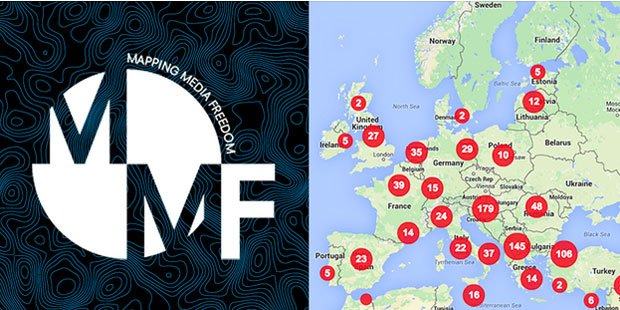
Index on Censorship, the European Federation of Journalists and Reporters Without Borders are delighted to announce the expansion and redesign of Mapping Media Freedom, which records threats to journalists across Europe, and which will now also cover Russia, Ukraine and Belarus.
First launched in May 2014, the map documents media freedom violations throughout the European Union and neighbouring countries including the Balkans and Turkey.
More than 700 reports were logged on the map in its first year, lifting the lid on the everyday threats to media freedom that have previously gone largely unreported or undocumented.
“Mapping Media Freedom has highlighted the kinds of threats faced by media organisations and their staff everyday throughout Europe — from low-level intimidation to threats of violence, imprisonment, and even murder. Having a detailed database of these incidents – most of which previously went unreported — helps us and others to take action against the culprits,” said Index on Censorship CEO Jodie Ginsberg.
The relaunched online platform will make it easier for policy makers and activists to identify trends in media freedom and to respond efficiently with immediate assistance or to campaign on specific issues. It also provides support such as legal advice and digital security training to journalists at risk. Anyone can submit their own reports to the site for verification by project officers.
“At a time when freedom of information is facing threats not seen since the times of the Soviet Union, supporting journalists and bloggers is crucial. While part of the continent is sinking in an authoritarian drift, online surveillance has become a common challenge”, said RSF Programme Director Lucie Morillon.
Following renewed funding from the European Commission earlier this year, the crowd-sourced map incorporates new features including country filters and an improved search facility. The project also aims to forge new alliances among journalists across the continent, especially young media practitioners who will find useful resources and in depth coverage on a dedicated “Free Our Media!” page.
In reaction to new draconian measures and violence in the region, the new design coincides with an expansion into Russia, Ukraine and Belarus. All new reports from this area will be available in English and the regional language.
“The enlargement of the monitoring process to Ukraine, Russia and Belarus is good news for journalists and media workers in the region. Journalists are usually at the heart of violent demonstrations, clashes and armed conflicts where they may be shot, assaulted, kidnapped, arrested, abused and killed. They are facing difficult professional challenges between extremists or propaganda agents. Thanks to its affiliates, the EFJ will continue to document all media violations and raise awareness to end impunity when violations occur”, said Mogens Blicher Bjerregård, EFJ President.
Partners, country correspondents and affiliates to the project — including Human Rights House Ukraine, Media Legal Defence Initiative and European Youth Press — will work together to ensure the growing threats to media freedom in the region are highlighted, and tackled.
For further information please contact Hannah Machlin, project officer,[email protected], +44 (0)207 260 2671
Mapping Media Freedom
Click on the bubbles to view reports or double-click to zoom in on specific regions. The full site can be accessed at https://mappingmediafreedom.org/
|
