17 Oct 2014 | Bahrain, Statements
Dear Mr. Hammond,
We are writing to you in light of your current tour of Gulf Cooperation Council countries regarding the arbitrary arrest and detention of human rights defenders Nabeel Rajab, Zainab Al-Khawaja and Ghada Jamsheer in Bahrain for cases of peaceful expression.
Nabeel Rajab, the President of the Bahrain Center for Human Rights, Director of the Gulf Center for Human Rights (GCHR) and Deputy Secretary General of the International Federation for Human Rights (FIDH), remains in prison following his arrest for a tweet in which he expressed his view about the role Bahrain security institutions play as “incubators of ISIS ideology”. Mr. Rajab had travelled to Bahrain from the United Kingdom following a European advocacy tour that included a panel at the House of Lords.
His detention has been criticised internationally. The United Nations has warned that it sends a “chilling message”. The Norwegian government has recently advised that the arrest of Mr. Rajab sends a negative message and has called for his immediate release. The European Parliament Subcommittee on Human Rights has voiced serious concerns over his arrest and detention and the United States State Department has called on Bahrain to drop the charges against him.
We urge the United Kingdom to add its voice to these universal calls. As a close ally to Bahrain, the UK has influence that could result in steps to release human rights defenders and political prisoners in Bahrain. You will recall that the UK signed a joint statement during the 26th session of the UN Human Rights Council, which urged the government of Bahrain “to release all persons imprisoned solely for exercising human rights, including human rights defenders some of whom have been identified as arbitrarily detained according to the UN Working Group on Arbitrary Detention”. We ask you to follow up on this statement by calling for the immediate and unconditional release of both Mr. Rajab and Ms. Al-Khawaja who have been detained solely for exercising their human right to free expression.
Zainab Al-Khawaja is a prominent activist in Bahrain, who is facing serious charges of “publicly insulting the King” after ripping a photo of him during a court hearing. The case, which runs contrary to Bahrain’s international human rights obligations, was immediately transferred to the Higher Criminal Court in Bahrain meaning that she now faces up to seven years in prison for a peaceful act of expression. It is important to note that Ms. Al-Khawaja is eight months pregnant, and faces the possibility of going into labour in arbitrary detention.
Amnesty International has criticised the decision and called for her immediate release arguing”laws that prohibit insults or the disrespect of heads of state or other public figures are contrary to international human rights law and standards”.
Her sister Maryam Al-Khawaja, Co-Director of the GCHR, is also facing prison on charges of assault brought against her after she arrived in Bahrain on 30 August to try to visit her father, jailed human rights defender Abdulhadi Al-Khawaja, founder of BCHR and GCHR. She was released after two weeks but is due in court on 5 November.
In addition to these cases, women’s rights defender Ghada Jamsheer was arrested and imprisoned on 15 September, on charges of defamation on Twitter. She remains in detention and will face court prosecution on charges related to her freedom of expression on 22 October.
The arrest and ongoing detention of both Mr. Rajab and Ms. Al-Khawaja threaten to destabilise further an already unstable country. It is imperative that human rights advocates are not targeted for exercising their human rights peacefully. The work of human rights defenders often requires criticising governments as noted by the European Union Guidelines on Human Rights Defenders, which call for this role to be “recognised and supported”.
We urge the British government to demand the immediate release of all detained human rights defenders and activists in Bahrain.
Thank you for your consideration.
Sincerely,
Americans for Democracy and Human Rights in Bahrain (ADHRB)
Bahrain Center for Human Rights (BCHR)
Bahrain Institute for Rights and Democracy (BIRD)
English PEN
Gulf Centre for Human Rights (GCHR)
Index on Censorship
Pen International
Redress
Reprieve
1 Oct 2014 | Campaigns, Statements
British Home Secretary Theresa May has proposed new laws that would ban extremists from TV and impose stricter controls on what can be said on the internet, in a speech at the annual Conservative Party conference. Index on Censorship is disturbed at these plans and their potential for stifling legitimate free speech.
It is unclear why further legislation is needed in this area: there are already laws on incitement to violence and hatred, and extremists can already be prosecuted under existing hate crime laws. The proposed banning orders would encompass a far wider group than at present and apply to any organisations deemed to be undertaking activities “for the purpose of overthrowing democracy”. That smacks of the McCarthy witch-hunts of the 1950s. Rather than focusing on terrorist or extremist groups who expressly incite violence, the new categories defined by May could include anyone who disagrees with the government.
Driving debate underground is not the answer in tackling extremism or terrorism. May’s proposals for additional powers to silence extremists are unworkable in their present form and will need serious vetting before they see the light of day. Index hopes that parliament will see the wisdom of using existing laws that May claims are already the toughest anti-terrorism legislation in the world, rather than introducing new laws that further erode our civil liberties.
30 Sep 2014 | Egypt, News, Press Releases, Religion and Culture
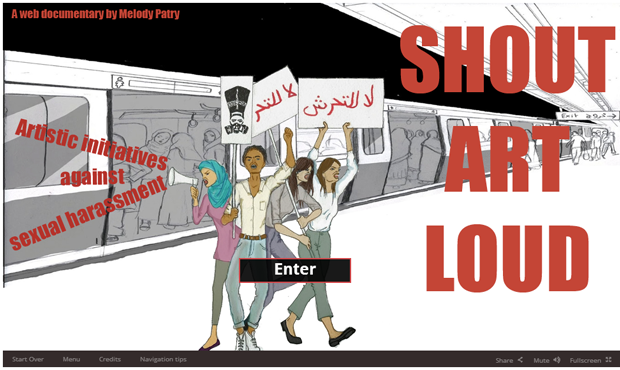
Index on Censorship’s Shout Art Loud, an interactive documentary highlighting how Egyptian graffiti artists, cartoonists, dancers and actors are fighting back against rising levels of violence and sexism on the streets of Cairo, has been named to the shortlist of the annual Amnesty International media awards.
Nominated in the Digital Innovation category, Shout Art Loud, created by Melody Patry, joins The Guardian’s The Shirt on Your Back and the Bureau of Investigative Journalism’s Covert Drone War on the short list.
Documentary maker Patry interviewed actors, dancers and other artists around Egypt, where 99% of women have experienced some form of sexual harassment, and 80% feel unsafe on the street. Sexual violence has risen sharply in Egypt in the past few years. During the period February 2011 to January 2014, Egyptian women’s rights groups documented thousands of cases of sexual harassment, as well as crimes of sexual violence against at least 500 women, including gang rapes and mob-sexual assaults with sharp objects and fingers.
With police, politicians and the judiciary seeming incapable of tackling the issue effectively, activists are turning to the arts to help lead the fight back. “Art is one of the most necessary mediums to impact society,” says Deena Mohamed who created a web-comic about a hijab-wearing superheroine who fights daily sexual harassment. “For people who are unaware of the issues women go through, I hope it helps them understand or at least give them something to think about.”
An interactive documentary intended as a “living report” that will be continuously updated, Shout Art Loud shows how Cairo residents are using different tactics to fight rising sexual harassment, including pro-women graffiti, drama workshops and street performances.
“We believe that spreading images, things that people are familiar with, women figures that people know and sayings that people know brings back some positivity about women in general,” says Merna Thomas, co-founder of a graffiti campaign to promote women’s rights in Cairo’s public spaces.
See how Egyptians are using theatre, dance, music and street art to tackle the issue of sexual harassment and violence against women in Egypt in this interactive documentary, which features interviews with artists, original artwork, videos and performances, including from Index’s 2014 Freedom of Expression Arts Award winner Mayam Mahmoud. You can access the documentary here: indexoncensorship.org/shoutartloud
“This innovative documentary is a reminder of the vital role artistic expression plays in tackling taboo subjects like sexual violence — in Egypt and beyond,” said Index CEO Jodie Ginsberg. “We want to bring this issue to a wider audience to show just how important artists and writers can be in bringing about change, and to tell the story in a new way.”
For further information and interview requests, please call +44 (0)207 260 2660
26 Sep 2014 | Campaigns, Statements

We the undersigned members of Artsfex condemn an alarming worldwide trend in which violent protest silences artistic expression that some groups claim is offensive. People have every right to object to art they find objectionable but no right whatsoever to have that work censored. Free expression, including work that others may find shocking or offensive, is a right that must be defended vigorously.
We call on artists, arts venues, protestors and the police to work together as a matter of urgency, to stand up for artistic free expression and to ensure that the right to protest does not override the right to free expression. This means that every possible step is taken to ensure that the art work remains open for all to see, while protesters voices are heard.
We must prevent the repetition of recent ‘successful protests’ in which the artist is silenced by threats of violence towards the institution, the work or the artist him or herself, as we saw with Exhibit B in London, and The City, the hip-hop opera by the Jerusalem-based Incubator Theatre company, which was disrupted and consequently cancelled earlier this year in Edinburgh.
Greater clarity around policing of controversial arts events is an essential first step. In the United Kingdom there is nothing at present in Association of Chief Police Officers guidance relating to the particulars of policing cultural events, except in reference to football matches and music festivals.
Controversial art triggers debate – and in the case of Exhibit B there was a huge outpouring of feeling in opposition to the work. A contemporary institution should anticipate and provide for this. Detailed planning such as this is important if the arts venue is to cater for both the artwork and the debate it generates.
We are concerned that unless arts institutions prepare procedures to manage controversy, including to develop strategies for working with the police to control violence, our culture will suffer as a result and become less dynamic, relevant and responsive.
Article 19
freeDimensional
Freemuse
Index on Censorship
National Coalition Against Censorship (US)
Vivarta
For further information, please call 0207 260 2660
About Artsfex
ARTSFEX is an international civil society network actively concerned with the right of artists to freedom of expression as well as with issues relating to human rights and freedoms. ARTSFEX aims to promote, protect and defend artistic freedom of expression, and freedom of assembly, thought, and opinion in and across all art disciplines, globally. http://artsfex.org/
