5 Feb 2014 | About Index, Campaigns, Press Releases
After two years at the helm of Index on Censorship, Chief Executive Kirsty Hughes will be leaving the leading international freedom of expression organisation in mid-April to pursue new projects and writing in the international and European politics arena.
Hughes joined Index in April 2012 taking its international editorial and advocacy strategy to new audiences and leading Index in its work on international digital freedom, including Index’s opposition to mass surveillance as revealed by the Snowden revelations, reinforcing its work in authoritarian and transition regimes around the world, and introducing a new focus on the question of access to freedom of expression. Hughes has been a key commentator and evangelist for Index, raising the organisation’s profile in the United Kingdom, India, Brazil, the EU and the United States.
Index on Censorship is currently seeking a leading free speech defender as our new CEO. Full details on the role can be found here.
31 Jan 2014 | About Index, Campaigns, Egypt, Statements
PDF: Arabic Version
Leading international media freedom and human rights organisations call on the EU and US to demand Egypt’s authorities drop charges against Al-Jazeera journalists and release those under arrest
Article 19, the Committee to Protect Journalists, Index on Censorship and Reporters Without Borders today said the Egyptian authorities must stop their attacks on media freedom and freedom of expression. The deteriorating environment for journalists to operate safely and report freely is of grave concern. The deliberate chilling of media freedom and free speech through arrests and criminalisation of legitimate journalism has all the hallmarks of the authoritarian Egypt of the Mubarak era.
The organisations call on the leaders of the European Union and the US to demand that Egypt’s authorities immediately release the Al-Jazeera journalists and end their clamp-down on media freedom, free speech and freedom of assembly without delay. The EU and US must support all those standing up for democracy, human rights and media freedom in Egypt.
Egyptian prosecutors have said that 20 journalists face charges though only 8 are currently under arrest. Four of these are believed to be foreigners and the other 12 said to be Egyptians.
Thomas Hughes, Executive Director, Article 19
Joel Simon, Executive Director, Committee to Protect Journalists
Kirsty Hughes, Chief Executive, Index on Censorship
Christophe Deloire, Secretaire Général, Reporters Without Borders
Press Contacts
Article 19: Ayden Peach, 07973911993
Committee to Protect Journalists: Samantha Libby, [email protected] / +1 212 300 9032 ext 124
Index on Censorship: Padraig Reidy, [email protected] / 0207 260 2660
Reporters Without Borders: Isabelle Gourmelon, [email protected] / +33 01 44 83 84 56
17 Jan 2014 | About Index, Campaigns, Statements
Leading free speech and privacy organisations call on the world’s elite assembled at Davos to tackle the challenge of global mass surveillance of electronic communications.
ARTICLE 19, English PEN, Index on Censorship and Open Rights Group are urging global leaders to discuss how states ensure security measures do not undermine rights and individual liberties, following revelations that the security agencies have been conducting secret mass surveillance of the digital communications of millions of people around the world.
The organisations said:
“The mass surveillance of our communications by the NSA, GCHQ and others undermines the right to privacy, free speech and media freedom. As such it is an assault on democracies and our societies. The leaders assembled at Davos must take a stand against surveillance – stop spying on us now.”
Secret mass surveillance is a threat to democracy and the rule of law.
If people are unable to know about the extent of government surveillance, we are unable to protect our fundamental rights.
When private communications are monitored by the state in secret, confidence in digital communications technology is unacceptably compromised, which has a severe chilling effect on freedom of expression and dangerously risks restricting the free flow of information.
Online surveillance programmes threaten to weaken the general security and privacy of communications systems and undermines trust in digital services. This has economic implications, as well as compromising the ability of people to express themselves.
We believe that:
Surveillance is only legitimate when it is targeted, authorised by a warrant, and when it is necessary and proportionate.
Mass population-wide surveillance is never justified.
Secret agreements that sanction mass surveillance undermine democracy. Citizens need a clear legal framework that governs state surveillance, in order to protect their rights.
All surveillance should be sanctioned by an independent judge on a case-by-case basis.
There must be effective, independent oversight of surveillance to command public confidence that such surveillance is not being abused.
For further information or interviews please contact:
Jo Glanville, Director, English PEN – tel 0771 302 0971
Kirsty Hughes, CEO, Index on Censorship – tel 07577 483 815
Jim Killock, Executive Director, Open Rights Group – tel 0789 449 8127
ARTICLE 19 – tel 0207 324 2510
Liberty
19 Nov 2013 | About Index, News, Press Releases
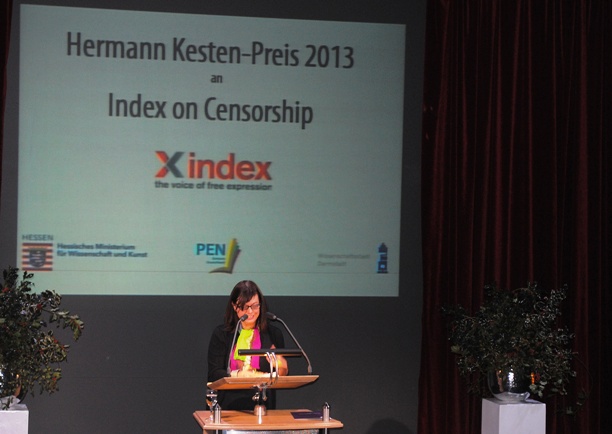 Index on Censorship was in Darmstadt, Germany, last week to receive the prestigious Hermann Kesten literary prize from German PEN.
The prize is given in honour of Hermann Kesten, the German novelist, who left Germany for Paris in 1933. From Paris, Kesten helped exiled and banned writers get published.
Previous recipients of the prize include Gunter Grass and Harold Pinter, and last year’s winner Belarusian journalist Irina Khalip. Khalip, who was not able to attend the ceremony last year as she was under house arrest, was in Darmstadt to present the award to Index. In her speech introducing Index, Khalip spoke of her personal connection with Index, as well as its history working with exiled and imprisioned writers. She said: When in prison Natalia (Radzina, of opposition website Charter 97) and I did not know that in 2011 together with all political prisoners in Belarus we were awarded the special Freedom of Expression prize. Index on Censorship did everything so that we were not forgotten in prison and were released as soon as possible. For instance, together with Free Belarus Now and the Belarus Free Theatre, Index persuaded several European banks to stop trading Belarus government bonds to prevent Europe from trading with the dictator. This made a big difference in persuading the regime it could not withstand international pressure forever.
Rachael Jolley, editor of Index on Censorship magazine, received the prize on behalf of the organization from the president of German PEN Josef Haslinger. She told the audience “ Index has taken aim at many authoritarian rulers and their regimes and made clear that contrary to what many may have thought and hoped for censorship is not over.”
“Index has sought, too, to keep the public aware of the pressure on journalists all over the world, who were struggling to do their jobs in difficult circumstances, often where their lives were in danger.”
