17 May 2013 | Americas
Brazil loves football – and it loves the game so much it’s hosting next year’s World Cup finals. But a huge number of fans from the state of Paraná are having a very hard time following their team this year because of media restrictions imposed by directors of the local club, Rafael Spuldar reports.
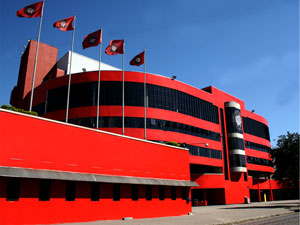
Atlético Paranaense from Curitiba, one of Brazil’s top flight teams and Brazilian champions in 2001, banned press conferences and independent media work during their weekly activities and on match days.
 On top of that, no staff member — including players and managers — of Atlético is officially allowed to speak to the media. The club says that radio stations and newspapers should pay for the right to report on the club, along the lines of fees television stations pay to broadcast matches.
However, a 2011 federal law forbids football clubs from charging money for radio broadcasts.
The club’s policy is that all information about the team will be funneled through official channels ike the team’s website, online radio and TV. Independent journalists will be limited to background information and off-the-record statements.
It’s a common practice in Brazil’s football industry to have at least two press conferences a week with players and managers and regular media activity on match days. It’s also usual in the country to have people from clubs on sport shows airing on TV and radio, which makes Atlético’s move a rare one in Brazilian football.
“The content we offer is not of a primary importance to the audience, it’s pure entertainment. So we don’t feel obliged to let anyone enter the club’s premises and profit from our business without paying for it, like radio stations do”, says Mauro Holzmann, Atlético’s director of communications and marketing.
“Less than thirty years ago it was OK for televisions to broadcast football matches without paying for it, but now it’s unthinkable to do so. So why don’t the other media pay for it? We know it’s a paradigm shift, but maybe other clubs will do this too”, Holzmann told Index on Censorship.
Broadcasting of matches became another problematic issue. Atlético did not reach an agreement for Paraná’s State Championship with TV rights holders RPC – a local affiliate of national media giant Rede Globo. Because of that, fans were not be able to watch the games unless they bought tickets and went to the pitch.
“This is a complete enclosure that ends up damaging everybody”, says Leonardo Bonasolli, reporter at Gazeta do Povo, Curitiba’s biggest newspaper.
“The club loses exposure at the media, and exposure means more sponsorship money. The press loses the chance of providing a different, independent point of view and, of course, fans also lose because they are not interested only on the team’s monolithic media work”, Bonasolli told Index on Censorship.
Atlético’s chairman Mário Celso Petraglia said the State Championship – which runs from January until early May – is not profitable, so he would not only deny TV broadcasting but would also put the Under-23 team on the pitch, while the main squad would have an extended pre-season in Europe until the start of the Brazilian Championship.
About the media ban, Petraglia said in a rare interview that the club “reached a limit” in its relationship with the press, and that journalists “should be neutral and conduct [their work] in an ethical and moral way”, something he believes does not happen in Paraná.
Petraglia’s disturbed relationship with the press has a long history – it started in the late 1990s, when he was involved in a bribery scheme with referees to fix match results. He was neither convicted nor banned because of the episode.
Atlético first tried to charge money from radios to broadcast its games in 2008. However, a judge ruled the fees were illegal and radio stations have since been given stadium access on match days.
Atlético’s media ban was effectively shut down in early May, during the State Championship finals against historic rivals Coritiba. Rede Globo, which also owns the TV rights of the Brazilian Championship, made a deal with Atlético to allow both matches to be aired. It also closed an agreement for broadcasting the State Championship in 2014 and 2015.
After the game, Atlético’s players gave interviews normally, even to outlets other than Globo, as if there was no ban.
Paraná’s Sports Journalists Association believes Atlético’s attitude towards general media won’t change much, even with the upcoming Brazilian Championship, which draws national attention to all clubs.
“When the Brazilian championship starts, Atlético will be forced to speak to Globo, and they will also feel pressed to hold conferences after matches, because there will be so many journalists from the whole country. But I doubt they will allow other radio or TV stations inside the club during the week, so Globo will do all interviews and share their material to the other outlets”, says the Association’s president, Isaías Bessa.
Local journalists also say the club’s lack of transparency damages Curitiba’s position as one of the host cities of the 2014 World Cup – Atlético’s stadium will a venue. Renovations on the stadium are said to be the most behind schedule of any of the 12 World Cup venues, but independent media was never allowed inside after the works began.
Atlético’s Mauro Holzmann firmly says the stadium will be ready by the end of 2013, like FIFA demands, and blames all delays on “Brazil’s bureaucracy” to deal with public financing.
8 May 2013 | Newswire
The discovery of a financial scam at a company in India’s West Bengal state is shining a light on the relationship between politicians and media owners, Mahima Kaul reports.
The firm in question, Saradha Group, had risen to become a financial empire over the past eight years under boss and owner Sudipta Sen. The company has business interests ranging from construction to travel to exports and agriculture. When the “chit fund” scandal came to light — with an estimated loss of $4-6 billion (US) to investors — Sen fled to Jammu and Kashmir, where he was ultimately arrested.
A chit-fund scandal, or “cheat fund” as some sections of the media are calling it, operates like a ponzi scheme. Sen duped many small and middle class investors into giving him their life savings, with promises of great returns. He managed to evade the regulators by using a nexus of companies to launder the money. The money collected was used to recklessly invest in a range of industries — including a mismanaged media empire. The government of West Bengal has had to set up a $2.5 million fund to ensure that the small investors are not bankrupted.
 In a letter to the Central Bureau of Investigation (CBI), Sen claims to have been misled by a group of individuals who cheated investors by using his name, unbeknownst to him. However, the letter also shows how political patronage is obtained through acquiring media houses.
Saradha Group owns 18 newspapers and TV channels in West Bengal and Assam. These include Bengal Post, Sakalbela, Kalam, Paroma, Azad Hind, Prabhat Varta, Seven Sisters Post – and the TV channels, Tara Musik, Tara Newz, South Asia TV, and Channel 10, all under the umbrella of Saradha Printing and Publishing Pvt Ltd.
As Indian media blog the Hoot reports, “many senior journalists then suspected that media ownership was a matter of business strategy to establish the company’s credentials and also a bid to emerge as the mouthpiece of the major political party and perhaps get benefits in return.”
This view is supported by BBC journalist Sudhir Bhowmik, who says he left a job with the Saradha Group after he was told to “go soft on some leaders.”
It appears that Sen bought and built a media empire, allegedly on the behest of politicians of the ruling Trinamool Congress party, to play the part of a proganda-spinning machine for the government. This is no small feat – the net worth requirement of an applicant seeking to launch a news channel had been raised by the government from approximately $555,500 to $3,703,000, ostensibly to keep away “fly by night” operators away. But since Sen had already raised his financial portfolio, by dubious financial practises as we know now, he was able to take this step to becoming a media baron.
The curious case of the Saradha Group media empire gets murkier as the story unravels. In his letter to the CBI, Sen also claims to have been regularly blackmailed by Kunal Ghosh and Srinjoy Bose — two sitting Trinamool Congress members of the Upper House — into setting up his news channels. He also says he paid Ghosh $28,000 USD a month. Ghosh, now on the back foot, claims that he was simply a “salaried employee” and that he had “no authority to sign cheques.”
Sen’s use of the media empire to build political clout and protection is now being outlined by the national media. Influential members of West Bengal’s ruling Trinamool Congress party have been closely aligned with the media group. But some politicians are now distancing themselves from the group, despite having benefited from positive propaganda from its media outlets.
In India, which now has over 800 private satellite channels, media houses often favour particular political parties, and many are actually directed owned by politicians themselves. Amid growing unease, the Ministry of Information and Broadcasting has asked all channels to furnish details of their shareholding patterns and equity share. Both the ministry and the Telecom Regulatory Authority of India (TRAI) have been looking to ways to ensure pluralism and diversity in the Indian media, and curbing monopolistic growth. They feel tracking ownership patterns might be one way of finding out which groups and individuals are involved in unethical behaviour like corporate and political lobbying, biased analysis and forecast in the political arena and sensationalism of news. The ministry has made it clear that if it finds any media group in violation of its license agreement – including shareholding patterns – it is ready to cancel licenses.
Meanwhile, another unfortunate result of the scandal is that more than 1,400 journalists are out of jobs, while some of Sen’s Channel 10 employees have filed a complaint with the police over non-payment of salaries by Sen and Ghosh.
8 May 2013 | India
The discovery of a financial scam at a company in India’s West Bengal state is shining a light on the relationship between politicians and media owners, Mahima Kaul reports.
The firm in question, Saradha Group, had risen to become a financial empire over the past eight years under boss and owner Sudipta Sen. The company has business interests ranging from construction to travel to exports and agriculture. When the “chit fund” scandal came to light — with an estimated loss of $4-6 billion (US) to investors — Sen fled to Jammu and Kashmir, where he was ultimately arrested.
A chit-fund scandal, or “cheat fund” as some sections of the media are calling it, operates like a ponzi scheme. Sen duped many small and middle class investors into giving him their life savings, with promises of great returns. He managed to evade the regulators by using a nexus of companies to launder the money. The money collected was used to recklessly invest in a range of industries — including a mismanaged media empire. The government of West Bengal has had to set up a $2.5 million fund to ensure that the small investors are not bankrupted.
In a letter to the Central Bureau of Investigation (CBI), Sen claims to have been misled by a group of individuals who cheated investors by using his name, unbeknownst to him. However, the letter also shows how political patronage is obtained through acquiring media houses.
Saradha Group owns 18 newspapers and TV channels in West Bengal and Assam. These include Bengal Post, Sakalbela, Kalam, Paroma, Azad Hind, Prabhat Varta, Seven Sisters Post – and the TV channels, Tara Musik, Tara Newz, South Asia TV, and Channel 10, all under the umbrella of Saradha Printing and Publishing Pvt Ltd.
As Indian media blog the Hoot reports, “many senior journalists then suspected that media ownership was a matter of business strategy to establish the company’s credentials and also a bid to emerge as the mouthpiece of the major political party and perhaps get benefits in return.”
This view is supported by BBC journalist Sudhir Bhowmik, who says he left a job with the Saradha Group after he was told to “go soft on some leaders.”
It appears that Sen bought and built a media empire, allegedly on the behest of politicians of the ruling Trinamool Congress party, to play the part of a proganda-spinning machine for the government. This is no small feat – the net worth requirement of an applicant seeking to launch a news channel had been raised by the government from approximately $555,500 to $3,703,000, ostensibly to keep away “fly by night” operators away. But since Sen had already raised his financial portfolio, by dubious financial practises as we know now, he was able to take this step to becoming a media baron.
The curious case of the Saradha Group media empire gets murkier as the story unravels. In his letter to the CBI, Sen also claims to have been regularly blackmailed by Kunal Ghosh and Srinjoy Bose — two sitting Trinamool Congress members of the Upper House — into setting up his news channels. He also says he paid Ghosh $28,000 USD a month. Ghosh, now on the back foot, claims that he was simply a “salaried employee” and that he had “no authority to sign cheques.”
Sen’s use of the media empire to build political clout and protection is now being outlined by the national media. Influential members of West Bengal’s ruling Trinamool Congress party have been closely aligned with the media group. But some politicians are now distancing themselves from the group, despite having benefited from positive propaganda from its media outlets.
In India, which now has over 800 private satellite channels, media houses often favour particular political parties, and many are actually directed owned by politicians themselves. Amid growing unease, the Ministry of Information and Broadcasting has asked all channels to furnish details of their shareholding patterns and equity share. Both the ministry and the Telecom Regulatory Authority of India (TRAI) have been looking to ways to ensure pluralism and diversity in the Indian media, and curbing monopolistic growth. They feel tracking ownership patterns might be one way of finding out which groups and individuals are involved in unethical behaviour like corporate and political lobbying, biased analysis and forecast in the political arena and sensationalism of news. The ministry has made it clear that if it finds any media group in violation of its license agreement – including shareholding patterns – it is ready to cancel licenses.
Meanwhile, another unfortunate result of the scandal is that more than 1,400 journalists are out of jobs, while some of Sen’s Channel 10 employees have filed a complaint with the police over non-payment of salaries by Sen and Ghosh.
8 May 2013 | India, Newswire
The discovery of a financial scam at a company in India’s West Bengal state is shining a light on the relationship between politicians and media owners, Mahima Kaul reports.
The firm in question, Saradha Group, had risen to become a financial empire over the past eight years under boss and owner Sudipta Sen. The company has business interests ranging from construction to travel to exports and agriculture. When the “chit fund” scandal came to light — with an estimated loss of $4-6 billion (US) to investors — Sen fled to Jammu and Kashmir, where he was ultimately arrested.
A chit-fund scandal, or “cheat fund” as some sections of the media are calling it, operates like a ponzi scheme. Sen duped many small and middle class investors into giving him their life savings, with promises of great returns. He managed to evade the regulators by using a nexus of companies to launder the money. The money collected was used to recklessly invest in a range of industries — including a mismanaged media empire. The government of West Bengal has had to set up a $2.5 million fund to ensure that the small investors are not bankrupted.
In a letter to the Central Bureau of Investigation (CBI), Sen claims to have been misled by a group of individuals who cheated investors by using his name, unbeknownst to him. However, the letter also shows how political patronage is obtained through acquiring media houses.
Saradha Group owns 18 newspapers and TV channels in West Bengal and Assam. These include Bengal Post, Sakalbela, Kalam, Paroma, Azad Hind, Prabhat Varta, Seven Sisters Post – and the TV channels, Tara Musik, Tara Newz, South Asia TV, and Channel 10, all under the umbrella of Saradha Printing and Publishing Pvt Ltd.
As Indian media blog the Hoot reports, “many senior journalists then suspected that media ownership was a matter of business strategy to establish the company’s credentials and also a bid to emerge as the mouthpiece of the major political party and perhaps get benefits in return.”
This view is supported by BBC journalist Sudhir Bhowmik, who says he left a job with the Saradha Group after he was told to “go soft on some leaders.”
It appears that Sen bought and built a media empire, allegedly on the behest of politicians of the ruling Trinamool Congress party, to play the part of a proganda-spinning machine for the government. This is no small feat – the net worth requirement of an applicant seeking to launch a news channel had been raised by the government from approximately $555,500 to $3,703,000, ostensibly to keep away “fly by night” operators away. But since Sen had already raised his financial portfolio, by dubious financial practises as we know now, he was able to take this step to becoming a media baron.
The curious case of the Saradha Group media empire gets murkier as the story unravels. In his letter to the CBI, Sen also claims to have been regularly blackmailed by Kunal Ghosh and Srinjoy Bose — two sitting Trinamool Congress members of the Upper House — into setting up his news channels. He also says he paid Ghosh $28,000 USD a month. Ghosh, now on the back foot, claims that he was simply a “salaried employee” and that he had “no authority to sign cheques.”
Sen’s use of the media empire to build political clout and protection is now being outlined by the national media. Influential members of West Bengal’s ruling Trinamool Congress party have been closely aligned with the media group. But some politicians are now distancing themselves from the group, despite having benefited from positive propaganda from its media outlets.
In India, which now has over 800 private satellite channels, media houses often favour particular political parties, and many are actually directed owned by politicians themselves. Amid growing unease, the Ministry of Information and Broadcasting has asked all channels to furnish details of their shareholding patterns and equity share. Both the ministry and the Telecom Regulatory Authority of India (TRAI) have been looking to ways to ensure pluralism and diversity in the Indian media, and curbing monopolistic growth. They feel tracking ownership patterns might be one way of finding out which groups and individuals are involved in unethical behaviour like corporate and political lobbying, biased analysis and forecast in the political arena and sensationalism of news. The ministry has made it clear that if it finds any media group in violation of its license agreement – including shareholding patterns – it is ready to cancel licenses.
Meanwhile, another unfortunate result of the scandal is that more than 1,400 journalists are out of jobs, while some of Sen’s Channel 10 employees have filed a complaint with the police over non-payment of salaries by Sen and Ghosh.
