6 Feb 2012 | Russia
On Saturday February 4 protesters calling for fair elections in Russia hit the streets worldwide.
The protests took place exactly one month before the presidential election, which is likely to return prime minister Vladimir Putin to the Kremlin’s highest post. Protest organisers estimated that 120,000 people took part in Moscow, it was the biggest demonstration to date triggered by suspicions of vote-rigging surrounding the December 4 parliamentary elections.
In London around 100 people attended a demonstration organised by the NGO Speak Louder! together with the Committee for Free Elections in Russia. At around 3pm, a letter was handed into No. 10 passed to prime minister David Cameron. The protesters asked the British government to monitor next month’s elections very closely:
On behalf of Russians living in the United Kingdom, and on behalf of all the citizens of this country who cherish freedom and democratic rights, we ask you to pay constant attention to the forthcoming presidential elections in Russia. Unfortunately, these elections will most probably not be democratic and fair, as the trend shows.

 “Russia without Putin” proved to be the most popular slogan at the demonstration, and a variety of creative posters were on display. Many joked about Putin’s attitude towards the white ribbons used by protesters to symbolise freedom — Putin compared them to condoms, and posters carried slogans such as “Put-in – preservatives with governmental flavour” and “Grandpa with a condom tattoo”.
Tamara, a Russian businesswoman and mother of two, says: “I think that Russia needs to make its own path to democracy. It is a very specific, very large country, and I don’t know how long will it take. But we need to start from somewhere, and what is finally happening in these months is a very important start”.
Finnish human rights activist Lauri Vuoriluoto came all the way from Cardiff to join the demonstration. “I am here because I believe that what happens in Russia is of big interest for all of us. As a Finnish citizen, these developments touch me deeply because of the proximity of my country to Russia, and because of the deep economic ties between the two countries. I am probably the only one here who does not speak a word of Russian, but I will learn by next time.”
Political artist Kaya Mar took part in the protest as well. He carried his latest work, a painting portraying Putin and Medvedev, naked, as they play on a seesaw.
“The bear in the middle symbolises Russia, with eyes and mouth shut because its fundamental freedoms have been breached,” he explained. “My subjects are always naked because this way you can catch people’s heart better — taking off their clothes you take off their power as well, and they are revealed the way they are – as human beings.”
Organisers announced that the next London protest action will take place on February 26.
Tena Prelec is a freelance writer and consultant at the ESOP Centre, London.
10 Dec 2011 | Europe and Central Asia, News
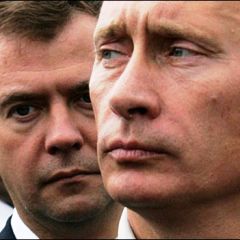
Tens of thousands of people participated in opposition rallies against alleged unfair parliamentary elections in Russia. The biggest was in Moscow: up to 120 thousand people demanded Russia’s prime-minister Vladimir Putin resignation.
“Putin Thief”, “We need fair elections”, “Register opposition parties” — these were slogans of Russia’s biggest protest rally since the day of parliamentary elections and since the beginning of post-Soviet Russia.
Famous Russian writer Boris Akunin, known for his public support to former oligarch and Putin’s opponent Mikhail Khodorkovsky, said he “hasn’t seen such Moscow for the last 20 years”. Opposition leaders, rights activists, well-known journalists and public figures appealed to the people to take further action to control authorities and use democratic tools to change government policy. The rally’s resolution included five points:
– Political prisoners to be released immediately;
– Elections results to be cancelled;
– The head of the Central Election Commission Vladimir Churov to resign,and his activities and election fraud to be investigated;
– Opposition parties to be registered, democratic election law to be passed;
– New fair elections to be held.
Rally participants agreed the authorities now have two weeks to react and fulfil their requirements. If not, a new rally, a bigger one, will be held on 24 December in Moscow and other cities. Opposition parties Yabloko and Communist Party, who took part in protest on 10 December, also resolved to remind the authorities about people’s demands on two rallies of their own — on 17 and 18 December respectively.
This day is not just remarkable because Moscow hasn’t faceda rally like this in 20 years, but also because other cities protested. Similar rallies were held in Saint Petersburg, Khabarovsk, Perm, Ekaterinburg, Novosibirsk, Samara amd other cities. Protests of solidarity were held outside Russia, too, in London, New-York, Oslo, Helsinki, Lisbon, Barcelona, Paris, Jerusalem, Tokio, Dublin, Berlin, Prague, Rome.
In most Russian cities policemen arrested tens of acivists, but in Moscow they earned applause from the rally participants for their unexpected accommodation. Previous Moscow protests against elections results have been marked with hundreds of detentions and cruel police actions.
Russian TV, just like the Moscow police, surprised people by broadcasting news about the rally. Previous protests were not covered. The current rally waseven covered live, although neither Putin nor Medvedev were criticised on air and the rally’s topic — mass election fraud — was not explained or discussed during the broadcasts. Most items looked like reports on how well the police performed and how bad the traffic jams were because of the rally.
Inspite of rights activists’ words about “civil society rebirth” and “dramatic changes in Russia”, the Central Election Commission deputy Stanislav Vavilov said the Commission will not review election results. Putin’s spokesperson Dmitry Peskov told journalist the government “has not yet formed an opinion on the rally”.
But post-Soviet Russia has changed already: Never before has it faced tens of thousands of people chanting that they, not Putin and his “United Russia”, are the real power.
7 Dec 2011 | News
Activists and opposition politicians arrested as Russians speak out against the prime minister’s party. Elena Vlasenko reports
(more…)
25 Mar 2011 | Index Index, minipost
Reporter Sergei Topol was beaten around the head on Wednesday as he left his home in Moscow, leaving him hospitalised. Topol published a series of articles in 2008 in which he alleged that Prime Minister Vladimir Putin was going to leave his wife for a 27-year-old Olympic champion gymnast. Putin denied the claims at the time, and told journalists to keep their “snotty noses” out of his private life. Topol’s assailant is unknown and police have declined to comment on the motive.


 “Russia without Putin” proved to be the most popular slogan at the demonstration, and a variety of creative posters were on display. Many joked about Putin’s attitude towards the white ribbons used by protesters to symbolise freedom — Putin compared them to condoms, and posters carried slogans such as “Put-in – preservatives with governmental flavour” and “Grandpa with a condom tattoo”.