28 Jan 2015 | Draw the Line, mobile, Youth Board
Censorship, and the degree to which we self-censor, is becoming an increasingly difficult, yet pressing and vitally important, topic of debate amongst an ever-growing international community.
Now, in the internet age, it has never been easier to connect and communicate with so many different people from all across the world. With these wide reaching forms of communication, and various people calling for censorship at different levels, the extent to which offence is considered an acceptable and fundamental part of free speech, has been called into question.
In the wake of the Charlie Hebdo killings, some world leaders have spoken publicly against self-censorship. Australian Prime Minister Tony Abbot urged media in the country to not resort to self-censorship. Some believe that certain groups, communities or organisations should be exempt from satire, criticism or insult. Others might argue that without the right to offend, a proper line of communication can never truly be attained, that no group should be exempt, and that people have the right to offend and be offended, but not to resort to violence and extremism.
This poses the question: is causing offence, and the ability to be offended, a fundamental part of freedom of expression? And, if we remove the right to offend, does this then close down the space for free and open debate?
Tweet your thoughts to #IndexDrawtheLine to get involved in the debate.
This article was published on 28 January 2015 at indexoncensorship.org
24 Nov 2014 | Egypt, News, Politics and Society
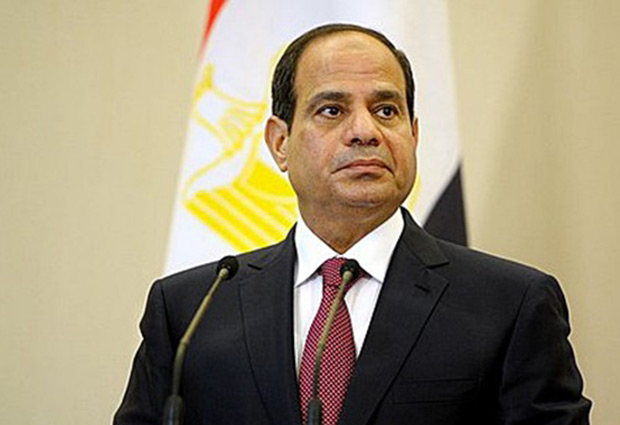
Egyptian President Abdel Fattah El Sisi has tightened the screws of the country’s journalists. (Photo: Wikipedia)
In a rare show of defiance, hundreds of Egyptian journalists have objected to a “statement of allegiance” to the government signed by editors-in-chief of the main state-owned and independent newspapers.
More than 600 Egyptian journalists signed an online petition defending press freedom and rejecting censorship in all its forms. The move came in response to a loyalty pledge by 17 editors-in-chief of newspapers to refrain from criticizing the police, the military and the judiciary at this sensitive time when Egypt was “at war with terrorism.”
The journalists dismissed the editors’ statement as “a futile attempt to create a one-voice media,” arguing that “fighting terrorism had nothing to do with voluntary abandonment of freedom of speech.”
“The editors’ statement is not worth the ink used in writing it,” Dina Samak, deputy editor-in-chief of the English language semi-official Ahram Online and one of the journalists who signed the petition, told Index on Censorship.
“The terrorists will win when they can control the media, and the state will fall when it agrees on the same goal,” said Khaled El Balshi, a journalist and board member of the Journalists Syndicate, who helped draw up the petition for press freedom.
In a show of solidarity with Egypt’s military-backed regime, the editors had gathered at El Wafd newspaper headquarters on 26 October to forge “a united front against terrorism”, expressing their “rejection of attempts to cast doubt on state institutions.” They also vowed to take measures to halt what they called the “infiltration by elements supporting terrorism” in their publications — a reference to supporters of the outlawed Muslim Brotherhood, designated as a terrorist group by Egypt last year.
While the move did not come as a surprise to many — as it was already clear that the majority of media outlets had aligned themselves closely with the government since the military takeover of the country in July 2013 — the “loyalty pledge” by the editors was nevertheless unusual even in a country where the media was in lockstep with the regime.
The signatories to the declaration — the editors-in-chief of the three main state-owned dailies Al Ahram, Al Akhbar, Al Gomhouria and those of the independent Al Masry Al Youm, Al Watan, Al Shorouq, El Tahrir, El Ahali, Al Fajr , El Messa, El Esboo, El Youm el Sabe and El Gamaheer newspapers — argued however that “crisis situations” required “exceptional measures”.
Defending the editors’ statement, Emad El Din, editor-in-chief of the independent Al Shorouk denied that the editors’ loyalty declaration gave journalists the green light to practice self censorship.
“We wanted to deliver a message to citizens that the media is with the state in fighting terrorism,” he told NPR Radio shortly after signing the statement.
“At this time of heightened nationalism, the climate does not allow for any criticism of the government,” he added.
The move came in response to a call by President Abdel Fattah El Sisi for Egyptians to rally behind him in his fight against terrorism following two deadly militant attacks on an army checkpoint in North Sinai on 24 October that killed 33 army soldiers and injured at least a dozen others. The militant assaults were the latest in a string of attacks targeting mainly security forces — but at times, also civilians — since the overthrow of Islamist President Mohamed Morsi in July 2013. The attacks have prompted a surge in nationalism and a heralding of a so-called “war on terrorism” waged by the military against suspect-militants in the Sinai Peninsula. The violence has also resulted in a massive government crackdown on dissent that has targeted all opposition including journalists critical of regime policies.
Six journalists have been killed and dozens detained since the military took power in July 2013, according to the New York-based Committee for the Protection of Journalists. While most have been released, at least 11 journalists remain behind bars for no crime other than being at — or near — Muslim Brotherhood protest sites. Among the detained are three journalists working for the Al Jazeera English news network who have been sentenced to between seven and 10 years in jail on charges of “threatening national security, fabricating news and aiding a terror group”.
The crackdown on the media has led many journalists to practice self-censorship for fear of being imprisoned, killed or labeled “unpatriotic” by an unsympathising Egyptian public. Meanwhile, the statement released by the editors has fueled fears among press freedom advocates of a further shrinking in the already-dwindling space for freedom of expression in Egypt.
Adel Hamouda, an Egyptian journalist and former editor-in-chief of Al Fajr, meanwhile, criticised the editors’ statement as “uncalled for“.
“It is an attempt by the editors to win favour with the regime for the sake of personal gains,” he told Index. He explained that all Egyptians — except those supporting the Muslim Brotherhood — support the state in its war on terror so it is “meaningless” to publicly assert their support. He further noted that all media organisations were required to seek approval from the Armed Forces Morale Affairs Department before publishing or broadcasting any news about the military.
The majority of the independent media outlets that signed the statement belong to wealthy businessmen with close links to the ruling military-backed regime. They are fully aware that publishing any criticism of government policies would ruffle feathers and likely jeopardize their business interests. All top editors were appointed by the Higher Press Council shortly after Morsi’s overthrow in July 2013. Their selection was clearly based on their willingness to cooperate with the regime rather than their merits. Shortly after Morsi’s ouster, a leaked video on YouTube showed then-Defence Minister Abdel Fattah El Sisi asking senior generals to “establish partnerships with media outlets to curb any criticism of the military”. An independent journalist who spoke on condition of anonymity told Index that days before Morsi’s ouster, she had been approached by security officials who promised her “fruitful rewards” if she joined the “winning side” — a clear reference to the country’s powerful security apparatus that drove the uprising against the democratically-elected president.
In the coup’s aftermath, most editors and TV talk show hosts have persistently lionised Sisi and cheered on the military while demonising the Muslim Brotherhood, the Islamist group from which former President Mohamed Morsi hailed.
The media in Egypt has traditionally been a propaganda tool for whoever is in power. Various successive regimes have used the state media as a mouthpiece to further their political gains. Under Mubarak, all editors-in-chief of the state-owned newspapers were handpicked by his powerful Minister of Information Safwat El Sherif who presented the list of chosen candidates to the Shoura or Consultative Council, the upper house of parliament dominated by members of the then-ruling party, the National Democratic Party, for ratification.
In the months following the fall of Mubarak, there was a brief period of free expression and a loosening up of restrictions on the media. Press freedom — one of the major gains of the 2011 mass uprising — was short-lived however as the Supreme Council of the Armed Forces (SCAF) which replaced Mubarak, quickly moved to exercise control over the media. During its one year in office, the SCAF confiscated newspapers, ransacked the offices of foreign news networks and investigated journalists critical of the military. Shortly after Morsi won the elections — becoming the country’s first democratically elected president — he too reneged on his election promises to promote freedom of speech, appointing a Muslim Brotherhood member as minister of information. The Muslim Brotherhood-dominated Shoura appointed regime loyalists as senior editors of state-owned dailies, repeating the Mubarak-era practice that allows tight government control over the media. The move provoked an outcry from non-Islamist journalists who held protest rallies and threatened to resign their posts.
Almost immediately after Morsi’s overthrow, all Islamist-leaning newspapers and TV channels were shut down by the new authorities — a move that sent a message to journalists that there was little tolerance for dissent in Egypt, post-3 July. The last sixteen months have seen a return of the media censorship reminiscent of that which prevailed under Mubarak. Newspapers that published articles deemed “controversial” by the authorities, have been pulled off newsstands and confiscated. In October 2014, a print edition of the independent Al Masry Al Youm was confiscated by government censors for publishing an interview with former national security intelligence chief Mohamed Gebril in which he was quoted as saying that “no Israeli spy has ever been executed in Egypt”. The paper later appeared on newsstands, albeit without the interview. Months earlier, columnist and screenwriter Belal Fadl resigned from the independent Al Shorouk after the paper’s management allegedly refused to publish his column ridiculing the promotion of Sisi (who was defence minister at the time) to the rank of field marshal. Fadl was accused by pro-military commentators of being a “traitor” and “a fifth columnist plotting to destroy the country”.
Several editors who signed the statement of support to the government are also known to be part of a fake opposition created by Mubarak to give a semblance of free speech and democracy. Like other pro-regime editors, they too have persistently glorified the military and vilified the Muslim Brotherhood. And they have gone a step further, slandering the January 25 Revolution as a “foreign conspiracy” and labelling the secular opposition activists who mobilised public support for the 2011 mass protests “traitors” and “foreign agents.”
Mostafa Bakri, editor-in-chief of Al Osbou — and one of the editors who signed the loyalty pledge — has recently been summoned by the public prosecutor after several legal complaints were filed against him by private citizens for “fabricating news” and “slandering the January 25 Revolution”.
Meanwhile, the journalists behind the online petition for press freedom are planning to form an independent association to advocate freedom of expression. While this is a step in the right direction, press freedom advocates fear the negative effects of the editors’ pledge of allegiance are already being felt.
“Their statement was perceived as a warning message by the younger, less skilled journalists, many of whom are now practicing self-censorship for fear of losing their jobs or in a bid to win favour with the management and get promoted,” lamented Dina Samak.
Despite the setback, the battle for press freedom is on.
“It is a battle pitting the younger, pro-reform journalists against the old regime loyalists, resisting change,” Amany Kamal, a former radio presenter told Index. Kamal was forced to quit her job as a broadcaster with a state-run radio channel after being accused by the management of sympathising with the Muslim Brotherhood. “But we shall win,” she said.
This article was published on 24 November 2014 at indexoncensorship.org
29 Apr 2014 | News, Politics and Society, Uganda, Young Writers / Artists Programme
(Photo illustration: Shutterstock)
As a master student of Conflict and Development at the University of Ghent, Jos Van Steelandt will write a dissertation on the subject of censorship on and self-censorship within the media in Uganda. Because of his background as a historian specialised in Ugandan media-history and his interest in human rights, he chose this politically sensitive topic. In July, he will be conducting interviews with journalists working in Uganda. He will be keeping Index on Censorship up to date on his research during his trip.
In Uganda, journalists are not only dealing with outright censorship. It seems the government of president Yoweri Museveni is employing a strategy that is aimed at pushing journalists towards self-censorship using a broad range of measures. Although the Ugandan media has a very strong tradition of critical reporting some journalists are probably more prone to self-censor.
The use of force by its security forces serves to stifle critical voices appears widespread. A local human rights organisation, Human Rights Network for Journalists-Uganda, states in its latest report that in 2012 there were 124 violations of press freedom. A staggering 83% of these violations against journalists were committed by state-actors, among which police forces incorporate the large majority of the perpetrators. The structural nature of these violations and especially the contexts of the violations seems to suggest that this would be the result of an active government policy.
Apart from this outright aggression, the security forces in cooperation with the Uganda Communications Commission are able to close down editorial offices, as happened to one of Uganda’s leading newspapers, The Monitor, in 2013. This newspaper, known for its critical stance towards the government, was shut down for a couple of days after publishing a leaked confidential letter by General Sejjusa, which contained very compromising information about president Museveni’s familypresident. This event underlined to Ugandan news organisations that publishing on politically sensitive topics is not without risk.
Security forces also create an atmosphere in which critical reporting is discouraged by arresting journalists arbitrarily. Renowned Ugandan journalist Andrew Mwenda, for instance, was arrested 16 times. Most of the journalists who are arrested, are released shortly after, but the message towards journalists is once again clear.
Uganda’s legal code is another possible cause of self-censorship. Various laws give the government and security forces the possibility to constrain essential freedoms and even contradict the Ugandan constitution. The Public Order Management Bill, the Uganda Communications Act, the Press and Journalist Act and the Penal Code Act contain provisions that can be and are being used to hamper journalists. Journalists are often sued for libel or sedition or get bogged down in other lawsuits concerning their work. Journalists are made painfully aware that critical reporting implies walking the line within this legal framework.
The theory of the ‘chilling effect’ suggests that Uganda’s legal regime creates the possibility to clamp down on journalists and will have negative consequences on their work. This regulatory environment, in combination with the threat of violence and arrest, could make the large majority of journalists working in Uganda less willing to cover sensitive topics or could make them use mitigating discourse in their reports.
This July, I will conduct interviews with journalists of different news organisations working in Uganda. In these interviews, I will ask them for their personal experiences working as a journalist, but also ask them for the stories they think are interesting about other journalists who have had a run-in with the state. These stories, called control parables, that circulate among journalists, can tell us a lot about what journalists consider behaviour that will result in a run-in with the state. It can show us in which way most journalists will censor themselves even though the state hasn’t explicitly told them so. When we lay bare these mechanisms and research why some journalists are more vulnerable to self-censor, we can begin to think about possible measures that donors or NGO’s can take to make journalists less prone to self-censor on politically sensitive but still important issues. These possible measures include providing insurance or legal protection for journalists and campaigning to implement some sort of Chilling-effect principle in the Ugandan legal code. This principle is being implemented in the European Court of Human Rights and can be invoked when a certain law threatens to impose silence upon journalists in cases of politically sensitive topics.
Three more months and I’m off to do my fieldwork in Kampala, Uganda. I will try to bring you the stories of the journalists I interview and share the experiences they encountered working as a journalist in ‘the pearl of Africa’. I’ll keep you posted!
This article was posted on April 25, 2014 at indexoncensorship.org
12 Aug 2013 | Asia and Pacific, China, News, Politics and Society, Taiwan
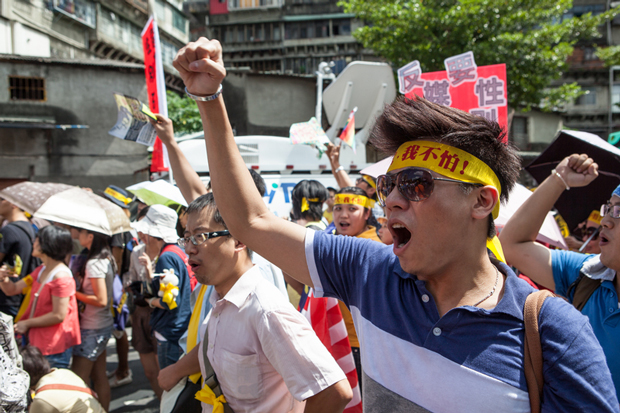
Activists and civic groups march in Taipei in protest against the Want Want China Times Group’s planned acquisition of China Network Systems’s cable TV services in Sept 2012.
(Photo: Craig Ferguson / Demotix)
The connections between China and Taiwanese media owners has given rise to concerns, along with some evidence, that the industry is under growing pressure to curb reporting on topics detrimental to Chinese interests and cross-strait ties.
The capital, Taipei, erupted in protests when it became known that Tsai Eng-ming, a pro-Beijing businessman, attempted to wrest control of Taiwan’s largest newspaper, the Apple Daily, earlier this year. The attempt failed amid popular outrage. But conversations with several journalists suggest that Beijing continues to exert a quieter influence – involving self-censorship and lucrative business interests – in attempt to avoid further scrutiny.
This is perhaps most prominent at the China Times Group, a Taiwanese media conglomerate that Tsai purchased in 2008. Estimated to be worth up to US$10.6 billion, the snack manufacturer has since led its subsidiaries to become more China-friendly, accepting payment from Beijing in return for camouflaged advertising and one-sided reporting. His flagship daily, the China Times, has been fined multiple times by Taiwan’s media regulators for masquerading advertising as reporting.
“It happens far more frequently than most people realize,” said Lin Chao-yi, the former head of the Association of Taiwan Journalists, that uncovered one such example last year. After receiving a copy of a schedule detailing how a visit from a ranking Chinese official was to be covered, including pre-defined topics and article lengths, Lin then impersonated a China Times employee to ask the delegation how the paper was going to be compensated.
Caught on tape, the Chinese press officer replied that the payment would be wired to a China Times Group subsidiary in Beijing. But far from discouraging such deals from taking place again, Lin said that his report “just made them more careful.” Indeed, accepting Chinese money is not only lucrative business, but also allows the paper to stay on Beijing’s good graces – guaranteeing access from behind China’s Great Firewall – according to sources familiar with the relationship.
The China Times Group’s cosy relationship with Beijing has led some journalists working under its banner to become more aware of what might, and might not, be publishable. Speaking on the condition of anonymity, one China Times reporter said that, there is an “unspoken understanding” of what articles or reports might contradict the paper’s political viewpoint, including, for example, pieces critical of either Beijing or Taiwan’s China-friendly president, Ma Ying-jeou.
“In these cases, we might choose to just drop the subject, instead of choosing to pursue it further,” the reporter said, in words reminiscent of the self-censorship taking place elsewhere in the Chinese-speaking region.
But far from taking place only at the China Times Group, self-censorship is also seen as a necessity by other media groups keen on maintaining access to the Chinese market. Much of this has to do with Taiwan’s highly profitable entertainment industry that feeds thousands of hours of programming each year into local Chinese television channels. Produced by the same media groups that also run cable news stations, coverage of some politically sensitive topics, such as the Dalai Lama or the Falungong movement, are toned down to avoid antagonizing Beijing.
“China uses its vast market as a bargaining chip,” said Cheryl Lai, the former editor-in-chief of the state run Central News Agency, adding that most of this takes place secretly and away from public scrutiny. “They know that most of these media companies are in it for the money. All they have to do is threaten to cut it off.”
The trend towards greater Chinese influence in the media is reflective of the realization that its political objectives of unifying Taiwan, which it claims to be a breakaway province, can be achieved cheaper and more effectively through propaganda, rather than force. Instead of “spilling blood on Taiwan,” an old rallying call for conquering the island by force if necessary, Beijing has deemed it easier to “spill money on Taiwan,” said Lai, who has been writing on China’s growing political sway on the island.
The same trend can be seen elsewhere where China holds political interests, such as Hong Kong, where a large number of publications are ostensibly under its influence. The South China Morning Post, for example, has reportedly been hit by allegations of self-censorship after the appointment of new Editor-in-Chief Wang Xiangwei, a member of the Chinese People’s Political Consultative Congress, a Chinese government body.
In Taiwan, even as most media interests are controlled by large corporations, some with extensive business ties to China, there is, however also a realization that hard-fought press freedoms must be protected. More than 100,000 protestors, including students and reporters, rallied in defence of the Apple Daily during the failed purchase in January this year, with some groups vowing to raise the equivalent funds if it meant protecting the paper’s journalistic integrity.
All this is reason why Beijing is likely to continue and incubate its media influence behind the scenes, at least for now.
