24 Jan 2017 | News, Turkey, Turkey Uncensored
[vc_row][vc_column][vc_column_text]
Turkey Uncensored is an Index on Censorship project to publish a series of articles from censored Turkish writers, artists and translators.
[/vc_column_text][/vc_column][/vc_row][vc_row][vc_column][vc_column_text]A journalist with hope is a common contradiction in these strange days. When I set forth to share my thoughts on what the new year may offer us, I was overwhelmed by the thickening siege on our profession worldwide.
Having recently witnessed President Tayyip Erdoğan praising Donald Trump for putting a CNN reporter in his place, what keeps swirling in my mind is the age-old Turkish saying that goes, in a rough translation: “Snow falls over the mountains that you trust.” It means disappointment is piling up and there is nowhere you can turn to.
That’s the taste Trump, elected as the leader of the “free world”, leaves when he redefines the professional standards we have grown up with, taken for granted and sought to establish in less free environments.
That leaves journalists, particularly those in Turkey, deeply stunned and more helpless than ever. Wishing for better times is a fragile exercise, a distant daydream, a hopeless task. What makes one think in those terms is the sheer horror of what we have been subjected to may only be a harbinger of what comes next, in a higher level of oppression.
The year we left behind marks an ordeal most of us would prefer to forget. Yet it is impossible. In every possible aspect, 2016 was annus horribilis for what we in the bold and independent flanks of Turkish journalism stand for. The year will go down in history as a midwife of a series of lethal blows to people’s right to have access to truth and diverse opinion.
It became a period of severe punishment with the constitution suspended and the rights of the Fourth Estate eviscerated. The introduction of the state of emergency, which was enthusiastically championed by Erdoğan, only accelerated the strangulation of the free word.
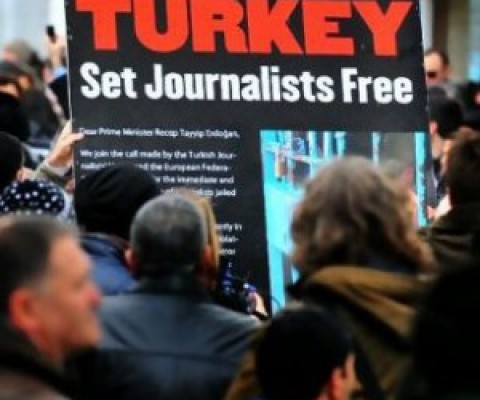 In the final days of 2016 journalism was in ruin: 146 journalists in jail (it now stands at 152), placing Turkey in the special position of having around 60% of the global total of journalists behind bars. More than 9,000 journalists have lost their jobs, or around 45% of the active journalists at home. Erdoğan’s regime also ended the year by shuttering more than 190 media outlets – a blend of all political leanings and various identities – leaving only one (out of 245) TV channels, the tiny Halk TV, as the lone critical voice. The remaining independent newspapers on the political left struggle with financial and circulation problems. Their alternative narrative is barely heard. A number of journalists – including myself – had to leave the country, chased into exile by the forces of the counter-coup that launched an immense purge and nearly 1,000 had their press cards cancelled. And more foreign colleagues experienced harassment at the hands of officials – as the arrest of Dion Nissenbaum of the Wall Street Journal showed – and deportations.
We entered the new year with a yet another announcement that the authorities had launched a massive legal inquiry and arrested over 62,000 people for “clandestine activity” on social media — such as critical tweeting — of which 17,000 were already indicted. This news came as Bekir Bozdağ, minister of justice, proudly declared that 25 new prisons are now being built, a 22% increase in capacity.
Journalism is a profession in agony. Frankly, none of us in this now dreaded exercise of informing the public can see any way out. The odds are that Erdoğan is only inches away from securing a fully empowered executive presidential rule, equipped with impunity and it is fair to assess that the state of emergency will continue as long as his party deems necessary. One can only pray — as a colleague told me over the phone recently — that the AKP shows mercy to release jailed journalists, who were all jailed for doing their job. Under such circumstances, it is an arduous task to report about daily events; forget about plunging into daring investigations of official corruption in the public interest.
Which leaves me with one hope for 2017: we won’t be able to give up. Turkey’s independent journalists will continue to do what they know best. But it will have to be mainly online from editorial bases outside the country. This will be a very tough battle for our integrity and a long-term one. We will have to keep our spirits intact. But we need the consistent, courageous backing of our colleagues in the West.
“The West is largely silent. And Erdoğan is triumphalist. ‘Now that the demagogue Trump is about to become the world’s most powerful man, the authoritarians believe history is on their side’,” wrote Owen Jones in The Guardian, adding:
“Turkey is a warning: democracy is precious but fragile. It underlines how rights and freedoms are often won at great cost and sacrifice but can be stripped away by regimes exploiting national crises. The danger is that Turkey won’t be an exception, but a template of how to rid countries of democracy. That is reason enough to stand by Turkey. Who knows which country could be next?”
Indeed.[/vc_column_text][/vc_column][/vc_row][vc_row][vc_column][vc_basic_grid post_type=”post” max_items=”4″ element_width=”6″ grid_id=”vc_gid:1485774465935-7b8b8f3b-cd52-8″ taxonomies=”8607″][/vc_column][/vc_row]
18 Jan 2017 | Magazine, News, Turkey, Volume 45.04 Winter 2016 Extras
[vc_row][vc_column][vc_custom_heading text=”Imprisoned journalists make headlines, but the Turkish government has a more insidious method for controlling the media, researchers BURAK BILGEHAN ÖZPEK and BAŞAK YAVCAN argue in an unpublished report excerpted in the winter edition of Index on Censorship magazine” font_container=”tag:p|font_size:24|text_align:left” google_fonts=”font_family:Libre%20Baskerville%3Aregular%2Citalic%2C700|font_style:400%20italic%3A400%3Aitalic”][/vc_column][/vc_row][vc_row full_width=”stretch_row_content_no_spaces”][vc_column][vc_single_image image=”84920″ img_size=”full” alignment=”center”][/vc_column][/vc_row][vc_row][vc_column][vc_column_text]
Advertising is the latest way for the Turkish government to lean on the media to stop critical stories going into the press, according to unpublished research.
The large advertising budgets of state-controlled Turkish industries like banks, telecoms companies and Turkish Airlines are being used by the government to develop a financial grip over newspapers and control what they report.
Patterns of advertising during 2015 suggest that newspapers which do not toe the government line, or are hostile, are being starved of those revenues.
For instance, Sabah, a newspaper particularly sympathetic to the government, received more than 20% of the advertising budget of the state-controlled bank Halk Bank, while the independent Hürriyet received only 2.9%, despite both having a similar circulation.
Government-controlled telecoms company Turkcell also favoured Sabah by giving it 9.4% of its advertising, while Hürriyet took just 3.1%.
The situation was similar for another state-controlled telecoms company, Turk Telekom: Sabah received more than twice Hürriyet’s share of their total advertising.
Their research found that any paper critical of the government – those associated with the social democratic movement, liberalism, Kemalism, nationalism, Islamism – was either discriminated against, or excluded entirely, when it came to crucial advertising revenue.
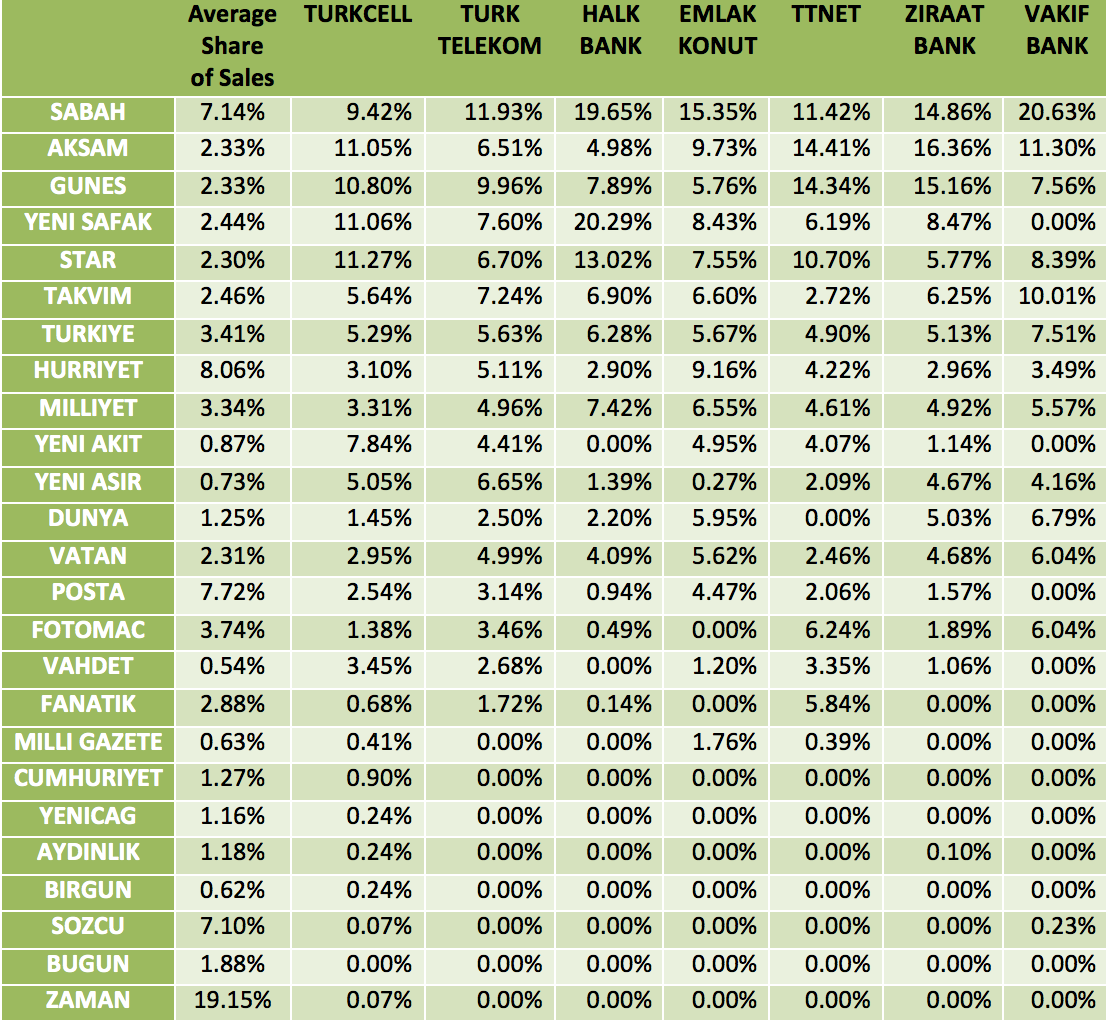
Table: Daily newspapers’ share of advertising from part-public firms in 2015
[/vc_column_text][/vc_column][/vc_row][vc_row][vc_column][vc_column_text]
Burak Bilgehan Özpek is an associate professor and Başak Yavcan is an assistant professor in the department of political science and international relations at TOBB University of Economics and Technology in Ankara. This is an extract of their article from the winter 2016 issue of Index on Censorship magazine, which is based on their as-yet unpublished research into press freedom in Turkey. The magazine article can be read in full for free on Sage Journals until 31 January 2017.
[/vc_column_text][/vc_column][/vc_row][vc_row][vc_column width=”1/3″][vc_custom_heading text=”Fashion Rules” font_container=”tag:p|font_size:24|text_align:left” link=”url:https%3A%2F%2Fwww.indexoncensorship.org%2F2016%2F12%2Ffashion-rules%2F|||”][vc_column_text]The winter 2016 issue of Index on Censorship magazine looks at fashion and how people both express freedom through what they wear.
In the issue: interviews with Lily Cole, Paulo Scott and Daphne Selfe, articles by novelists Linda Grant and Maggie Alderson plus Eliza Vitri Handayani on why punks are persecuted in Indonesia.[/vc_column_text][/vc_column][vc_column width=”1/3″][vc_single_image image=”82377″ img_size=”medium” alignment=”center” onclick=”custom_link” link=”http://www.indexoncensorship.org/2016/12/fashion-rules/”][/vc_column][vc_column width=”1/3″][vc_custom_heading text=”Subscribe” font_container=”tag:p|font_size:24|text_align:left” link=”url:https%3A%2F%2Fwww.indexoncensorship.org%2Fsubscribe%2F|||”][vc_column_text]In print, online. In your mailbox, on your iPad.
Subscription options from £18.
Every subscriber helps support Index on Censorship’s projects around the world.
 SUBSCRIBE NOW[/vc_column_text][/vc_column][/vc_row]
16 Jan 2017 | France, Greece, Mapping Media Freedom, News, Russia, Turkey, Ukraine
[vc_row][vc_column][vc_single_image image=”81193″ img_size=”full”][vc_column_text]Each week, Index on Censorship’s Mapping Media Freedom project verifies threats, violations and limitations faced by the media throughout the European Union and neighbouring countries. Here are five recent reports that give us cause for concern.
A Hatay court issued a detention order for Ceren Taşkin, a reporter for the local newspaper Hatay Ses, on the basis of her social media posts, news website Gazete Karinca reported.
Taşkin was detained earlier for “spreading propaganda for a terrorist group” via her social media posts. Taşkin was arrested and sent to prison on 12 January on the same charges.
Her arrest brings the number of journalists in prison to 148, Platform 24 reported.
The National Radio and TV Council has banned independent Russian television channel Dozhd from broadcasting in the country.
“The channel portrayed the administrative border between Crimea and Kherson region as the border between Ukraine and Russia,” national council member Serhiy Kostynskyy said during a council meeting, Interfax-Ukraine reported.
According to Kostynskyy, the channel repeatedly violated Ukrainian law in 2016 by broadcasting Russian advertising and having Dozhd journalists illegally enter annexed Crimea from the Russian Federation without receiving special permission.
The ban is set to be officially published by the authorities on 16 January, Interfax-Ukraine reported.
Dozhd Director Natalya Sindeyeva said that the channel is broadcasting through IP-connection without direct commercial advertising in Ukraine and follows the Russian Federation law requiring that media outlets use maps to show Crimea as part of Russia.
Dunja Mijatovic, media freedom representative at the Organization for Security and Cooperation in Europe, wrote on her Twitter that this decision is “very damaging to media pluralism in Ukraine.”
Police arrested Giannis Kourtakis, publisher of Parapolitika newspaper, and its director, Panayiotis Tzenos, following a lawsuit filed against them for libel and extortion by the defence minister and leader of the Independent Greeks Party (ANEL), Panos Kammenos, the news website SKAI reports.
Kourtakis said he voluntarily went to police headquarters after being informed about the lawsuit, while director Panagiotis Tzenos was arrested in his Athens office.
ANEL issued a statement stressing that the lawsuit was prompted by allegedly slanderous claims about Kammenos’s son, saying that he was an “anarchist” and involved in a terrorist group on their radio programme which aired on 9 January.
In July 2015, Kammenos gave Athens press union (ESIEA) a list of journalists who had allegedly received improper funding through advertising from the state health entity KEELPNO, which included the Parapolitika executives.
According to SKAI, Kammenos claims that the journalists made slanderous statements about his son in order to make him retract allegations that the Parapolitika executives were receiving funding.
The public prosecutor who investigated the lawsuit has since reportedly dropped charges of criminal extortion.
Greece’s main journalists’ union and opposition parties have expressed concern over the general tendency of police’s interventions to journalists’ offices.
“Journalism must be exercised according to specific rules, but also press freedom must be defended and protected,” the Journalists’ Union of the Athens Daily Newspapers writes in its statement.
Vladislav Ryazantcev, correspondent for the independent news agency Caucasian Knot, reported on Facebook that he was assaulted by five unknown individuals whose faces were covered by scarves.
According to Ryazantcev, one of them grabbed his hand and asked him to “follow him for a talk.” Right after that an additional four individuals came up and started to hit the journalist on the head.
Ryazantcev reported that bystanders then helped rescued him.
“I do not know what the attack is connected to,” he wrote on Facebook. He later filed a complaint to the police.
The day before on 9 January, Magomed Daudov, speaker of the Chechen parliament, published threats against editor-in-chief of the Caucasian Knot, Grigori Shvedov, on Instagram.
A TV crew working for TF1 channel was reportedly assaulted in Compiègne while trying to film a building set to be emptied of its inhabitants because of alleged high criminality linked to drug trafficking, Courrier Picard reported.
“We tried to film a story there this morning. Our crew was attacked and stoned by thugs who stole our camera in this unlawful zone. It was very violent,” TF1 presenter Jean-Pierre Pernaud said. The assault occurred in the Close des Roses neighbourhood.
One of the journalists told Courrier Picard that the channel would file a complaint.[/vc_column_text][vc_column_text]
Click on the bubbles to view reports or double-click to zoom in on specific regions. The full site can be accessed at https://mappingmediafreedom.org/
[/vc_column_text][/vc_column][/vc_row]
11 Jan 2017 | Mapping Media Freedom, News, Turkey, Turkey Uncensored
[vc_row][vc_column][vc_column_text]
Turkey Uncensored is an Index on Censorship project to publish a series of articles from censored Turkish writers, artists and translators.
[/vc_column_text][vc_column_text]This article is written by a human rights activist who has requested anonymity.
I am about to make a life changing move and leave Turkey. This decision did not come easy. I still do not feel very comfortable about leaving my family, friends and the struggle behind. However, this is a must-do move in order to keep my soul, spirit and mind intact.
I am an activist, a human rights defender, a dissident, and currently I feel like a lab rat trapped in a maze, trying to find the exit to freedom. And worse still, I can hear countless fellow mice doing the same! This is extremely disempowering.
In Turkey, we are losing all our legitimate grounds and means to scrutinise, criticise, oppose power and express our ideas and thoughts in the media, the streets, associations, social media….
There are almost no independent mainstream media left that dare write what is newsworthy if it touches the government or big business interests close to power. The outlets that do so face countless sanctions ranging from prosecution and arrest to total closure. Journalism was already under huge pressure but the failed 15 July coup provided a big opportunity to the government to further silence all opposition. As of today, there are 145 journalists in jail, 157 media outlets have been closed and approximately 9,000 journalists are jobless. Thousands of websites are either banned or blocked. If I cannot make my voice heard to influence public opinion, how can I be effective in my work to promote human rights, peace and justice?
Media is not the only medium that’s been hijacked; since 20 July, the government closed about 500 non-governmental organisations under emergency decrees. Some of these NGOs were very effective service organizations. Authorities confiscated all their equipment, bank accounts and documents — a violation of their clients’ right to privacy. And very recently, an investigation was initiated into four prominent human rights organisations — ok, listen to this — for reporting on human rights violations that occurred in cities that were under curfew. In other words, they are accused of their raison d’être!
The shrinking space for freedom
Social media was the only space left for us to communicate, inform and be informed. However, for a long while we are under attack for using this medium, too. Just a couple days ago, the deputy prime minister warned everyone to “behave on social media or face the consequences”. Actually, many have already faced it. There are hundreds of prosecutions with charges of terrorist propaganda and even more of insulting the president (based on Article 299 of the penal code, which became the new 301). Saying “I wouldn’t serve tea to the president” or “I don’t like the president” are now considered insulting.
The message is clear: Do not speak out, do not criticise, do not expose corruption, nepotism, abuse of power, lies or violations committed by the government. If you insist, you will be rendered jobless like thousands of journalists, academics, teachers and doctors, or you will be prosecuted and jailed.
We hear their message. We hear it again and again, every time a friend is put behind the bars, any time trolls target us on social media. We hear it when we are attacked by pepper gas and batons for protesting on the streets.
I know that this is an intimidation strategy. I also know that it will not deter me or my friends from doing what we do. Yet, the climate of fear dominating the country makes me feel trapped, cornered, inefficient and useless. I am at the verge of falling into a state of learned helplessness, if not depression.
I don’t want to self-censor what I am to say, yet I don’t want fall victim to their repressive policies just because of the non-violent things I say and do. Increasingly, I am turning into a lesser version of myself – less productive, less confident and losing faith.
It is true that the people of Turkey have never enjoyed a full democracy. Rights defenders and the opposition have always been targeted and criminalised as traitors, branded as terrorists and disloyal enemies for exposing the truth.
But for the first time in my life I feel so besieged and under threat. It is not just about the authoritarian regime, people find ways to bypass the restrictions and find other means to continue working. What slammed me to the ground and drained my hope and sapped my energy is the pure evil that has burgeoned in society. As the columnist Ahmet Insel quoted from Ibn al Muqaffa in his writing, “The worst time is when the ruler and the evil of the people are united.”
I couldn’t cope with it. I am choosing to retreat, only to come back stronger, wiser and more equipped.[/vc_column_text][vc_basic_grid post_type=”post” max_items=”4″ element_width=”6″ grid_id=”vc_gid:1485774506870-edde10de-35f5-10″ taxonomies=”8607″][/vc_column][/vc_row]
