22 Nov 2023 | Argentina, News
After far-right economist Javier Milei won Argentina’s presidency on Sunday night, it didn’t take him long to set his sights on the media.
“Public television has become a propaganda mechanism,” he told journalist Eduardo Feinmann of Radio Mitre in his first interview on Monday morning. “[…] I don’t believe in those practices of having a covert propaganda ministry. It must be privatised.”
Milei won Sunday’s presidential run-off election with 56% of the vote. His opponent Sergio Massa, economy minister and candidate for the ruling centre-left Union for the Homeland coalition, got 44%. Massa’s defeat came as Argentina suffers through a drawn-out economic crisis: inflation is running at 143% and just over 40% of the population are living in poverty. Neither the current ruling alliance nor the right-wing administration that preceded it have been able to turn things around.
In this context, the libertarian’s victory is a shocking rejection of politics as usual – but his election has been hotly controversial in Argentina. Milei is an outsider whose brash, abrasive populism has drawn comparisons with far-right former presidents Donald Trump in the USA and Jair Bolsonaro in Brazil. He enjoyed a vertiginous rise to the limelight as an eccentric TV pundit espousing ultra-libertarian views, and had never held elected office until he was voted in as a deputy in 2021. As president, he promises to dollarize Argentina’s economy, liberalise gun controls, privatise healthcare and hold a referendum on abortion, which was legalised in 2020.
As he surged to the forefront of national politics, Milei shouted at reporters, refused to do interviews with critical outlets and accused the media of lying. Online, his supporters insulted and harassed journalists, activists, women, LGBTQAI+ people and anyone else who spoke against their leader.
Now, faced with four years of a Milei presidency, onlookers worry his coalition will move to silence critical media, intimidate dissenting voices and embolden elements of the extreme right who deny the atrocities committed by Argentina’s last civic-military dictatorship.
Lucas “Fauno” Gutiérrez, a queer, HIV-positive activist and journalist, is already receiving thousands of hate messages from hordes of pro-Milei trolls on his social media, and fears the situation will worsen when he takes office. “Once they’ve installed that hate speech, we communicators think twice before saying many things,” he said. “You don’t always have the emotional momentum to deal with 700 messages attacking, insulting and threatening you.”
Some of the most disturbing threats involve Argentina’s last dictatorship. Under the military junta that ruled the country from 1976-1983, 30,000 people were disappeared, tortured and murdered, many of them thrown alive from aeroplanes into the River Plate in the “death flights”.
The scale of the violence and the difficulties reporting disappearances mean it’s impossible to reach an exact figure, but the number of victims is widely accepted by human rights groups in Argentina. However, Milei’s vice president-elect, Victoria Villarruel, campaigns on narratives that seek to play down and exonerate atrocities committed by the security forces. She has repeated the denialist claim that the true number of victims is far lower, a statement Milei echoed during a televised presidential debate. A lawyer by training, she has defended former members of the security forces accused of crimes against humanity. Before his death, she also visited former dictator Jorge Rafael Videla in jail.
In this context, some Milei supporters have taken to threatening those they disagree with by sending them photos of green Ford Falcons with no licence plates – the vehicle the dictatorship’s security forces used to abduct their victims.
“The green Ford Falcon means endorsing the disappearance, torture and extremely violent death of all those who opposed the dictatorship,” said Beatriz Busaniche, president of the human rights and technology foundation, Vía Libre. She described Milei and Villarruel’s denialism as “re-legitimising” discourse that was widely discredited in Argentine society.
“There’s been a retreat of public discourse,” she said. “The sphere of public debate has become so aggressive that many people have started to lock their accounts and leave social media.”
Despite his promises, it is not clear whether Milei would be able to privatise Argentina’s public media, because doing so would require changing the law that governs them, explained Agus Lecchi, secretary general of the SiPreBA journalists’ union, who works for Argentina’s Televisión Pública. That means it would have to pass through Argentina’s congress. Milei’s Freedom Advances coalition will not have a majority in either the deputies or the senate.
Nonetheless, Argentina’s public media have come under fire from hostile governments before: in 2018, right-wing President Mauricio Macri’s administration attempted to lay off 68 journalists at the state news agency, Télam, although all were reincorporated after a labour court found their dismissals to be illegal.
“TV Pública plays a fundamental role for Argentine democracy, not just with regard to pluralist information, but also in terms of coverage of situations across the country,” Lecchi said. “In some corners of the country, TV Pública, National Radio or [state news agency] Télam are all they receive.”
While his comments on Monday took aim at Argentina’s state-owned media, Milei would also have tools in his arsenal to pressure private media. Many Argentine outlets, especially small local and independent media, rely largely on state advertising revenue to stay afloat. Politically-motivated allocation of this budget can exert pressure on the media.
Gutiérrez believes that major social media platforms like Meta and X (formerly Twitter) have a duty to stop hate speech, but worries that they often hold back because the floods of abuse he receives drive engagement. “My emotional life, my mental health and our freedom of expression can’t be subordinated to engagement,” he said.
In October, the government passed the “Olympia Law”, which recognises digital attacks such as doxxing, revenge porn and threats or harassment as a form of gender-based violence. If enforced, its proponents hope it would serve to dissuade some of the worst online attacks. However, Milei has already said that he plans to shut down Argentina’s Ministry of Women, Gender and Diversity, along with most other government ministries.
A bill currently under discussion in Congress also aims to prevent people who deny the dictatorship’s crimes from holding public office, but with the change of government in less than three weeks, it’s unclear whether the bill will become law.
To Busaniche, faced with a president who many say represents antipolitics, the first line of defence could be politics itself. “Congress will oblige him to negotiate,” she said. “Unlike what many Milei voters might expect, the importance of politics will be central.”
29 Mar 2019 | Campaigns -- Featured, Magazine, Press Releases, Volume 48.01 Spring 2019, Volume 48.01 Spring 2019 Extras
[vc_row][vc_column][vc_custom_heading text=”97% of editors of local news worry that the powerful are no longer being held to account ” google_fonts=”font_family:Libre%20Baskerville%3Aregular%2Citalic%2C700|font_style:400%20italic%3A400%3Aitalic”][vc_column_text]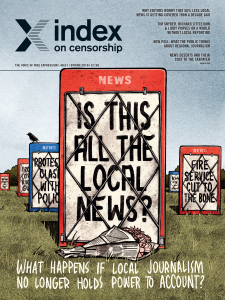
Ninety seven per cent of senior journalists and editors working for the UK’s regional newspapers and news sites say they worry that that local newspapers do not have the resources to hold power to account in the way that they did in the past, according to a survey carried out by the Society of Editors and Index on Censorship. And 70% of those respondents surveyed for a special report published in Index on Censorship magazine are worried a lot about this.
The survey, carried out in February 2019 for the spring issue of Index on Censorship magazine, asked for responses from senior journalists and current and former editors working in regional journalism. It was part of work carried out for this magazine to discover the biggest challenges ahead for local journalists and the concerns about declining local journalism has on holding the powerful to account.
The survey found that 50% of editors and journalists are most worried that no one will be doing the difficult stories in future, and 43% that the public’s right to know will disappear. A small number worry most that there will be too much emphasis on light, funny stories.
There are some specific issues that editors worry about, such as covering court cases and council meetings with limited resources.
Twenty editors surveyed say that they feel only half as much local news is getting covered in their area compared with a decade ago, with 15 respondents saying that about 10% less news is getting covered. And 74% say their news outlet covers court cases once a week, and 18% say they hardly ever cover courts.
The special report also includes a YouGov poll commissioned for Index on public attitudes to local journalism. Forty per cent of British adults over the age of 65 think that the public know less about what is happening in areas where local newspapers have closed, according to the poll.
Meanwhile, 26% of over-65s say that local politicians have too much power where local newspapers have closed, compared with only 16% of 18 to 24-year-olds. This is according to YouGov data drawn from a representative sample of 1,840 British adults polled on 21-22 February 2019.
[/vc_column_text][vc_row_inner][vc_column_inner width=”1/4″][vc_icon icon_fontawesome=”fa fa-quote-left” color=”custom” size=”xl” align=”right” custom_color=”#dd3333″][/vc_column_inner][vc_column_inner width=”3/4″][vc_custom_heading text=”The demise of local reporting undermines all journalism, creating black holes at the moment when understanding the “backcountry” is crucial” font_container=”tag:h3|text_align:left” google_fonts=”font_family:Libre%20Baskerville%3Aregular%2Citalic%2C700|font_style:400%20italic%3A400%3Aitalic”][/vc_column_inner][/vc_row_inner][vc_column_text]The Index magazine special report charts the reduction in local news reporting around the world, looking at China, Argentina, Spain, the USA, the UK among other countries.
Index on Censorship editor Rachael Jolley said: “Big ideas are needed. Democracy loses if local news disappears. Sadly, those long-held checks and balances are fracturing, and there are few replacements on the horizon. Proper journalism cannot be replaced by people tweeting their opinions and the occasional photo of a squirrel, no matter how amusing the squirrel might be.”
She added: “If no local reporters are left living and working in these communities, are they really going to care about those places? News will go unreported; stories will not be told; people will not know what has happened in their towns and communities.”
Others interviewed for the magazine on local news included:
Michael Sassi, editor of the Nottingham Post and the Nottingham Live website, who said: “There’s no doubt that local decision-makers aren’t subject to the level of scrutiny they once were.”
Lord Judge, former lord chief justice for England and Wales, said: “As the number of newspapers declines and fewer journalists attend court, particularly in courts outside London and the major cities, and except in high profile cases, the necessary public scrutiny of the judicial process will be steadily eroded,eventually to virtual extinction.”
US historian and author Tim Snyder said: “The policy thing is that government – whether it is the EU or the United States or individual states – has to create the conditions where local media can flourish.”
“A less informed society where news is replaced by public relations, reactive commentary and agenda management by corporations and governments will become dangerously volatile and open to manipulation by special interests. Allan Prosser, editor of the Irish Examiner.
“The demise of local reporting undermines all journalism, creating black holes at the moment when understanding the “backcountry” is crucial. Belgian journalist Jean Paul Marthoz.
The special report “Is this all the local news? What happens if local journalism no longer holds power to account?” is part of the spring issue of Index on Censorship magazine.
Note to editors: Index on Censorship is a quarterly magazine, which was first published in 1972. It has correspondents all over the world and covers freedom of expression issues and censored writing
[/vc_column_text][/vc_column][/vc_row][vc_row][vc_column][vc_column_text]
Rachael Jolley is editor of Index on Censorship. She tweets @londoninsider. This article is part of the latest edition of Index on Censorship magazine, with its special report on Is this all the Local News?
Index on Censorship’s spring 2019 issue asks Is this all the local news? What happens if local journalism no longer holds power to account? We explore the repercussions in the issue.
Look out for the new edition in bookshops, and don’t miss our Index on Censorship podcast, with special guests, on iTunes and Soundcloud.
[/vc_column_text][/vc_column][/vc_row][vc_row][vc_column width=”1/3″][vc_custom_heading text=”Is this all the Local News?” font_container=”tag:h3|text_align:left” link=”url:https%3A%2F%2Fwww.indexoncensorship.org%2F2018%2F12%2Fbirth-marriage-death%2F|||”][vc_column_text]The spring 2019 issue of Index on Censorship magazine explores what happens to democracy without local journalism, and how it can survive in the future.
With: Richard Littlejohn, Libby Purves and Tim Snyder[/vc_column_text][/vc_column][vc_column width=”1/3″][vc_row_inner][vc_column_inner][vc_single_image image=”105481″ img_size=”full” onclick=”custom_link” link=”https://www.indexoncensorship.org/2018/12/birth-marriage-death/”][/vc_column_inner][/vc_row_inner][/vc_column][vc_column width=”1/3″][vc_custom_heading text=”Subscribe” font_container=”tag:h3|text_align:left”][vc_row_inner][vc_column_inner][vc_column_text]In print, online. In your mailbox, on your iPad.
Subscription options from £18 or just £1.49 in the App Store for a digital issue.
Every subscriber helps support Index on Censorship’s projects around the world.
 SUBSCRIBE NOW[/vc_column_text][/vc_column_inner][/vc_row_inner][/vc_column][/vc_row]