Belarus: KGB issues warrant for Nikolai Khalezin
 Nikolai Khalezin in hiding after the KGB issue arrest warrant for the co-founder of the Belarus Free Theatre. Mike Harris reports
(more…)
Nikolai Khalezin in hiding after the KGB issue arrest warrant for the co-founder of the Belarus Free Theatre. Mike Harris reports
(more…)
Two weeks ago I wrote of Tehran Bus Workers’ Union treasurer Reza Shahabi, eight days into a dry hunger strike (nil by mouth) at Evin Prison. Shahabi’s demand for basic rights for he and his fellow workers in the first instance and for justice with regards to his arrest and imprisonment for this very fight in the second, lasted 16 days. He ended his hunger strike on 19 December following calls from workers unions worldwide who sent statements in his support including one from the TUC “On behalf of the British trade union movement, and its 6.2m members”.
Reza Shahabi now sends a New Year message of thanks from his prison ward:
To workers and workers’ organisations throughout the world!
On the occasion of the coming New Year 2011, I would like to extend my congratulations to my beloved co-workers and fellow-workers throughout the world.
While my fellow workers and I have been incarcerated for our advocacy of workers’ rights in Iran, and our demands for the creation of independent workers’ organisations in Iran, many workers’ organisations throughout the world have rallied in our support, and have condemned the treatment we have received in jail.
While I was on hunger strike, I received a multitude of support from workers and their organisations throughout the world. I would like to acknowledge and thank each of you for your messages of solidarity.
I hope that through our solidarity we shall be able to overcome all obstacles in achieving our goals of justice, freedom and equality, and through our daily efforts transcend capitalism and achieve what rightly belongs to us.
I wish for a day when all of us will be able to live a decent and humane life, without any wars or violence.
Finally I wish you all a happy New Year, full of success, health and unity.
I warmly shake all your hands
Reza Shahabi
Incarcerated Worker
Ward 209, Evin Prison, Tehran
26, December 26 2010 (5 Dey, 1389)
The Hungarian parliament has passed a new law creating a media watchdog with powers to restrict and punish private news agencies. The new body has the power to impose sanctions upon media outlets if it decides that their coverage is unbalanced or breaches the rules on coverage of sex, violence and alcohol. The Hungarian parliament is dominated by the centre right ruling party Fidesz, which will also act as the majority in the media watchdog. Hungary is set to take EU presidency on 1 January 2011.
The Ministry of Truth is an Orwellian notion. But in China directives dictating what newspapers can and cannot write about actually exist. China Digital Times (CDT), an excellent online publication co-ordinated by Xiao Qiang, director of the China Internet Project at UC Berkeley, California collects directives and publishes them on a weekly basis, under the title of the Ministry of Truth directives. The censorship directives aren’t widely available, Xiao’s sources vary, but they include twitter accounts and blogs. The CDT translate the instructions and check “them against official Chinese media reports to confirm their implementation.”
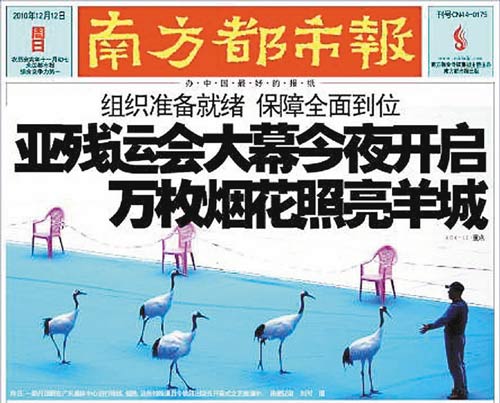 A directive published by CDT on 12 December makes clear that after the Nobel Peace Prize ceremony on 10 December, the Ministry of Truth pointedly told newspapers not to report on the Chinese winner of the nobel peace prize dissident Liu Xiaobo. As usual some Chinese citizens and journalists found a way to covertly talk about the issue, one newspaper front page — the groundbreaking Southern Metropolis Daily — broke this rule. The chairs on the cover, which were for a story on the opening of the Asian Para Games, were widely interpreted as representing Liu’s empty chair at the Nobel ceremony, with the cranes apparently indicating a tribute to the empty chair.
One of the comments from netizens, translated by CDT, was:
qqxk 缱绻星空: Congratulating the empty chair??? This is fatalistic. I love Southern Metropolis Daily. Very talented. But I am extremely worried how long [the paper] will last?!!
Other Chinese citzens celebrated the award via the Sina microblog, the hottest new social media in China, which is often used to publish fresh information and celebrate censored events. In the weekend that followed the ceremony, people began to publish descriptions of people they admired, people who just happened to have the surname Liu. Cooincidently these Liu’s seemed to share many attributes with Liu Xiaobo, they had “won many awards” the were also “unjustly accused and spent many years in prison.” The ultimate name, though, would be a celebrated actor, political figure or sportsman. Examples that were wildly circulated were translated by China blog Danwei’s Joel Martinsen:
From @VicCh:
Essay: The person I admire most — “The person I most admire has the surname Liu. He has won major international prizes, and his deeds have inspired a fighting spirit in his countrymen. Although for a time he vanished from our sight, I believe his spirit will live on….” The teacher moves to call the police. The next line: “His name is Liu Xiang (刘翔).”From @doubleaf (陈双叶) via @songshinan (宋石男):
The person I most admire has the surname Liu. He led students campaigns, published books, and won international prizes. Later he was unjustly accused and spent many years in prison. But I believe that all of this is but the test of history, because he said that fortunately, history is written by the people. His name is Liu Shaoqi (刘少奇).
There have been few other ways of celebrating or reacting to the ceremony this month, either on the internet or in state media. iZaobao, a well-known (and blocked) news analysis blog, mentioned only the “award ceremony in Oslo”, and not to the person or prize by name. Liu Xia, Liu Xiaobo’s wife, is still under close surveillance and had her telephone line was cut on the day of the ceremony. Those who feel the confinement unnecessary so long after the event have condemned this act. Members of Liu’s family are also still prevented from visiting him in prison.