7 Mar 2014 | Americas, Ecuador, News, Politics and Society
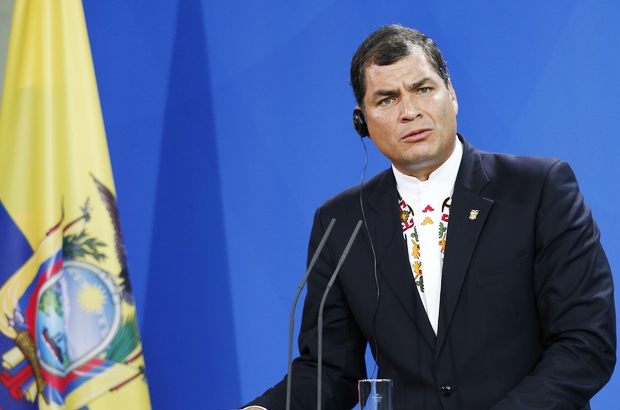
Ecuadorian president Rafael Correa (Image: Reynaldo C. Paganelli/Demotix)
President Rafael Correa’s new media law has “undercut press freedoms,” and “opens the door to censorship by giving the government or judges the power to decide if information is truthful”, according to a new report by the US State Department that ranked Ecuador as one of Latin America’s worst violators of press freedoms.
Unsurprisingly, the Correa administration hit back at the US. The Ecuadorian foreign minister, Ricardo Patiño, released a statement which claimed the report was “one sided” and came from, “a country that has a poor track record in observing human rights.”
The diplomatic tussle marked another stage in the deteriorating relationship between Quito and Washington, after Correa offered Julian Assange asylum in Ecuador in August 2012 — the Wikileaks founder still remains at the Ecuadorian embassy in London. However, the report has also highlighted the explicit crackdown on the media by Correa.
At the end of January, Correa’s government lashed out at El Universo newspaper for printing a cartoon which satirised the Boxing Day raid of opposition activist Fernando Villavicencio. Using Supercom, the media regulator established by last year’s communications law, El Universo was ordered to print a correction, and the paper was fined 2% of its average monthly sales. This recent incident marks a dangerous precedent for print media in Ecuador.
The communications law is a sweeping reform to the media landscape in Ecuador that in principle was designed to prohibit censorship, redistribute broadcast fairly and protect the rights of journalists. The reality is that the law is filled with loopholes which are open to manipulation, and allow for state interference — the creation of Supercom is a clear example of such problems.
Martin Pallares, a journalist at El Comercio, said the law, and its “subjective norms,” has led to, “tremendous self-censorship and a terrible fear among journalist.” According to Pallares, newspapers are constantly overshadowed by a fear that they will be forced out of business by a heavy fine for publishing an anti-government article. He also said the situation is more worrying because, “Correa controls the judicial system and if he wants he may order that any journalist can be prosecuted for libel.”
Reporters Without Borders has said some aspects of the communications law are positive, praising the “fairer distribution” of broadcast frequencies. But Camille Soulier, the head of Reporters Without Borders Americas desk warned the cartoon incident was the most “obvious case” of the dangers of the law which, “used in this way could foreshadow an increase in the disrespect for freedom of information.”
El Universo’s cartoon fine was not the only example of Correa intimidating partisan journalists. In September 2012, the magazine Vistazo was fined $80,000 for publishing an article which supposedly advocated a “no” vote against Correa. Then in February 2013, Ecuador’s highest held court upheld a libel conviction against El Universo that imposed a $40m fine and sentenced the three directors of the paper, and its leading columnist Emilio Palacio, to three years in jail each, for an article which accused Correa of human rights abuses. The men were later pardoned by the president, but the case still demonstrates the president’s ongoing bullying of the press.
The El Universo lawsuit had serious implications for Ecuador’s media according to the Committee to Protect Journalists’ (CPJ) Andes correspondent, John Otis. Otis said that after this lawsuit, Ecuadorian publishers and newspapers became more worried about publishing material, even if they knew that all their information is correct. “The El Universo case scares people”, Otis said, because of its potential financial implications.
Incidents such as this libel case have given rise to intense animosity from Ecuador’s media against the president. El Comercio’s Pallares has accused Correa of Orwellian control of the press. He said: “Correa does not tolerate diversity of opinions because of his deep seated religious background, and other traumas which makes him think he owns the truth. ‘You are a liar and we are the truth,’ he said to a journalist who asked him an uncomfortable question at a presentation at Columbia University some years ago.” While this depiction of Correa is evidently extreme, it is true that the president, now in his third term, set off to battle against the media from the outset.
Antoni Kapcia, a professor of Latin American History, at the University of Nottingham, views the relationship between Correa and Ecuador’s press in a more complex way however. Kapcia said that the press have been, “vehemently anti-Correa from the start,” and “they have not exactly been pursuing the lily-white truth in all these battles.” Kapcia believes that faults have been convicted on both sides of the war. “Correa is as much hitting out in retaliation as repressing the press, and in reality, he doesn’t control enough to really repress, even if he wanted to, so it’s more a case of kicking the press’s shins than really chaining it up.”
With the populist Correa, who has been in power since 2006, recently losing important local elections, the political future of Ecuador remains uncertain. One thing remains clear however, Correa’s crackdowns on Ecuador’s press are a serious threat to the democratic hopes of this Latin American nation.
This article was posted on March 7, 2014 at indexoncensorship.org
7 Mar 2014 | Awards, Honduras, News
Dina Meza is an investigative journalist working for the Committee of Relatives of the Detainees and Disappeared in Honduras, an incredibly difficult environment for press freedom.
Since the country’s 2009 coup d’état there have been a number of cases of the press being attacked and intimidated with impunity. Meza has dedicated her career to reporting on human rights stories shunned by the mainstream media, taking on the police, the security firms, and abusive employers in the process. The abduction and torture of her brother in 1989 by security forces was what initially sent her down this path — “It made me angry, the injustice. I knew then that I had to cover human rights abuses. I never had any choice!” she says.
Because of her work, Meza has been subjected to relentless threats – including threats of sexual violence – followed, watched, and had her communications intercepted. Her three children have also been threatened and followed. She briefly left Honduras to take up a fellowship at the University of York’s Centre for Applied Human Rights as part of their Protective Fellowship scheme. During this time, her children were forced to leave Tegucigalpa for a period due to a suspicious looking man keeping watch outside her younger son’s school.
After returning to Honduras in May 2013, Meza reports that she continues to be subject to harassment and surveillance. She reports having been followed on at least four occasions between May and August, and on 12 August Meza reported being the victim of a suspected attempt to abduct her.
This all happens with complete impunity, as despite her reporting the issues to the police, nothing is ever done. But the idea of giving it up is not an option for Meza: “I could not look into my children’s eyes and tell them I can do nothing about the situation, because to do nothing would be far worse than the threats, beatings or bullets of the police and the military”.
Nominees: Advocacy | Arts | Digital Activism | Journalism
Join us 20 March 2014 at the Barbican Centre for the Freedom of Expression Awards
This article was posted on March 7, 2014 at indexoncensorship.org
7 Mar 2014 | News, Religion and Culture, Ukraine, Young Writers / Artists Programme
As the Euromaidan protests gripped Ukraine, French street-artist Roti travelled to Kiev. He was eager to support protesters who were struggling with a violent police response to their government’s tilt toward Russia.
For months Roti had worked on an idea for a sculpture: A woman emerging out of water. The concept, which was originally meant for Paris, took on new meaning as the demonstrators in Kiev became set on revolution.
Roti cast his idea in marble and the sculpture, New Ukraine, became an allegory for Euromaidan protesters. The woman’s face, toes and hands protruded from the block of stone. As she struggled for freedom, she created ripples in the stone surrounding her – after all, discontent spreads.
On January 7, 2014, the artist illegally installed his work at the center of Kiev’s Independence Square. “It’s a gift. Not to a nation but to its people”, Roti declared. His intentions were clear. The work came as attacks on journalists and protesters became more and more regular. New Ukraine was a symbol of hope and progress at a time when resolve could have easily wavered.
The night of the installation, protesters celebrated by dancing and singing in the street. Confidence seemed momentarily rejuvenated. In the following weeks clashes between police and protesters would claim their first lives.
New Ukraine is not the only street-art to offer support to the Ukrainian people. Graffiti decorates Kiev’s main square – crossed out swastikas and the slogan “BIG BROTHER IS WATCHING YOU” have become common features.
During protest, street-art becomes a barometer of social consciousness. Scrawled words and images on city walls reflect changing attitudes and a disdain for the ruling authority. The stencils of President Yanukovych’s body, punctured with bullet holes, were a more extreme example.
Like the ripples of New Ukraine, street art spread ideas through Kiev and further afield. With Twitter and Reddit offering a more collective version of the news, artists’ efforts escaped the borders of Ukraine and communicated their message to the global community. They achieved impact through imagery and reached a more diverse audience than most newspapers.
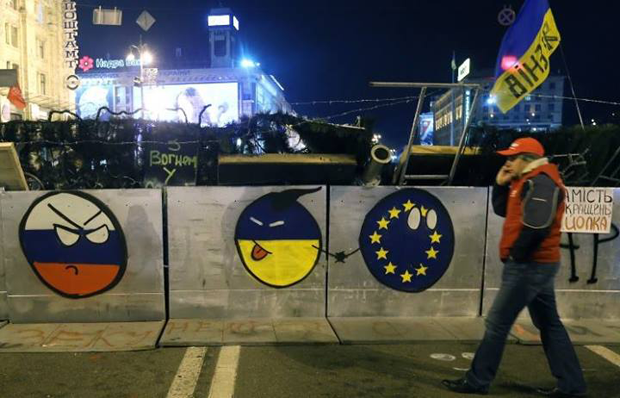
It was on Reddit that I discovered a photograph of a police barricade. It had been painted with a cartoon depicting a Ukrainian flag holding hands with a European flag as Russia looks on, scowling. The message was simple but memorable.
Protest posters also played an important role in boosting morale. Displayed around Kiev during the early days of the crisis, they highlighted the government’s inconsistencies and the power of the Ukrainian people. Of course, the country’s flag’s blue and yellow is the overriding color theme. Pairing graphic design with emotionally engaging political statements – “I am a drop in the ocean” – these works were incredibly empowering.
With a selection of these posters currently on display in Edmonton, Canada, it’s easy to see how imagery has the power to spread a political message. The exhibition features 50 designs which were posted around Ukraine. Each work was designed to encourage their audience to identify emotionally while keeping the message clear.
Artists use symbolism to monumentalise protesters’ efforts. With museums and galleries filled with artist’s renditions of historical events, we are programmed to link iconic moments with art. As creativity littered Kiev’s Independence Square, demonstrators were spurred on – the art around them transformed Euromaidan into a very stirring moment. Demonstrators were reminded: Here is the chance to make history.
Although they have since been annulled, anti-protest laws and restrictions on social media revealed the extent of how close Ukrainians came to losing the right to express themselves.
But on the streets, ideas would have continued to appear on walls and barricades. Street-artists cannot be tracked by algorithms. During times of crisis, they will always be on hand to support the people and spread their message.
This article was published on March 7, 2014 at indexoncensorship.org
6 Mar 2014 | European Union, Religion and Culture
A policy paper published by Article 19 has provided guidelines to help establish the difference between hate speech and freedom of expression, especially in reference to the use of hate speech against LGBTI people.
By focusing on “international standards and domestic trends countering the advocacy of hatred that constitutes incitement to hostility, discrimination or violence (“incitement”) specifically, and hate speech more generally,” Article 19 aims to define what constitutes as hate speech as well as making recommendations for the protection of freedom of expression.
The paper comes after human rights advocates, policy makers and the general public demanded clarity as to where the line should be drawn between free speech and hate speech, in particular that surrounding LGBT people.
In a statement on their own website, Article 19 said: “The paper is guided by the principle that coordinated and focused action to promote the rights to freedom of expression and equality is essential for fostering a tolerant, pluralistic and diverse democratic society in which all human rights can be realised, including those of LGBTI people.”
The policy paper points out the need for all “domestic prohibitions” to include sexual orientation and gender identity as protected characteristics, but that these laws need to conform to international standards on limiting the right to freedom of expression and information.
Through the paper Article 19 hopes to establish clear boundaries “between permissible and impermissible expression” as well as providing guidelines to help others determine what fits into each category. Not only this, but the report will also contribute to “ensuring that all people are able to enjoy both the right to freedom of expression and the right to equality.”
The report also includes a breakdown of the current jurisdiction against hate speech in 36 countries, primarily in Europe, to highlight the difference between the constitutional and philosophical choices that each country makes when drawing up legislation on free speech and equality.
Read the full report here.