28 Mar 2014 | Africa, News, Politics and Society, Uganda

(Photo illustration: Shutterstock)
Ugandans could soon be required by law to love their country. The Patriotism Bill, to be tabled by minister for the presidency Frank Tumwebaze, will require every Ugandan to, among other things, support all government development programs and defend national property. Failure to do so would lead to imprisonment or a fine. The bill would also ensure the establishment of “Patriotism Clubs” in schools to instil patriotic values among pupils and students.
Tumwebaze told the parliamentary presidential affairs committee that if this bill gets enacted into law, it will helping in the fight against a number of societal problems, worst of which is government corruption. “Our constitution demands that Ugandans be patriotic, therefore there is a need for a law to clearly define this obligation,” he said.
However, the move has been labelled a farce by both opposition parties and civil society organisations.
The president of Uganda Peoples’ Congress (UPC) Dr. Olara Otunnu terms it as “utter fraud.” He says that patriotism cannot be a law passed by parliament, but a feeling that comes from inside, appreciating the things that makes you celebrate and be proud your country. “Now unless we say that we should be proud of and celebrate corruption, discrimination, segregation, poverty and brutality, there is no point in being patriotic in Uganda,” Otunnu maintains. He claims the bill is meant to ensure that President Yoweri Museveni is praised across the country.
Renowned Ugandan media personality and social commentator Angelo Izama too disagrees with the idea of compelling Ugandans to love their country. He believes that if the government is indeed serious about patriotism, it should start with respecting the separation of powers among state institutions, and harness the intrinsic values of state symbols to build a stronger national identity.
Others, including Ugandan youth groups, have advised the government that instead of legislating for patriotism, it should create more opportunities for the country’s millions of unemployed young people. Government has in the past years come up with different programs tackling the issue, but these have failed due to corruption among government officials.
Godber Tumushabe, a civil society activist, says that government needs to invest more in social service delivery and overhaul the symbols of state power if it wants Ugandans be proud of, and appreciate their country. While the patriotism debate is raging, the national referral hospital in Mulago recently had its water supply cut off over not paying its water bills, and several children and adult patients recently because the hospital ran out of oxygen. Hundreds of women deliver their babies in the hospital corridors, and tens of mothers and their babies die in childbirth every day.
Prominent Ugandan lawyer and social critic David Mpanga says that government officials call for new laws to hide failure to address real problems, and that existing laws are unenforced due to lack of capacity or poor prioritisation. “How would you measure that love or lack thereof,” he asks.
“Patriotism and the love of a country are important, but they are lacking now for a whole host of social, economic, cultural and political reasons, and not simply because of lack of a law. Parliament can do many things but it cannot make the people love Uganda any more than they do now merely by passing a law,” Mpanga noted.
This article was posted on March 27, 2014 at indexoncensorship.org
28 Mar 2014 | Africa, Gambia, News
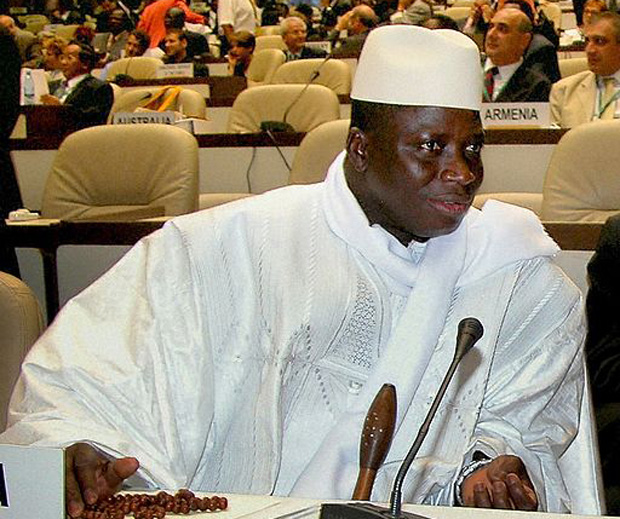
Yahya Jammeh (Image: IISD/Earth Negotiations Bulletin/Wikimedia Commons)
Gambia’s president Yahya Jammeh has said he will soon discontinue the use of English as his country’s official language, describing it as “colonial legacy”. The plan appears to be to make a local language the country’s official one, but reports have also emerged suggesting Arabic will replace English.
Speaking at the swearing-in ceremony of the country’s newly appointed Chief Justice, Jammeh — known for his anti-western rhetoric and policies — said for the next “one billion years”, the British have “no moral platform to talk about human rights anywhere in the world”. Gambia gained its independence from the UK 49 year ago, and the president stated that the only British remnant is the English language. “We no longer believe that for you to be a government, you should speak a foreign language; we are going to speak our own language,” he emphasised.
The move comes after Gambia withdrew its membership of the British Commonwealth in October last year, stating that it “will never be a member of any neo-colonial institution and will never be a party to any institution that represents an extension of colonialism”.
The news has been met with opposition. Former diplomat Dr Momodou Lamin Sedat Jobe, now heading the pro-democracy group Gambia Consultative Council (GCC), told news site Jollof that the president’s latest statement is “yet another disappointment”, questioning its feasibility.
“It is much easier said than done,” said Hamat Bah, leader of the oppositional National Reconciliation Party (NRP), in an interview with local newspaper the Point. He said the implications and ramifications would be huge and must be addressed before the change could be made.
Demba Ali Jawo, a journalist and prominent political analyst, suggested that President Jammeh’s announcement was just a diversionary tactic to shift focus from the economic and social problems his government faces. He points out that a change of language would take much more than just mere anti-western rhetoric, arguing that “as our languages are not yet written, we need to develop a dynamic written form which has the capacity to accommodate the rapid technological development, including information technology”. He highlighted the judicial system as a sector where the switch away from English could be particularly complicated, and predicted that it would take much longer than President Jammeh’s own lifetime for Gambia to completely do away with the use of English.
This article was posted on March 28, 2014 at indexoncensorship.org
27 Mar 2014 | News, Politics and Society, Religion and Culture, United Kingdom, Young Writers / Artists Programme
There are people out there who claim they can make things go viral. They are lying.
They are the digital version of economists, confidently asserting they can predict the behaviour of millions of barely-rational people, when nothing of the sort is possible. You can maximise the chances of something going viral but you can’t guarantee it, let alone predict it.
In the last few months, I’ve written about a dying man being deported by the Home Office, the decision to secretly restart removals to Somalia and a Home Office document which admits they have no idea whether their drug policy is working. They do fine, but you can often watch stories you spent time working on go out to the usual liberal minded folk, whirl around for a bit and then die a respectable death, with little to no impact on the wider world.
And then occasionally something explodes. A week and a half ago I saw Frances Cook, of the Howard League for Penal Reform, a brilliant but little-understood campaign group, tweeting about justice secretary Chris Grayling’s Incentives and Earned Privileges scheme, which was brought in last November.
It was part of his attempt to look tough on prisoners, the latest chapter in a seemingly endless cycle of tabloid coverage of supposedly cushy prisoner life, followed by a draconian clampdown by the secretary of state and stubbornly high reoffending rates.
Justice secretaries, like all ministers, are far more interested in the views of tabloids than academic researchers. If they valued the latter, they would build small prisons in the local community so inmates kept regular contact with their families, structure internal learning programmes to improve literacy levels and up-skill people so that they don’t rely on crime once they get out. But they don’t listen to researchers. They listen to tabloids, so they end up trying to flex their muscles, which in Grayling’s case is not an agreeable image.
The purpose of the scheme is to make prisoners earn spending money through discipline and participating in their rehabilitation programme. They can then use this (tiny) amount of money to buy things like toothpaste, underwear or, if they want, books.
Core to this project, Grayling says, is the idea that parcels from family and friends must be stopped. The justice secretary has many reasons for this. Perhaps it is to stop gifts making his earned privileges redundant. Perhaps it is because it is impossible to securely scan all the parcels. Perhaps it is because the parcels are sometimes used for contraband. It is hard to tell, because he is prone to using any number of these excuses as he goes.
But regardless of the reason, the Ministry of Justice banned prisoners receiving books or magazines by mail. Books were now considered a reward, not a tool for rehabilitation.
I asked Frances to write politics.co.uk a blog post on it, with a focus on the restrictions on books. But I was in no particular rush. I figured it would be one of those worthy pieces we publish, which get a bit of an airing and some decent traffic for a couple of days, then respectably fade away. I didn’t bother writing a news story about it, given the policy was actually four months old. When she asked what the deadline was, I was rather flippant. “Whenever really,” I told her. “It’s not very time sensitive.”
I published it late on Sunday morning and went off for lunch. The first sign that something had happened came when I went to the loo and checked Twitter (always a dangerous juggling act). Billy Bragg and Caitlin Moran were tweeting it. ‘That’ll get some traffic in,’ I thought.
By the time I went to bed it has been retweeted by the great, the good and everyone in between. A petition had been launched on Change.org.
I talked to Frances on the phone. For someone from her perspective, it is strange when this happens. Groups like the Howards League deal with stories about people being killed in prison and no-one gives a damn. The campaigners and prison officer groups I’ve talked to have been taken aback by the reaction to the piece, and often not a little frustrated. Perhaps people should be more concerned about the fact that inmates are being locked up two-to-a-cell, forcing them to go through the grim humiliation of going to the toilet in front of each other, one told me.
Their problem was mine too: Why do some issues, which might ultimately be more trivial than others, go viral?
In this case it is to do with the almost-mystical power of books in the middle class imagination.
There is a trivial side to this – the bourgeois pretention around books as idol-worship, typified by the stigma around marking your spot by turning the corner of the page. It is a fetishisation of the book, as if Waterstones were one of those Middle Aged tradesmen flogging you a strand of Jesus’ hair. It’s nonsense. Books are nothing but a machine, a tool to get information from brain A to brain B. They are beautiful, but it is a beauty which survives quite well when stuffed into the back pocket of a pair of jeans or covered in coffee stains.
The novel allows access to characters inner life in a way film never can. It is the most empathetic of art forms. Political books, from Paine to Orwell, weigh heavily in the battle of ideas in a way other mediums struggle to match. Even seemingly turgid course text books stand as a tribute to people’s capacity for self-improvement.
These are all vital functions of the book which inmates could benefit from. But for most of them, the importance of books is more sombre and rudimentary. Two-thirds of ex-offenders have the literacy and numeracy levels of an 11-year-old. What they need, more than anything, is young adult literature – appealing, simply written novels which can improve their core reading skills. Perhaps that sounds patronising. It is not meant to be. It is meant to be realistic.
Supporters of the Grayling policy in government told me I was kicking up a fuss so that some mugger could get his hands on a Harry Potter book. I accepted that proposition proudly. It is important that he does. It will do nothing to encourage him mugging someone and might just have a small role in discouraging it.
Anything that stands in the way of a prisoner reading anything is a lunatic act. It costs them more and it costs us more.
This article was posted on March 27, 2014 at indexoncensorship.org
27 Mar 2014 | India, News, Pakistan

(Photo illustration: Shutterstock)
Shapoorjee Sorabjee, the first historian of cricket in India, had cautioned more than a century ago in 1897- “… to expect all political difference to disappear or all available self-interests to be foregone on the institution of cricket relations is to live in a fool’s paradise.” Sorabjee’s words echo loudly in the persecution of 67 Kashmiri Muslim students in the city of Meerut on March 6. Historian Ramachandra Guha’s statement- “post-independence, cricket was equated with patriotic virtue”, echoes louder.
These local college students had cheered the Pakistan cricket team which trounced India in a cricket tournament. In normal circumstances, cheering a team would not have been considered perfidious or criminal. Unless of course one is thrown back to 1945, when Orwell acerbically noted that there’s nothing like certain spectator sports to add to the fund of ill-will between nations and their populations. Or, more recently, to the times of Norman Tebbit and David Blunkett for whom a cricket match was the perfect crucible to test one’s loyalty to his country.
But Indo-Pak cricket matches are anything but “normal”. On the Indian side of the border, they are nothing but battles to be won, and once victory has been achieved, to be celebrated by humiliating, vilifying and demonising “the other”, that is, Muslims. And when there are Kashmiri Muslims, the viciousness is increased manifold.
So it happened that these students were charged with sedition, which under Indian criminal law, is equivalent to treason, and carries a maximum sentence of life imprisonment. The Bharatiya Janata Party (BJP), which in its present incarnation can give the British National Party and United Kingdom Independence Party lessons in jingoism and xenophobia, quickly bared its fangs, and raised a din about bringing these “terrorist” students to justice. Not unsurprising, when its senior leader and a proclaimed patron of cricket, states with pride that cricketing nationalism is an integral aspect of a person’s national identity. When the charges were withdrawn following a loud backlash, the BJP rushed to the election commission alleging that the ruling party in Uttar Pradesh (where Meerut is located) was violating the poll code by this act of pandering to anti-national Muslims.
This sordid affair brings back memories of March 2003. The police top brass in Calcutta had planned how to prevent Muslims from supporting Pakistan during the World Cup quarter-final against India. When India won, a precedent of sorts was set- the army chief, the prime minister and deputy prime minister rang up the players and congratulated them. Such praise is usually reserved for occasions when the team wins the tournament, and not a particular match. In Ahmedabad, riots broke out when Muslims were prevented from celebrating India’s win.
It is easy to excoriate the Hindu right wing parties, but rabid Islamophobia is par for the course in so far as they are concerned. The Meerut incident demonstrates a new use of sedition initiated not by the usual suspects but by a state government which professes to be secular.
An incident of 2010 brings out the novelty factor. Arundhati Roy had criticised the government for decades of brazen civil rights violations in Kashmir, and demanded that the people of the disputed territory be allowed to exercise their right of self-determination. The “patriotic” Hindu right went ballistic, and demanded that she be tried for sedition and also deported. Charges were pressed, and even some sections of the media were complicit in an all-out attack against her, as this report details.
But Meerut is not the bastion of the rabid fundamentalists, so what could have happened? The answer is found in the antecedents of the college administrators who went to the police in the first place. The rector and chancellor are a retired police officer and army general, respectively. Representatives and agents of the Indian state, which has always used the sedition law to squelch dissent and perpetrate impunity. Almost like Omar Abdullah, the chief minister of the state of Jammu & Kashmir, who exposed his real stance by calling the charges harsh and unacceptable, and in the same breath, labelled the students’ actions as “wrong and misguided”. But more striking is the cynical opportunism by the government of Uttar Pradesh. It had done nothing to stop the bloody riots in Muzaffarnagar last year but beat the tin drum of it being “secular” to the core. Taking it one step further, it used a law described as “objectionable and obnoxious” by none less than India’s first prime minister Jawaharlal Nehru, to curry favour with the majority Hindu constituency on the eve of national elections.
Whoever thought that the odious doesn’t have its productive uses?
This article was posted on March 27, 2014 at indexoncensorship.org