5 Mar 2014 | About Index
Index on Censorship is embarking on a year-long project tracking and reporting on media plurality and media freedom in the European Union. The goal of the project is to map the environment for journalists and media outlets across the continent and its neighbourhood.
The project will utilize a suite of digital tools, which are under development, to measure and analyse threats to media freedom. The data gathered will be displayed in real time through the Ushahidi mapping software. This project will cover 36 nations (all 28 EU member states and 8 candidate countries).
Index wants to appoint 8 regional correspondents to be a key part of this great project. Crucial for the success of the project, each part-time regional correspondent will be assigned 4-5 countries to monitor and report on. Correspondents will work with Index staff, pitching their own reports and stories, and will be tasked with following up on submitted reports, file news dispatches on the incidents and reach out to professional media and citizen journalists via social media or through participation in professional groups to spread awareness of the tools and project. The correspondents will also assist in the production of training materials for the project in conjunction with Index staff. We expect that the regional correspondents will devote 25 hours per month to this role.
We are seeking eight (8) regional correspondents for the year-long project, which is expected to end by January 2015. Correspondents will be compensated.
Monthly expectations for the regional correspondents:
— Monitor and report on violations of media plurality and freedom
— Review and research crowd sourced information for verification
— File at least three (3) editorial pieces about media plurality and freedom in assigned countries per month for publication on IndexonCensorship.org and related websites in consultation with Index on Censorship staff
— Evangelise media plurality and media freedom reporting tools to media professionals and citizen journalists
We are looking for professional journalists who are seeking a secondary role. Written fluency in English required.
Interested applicants should apply to [email protected] with two recent examples of their work and their CV.
Absolutely no phone calls.
5 Mar 2014 | India, News, Politics and Society
In 1993 Nancy Adajania, a 21-year-old student, published an article titled Myth and Supermyth. In it she explored the way in which newly formed nations often fostered a sense of identity by converting their historical figures into national icons. Her article provoked angry protests across the state of Maharashtra, India’s financial hub, where she was charged and arrested for insulting the memory of Shivaji, a 17 century king revered in the state as a Hindu hero. Justice Saldanha considered Adajania’s bail application and said in his judgment: values from “the dark ages” must not be allowed to “turn the clock backwards” on freedom of expression.
And yet the clock has been turned back, and this became clear once again last month when Penguin India agreed to withdraw and destroy all copies of The Hindus, a monograph by the Sanskritist Wendy Doniger. The publishers pulped the book after a four-year legal battle with the Shiksha Bachao Andolan (Save Education Movement), a fundamentalist Hindu outfit that complained the book “insulted” their religion.
In a statement released after the out-of-court settlement Penguin condemned India’s criminal laws, which it said undermined free expression. In no legal system is freedom of speech an absolute, unqualified right. Liberal jurisdictions do, however, recognise that free expression is integral to a free society, and ensure that any qualifications to the right are limited. In India the right to free speech is enshrined in Article 19 of the Constitution, but it is immediately and extensively qualified by Article 19(2) which gives the state licence to impose “reasonable restrictions” – a broad power justifying curtailments based on vague notions such as “morality” and “decency”.
The state and private petitioners have equally exploited India’s penal code to harass, censor or silence individuals. Beyond religion and folk history, politicians and big business have used criminal proceedings to muzzle activists, social workers and political commentators. In 2012 Aseem Trivedi, a satirical cartoonist, was charged with sedition – a crime against the state – for publishing cartoons criticising official corruption. Arundhati Roy, the author and essayist, was similarly threatened with sedition charges for publicly speaking in favour of the Kashmiri right to self-determination. The silencing of personal opinion now also extends to social media. In 2012 a 21-year-old was arrested for hurting religious sentiments after she criticised the decision by authorities to shutdown Mumbai to mark the death of a controversial local politician.
As Faisal Devji, a historian at the University of Oxford, notes, the agents of censorship in India have changed. The colonial-era penal code served the repressive functions of the Raj, but the state has long since been replaced by hard-line extremist groups. For many this shift occurred in 1988 when Rajiv Gandhi, a former Prime Minister, bowed down to pressure from Muslim fundamentalists and banned imports of Salman Rushdie’s Satanic Verses.
In the 2014 World Press Freedom Index, Reporters without Borders ranked India 140 out of 180 countries. India’s denial of free speech in Kashmir and other insurgency-inflicted areas is well established. In its report Reporters with Borders go further, noting journalists are “abandoned by the judicial system” and subjected to “threats and physical violence”, forcing themselves to self-censor. Security forces, criminal groups, demonstrators and members of political organisations are all implicated, the report goes on, in the erosion of freedom of speech.
The state has consistently failed in its duty to safeguard the right to free speech, and increasingly stands back to allow extremists to trample on it. As well as opportunistic politicians the courts, as Ramachandra Guha a prominent Indian historian explains, are also to blame. Before M.F. Husain, India’s most celebrated painter, fled India in self-imposed exile, courts across the country entertained spurious cases filed against him from angry Hindus offended by the artist’s portrayal of Indian gods.
Last year Salman Rushdie described the deterioration of free expression in India as a “cultural emergency”. The extent of this emergency was made shockingly clear when Hoot, a media watchdog, published its annual Free Speech report. In 2013 alone eight journalists were killed, 99 counts of official censorship were recorded and India’s surveillance infrastructure grew to include the Central Monitoring System, National Intelligence Grid and ad hoc interceptions of electronic communications.
Free speech in India is under attack on two fronts: top-down state censorship has been matched by the bottom-up moral policing of ad hoc fundamentalist groups. As Pranab Bhanu Mehta, a leading commentator, warns, “If the state gives taking offence such aid and succour, offence will be easily taken.” Indeed, the clock is at risk of being turned back much further. Emboldened by its victory the Shiksha Bachao Andolan is now determined to see Doniger’s other works destroyed. As Dinanath Batra, the organisation’s octogenarian leader said during a recent interview, “Freedom of expression cannot trample our identity, culture, religion and tradition. We cannot allow anti-national writings.”
This article was published on March 5, 2014 at indexoncensorship.org
5 Mar 2014 | About Index
Project manager (part-time, 2-2.5 days per week, April 1-June 30)
Salary £35,000 pro-rata.
Leading international free expression organisation Index on Censorship is looking for someone with experience of project management including coordinating with partners and delivering project-related events.
We are looking for someone who can get up to speed rapidly on three of our key projects, providing clear project management to support and lead Index staff working on those projects. You will have good project management skills, and be used to delivering dynamic, effective projects to deadline and meeting clear project deliverables as specified in project outlines.
Index has a number of exciting current projects (ranging from youth to EU media to digital reporting of censorship) involving both UK and international work. The three projects that need a temporary project manager include delivering events with partners in four countries on free speech and reporting censorship, establishing a reporting network on media censorship across the EU, and delivering a set of youth events and outputs. All these three projects have dedicated Index staff working on them but need an overarching project manager.
Experience of working in the NGO and charitable sector would be helpful (whether in freedom of expression, human rights, international development, the EU or other areas).
Please send covering letter, not more than one page, setting out your key project management expertise and experience and CV to [email protected]. Informal enquiries or questions can also be directed to David.
Closing Date 16th March 2014
Interviews 25th March 2014
Applicants must be available for immediate start.
5 Mar 2014 | Awards, Azerbaijan, Azerbaijan News, News
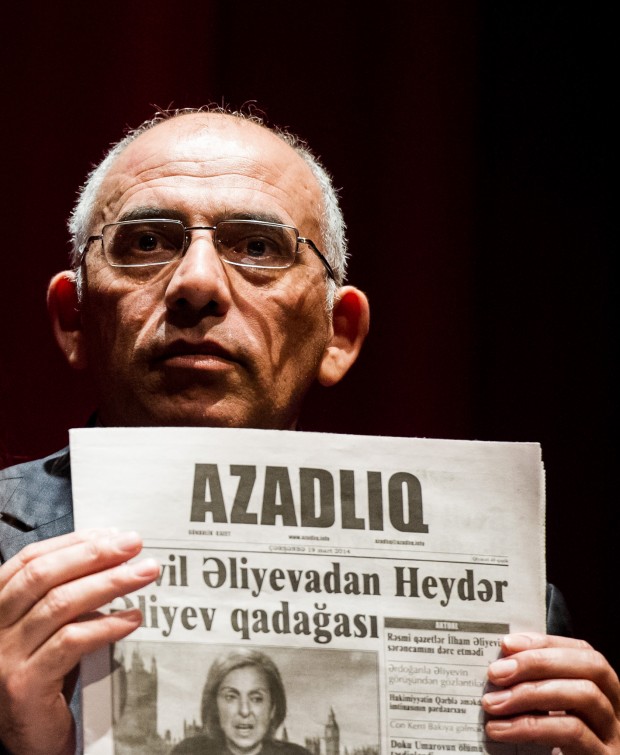
Rahim Haciyev, deputy editor-in-chief of Azerbaijani newspaper Azadliq (Photo: Alex Brenner for Index on Censorship)
One of the few remaining independent media outlets in Azerbaijan, the newspaper Azadliq has continued to report on government corruption and cronyism in spite of an increasing financial squeeze enforced by the authorities.
The country likes to present itself as a modern democracy, but it is widely recognised as an authoritarian regime where opposition is often brutally cracked down on and critical voices silenced. In this environment, Azadliq works to hold the ruling Aliyev family, and the rest of the powerful elite in the country to account. The latest attacks on the paper came hot on the heels of the country’s 2013 presidential election, where Ilham Aliyev was reelected in a vote labelled flawed by the OSCE.
The paper has been been the target of defamation suits that have resulted in £52,000 in fines. Courts found Azadliq guilty of “damaging” the business reputation of Kabira Mamedova, director of the Baku-based Bina shopping centre, and Taghi Ahmadov, CEO of the Baku Metro, after the paper published articles critical of their activities.
The paper’s bank accounts have been frozen since 25 October, and Gasid, the state-owned press distribution company, has not been transferring payments that reflect the paper’s sales; according to Azadliq’s latest calculations, Gasid now owes about £44,000.
Azadliq’s journalists also face continuous threats. On 4 October 2013, Azadliq reporter Ramin Deko was part of a group of journalists assaulted by a pro-government mob while covering an opposition rally in the central Azerbaijan town of Sabirabad. He also alleges he was abducted and beaten up on 3 and 4 April 2011 by law enforcement bodies. While he was illegally detained, he said he was told to stop writing critical articles and to change his workplace to a pro-government newspaper.
Despite this, Azadliq refuses to back down, and continues to cover the activities of the Azerbaijan corrupt elite. “We play a significant role in providing people with alternative information. Our staff are underpaid, overworked, and yet are fully committed to their work”, said deputy editor-in-chief and acting editor Rahim Haciyev.
Haciyev, who joined the paper in 2001, talked to Andrei Aliaksandrau about why his work at Azadliq is so important.
Index: Your publication faces constant pressure from the authorities. Have you ever thought of leaving for a safer job?
Haciyev: No, this is my work, and it is not only a job, it is my form of expression. The fight for free speech is sacred for me. This is the way of opposing lawlessness and tyranny, and working for Azadliq provides me with a possibility to continue this fight for what I believe in.
Index: What is the wider media landscape in Azerbaijan? And how does this fit into the wider political and social situation?
Haciyev: Repressive steps taken by the government of the country have led to significant restrictions of media freedom. Today there is a real threat of independent press in Azerbaijan totally disappearing. The country lives under a strict authoritarian rule. Activists of political opposition, civil society organisations and independent journalists face constant pressure. There are more than a hundred political prisoners behind bars in Azerbaijan, including journalists.
Index: What is your view on the Snowden/Greenwald revelations about mass surveillance?
Haciyev: Our newspaper covered the story. I think a government should keep its secrets – but it is the role of the press to inform the public and share the information they gather. And any kind of pressure exerted on the media is nothing but a violation of the freedom of expression.
Index: Technologies have changed the media market globally. Do you think newspapers are still relevant?
Haciyev: I am sure printed newspapers will keep their relevance for a long time. Despite the development of the internet, we can still see great demand for newspapers among the audience. For us,our website is getting more and more popular, and the circulation of the printed newspaper is going down – but it is not because people are losing their interest in the printed publication, merely because of all the restrictions and pressure our authorities put on us.
Nominees: Advocacy | Arts | Digital Activism | Journalism
Join us 20 March 2014 at the Barbican Centre for the Freedom of Expression Awards
This article was posted on March 4, 2014 at indexoncensorship.org
