Malaysian cartoonist Zulkiflee Anwar Haque, aka Zunar, is currently in the UK to raise awareness ahead of his court case in his home country at the start of next month. He is facing nine charges of sedition for criticising Malaysia’s judiciary over the recent incarceration of a Malaysian opposition leader and could be sentenced to a maximum of 43 years imprisonment.
While in the UK, Zunar will be part of an exhibition at the Cartoon Museum.
“I want people to understand the situation in Malaysia through cartoons,” he said during an interview with Index on Censorship. The full video can be seen above.
“I will never stop,” he added. “It is my right as a citizen to express my view and my responsibility as a cartoonist to give alternative views.”
Zunar and his work have been repeatedly targeted by the Malaysian authorities. In September this year, police opened an investigation on his latest book of political cartoons, Sapuman – Man of Steal. A sales assistant who manages online sales of the title was questioned by police under the Sedition Act. A number of his cartoon books been banned by the government.
This article was posted on 29 October 2015 at indexoncensorship.org
Holding a dustbin in front of his chest the young bare-chested student stands defiantly in the middle of a dusty road, facing down a squad of heavily-armed riot police.
Suddenly his body begins jerking crazily like a puppet on a string as bullets fired by a police marksman armed with a high-powered FN rifle smash through his useless shield and thud into his body. Almost four decades later this deadly tableau that played out on an Alexandra Township street a few days after the 16 June 1976 student uprising against the use of Afrikaans began in Soweto is still etched into my memory.
As a young reporter, I had been assigned that day to cover the unrest that had spread to Alex, as the flames of insurrection raced across apartheid South Africa like wildfire.
Over the weeks that followed, I regularly witnessed how police reacted with deadly brute force against student protesters armed only with rocks and anti-apartheid songs.
I also remember the mass meetings and marches in the early 70s against harsh apartheid laws by students at Johannesburg’s Wits University, which were inevitably broken up by police with vicious dogs and armed with whips, batons and tear gas.
So it was with a sense of déjà vu that I sat and watched on television almost two decades into South Africa’s young democracy as riot police used rubber bullets, stun grenades and tear gas to break up country-wide protests by students against above-inflation university fees hikes. They were also demanding that universities end the outsourcing of campus cleaning and maintenance jobs and for the people who do them to become full-time employees.
What South Africa has been witnessing is a reawakening of activism among students after a hiatus of almost two decades. For a week, campuses across the country embarked on the biggest nationwide student protests since the birth of the new democratic society in 1994.
But student and youth-led activism in South Africa is not new. It was pressure by the ANC Youth League leaders, including Nelson Mandela, which forced the organisation’s leadership to adopt a programme of action in 1949, including mass resistance tactics like strikes, boycotts and civil disobedience. It was also pressure on the leadership by youth that resulted in the 1952 launch of the Defiance Campaign against unjust apartheid laws.
But one big difference in these latest protests was the harnessing of social media as a rallying and activism tool. Powered by the #FeesMustFall hashtag the issue went viral with over half a million tweets and counting as Twitter became a powerful tool in the hands of the protestors.
With the ubiquity of smartphones among the students, Twitter became the go-to source to keep up with the rapidly unfolding story as the protests spread to 18 university campuses in eight of the country’s nine provinces, forcing the suspension of lectures and the cancelation of exams.
In the early days of the protests, some callers to radio shows at first dismissed the students’ actions as hooliganism.
Having evicted students, many holding their hands in the air as a sign of non-violence, the protest continued on the streets around Parliament–but once again police reacted with a heavy-handed response.
But Twitter also captured some poignant lump-in-the-throat moments as social media showed students of all races and political persuasions joining hands, and white students forming a human shield around black students in the belief that police were less likely to act against them.
As demonstrators on the lawns outside chanted and sang, President Jacob Zuma met with university chancellors and students leaders, before his government capitulated to student demands. As the protests continued outside, Zuma appeared live on national TV and announced that there would be a 0% increase in university fees in 2016.
The news immediately spawned the jubilant new hashtag #FeesHaveFallen with some protesters saying that the suspension of 2016 fees was just the beginning of their struggle and vowed to continue the fight for free university education.
One thing is clear: after a week of protests by South Africa’s future generation of leaders, the country’s democracy was far stronger than when it began – and the high toll paid by the young man with the dustbin lid and others had not been in vain.
Romania has a lot of high-calibre journalists to its name. However, many media outlets are now fighting to survive while maintaining professional standards due to judicial investigations, political scandals and struggles with high debt loads. This is according to the authors of The Men Who Bit the (Watch) Dogs, which explores the media landscape in the country.
The report focuses on transparency and ownership of the media — particularly the most influential medium, television, over the past 25 years — from post-communist enthusiasm to today’s chaotic mix of business models.
While journalists in the early 1990s were independent of the pressures that marked the Soviet age, most of the 1,200 newspapers that were established at the time didn’t take off. Speaking to Index on Censorship, one of two Romanian academics behind the report, Manuela Preoteasa from think tank The Centre for Media Transparency, explains that at the time, well-known international media companies just weren’t interested in quality journalism.
“As we demonstrated in the report, the market was kept half-closed during the early 90s, which means that it was not open to foreign investors,” Preoteasa says. As the report highlights, the “market that was inhospitable to the promotion of professional journalism” and so “foreign investors had to focus solely on commercial success”.
The ethos of the era seemed to be: “We don’t sell our country to foreigners.” Foreign investors could not own a licence without a Romanian partner, and apart from state-owned channels, no other private entity could apply. For nine years, only local licences for each of the 41 counties and Bucharest were available.
With ownership of the media confined a handful of tycoons, many outsiders would have lost interest. “Show me a serious TV investor who would have been willing to invest in such an unfriendly market,” Preoteasa says. “I strongly believe that the media market was intentionally kept closed to serious investors.”
Print was different. “The history of the last decade shows that print media could not exist on its own, but only as part of a conglomerate, and the conglomerates were formed around TV stations,” Preoteasa explains. “That is why the TV industry has such a strong influence.”
Economically, many of these media outlets relied on state advertising. Some TV stations — already benefiting from debt cancellations and debt rescheduling — started to receive public money as state-owned companies began to advertise. The scheme was introduced by the government led by former Prime Minister Adrian Năstase (2000-2004) and was soon adopted by local politicians and businessmen.
Romania’s unfriendly business environment, high taxes, bureaucracy and a chronic economic instability also challenged the viability of commercial models within the media, the report says. Other challenges include “the lack of a clear distinction between information and opinion and the absence of marketing- and sales-related knowledge”.
These days, the media industry faces serious legal problems that involve either the owners of the main media groups or the groups themselves. Media owners such as Adrian Sârbu, Dan Voiculescu, Sorin Ovidiu Vântu, Sebastian Ghiţă and Dinu Patriciu have all been on trial or are under various criminal investigations.
In a young democracy, the media should play a key role in holding the powerful to account. However, this doesn’t seem to be the case in Romania.
So are there any signs of hope? “I believe the initiative will come from the telecom industry,” Preoteasa says. As to whether the telecom industry will swallow the existent media or would it invent a new one, the answer lies somewhere in between. “I am sure the online media started to have a say and the pressure from the interactive medium is high,” she says, offering an open suggestion: “Someone should look carefully at what young people are looking for and perhaps this will reveal the answer about what might come next.”
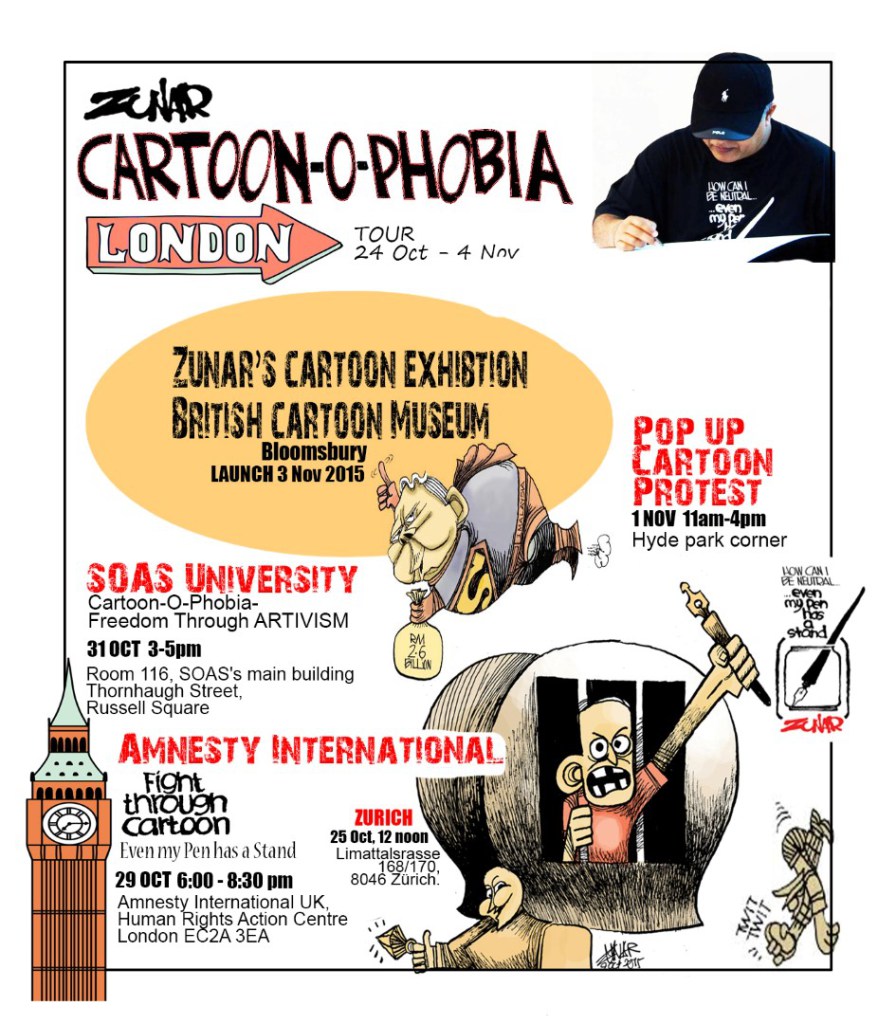
Malaysian cartoonist Zulkiflee Anwar Haque, aka Zunar, is facing nine simultaneous charges under the country’s Sedition Act and will appear in court on 6 November. He could be sentenced to 43 years in prison for drawing cartoons that mock Malaysia’s corrupt government officials.
Ahead of his court appearance, Zunar is coming to the UK to display a small selection of his work as part of the permanent exhibition at the Cartoon Museum and several other events.
29 Oct: My fight through cartoons: In conversation with Zunar
Join Index on Censorship, Amnesty International and SUARAM International to hear a courageous artist speak about his cartoons and his inspirations, and human rights and freedom of expression in his home country Malaysia. When: Thursday, 29 Oct, 2015, 6pm – 8:30pm Where: Amnesty International UK, Human Rights Action Centre, London, EC2A 3EA (map) Tickets: Free, but registration required Full details
In early October 2015, the country’s Supreme Court rejected a challenge to the constitutionality to the Sedition Act. The decision was a setback for Zunar, who’s trial had been postponed pending the outcome.
The court, challenged by law professor Azmi Sharom, ruled on 6 October that the Sedition Act 1948 remains constitutional and a valid piece of legislation. Azmi had argued that the Sedition Act 1948 is not a valid law as it was not enacted by parliament and contradicted with the Article 10 of Malaysia’s constitution.
At the time, Zunar said: “The decision by the court simply mocked the Constitution and [is] politically motivated.”
The cartoonist said the Sedition Act has been used as political weapon by the government to constrain and curtail freedom of expression since it was introduced in 1948. More than 200 activists – students, lecturers, lawyers, writers, religious activists, opposition leaders and cartoonist – have either been arrested, detained, investigated or charged since last year.
“I am now being slapped with nine charges under the draconian act and facing a possible 43 years of jail term,” he added. “The hope to get justice from the court is just fairy tale.”