4 Apr 2018 | Europe and Central Asia, Mapping Media Freedom, Media Freedom, media freedom featured, News, Portugal
[vc_row][vc_column][vc_column_text]
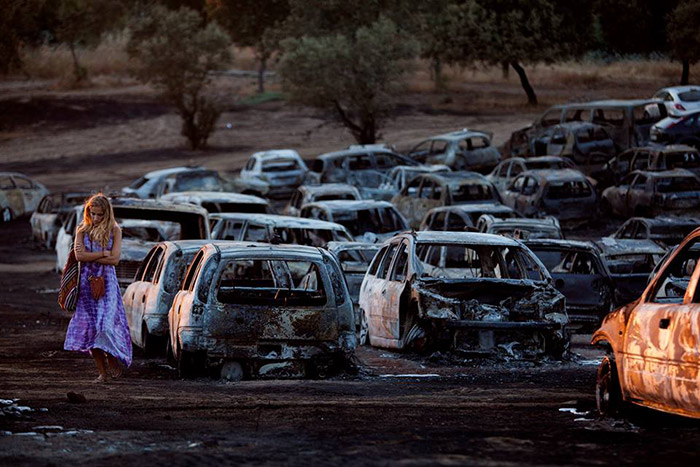
The photo that won Enric Vives-Rubio the 2017 Gazeta Award, one of the most prestigious awards in Portuguese journalism.
Despite having worked in Portugal’s small media industry for the past two decades, photojournalists Enric Vives-Rubio and Nuno Fox have never worked in the same newsroom. However, their careers share certain similarities, including poor working conditions, job loss and a reluctant turn of their backs to the profession.
Vives-Rubio got a job at the Portuguese daily Público in November 2005. “It was just the kind of newspaper I hoped I’d work for one day,” he told Mapping Media Freedom.
However, the conditions offered didn’t match Vives-Rubio’s hopes. Instead of proposing to hire him on a regular contract like most of its workers, Público offered to pay him through a “recibo verde”. These “green receipts” are a way for independent or freelance workers to charge companies for their services on an occasional basis, but the system is often abused by Portuguese companies to hire de facto full-time workers without offering them job security or the benefits that come with a full-time contract.
Employers get all the advantages of full-time staff — no obligation to grant job benefits and the possibility to lay off employees with no justification or severance pay due — while the worker is left with no job security and pays nearly twice as much tax as someone on a regular contract.
According to a study by the Union of Journalists, 33.4% of journalists working in Portuguese newsrooms are working without a contract. Although there isn’t a specific number, João Miguel Rodrigues, a photojournalist and a member of the Union of Journalists, says that “many are photojournalists”.
The offer made to Vives-Rubio by Público was hard to resist. “The offer was bad, but I couldn’t say no otherwise I’d be unemployed,” he explained. He was told when he was hired that the green receipt situation was “temporary” and that two months later — come the end of the financial year in 2006 — he would get a proper contract.
“Things didn’t turn out quite like that after all,” Vives-Rubio said.
During the first two years, he’d ask his superiors about his situation on a monthly basis. His insistence got him a contract — although not the one he was looking for — in which he would still work under the green receipt system on an annual basis. This, however, did not grant him any job benefits or job security beyond 365 days.
While all of his colleagues had a €3,000 annual stipend to spend on working material, Vives-Rubio had to pay for his own camera and lenses. He also missed out on food allowance, health insurance, sick days, parental leave and the additional two pay packets per year that full-time workers are entitled to by law.
The situation dragged on until June 2017 when he was called for a meeting with Público. They wanted him to work 15 days per month rather than 22 (a decrease of 32%), and for €1,000 instead of €1,750 (a decrease of 43%).
“They weren’t there to negotiate and were just looking for a way to get rid of a problem,” Vives-Rubio said. Leaving the room without a deal in hand, he resolved to work until the end of his contracted year on 23 July. During this time he was given less assignments while his colleagues were given more. Then, in June, his entrance card stopped working. Público had told a contracted worker who had been going in and out of the building for 12 years that he was barred from entering.
Since he was laid off, Vives-Rubio has received the Gazeta award, one of the most prestigious in Portuguese journalism. However, he doesn’t see a future for him in the media industry anymore. “Photojournalists are all slowly being laid off, so why knock on doors?” he asks. “I’ll keep on making journalism, but it will be for myself. As a photographer, I’ll have to reinvent myself.”
The experience of photojournalist Nuno Fox is similar to that of Vives-Rubio. Ever since he started his career in 2004, he has never had a full-time contract. He started his career at the daily Diário de Notícias before moving to the weekly Expresso, all under the green receipt regime.
“I was hired after there was a layoff in the newspaper and they needed to fill in some positions,” said Fox. He was given a €1,500 monthly salary. “This figure was verbally agreed; there’s no paper trail,” Fox said. “I was a part of the newsroom in every way except I wasn’t properly contracted.”
Fox also used his own camera and lenses too. In one of his last assignments for Expresso, he covered the funeral of Portuguese football legend Eusébio. “It was raining heavily but I had to do my work anyway,” he says. As a result, two of his lenses were damaged. “I thought the newspaper would pay for the damage but they told me it was none of their business. I had to pay €900 to fix one of them and I gave up on the other one because it would have cost me more than €1000 to repair it.”
In 2014, the Impresa media group, to which Expresso belongs, decided to create a pool of photojournalists that would work across all of its titles. Fox wasn’t included and was told his services were no longer needed. “I had no protection against this, so it was an easy choice for them,” he says.
The day after he was laid off, Fox wrote down a list of all publications he was interested in working for, picked up the phone and called their photo editors. “I knew things weren’t easy in journalism, so I decided to go beyond those phone calls,” he says. He also made calls to find work as a commercial photographer. “It was never my intention to go that way, I really believed in journalism, but I was left with no option.”
Three years on, most of Fox’s income now comes through commercial photography. At first, he felt uneasy about turning his back on photojournalism, but is now at peace with this reality. “It’s not that I lost my passion for the job, but I don’t identify with the mindset that values quantity over quality that brought us here.”
Rodrigues underlines that “photojournalists are the most affected by job instability” amongst Portuguese media workers. Those who work with images rather than words deemed less crucial for journalism. “In the eyes of many in newsrooms, photojournalists are looked down on as mere technicians.”
Photojournalists are among the “most versatile” elements in newsrooms and, with increasing pressures, aren’t given enough time to do their jobs properly, Rodrigues says. “When photojournalists are treated like this, the pride they take in their work vanishes and they lose their motivation.”[/vc_column_text][/vc_column][/vc_row][vc_row][vc_column][vc_basic_grid post_type=”post” max_items=”4″ element_width=”6″ grid_id=”vc_gid:1525097962341-ec9d666d-b1a7-9″ taxonomies=”6564″][/vc_column][/vc_row]
4 Apr 2018 | Awards, Fellowship 2018, News
[vc_row][vc_column][vc_video link=”https://youtu.be/Ev3C9EZqY48″][vc_column_text]Fereshteh Forough is the founder and executive director of Code to Inspire, which opened its first coding school for girls in Afghanistan in November 2015, and aims to address the low levels of female education and paltry levels of economic participation by women in the labour market. 
This is a widely recognised innovative project that helps women and girls learn computer programming. The aim is to tap into the commercial opportunities offered by the online world to liberate women in Afghanistan and offer them economic independence.
Afghanistan is still a male-dominated country where ordinary women find it difficult even to socialise or trave, let alone work, use technology or be economically independent. Women are also discouraged from working where men are present and experience sexual harassment if they do.
Forough believes that with programming skills, an internet connection and using bitcoin for currency, women in Afghanistan can be independent, transform their society and create wealth and economic opportunity.
“Some of the girls had never touched a computer, been online – nothing,” said Forough. “Today, they are able to create web pages and a some are now going out and talking to women-based companies and offering their expertise to them, to help them create websites. This is a real act of resistance in a country where women are still being pushed back for accessing the internet and computers.”
Only 21% of Afghan women receive secondary education according to a UNICEF study and in Afghanistan there is only a 16% female participation in the labour market.
Afghanistan is still economically and politically unstable and parts of it are dangerous and violence-prone, which presents many hurdles to entrepreneurs who want to drive change like Forough, and the women and girls she teaches and helps get jobs.
However Forough is used to challenges. She herself was a refugee. Born to Afghan parents in Iran, she returned to Afghanistan after the fall of the Taliban, and took a position teaching computer sciences at Herat University after studying for a Masters in Germany.

Forough has received support from abroad for Code to Inspire, particularly from the USA with Google, GitHub, but she is still working on a relatively small scale. She needs more support to expand and build her vision round the country franchising the model to other larger cities such as Mazar-e Sharif and Kabul. Forough also wants to organise the first Afghan women hackathon at a national level.
Forough was a 2013 TED Talks speaker and took part in the 2015 Clinton Global Initiative.
In 2017, Code to Inspire enrolled about 20 girls for new graphic and design classes, and later on in the year another group of 60 girls took classes in unity (a gaming software), mobile applications and full stack development.
“It doesn’t matter where you are or what you are, what you have or don’t have,” said Forough. “You should never be afraid to do what you believe in and that’s what Index of Censorship Award means to me, to raise my voice and share my story freely”.
See the full shortlist for Index on Censorship’s Freedom of Expression Awards 2018 here.[/vc_column_text][/vc_column][/vc_row][vc_row full_width=”stretch_row_content” equal_height=”yes” el_class=”text_white” css=”.vc_custom_1490258749071{background-color: #cb3000 !important;}”][vc_column width=”1/2″][vc_custom_heading text=”Support the Index Fellowship.” font_container=”tag:p|font_size:28|text_align:center” use_theme_fonts=”yes” link=”url:https%3A%2F%2Fwww.indexoncensorship.org%2Fsupport-the-freedom-of-expression-awards%2F|||”][vc_column_text]
By donating to the Freedom of Expression Awards you help us support
individuals and groups at the forefront of tackling censorship.
Find out more
[/vc_column_text][/vc_column][vc_column width=”1/2″ css=”.vc_custom_1521479845471{background-image: url(https://www.indexoncensorship.org/wp-content/uploads/2017/05/2017-awards-fellows-1460×490-2_revised.jpg?id=90090) !important;background-position: center !important;background-repeat: no-repeat !important;background-size: cover !important;}”][/vc_column][/vc_row][vc_row][vc_column][vc_basic_grid post_type=”post” max_items=”4″ element_width=”6″ grid_id=”vc_gid:1523376151785-23b6414e-add3-5″ taxonomies=”10735″][/vc_column][/vc_row]
4 Apr 2018 | Media Freedom, media freedom featured, News
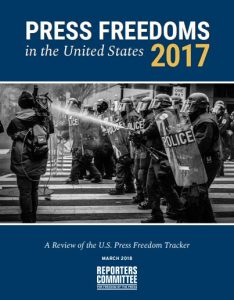
Read the report here
This post was originally published by the Reporters Committee for Freedom of the Press.
The most perilous place for a journalist in the U.S. last year was at a protest, according to a new report released Tuesday by the Reporters Committee for Freedom of the Press that surveys the 2017 data from the U.S. Press Freedom Tracker. Of the 122 incidents threatening press freedom that the tracker logged last year, nearly half occurred at protests, where journalists faced physical attacks from police and demonstrators, were arrested by law enforcement, and had their equipment seized and, in some cases, searched.
The Reporters Committee and more than two dozen press freedom groups launched the tracker last year to provide “an honest accounting of the country’s record on press freedoms” amid increasing hostility toward the news media. The report, “Press Freedoms in the United States 2017,” is the Reporters Committee’s first annual assessment of the tracker’s data and sheds light on the challenges facing journalists as they work to inform the public and hold those in power accountable.
According to the report, law enforcement officials arrested journalists 34 times, with more than three-quarters of those arrests taking place at protests, where police used a controversial crowd-control technique known as “kettling.” Of the 45 physical attacks on journalists in 2017, two were notably committed by elected officials: Montana congressional candidate Greg Gianforte “body slammed” a reporter who tried to interview him but was nevertheless elected the next day, and an Alaska state senator slapped a reporter in the state capitol building. The tracker also identified instances where journalists were stopped while crossing U.S. borders, denied access to public meetings and information, subpoenaed to testify in court, and subjected to unprecedented verbal attacks from public officials, often at the highest levels of government.
The report also notes that in 2017, the Department of Justice only brought charges in one case involving disclosure of classified information to the media, that of Reality Winner. However, the DOJ has said it is investigating 27 leak cases as of November 2017, and just days ago charged a former FBI agent in Minnesota in connection with a leak investigation, potentially indicating more prosecutions may be forthcoming.
Read the full report here.
3 Apr 2018 | News, Volume 47.01 Spring 2018
[vc_row][vc_column][vc_custom_heading text=”Women of the Wild West have been omitted from popular history and culture, but they’re finally receiving airtime, writes Jan Fox “][vc_row_inner][vc_column_inner][vc_column_text]
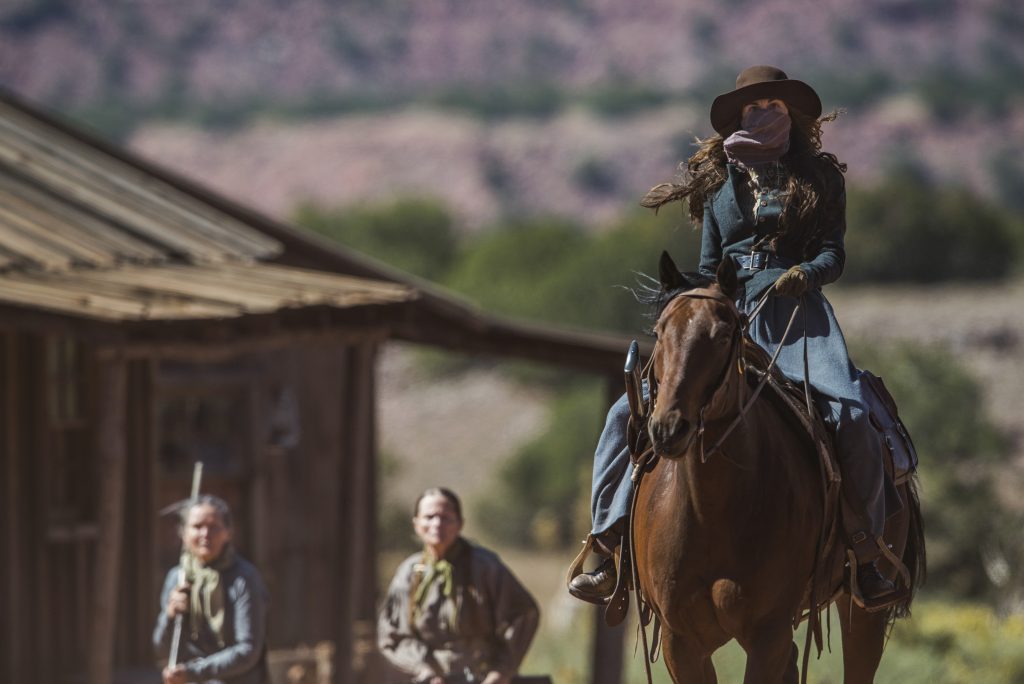
Michelle Dockery stars in Netflix’s Godless, a new show featuring the rarely seen female pioneer, Ursula Coyote/Netflix
[/vc_column_text][/vc_column_inner][/vc_row_inner][/vc_column][/vc_row][vc_row][vc_column][vc_column_text]
Netflix’s new hit show, Godless, is set in a 19th century western USA town run by women. La Belle, New Mexico, has experienced a mining tragedy, killing most of the men and putting women in charge. The cowboys are almost gone and in their place we see women brandishing guns and riding horses.
Godless turns the traditional male-dominated Western genre on its head. It has focused attention on the forgotten women who rolled across the western plains. The storyline may be fictional, but strong pioneer women playing a major part in running these frontier towns is more true to life. But often this side of the history of the west was ignored.
The term “pioneer” refers to anyone who ventured into, and settled, new lands in the USA. Starting in Jamestown, Virginia, in 1607, people moved into the country’s interior and, finally, to the west coast. This history of westward exploration has been told mostly from a male angle. Western landscapes are represented by heroic men on horseback: cowboys, cavalry officers, sharpshooting sheriffs and notorious outlaws.
“In films like Shane and other Westerns, women lack real decision-making authority, and ethnic or racial women appear as prostitutes or bad influences, if they appear at all,” said Laura Woodworth-Ney, executive vice-president and provost of Idaho State University and author of Women and the American West.
It’s definitely a case of his-story, not her-story.
In response to this, the Pioneer Woman Museum in Oklahoma was born.
“I don’t remember learning anything about these women when I was at school in the 1980s, and from the visitors we get at the museum, I don’t think student textbooks are any different today. We need to change that story,” said museum director Kelly Houston. “There were many single and widowed women who went west, but they are largely ignored by history.”
For example, after the Homestead Act of 1862, people raced to claim 160 acres of free public land. Among the biggest of these land races or “runs” in Oklahoma was the one in 1893 when more than 100,000 people showed up.
[/vc_column_text][/vc_column][/vc_row][vc_row][vc_column width=”1/4″][vc_icon icon_fontawesome=”fa fa-quote-left” color=”custom” align=”right” custom_color=”#dd3333″][/vc_column][vc_column width=”3/4″][vc_custom_heading text=”There were many single and widowed women who went west, but they are largely ignored by history” google_fonts=”font_family:Libre%20Baskerville%3Aregular%2Citalic%2C700|font_style:400%20italic%3A400%3Aitalic”][/vc_column][/vc_row][vc_row][vc_column][vc_column_text]
“Widowed or single women could take part if they were over 21. The land runs were extremely competitive and arduous. You had to line up for days, including overnight,” said Houston.
Once a starting gun was fired, people sprinted to a free lot and literally staked a claim. They then had to go to the land registry office to have it signed into their name.
“Not many people realise that women were doing this,” Houston explained.
There were other ways in which pioneer women were key to the development of new towns.
“In Oklahoma, they were the movers and shakers of society, forming clubs and organisations. They are the ones improving school lunches, starting libraries, raising money and so on, and that often gets ignored. They also set up businesses like laundries, shops and cafes,” said Houston.
Something else that gets forgotten is the vital economic role women played in the home.
“In many cases, they were vitally important to their family’s survival through the side-businesses that they ran: raising and selling chickens, making butter, taking in mending. That income could literally save a family in a bad winter if a crop failed,” Houston explained.
A lack of historical sources is a major problem in piecing together a true picture of 19th century pioneer women, explained Woodworth-Ney. “Most working-class women were illiterate at this time, and for many minority women English was not their first language. Apart from that, they would have been too busy working to write anything down. We do have some diaries and letters from lower-middle-class and educated women, including some on the Oregon Trail. In the past 20 years, women historians have been active in shining a light on these, but they are still not readily available.
“They are hard to find because of the cataloguing practices of the late 19th and early 20th centuries when items would have been filed in the archives under the husband’s name and things like diaries and letters would have been filed in the ‘family’ section of his papers and were considered far less important. So this is not so much an intentional type of censorship, but it was hiding these women.”
Elizabeth Gillan Muir, a Toronto-based author and retired lecturer, addresses some of the reasons why pioneer women preachers have been left out of history in her upcoming book, A Women’s History of Christianity. Religion was the cornerstone of life in 19th century USA, and in the great westward expansion more than 100 women preachers travelled to new towns to help “civilise” these unregulated, and often wild, frontier communities.
Although travelling evangelists were perhaps less of a problem than women preaching from the pulpit, men still saw women as a real threat in this situation,” said Muir.
“For the most part, I think why we don’t hear about these pioneer woman preachers is that when they died, their obituaries omitted any reference to preaching activity. Pliny the Elder, writing in the first century AD, said that information about women doctors was intentionally hidden so that, after they died, no one would ever know that they had lived. This is a similar thing, erasing women preachers from history.”
[/vc_column_text][/vc_column][/vc_row][vc_row][vc_column][vc_column_text]
This article is a web special ahead of the launch of the special report in Index on Censorship‘s spring 2018 issue, The Abuse of History, focusing on how history is being manipulated or censored by governments and other powers.
Look out for the new edition in bookshops
Jan Fox is the US contributing editor for Index on Censorship
[/vc_column_text][/vc_column][/vc_row][vc_row][vc_column][vc_custom_heading text=”From the Archives”][vc_row_inner][vc_column_inner width=”1/3″][vc_single_image image=”70877″ img_size=”213×287″ alignment=”center” onclick=”custom_link” link=”http://journals.sagepub.com/doi/pdf/10.1080/03064229108535157″][vc_custom_heading text=”Fear and loathing in San Francisco ” font_container=”tag:p|font_size:24|text_align:left” link=”url:http%3A%2F%2Fjournals.sagepub.com%2Fdoi%2Fpdf%2F10.1080%2F03064229108535157|||”][vc_column_text]July 1991
The law of the gun rules in Cyberspace as it did in the days of America’s ‘Wild West‘, according to American poet and internet activist John Perry Barlow in 1991[/vc_column_text][/vc_column_inner][vc_column_inner width=”1/3″][vc_single_image image=”90649″ img_size=”full” alignment=”center” onclick=”custom_link” link=”http://journals.sagepub.com/doi/pdf/10.1080/03064220008536796″][vc_custom_heading text=”Women as censors” font_container=”tag:p|font_size:24|text_align:left” link=”url:http%3A%2F%2Fjournals.sagepub.com%2Fdoi%2Fpdf%2F10.1177%2F0306422013495334|||”][vc_column_text]September 2000
Mark Kenny looks at how women’s self-censorship has a long, and in most cases, honourable history[/vc_column_text][/vc_column_inner][vc_column_inner width=”1/3″][vc_single_image image=”90965″ img_size=”full” alignment=”center” onclick=”custom_link” link=”http://journals.sagepub.com/doi/pdf/10.1080/03064229308535477″][vc_custom_heading text=”Portrait of a much abused lady” font_container=”tag:p|font_size:24|text_align:left” link=”url:http%3A%2F%2Fjournals.sagepub.com%2Fdoi%2Fpdf%2F10.1177%2F0306422013513103|||”][vc_column_text]January 1993
The politically correct establishment is coopting the feminist discourse to turn it back on the radicals says Marjorie Heins[/vc_column_text][/vc_column_inner][/vc_row_inner][vc_separator][/vc_column][/vc_row][vc_row content_placement=”top”][vc_column width=”1/3″][vc_custom_heading text=”The abuse of history” font_container=”tag:p|font_size:24|text_align:left” link=”url:https%3A%2F%2Fwww.indexoncensorship.org%2F2018%2F04%2Fthe-abuse-of-history%2F|||”][vc_column_text]The spring 2018 issue of Index on Censorship magazine takes a special look at how governments and other powers across the globe are manipulating history for their own ends
With: Simon Callow, David Anderson, Omar Mohammed [/vc_column_text][/vc_column][vc_column width=”1/3″][vc_single_image image=”99282″ img_size=”medium” alignment=”center” onclick=”custom_link” link=”https://www.indexoncensorship.org/2018/04/the-abuse-of-history/”][/vc_column][vc_column width=”1/3″ css=”.vc_custom_1481888488328{padding-bottom: 50px !important;}”][vc_custom_heading text=”Subscribe” font_container=”tag:p|font_size:24|text_align:left” link=”url:https%3A%2F%2Fwww.indexoncensorship.org%2Fsubscribe%2F|||”][vc_column_text]In print, online. In your mailbox, on your iPad.
Subscription options from £18 or just £1.49 in the App Store for a digital issue.
Every subscriber helps support Index on Censorship’s projects around the world.
 SUBSCRIBE NOW[/vc_column_text][/vc_column][/vc_row]
