NEWS

Starlink offers a glimmer of hope in the internet darkness
Uganda is the latest country to shut down the internet as people goes to the polls
21 Jan 26

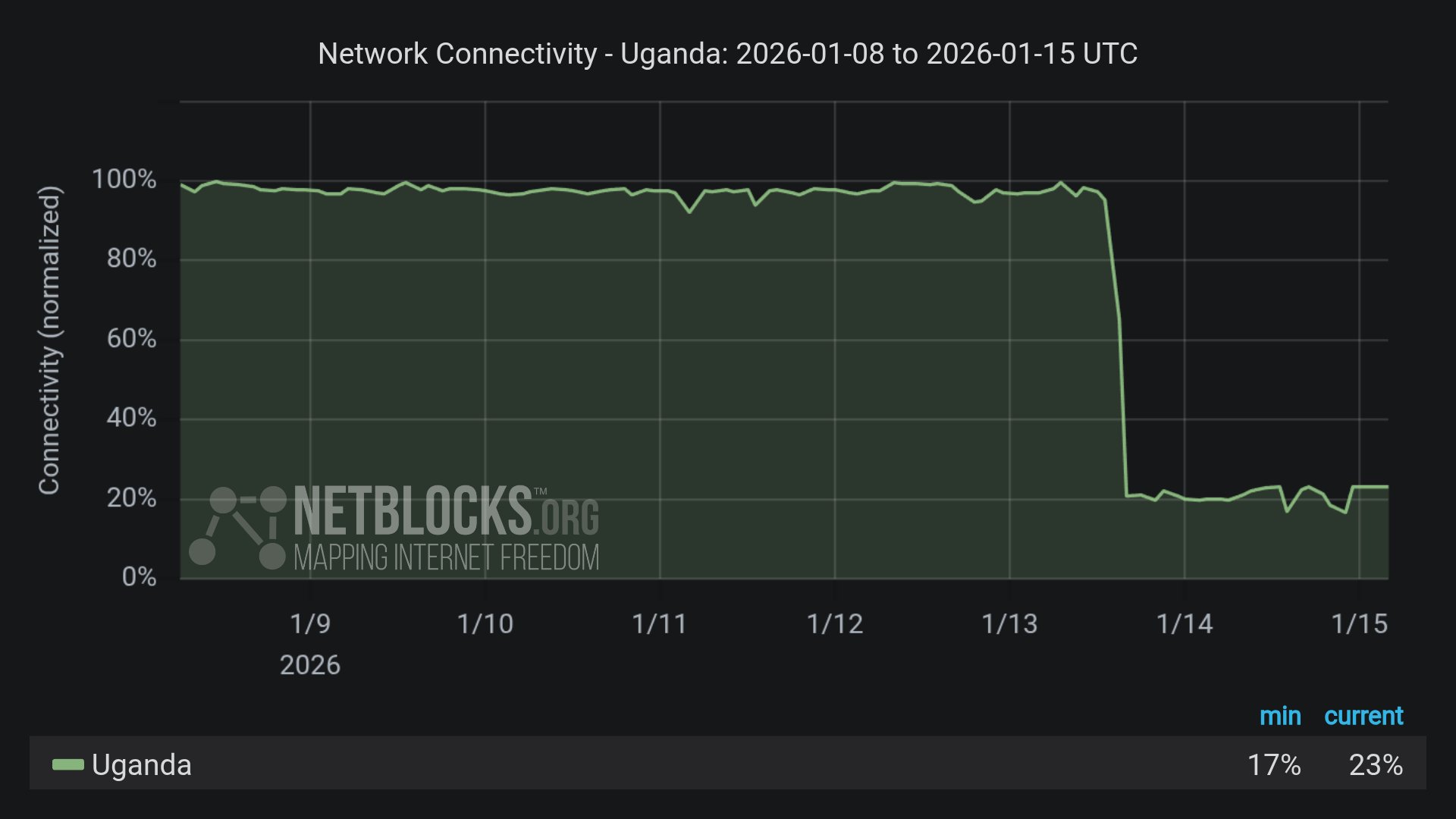
Uganda’s internet blockade. Image by NetBlocks/X

Is it two thousand? Is it 12,000? Is it even more? These are the figures of protesters killed in Iran that have been circulating in the news since last week. We don’t know for certain what the exact number is. To hide what’s happening, authorities pulled the plug on the internet last Thursday and it is still largely off. The move was both desperate and despotic. Without the internet ordinary people can’t organise online, they can’t reveal the true extent of the horrors taking place and they can’t even be reached by loved ones outside the country.

This is not the first time Iran has imposed a digital blackout. Operating their own version of a Great Firewall, nicknamed the “halal internet”, they first trialled a blackout during the protests of 2019. Nor is Iran alone in resorting to this tactic. The Taliban did the same in Afghanistan last September, Israel cut fibreoptic cables in parts of Gaza, Pakistan shut down the internet in Balochistan, India implemented a months-long blockade in Kashmir and Ethiopia disconnected restive regions 30 times in a decade – to name just a few.

Uganda was also without internet last week. The authorities there have cut access before – during the last election in 2021. People were back at the polls last week and the internet was suspended ahead of voting. The government says it’s on the grounds of public safety, to prevent “online misinformation, disinformation [and] electoral fraud… as well as preventing [the] incitement of violence”. That’s rubbish. The election is a rematch of the 2021 contest between President Yoweri Museveni, who’s been in power for four decades, and the incredibly popular former singer Bobi Wine (who we’ve interviewed several times, the latest here). Like Ali Khamenei, Museveni is an autocrat through and through. Ergo, information must be controlled. Failing that, information must be stopped.

On the positive side, the shutdowns have their weaknesses. Iran International spokesman Adam Baillie told me they’re still receiving information from Iran, even if it’s a fraction of what it was (it’s dropped from approximately 12,000 clips a day to 400 Baillie told me this week). The opposition has found a major loophole in Starlink, a satellite internet service operated by SpaceX.

In Uganda, where Starlink has been disabled, Wine encouraged supporters to download an app that provides online access via Bluetooth technology. He had this message for his followers last week: “All those in Uganda, who are able to bypass the criminal regime’s internet blockade – big up yourselves! Pass around the message. Let everyone know how to do it. They cut off the internet in order to hide rigging and atrocities. Record everything and share with the world. #FreeUgandaNow”.

None of this is a substitute for full, unfiltered internet access, which in 2026 is a basic human right, and in Iran authorities are racing to confiscate personal Starlink devices and jam GPS signals, reportedly using Russian military tech. But when the goal of these regimes is total darkness, even a flicker of light, or WiFi matters.

[Update: Last week, President Museveni was declared winner of the elections. Many have accused him of holding unfair elections. Bobi Wine is now in hiding after concerns for his safety].

Support free expression for all


At Index on Censorship, we believe everyone deserves the right to speak freely, challenge power and share ideas without fear. In a world where governments tighten control and algorithms distort the truth, defending those rights is more urgent than ever.

But free speech is not free. Instead we rely on readers like you to keep our journalism independent, our advocacy sharp and our support for writers, artists and dissidents strong.

If you believe in a future where voices aren’t silenced, help us protect it.

Make a £10 monthly donation

At Index on Censorship, we believe everyone deserves the right to speak freely, challenge power and share ideas without fear. In a world where governments tighten control and algorithms distort the truth, defending those rights is more urgent than ever.

But free speech is not free. Instead we rely on readers like you to keep our journalism independent, our advocacy sharp and our support for writers, artists and dissidents strong.

If you believe in a future where voices aren’t silenced, help us protect it.

Make a £20 monthly donation

At Index on Censorship, we believe everyone deserves the right to speak freely, challenge power and share ideas without fear. In a world where governments tighten control and algorithms distort the truth, defending those rights is more urgent than ever.

But free speech is not free. Instead we rely on readers like you to keep our journalism independent, our advocacy sharp and our support for writers, artists and dissidents strong.

If you believe in a future where voices aren’t silenced, help us protect it.

Make a £10 one-off donation

At Index on Censorship, we believe everyone deserves the right to speak freely, challenge power and share ideas without fear. In a world where governments tighten control and algorithms distort the truth, defending those rights is more urgent than ever.

But free speech is not free. Instead we rely on readers like you to keep our journalism independent, our advocacy sharp and our support for writers, artists and dissidents strong.

If you believe in a future where voices aren’t silenced, help us protect it.

Make a £20 one-off donation

At Index on Censorship, we believe everyone deserves the right to speak freely, challenge power and share ideas without fear. In a world where governments tighten control and algorithms distort the truth, defending those rights is more urgent than ever.

But free speech is not free. Instead we rely on readers like you to keep our journalism independent, our advocacy sharp and our support for writers, artists and dissidents strong.

If you believe in a future where voices aren’t silenced, help us protect it.

Donate a different amount

By Jemimah Steinfeld

Jemimah Steinfeld has lived and worked in both Shanghai and Beijing where she has written on a wide range of topics, with a particular focus on youth culture, gender and censorship. She is the author of the book Little Emperors and Material Girls: Sex and Youth in Modern China, which was described by the FT as "meticulously researched and highly readable". Jemimah has freelanced for a variety of publications, including The Guardian, The Telegraph, The Independent, Vice, CNN, Time Out and the Huffington Post. She has a degree in history from Bristol University and went on to study an MA in Chinese Studies at SOAS.

READ MORE

CAMPAIGNS

SUBSCRIBE

SUPPORT INDEX'S WORK