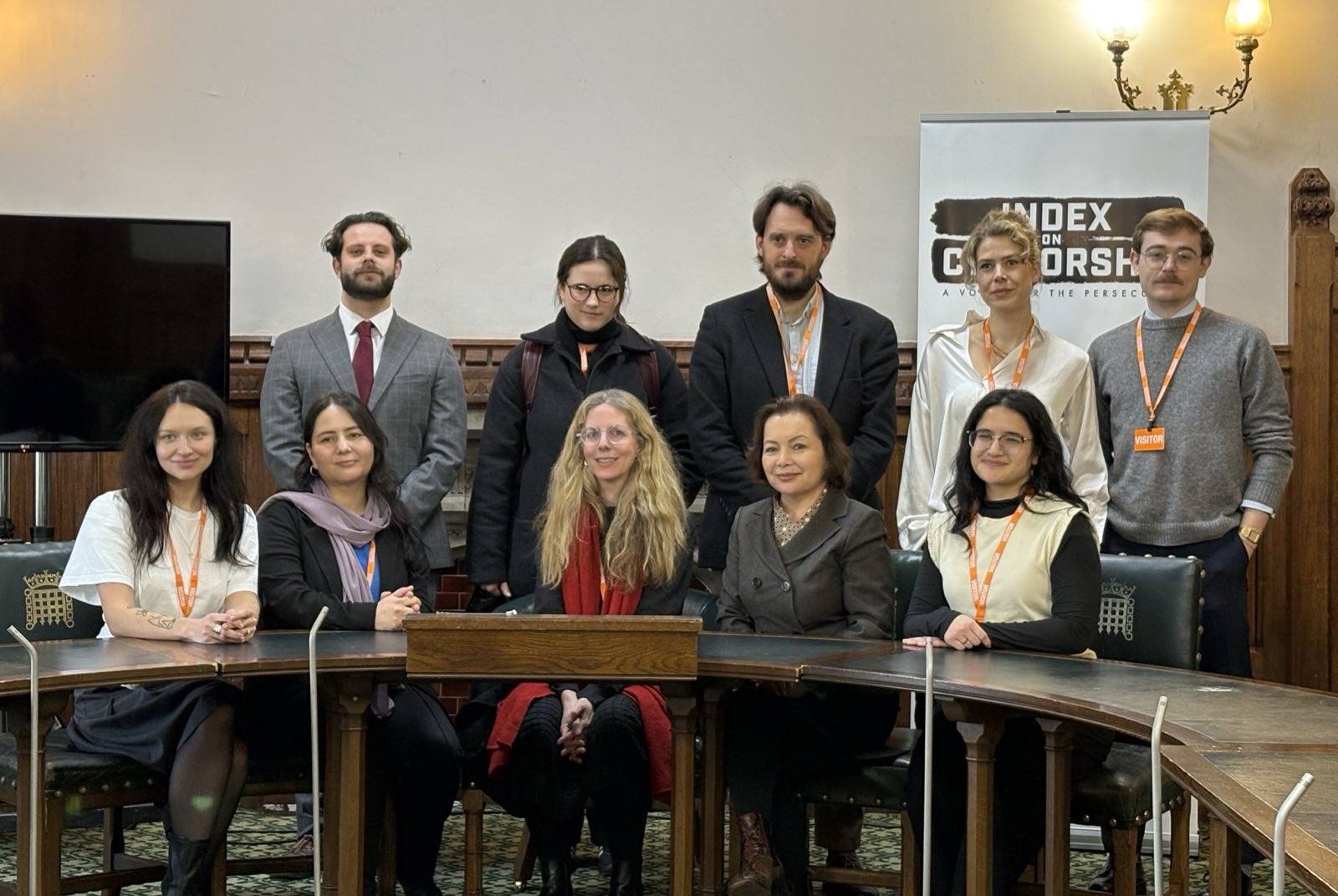
To mark World Privacy Day this year (28 January 2026), Index on Censorship invited extraordinary human rights activists to share their experiences of the importance of encrypted apps at an event sponsored by former cabinet minister Louise Haigh MP. A number of members of parliament took part in the discussion. Among the speakers were Uyghur activist Rahima Mahmut and ex-Pussy Riot member Olga Borisova. They both told us why encryption is not a nice-to-have. It is essential to their lives and work.
End-to-end encryption has been designated a risk factor by Ofcom as part of their role in implementing the Online Safety Act. This means pressure could seriously mount to create a “backdoor” to the apps that have encryption as their central feature. This would be a disaster for our privacy and one we won’t stand for. We’ve written about the many reasons this is a terrible path to walk here. And so long as the future of encryption remains precarious in the UK, we will continue to make noise. As these women told us powerfully at the event, there is so much at stake if end-to-end encryption is broken.
Below we share the speeches delivered by Mahmut and Borisova. Both act as powerful reminders of the extreme costs incurred when privacy is laid to waste.
Rahima Mahmut, Uyghur human rights activist and director of Stop Uyghur Genocide
As a Uyghur, when I hear the words “online safety” I do not hear reassurance.
I hear a warning.
I come from a community where the language of “safety” was used to justify one of the most extensive systems of digital surveillance the world has ever seen. In China, the government claimed it was keeping people safe, while it monitored every message, every contact, every digital footprint of Uyghur lives. People disappeared not because they committed crimes, but because of what they searched, shared or said online.
That is why I am deeply concerned by the Online Safety Act.
I understand its intention. Protecting children and preventing harm matters. But intention is not enough. We must look at how power operates once it is written into law.
When governments pressure platforms to remove vaguely defined “harmful” content, the result is not safety – it is pre-emptive censorship. Platforms will always choose caution over justice. They will silence first and ask questions later.
For Uyghurs in exile, digital platforms are not a luxury. They are our lifeline.
They are how we document atrocities, speak to journalists, warn the world and preserve our culture.
When content is removed, when accounts are suspended, when voices are quietly buried by algorithms, the cost is not abstract. It is human.
I have seen where this road leads. In China, online control did not stop at content moderation. It led to mass surveillance, collective punishment and genocide.
The UK must not – even unintentionally – normalise the logic that safety requires less freedom, less privacy and more state control.
True online safety does not come from expanding surveillance powers. It comes from protecting rights, enforcing transparency and defending the most vulnerable voices – not silencing them.
As someone who has lived the consequences of digital authoritarianism, I urge you: do not build a system that future governments could abuse. Do not trade freedom for a false sense of security. Because once lost, our voices are very hard to recover.
Olga Borisova, former member of Pussy Riot and Russian human rights activist
For people like me, online safety is not an abstract concept. It is directly connected to physical safety and survival.
I now live in the UK, but my work and many of the people I communicate with are still connected to Russia and Belarus – countries where surveillance is routine and political repression is part of everyday life.
I have been sentenced in absentia to eight years in prison in Russia for my anti-war stance and support for Ukraine. I am on a federal wanted list and cannot travel to half of the countries in the world. Because of this, I have no choice but to think carefully about the security of my communications every single day.
For activists, journalists and human rights defenders, encrypted communication is not about hiding, it is about preventing state surveillance. It is about making sure that conversations cannot be intercepted, taken out of context or used as evidence.
One of the tools I rely on in my work is Signal. I use it precisely because neither the company nor any government can read the messages. That is the whole point of the technology.
Signal helps Russian human rights workers and other people to flee persecution in Russia and avoid being sent to the war.
Russia already banned calls in WhatsApp and Telegram. And sending information from Russia abroad can be considered a high treason.
Signal is just an example, but it is considered the most secure way to communicate.
In fact, encryption helps save lives. Encryption helps provide the truth.
If the Online Safety Act forces companies to scan private messages or weaken encryption, services like Signal may simply stop operating in the UK. If that happens, the impact will be very real. Human rights defenders based here will lose one of the few secure ways they have to communicate with people living under authoritarian surveillance.
The UK is home to many exiled activists and journalists like me. If secure tools disappear here, the UK becomes a less safe place to do human rights work, not by intention, but by technical design.
There is also a security issue. Russia actively uses cyber operations and state-linked hackers as part of hybrid warfare, and the UK itself has been a target. Weakening encryption does not make societies safer, it creates vulnerabilities that hostile actors know how to exploit.
I recognise that serious crimes, including child sexual exploitation, do take place in private and encrypted messaging spaces. But the evidence also shows that these crimes are addressed through targeted investigations, intelligence-led operations and lawful hacking, not through blanket access to everyone’s private communications.
That is why I believe the Online Safety Act should be amended to draw a clear and explicit line: end-to-end encrypted private messaging must not be subject to scanning requirements or technical backdoors. Instead, the focus should remain on proportionate, targeted enforcement against suspects, while preserving strong encryption as a core part of public safety, digital resilience and democratic infrastructure.
This approach protects children and the public without exposing journalists, activists, victims of abuse and people targeted by hostile states to new and irreversible risks.