Winner of the 2019 Index on Censorship Freedom of Expression Journalism Award, the Berlin-based Cameroonian journalist Mimi Mefo was one of less than a handful of reporters working without fear or favour in Cameroon’s climate of repression and self-censorship. An award-winning broadcast journalist at private media house Equinoxe TV and Radio, Mefo was arrested in November 2018 after she published reports that the military was behind the death of an American missionary in the country. Mefo reports on the escalating violence in the country’s western regions, a conflict that has become known as the “Anglophone Crisis” and is a leading voice in exposing the harassment of other Cameroonian journalists, calling publicly for the release of those jailed.
Mefo now works for Deutsche Welle. In October 2019, she was denied a visa to enter Australia where she was due to visit a press freedom conference.
We caught up with Mefo to find out what she has been working on since winning the award in April and how being part of the Index on Censorship Freedom of Expression Awards Fellowship has helped with this work.[/vc_column_text][/vc_column][/vc_row][vc_row][vc_column][vc_basic_grid post_type=”post” max_items=”4″ element_width=”6″ grid_id=”vc_gid:1571926428871-f3c44e41-b5e4-10″ taxonomies=”9015″][/vc_column][/vc_row]
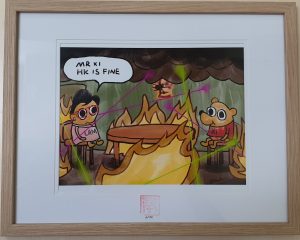
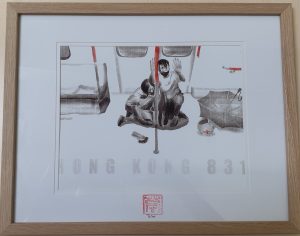
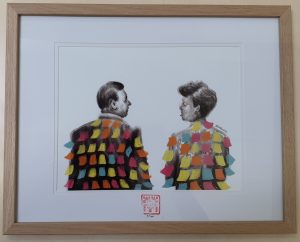
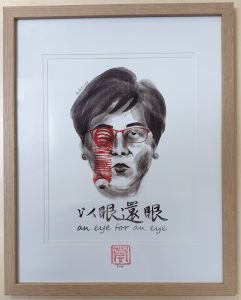
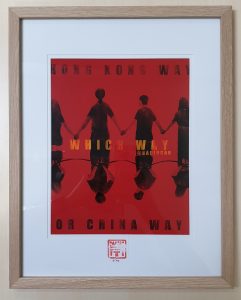
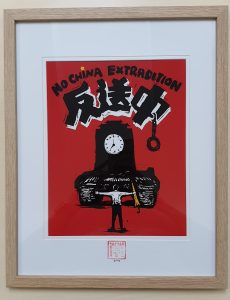
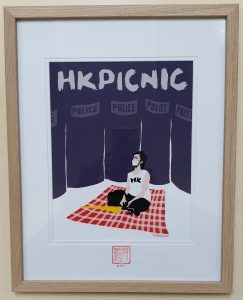
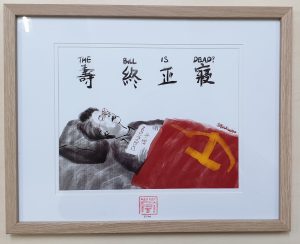
[vc_row][vc_column][vc_column_text]Badiucao is a Chinese cartoonist whose provocative work has made him persona non grata with the Chinese government. As a result, he currently lives in exile in Australia, although that distance has not stopped him being the target of Chinese authorities.
His bold artwork homes in on the areas the Chinese government would rather not talk about. Tiananmen for example, alongside critical work on the current leader Xi Jinping. And his life is now the subject of a recently released documentary by filmmaker Danny Ben-Moshe, China’s Artful Dissident, which charts the road to an exhibition of his work in Hong Kong. Click here to read about our private screening of the film and our Q&A with Badiucao.
You can help support the artist and free speech more widely by purchasing your own exclusive Badiucao print. All proceeds will go to the artist. If you are interested in purchasing any of the pieces below, please email [email protected]
[vc_row][vc_column][vc_single_image image=”110170″ img_size=”full” add_caption=”yes”][vc_column_text]“Every Hong Kong protester is my biggest inspiration. You guys think I am brave? Those young kids, 16 and 17 years old, are risking their lives at every protest. They are the people who inspire me, they are the people who motivate me to do more work to share their story with you guys.” These words, from the Chinese dissident artist known as Badiucao, were met with rapturous applause from the audience at the private screening of the new documentary about his life, China’s Artful Dissident.
The invitation-only screening was held at the Tate Exchange and hosted by Index On Censorship. Badiucao, who until recently had kept his identity a secret in an attempt to protect himself and his family from the Chinese government, was present, alongside the filmmaker Danny Ben-Moshe.
The film cannot fail to move and inspire. It documents Badiucao’s move into political activism after watching a documentary about the Tiananmen Square massacre, the details and death toll of which the Chinese government has done its best to suppress, and his move to Australia in 2009 to escape the censorship and artistic oppression in China.
The last part of the documentary shows the lead up to an exhibition of Badiucao’s work in Hong Kong. It ends on a heartbreaking note when the exhibition is cancelled following threats to Badiucao’s family in China. This was the reason Badiucao revealed his identity; it became clear that the Chinese government had already discovered it.
The screening was followed by a Q&A with Badiucao and Ben-Moshe, chaired by Martin Rowson, the political cartoonist and regular contributor to Index on Censorship magazine. Responding to a question about his safety in Australia, Badiucao described it as “a problematic country” and that he may have been naive to think he could entirely escape the influence of Beijing.
“Australia can be an example of how China is projecting its threat all over the world,” he said.
Addressing current counter-protests from the Chinese diaspora specifically, Badiucao said:
“You have to remember that when we grow up in China, we grow up with an entire machine of propaganda, it will take a very long time for people to walk out of this shadow.”
He expressed concern that people may view the Chinese population, the counter-protesters in particular, as brainwashed, aggressive nationalists who don’t deserve democracy.
“As a consequence, the far right will rise, xenophobia will rise, discrimination will rise, racism against China will rise. Ultimately this solution will not solve the problem, it just pushes the Chinese back to Beijing.”
Badiucao’s career goal, he explained, is to destroy censorship using art. He said: “I’m very proud and honoured that my work is recognised and used by the Hong Kong protesters.” He also said that his art is a way to record history to act as counterpoint to the Chinese government, who rewrite history.
Badiucao is now living in Australia and having revealed his identity, he is followed, sees strange cars outside his home and receives daily threats via social media. He made light of those that daily detract him.
“We call them 50 cent, because when they send me a death threat, they get 50 cent deposited into their bank accounts,” he said of China’s infamous trolls.
All of this is the price he pays for simply expressing himself through his art.
Click here to read more about Badiucao and to see an exclusive cartoon of his in the new magazine[/vc_column_text][/vc_column][/vc_row][vc_row][vc_column][/vc_column][/vc_row]
The recent AFP raids in Australia highlighted that challenges to media freedom are not limited to authoritarian countries.
It has been reported that since 9/11, Australia has seen the introduction or amendment of more than 75 sets of legislation, many of which may impinge on press freedom. Simultaneously, the debate about journalist and whistleblower protection laws has gained momentum.
But where does the security issue fit into this? While a successful democracy is characterised by a free press, it remains true that there are often good reasons for secrecy and confidentiality. How can we reconcile the conflicting perspectives of press freedom and security?
As part of the Integrity 20 conference, Index chief executive and 2019 Freedom of Expression Award winner Mimi Mefo join a panel of experts to discuss challenges to media freedom worldwide.[/vc_column_text][/vc_column][/vc_row][vc_row][vc_column][vc_column_text]
When: Friday 25 October, 12.15pm
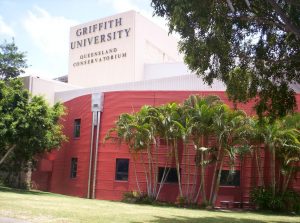
Where: Conservatorium Theatre, South Bank Brisbane Tickets: AUS $153