17 Dec 2018 | Magazine, News, Volume 47.04 Winter 2018
[vc_row][vc_column][vc_custom_heading text=”Vital moments during our lifetimes are complicated by taboos about what we can and can’t talk about, and we end up making the wrong decisions just because we don’t get the full picture, says Rachael Jolley in the winter 2018 issue of Index on Censorship magazine” google_fonts=”font_family:Libre%20Baskerville%3Aregular%2Citalic%2C700|font_style:400%20italic%3A400%3Aitalic”][vc_column_text]
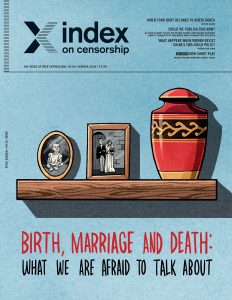
Birth, Marriage and Death, the winter 2018 issue of Index on Censorship magazine.
Birth, marriage and death–these are key staging posts. And that’s one reason why this issue looks at how taboos around these subjects have a critical impact on our world.
Sadly, there are still many of us who feel we can’t talk about problems openly at these times. Societal pressure to conform can be a powerful element in this and can help to create stultifying silences that frighten us into not being able to speak.
Being unable to discuss something that has a major and often complex impact on you or your family can lead to ignorance, fear and terrible decisions.
Not knowing about information or medical advice can also mean exposing people to illness and even death.
The Australian Museum sees death as the last taboo, but it also traces where those ideas have come from and how we are sometimes more shy to talk about subjects now than we were in the past.
The Sydney-based museum’s research considers how different cultures have disposed of the dead throughout history and where the concepts of cemeteries and burials have come from.
For instance, in Ancient Rome, only those of very high status were buried within the city walls, while the Ancient Greeks buried their dead within their homes.
The word “cemetery” derives from the Greek and Roman words for “sleeping chamber”, according to the Australian Museum, which suggests that although cremation was used by the Romans, it fell out of favour in western Europe for many centuries, partly because those of the Christian faith felt that setting fire to a body might interfere with chances of an afterlife.
Taboos about death continue to restrict speech (and actions) all around the world. In a six-part series on Chinese attitudes to death, the online magazine Sixth Tone revealed how, in China, people will pay extra not to have the number “4” in their mobile telephone number because the word sounds like the Mandarin word for “death”.
It also explores why Chinese families don’t talk about death and funerals, or even write wills.
In Britain, research by the charity Macmillan Cancer Support found just over a third of the people they surveyed had thoughts or feelings about death that they hadn’t shared with anyone. Fears about death concerned 84% of respondents, and one in seven people surveyed opted out of answering the questions about death.
These taboos, especially around death and illness, can stop people asking for help or finding support in times of crisis.
Mental health campaigner Alastair Campbell wrote in our winter 2015 issue that when he was growing up, no one ever spoke about cancer or admitted to having it.
It felt like it would bring shame to any family that admitted having it, he remembered. Campbell said that he felt times had moved on and that in Britain, where he lives, there was more openness about cancer these days, although people still struggle to talk about mental health.
Hospice director Elise Hoadley tells one of our writers, Tracey Bagshaw, for her article on the rise of death cafes (p14), that British people used to be better at talking about death because they saw it up close and personal. For instance, during the Victorian period it would be far more typical to have an open coffin in a home, where family or friends could visit the dead person before a funeral. And vicar Laura Baker says of 2018: “When someone dies we are all at sea. We don’t know what to do.”
In a powerful piece for this issue (p8), Moscow-based journalist Daria Litvinova reports on a campaigning movement in Russia to expose obstetric abuse, with hundreds of women’s stories being published. One obstacle to get these stories out is that Russian women are not expected to talk about the troubles they encounter during childbirth. As one interviewee tells Litvinova: “And generally, giving birth, just like anything else related to women’s physiology, is a taboo subject.” Russian maternity hospitals remain institutions where women often feel isolated, and some do not even allow relatives to visit. “We either talk about the beauty of a woman’s body or don’t talk about it at all,” said one Russian.
Elsewhere, Asian-American women talk to US editor Jan Fox (p27) about why they are afraid to speak to their parents and families about anything to do with sex; how they don’t admit to having partners; and how they worry that the climate of fear will get worse with new legislation being introduced in the USA.
As we go to press, not only are there moves to introduce a “gag rule” – which would mean removing funding from clinics that either discuss or offer abortion – but in the state of Ohio, lawmakers are discussing House Bill 565, which would make abortions illegal even if pregnancies arise from rape or incest or which risk the life of the mother. These new laws are likely to make women more worried than before about talking to professionals about abortion or contraception.
Don’t miss our special investigation from Honduras, where the bodies of young people are being discovered on a regular basis but their killers are not being convicted. Index’s 2018 journalism fellow Wendy Funes reports on p24.
We also look at the taboos around birth and marriage in other parts of the world. Wana Udobang reports from Nigeria (p45), where obstetrician Abosede Lewu tells her how the stigma around Caesarean births still exists in Nigeria, and how some women try to pretend they don’t happen — even if they have had the operation themselves. “In our environment, having a C-section is still seen as a form of weakness due to the combination of religion and culture.”
Meanwhile, there’s a fascinating piece from China about how its new two-child policy means women are being pressurised to have more children, even if they don’t want them — a great irony when, only a decade ago, if women had a second child they had to pay.
[/vc_column_text][vc_row_inner][vc_column_inner width=”1/4″][vc_icon icon_fontawesome=”fa fa-quote-left” color=”custom” size=”xl” align=”right” custom_color=”#dd3333″][/vc_column_inner][vc_column_inner width=”3/4″][vc_custom_heading text=”Taboos, especially around death and illness, can stop people asking for help or finding support in times of crisis” font_container=”tag:h3|text_align:left” google_fonts=”font_family:Libre%20Baskerville%3Aregular%2Citalic%2C700|font_style:400%20italic%3A400%3Aitalic”][/vc_column_inner][/vc_row_inner][vc_column_text]
In other matters, I have just returned from the annual Eurozine conference of cultural journals, this year held in Vienna. It was interesting to hear about a study into the role of this specific type of publication. Research carried out by Stefan Baack, Tamara Witschge and Tamilla Ziyatdinova at the University of Groningen, in the Netherlands, is looking at what long-form cultural journalism does and what it achieves.
The research is continuing, but the first part of the research has shown that this style of magazine or journal stimulates creative communities of artists and authors, as well as creating debates and exchanges across different fields of knowledge. Witschge, presenting the research to the assembled editors, said these publications (often published quarterly) have developed a special niche that exists between the news media and academic publishing, allowing them to cover issues in more depth than other media, with elements of reflection.
She added that in some countries cultural journals were also compensating for the “shortcomings and limitations of other media genres”. Ziyatdinova also spoke of the myth of the “short attention span”.
At a time when editors and analysts continue to debate the future of periodicals in various forms, this study was heartening. It suggests that there still is an audience for what they describe as “cultural journals” such as ours – magazines that are produced on a regular, but not daily basis which aim to analyse as well as report what is going on around the world. Lionel Barber, the editor of the Financial Times newspaper, spoke of his vision of the media’s future at the James Cameron Memorial Lecture at London’s City University in November. As well as arguing that algorithms were not going to take over, he said he was convinced that print had a future. He said: “I still believe in the value and future of print: the smart, edited snapshot of the news, with intelligent analysis and authoritative commentary.”
His belief in magazines as an item that will continue to be in demand, if they offer something different from something readers have already consumed, was made clear: “Magazines, which also count as print – are they going to just disappear? No. Look at The Spectator, look at the sales of Private Eye.”
The vibrancy of the magazine world was also clear at this year’s British Society of Magazine Editors awards in London, with hundreds of titles represented. Jeremy Leslie, the owner of the wonderful Magculture shop in London (which stocks Index on Censorship) received a special award for his commitment to print. This innovative shop stocks only magazines, not books, and has carved out a niche for itself close to London’s City University. Well done to Jeremy. Index was also shortlisted for the specialist editor of the year award, so we are celebrating as well.
We hope you will continue to show your commitment to this particular magazine, in print or in our beautiful digital version, and think of buying gift subscriptions for your friends at this holiday time (check out https://shop.exacteditions.com/index-on-censorship for a digital subscription from anywhere in the world). We appreciate your support this year, and every year, and may you have a happy 2019.
[/vc_column_text][/vc_column][/vc_row][vc_row][vc_column][vc_column_text]
Rachael Jolley is editor of Index on Censorship. She tweets @londoninsider. This article is part of the latest edition of Index on Censorship magazine, with its special report on Birth, Marriage and Death.
Index on Censorship’s winter 2018 issue is Birth, Marriage and Death, What are we afraid to talk about? We explore these taboos in the issue.
Look out for the new edition in bookshops, and don’t miss our Index on Censorship podcast, with special guests, on Soundcloud.
[/vc_column_text][/vc_column][/vc_row][vc_row][vc_column width=”1/3″][vc_custom_heading text=”Birth, Marriage and Death” font_container=”tag:h3|text_align:left” link=”url:https%3A%2F%2Fwww.indexoncensorship.org%2F2018%2F12%2Fbirth-marriage-death%2F|||”][vc_column_text]The winter 2018 issue of Index on Censorship magazine explores taboos surrounding birth, marriage and death. What are we afraid to talk about?
With: Liwaa Yazji, Karoline Kan, Jieun Baek[/vc_column_text][/vc_column][vc_column width=”1/3″][vc_row_inner][vc_column_inner][vc_single_image image=”104225″ img_size=”full” onclick=”custom_link” link=”https://www.indexoncensorship.org/2018/12/birth-marriage-death/”][/vc_column_inner][/vc_row_inner][/vc_column][vc_column width=”1/3″][vc_custom_heading text=”Subscribe” font_container=”tag:h3|text_align:left”][vc_row_inner][vc_column_inner][vc_column_text]In print, online. In your mailbox, on your iPad.
Subscription options from £18 or just £1.49 in the App Store for a digital issue.
Every subscriber helps support Index on Censorship’s projects around the world.
 SUBSCRIBE NOW[/vc_column_text][/vc_column_inner][/vc_row_inner][/vc_column][/vc_row]
11 Oct 2018 | Artistic Freedom, News, Risks, Rights and Reputations
[vc_row][vc_column][vc_single_image image=”97076″ img_size=”full” add_caption=”yes”][vc_column_text]Agnieszka Kolek is curator and co-founder of Passion for Freedom, an annual competition exhibition of by artists facing censorship worldwide. In February 2015, Kolek survived the terrorist attack in Copenhagen, targeting the panel discussion she appeared in alongside Swedish artist Lars Vilks. Later that year in London, the Passion for Freedom 2015 exhibition at Mall Galleries, London, hit the headlines when a work Isis Threaten Sylvania by Mimsy was removed by the curators on the advice of the police. They had no choice because they couldn’t pay the £36,000 demanded by the police to guarantee security of the exhibition.
JF: How does your experience of the Danish police compare to the British police?
AK: The panel discussion — Art, Blasphemy and Freedom of Speech — was organised by the Lars Vilks Committee with the full support of the police. This was only a month after the Charlie Hebdo attack, but there was no question that the discussion should go ahead. There were two plain-clothed police officers, two uniformed police and then two special service officers responsible for Lars, who has 24-hour police protection. Police checked bags as the audience came in. When the attack happened — the Danish filmmaker Finn Nørgaard, one of the guests, was shot outside the venue and died on the pavement — the two special service officers took Lars to safety. We know that after an attack on freedom of speech the next target is Jews – it happened with Charlie Hebdo and it happened in Copenhagen when the same gunman attacked a bat mitzvah party in the evening, killing the security guard. Danes feel very bad that they didn’t anticipate this pattern and there was a lot of blaming of the police for this, but they did their best considering the circumstances. I think there has to be more legal power give to the police to extinguish the sources of the extremism, and its results. When you already have flames it is harder to put it, instead you have to prevent the fire from starting.
In London in 2015 it was very different. The police wanted to determine what artworks could go on show, and even the artistic value of exhibited works, showing an indirect form of censorship claiming it was “for your own good – security”. Police intelligence identified “serious concerns” regarding the “potentially inflammatory content” of Mimsy’s work and for this reason “advised” us to remove the work or pay protection money at £6,000 a day. We were completely shocked. Out of all the works in the exhibition, we would never have thought that they would pick this one out. We asked for more information about the “serious concerns”, especially because we wanted to know if there was a threat to Mimsy herself. They didn’t give us any more information. They wanted to place blame on the festival or its artists for causing problems, rather than protecting the space for art to show the suffering of people around the world and the lack of freedom to openly discuss it. While we tried to fundraise for our own protection, we were threatened with more works being withdrawn. Art cannot be controlled by the police – not in London, which for hundreds of years is a symbol of democracy and freedom. Not in the creative capital of Europe where artists flock from all over the world.
JF: But in Copenhagen two people lost their lives – you could have lost yours. How do you reconcile the loss of life with the pursuit of freedom?
AK: It is not easy to answer as I am not treating others’ and my own life lightly. Behind each individual there is a unique person, unique life story and to cut it short for the supposedly abstract ideal of free speech and expression might seem reckless. It is not. Again and again we learn how giving concessions to those who want to restrict freedoms of speech allows the darkness not only to enter our home but also our hearts. Not resisting it at early stages causes our societies to change beyond recognition.
I was invited to the Copenhagen event way ahead, so after the Charlie Hebdo attack, the chair got in touch with me to say she would understand in view of the heightened security risk, if I chose not to come. So I thought long and hard about it and said I will have to die someday, and I know I will look back at that this moment and I will remember the choice I made and it will be important.
Passion for Freedom is a very effective tool for assessing how much freedom there is in society. Artists cannot be easily controlled. In their inner core they are idealists. We stand with them giving them space and time to express themselves. Freedom will prevail despite political and corporate pressure to censor and restrict open debate. We are its guardians.
JF: How have the experiences of 2015 impacted on how you approach this year’s exhibition?
AK: The commitment and the conviction are still there. But we are not clear where we stand, because there is no clear definition of what is appropriate or what is inflammatory. It is a shifting ground. In the past, we created the space to fully exhibit work that had been censored elsewhere by a curator or a gallery owner. Now we are in the situation where the state, through the arm of the police, imposes this pre-emptive self-censorship on you. Since the censorship incident, we cannot guarantee artists that they will be able to exhibit/perform during a festival talking about freedom. Over the years there has been a number of artists who requested to be exhibited under pseudonyms (as often their lives are threatened in the UK or back in their home countries). Can we guarantee that the police will not arrest them? Until now, we could guarantee it to them. Since 2015 we are not sure that is the case. My approach is not to have any preconceived idea of how it will go with the police this time. We will still try to be open and have a dialogue in the belief that the police are still there to protect us and it is still a democratic country. I will be honest – we are also treating it as a kind of testing ground. Let’s see if this is still a democratic country or is it just on paper?
The artistic community in the United States and Australia is shocked by the police’s censorious attitude to arts in London. There are groups of people who decided to open Passion for Freedom branch offices in New York and Sydney to ensure that British censorship is being exposed. And in case freedom is completely extinguished in the UK they can continue the important work to give artists the platform to exhibit their works and debate important issues in our societies. And if we discover that there is even less freedom than in 2015, we are considering moving this exhibition to Poland because there is more freedom there. This is on the cards, we are already discussing it.
JF: Do you think Passion for Freedom exhibition represents a security risk?
AK: The way it is being framed in the media it looks like we are troublemakers and we are asking for it. I see it another way – we are representing the majority of society that wants to ask questions, to solve problems and to move forward together. Instead of giving in to a minority that wants to use violence and threats as a way to push forward their own agenda. I think it is in the interests of any society to make sure there is the space for difficult conversations because it moves away from creating the situation where the only way to solve problems is violence. You need to allow people to have this space and art is a wonderful tool to do that, without falling for propaganda, or just favouring one way of looking at things over another. Here you can have different voices, at different volumes, and different issues at play.
JF: The 2015 terror attack in Copenhagen targeted Swedish artist Lars Vilks and those who support him. Why do you think it is important for an artist to be free to deliberately insult and offend people’s religious beliefs?
AK: The world is a much more complex place than the newspaper headlines would like us to believe. Lars Vilks was invited to participate in an art exhibition on the theme “The Dog in Art” that was to be held in the small town of Tällerud in Värmland. Vilks submitted three pen and ink drawings on A4 paper depicting Muhammad as a roundabout dog. At this time, Vilks was already participating with drawings of Muhammad in another exhibition in Vestfossen, Norway, on the theme “Oh, My God”. Vilks has stated that his original intention with the drawings was to “examine the political correctness within the boundaries of the art community”. It is not a secret that Sweden is known for vehemently criticising the United States and Israel, whereas political Islam and its influence on non-Muslim communities are rarely questioned.
Artists practising various forms of art, whether poetry, drama, drawing or film, have been challenging those who hold power for millennia.
Few kings, warlords or dictators allowed criticism or satire of themselves. The blasphemy laws were in place not to protect God but those who claimed to be his only representatives on earth. Nowadays, the same seems to be disguised in the cloak of hurt feelings and delicate egos. Artists are idealistic visionaries. They cannot hold themselves back pretending that they are blind to what is in front of their eyes. Lack of open discussion stifles our development as societies. Fear of reprisal and death cripples the human spirit. Those who cower under the whip hoping to appease and remove the threat are actually risking the fate of a slave and subordinating to dehumanised serfdom their true nature – that of a free man.
JF: Why do you have this passion for freedom?
AK: Behind the Iron Curtain we naively believed that not only was the West this Land of Milk and Honey of material goods, we were also certain that there was freedom here, that people would value and protect it. So moving here, first you discover that everything is not so perfect materially, but then the bigger eye-opener is that there is always someone who wants to take freedom away and if you don’t stand up tall in society this threat is always present. I don’t think you can continue just exercising freedom of speech without appreciating what it has brought to us over the long years when previous generations were fighting for it, and though it is not ideal, the state we are in is much better than it used to be.[/vc_column_text][vc_row_inner][vc_column_inner width=”1/4″][vc_single_image image=”103159″ img_size=”full”][/vc_column_inner][vc_column_inner width=”3/4″][vc_column_text]
Passion for Freedom Art Festival
10th-anniversary edition, 1 – 12 October 2018, London
The Royal Opera Arcade Gallery & La Galleria Pall Mall
Royal Opera Arcade, 5b Pall Mall, London SW1Y 4UY
The 10th-anniversary edition of internationally renowned Passion for Freedom Art Festival will open in London on 1 – 12 October 2018 at its new location – the Royal Opera Arcade Gallery & La Galleria Pall Mall. The exhibition showcases uncensored art from around the world, promoting human rights, highlighting injustice and celebrating artistic freedom.
Passion for Freedom was founded in 2008 and over the past ten years grew into an international network of artists, journalists, filmmakers and activists striving to celebrate and protect freedom of expression. We have displayed more than 600 artworks from 55 countries, including China, Iran and Venezuela.
The competition attracts much worldwide attention. This year, we received more than 200 submissions out of which we will exhibit over 50 shortlisted artists. From Venezuela to Turkey to the United Kingdom, those artists ceaselessly expose the restraints on freedom of speech, expression, and information in their countries. Altogether, we will display 100 such artworks during the festival. Passion for Freedom covers painting, photography, sculpture, performance, video, as well as authors, filmmakers and journalists.
Competitors will be judged by a prestigious selection panel. Winners will be announced on the 6th of October at the Gala Award Night.
This year’s judges are:
Andrew Stahl (United Kingdom)
Francisco Laranjo (Portugal)
Gary Hill (USA)
Lee Weinberg, PhD (Israel)
Mehdi-Georges Lahlou (Belgium)
Miriam Elia (United Kingdom)
Mychael Barratt PRE (Canada/United Kingdom)
This year we are thrilled to announce a Special Theo Van Gogh Award awarded in honour of his courage and contributions to freedom of expression.
Furthermore, we have invited a select group of special guest artists to display their latest works.
Passion for Freedom 2018 Guest Artists are:
Agata Strzalka (Poland)
Andreea Medar (Romania)
Emma Elliott (United Kingdom)
Jana Zimova (Czech Republic/Germany)
Mimsy (United Kingdom)
Öncü Hrant Gültekin (Turkey/Germany)
Oscar Olivares (Venezuela)
[/vc_column_text][/vc_column_inner][/vc_row_inner][/vc_column][/vc_row][vc_row][vc_column][vc_basic_grid post_type=”post” max_items=”12″ style=”load-more” items_per_page=”4″ element_width=”6″ grid_id=”vc_gid:1539249597657-189331c4-e1af-0″ taxonomies=”15471, 8884″][/vc_column][/vc_row]
17 Aug 2018 | Events
[vc_row][vc_column][vc_column_text]
Whether we are talking politics or something as benign as which way to hang the toilet roll, we are increasingly intolerant of those views with which we disagree. Our views are laced with moral judgement, our language inflammatory, and our argument delivered with the intent to win rather than understand or find common ground. Alternative, uncomfortable or ‘politically inconvenient’ ideas are silenced and we find refuge in our political, social and cultural bubbles. ‘Feel free to unfriend me if you disagree’.
How do we re-learn how to listen with an open mind and make contributions with respect, logic, and clarity? How do we prioritize and ensure greater commitment to truth and fact over opinion and restore civility to public and political debate?
[/vc_column_text][vc_custom_heading text=”Speakers” font_container=”tag:h3|text_align:left” use_theme_fonts=”yes”][/vc_column][/vc_row][vc_row][vc_column width=”1/4″][vc_single_image image=”102254″ img_size=”full” add_caption=”yes”][/vc_column][vc_column width=”1/4″][vc_single_image image=”102252″ img_size=”full” add_caption=”yes”][/vc_column][vc_column width=”1/4″][vc_single_image image=”102253″ img_size=”full” add_caption=”yes”][/vc_column][vc_column width=”1/4″][vc_single_image image=”102251″ img_size=”full” add_caption=”yes”][/vc_column][/vc_row][vc_row][vc_column][vc_column_text]This event is part of Integrity 20, which gathers remarkable people from Australia and around the world to examine and discuss some of our greatest social, moral and political challenges.[/vc_column_text][/vc_column][/vc_row][vc_row][vc_column][vc_column_text]
When: 26 October 2018
Where: Integrity 20, South Bank, Brisbane, Australia
Tickets: Via Integrity 20 website
[/vc_column_text][/vc_column][/vc_row]
18 Jun 2018 | News
[vc_row][vc_column][vc_column_text]By Nicole Ntim-Addae and Long Dang. With additional reporting by Shreya Parjan and Sandra Oseifri.[/vc_column_text][vc_single_image image=”100888″ img_size=”full” add_caption=”yes”][vc_column_text]“What do we do next? We are losing our point of reference. The loss of the United States and the United Kingdom as democratic beacons for the rights of journalists and the freedom of information is a bad omen for the rest of the world.”
The question was raised by Javier Garza of Article 19, a British human rights organisation, at the discussion about the growing threats to press freedom in the United States that took place at the Free Word Centre on Thursday 14 June. The panel was held to explore the findings of the unprecedented mission to the USA undertaken by six press freedom groups — Index on Censorship, Article 19, Committee to Protect Journalists, IFEX, International Press Institute, and Reporters Without Borders—in January 2018. Representatives of the groups conducted interviews with journalists in St. Louis, Missouri, Houston, Texas, and Washington DC. Their findings were published in a mission report in May 2018.
Jodie Ginsberg, CEO of Index on Censorship, stated the motivation behind the mission. “It is unusual for press freedom organisations to take a mission to the US”, she said. “According to the findings of the mission, violations of freedom of press and freedom of information may be closer to home.” The mission was carried out in recognition that discussions regarding press freedom are taken for granted in democracies in a way that they are not in authoritarian states.
At the same time, Trump’s hostile rhetoric directed against the US press is problematic for press worldwide. Rebecca Vincent, UK bureau director of Reporters Without Borders, noted that the Trumpian denunciation of the press as “fake news” and “enemies of the people” is gradually becoming a global phenomenon.
Vincent, Ginsberg, and Dave Banisar, senior legal counsel of Article 19 were moderated by Paddy Coulter, director of communications at Oxford Poverty & Human Development Initiative and member of the Article 19 board, to review the mission.
According to the US Press Freedom Tracker, there were 34 arrests of journalists made by the authorities in 2017 alone. Along with that, there has been a noticeable uptick in border controls since 2017, with journalists being searched, forced to hand over their phones for inspection, and denied entry into the U.S. This kind of problematic border control renders it extremely difficult for journalists to travel for work. Moreover, the excessive phone screening not only poses a violation of journalists’ right to privacy, but also a risk to the safety of their sources.
“The US office [of RSF] now puts out a weekly violations report because there are so many of them” said Vincent. The UK is currently ranked 40th out of 180 countries in terms of press freedom, according to the 2018 World Press Freedom Index. The US is faring worse, ranking at 45th. Since the beginning of 2018 alone, two journalists have been arrested and 12 have been attacked. The panelists noted that these problems did not start with the Trump administration. “Don’t get complacent. The beautiful [Clinton-Bush-Obama] administration’s era when nothing went wrong hasn’t existed for a long time.” said Banisar.
Banisar explained how little protection there is for whistleblowers and their sources under the Espionage Act of 1917. It is important to note that the improper use of the act had started before the Trump administration: under the Obama administration, the act was used to prosecute more whistleblowers than ever before. Banisar highlighted the case of Reality Winner, the former NSA contractor who was incarcerated only a few days after she released information that the Russians had hacked the 2016 presidential election. Jen Robinson from Article 19, an Australian human rights lawyer and barrister with Doughty Street Chambers in London and advisor to Julian Assange WikiLeaks founder noted that Wikileaks’ 2010 investigation was unprecedented. Never before has the Espionage Act been used in a civil lawsuit as that would have set the stage for larger news agencies such as The New York Times.
How could we do better?
Ginsberg stressed the importance of “reverse education” – that is, showing people how to navigate the negative environments. Border stops, according to her, are “a deeply concerning intrusion on the confidentiality of a reporter’s sources”. Accordingly, when journalists travel to the US to work, they should be aware of the situation and take steps to protect themselves and their sources. In that vein, Index has provided a journalist tool kit drawing from the experience of journalists who have had to deal with problems first hand. It has also corroborated with the Missouri School of Journalism in Project Exile, which documents the experience of journalists forced to live in exile because of their work.
Vincent reaffirmed that the hostile rhetoric directed at journalists needs to stop, since “the line between hateful, hostile terms and violence against journalists is blurring”. Bainsar emphasized that legal changes needs to be made to facilitate the free flow of information. He also stated that the US government needs to strive to improve its laws on source protection, protection for whistleblowers and statutory rights. Banisar calls for the Espionage Act of 1917 to be “ceremonially buried”.
But it is not all doom and gloom. Ginsberg, pointing to the demonstrations taking place around the world, commented that there is “still a huge appetite to assemble freely”. Banisar reported that the influx of cash flow into organisations such as the ACLU and HRW shows citizens are aware that press freedom violations are not problems they want to see coming back. He also reminded the audience that the president could just serve four years, and there are rules and regulations that would keep him in check. Despite Trump’s adamant dismissal of climate change, 10,000 documents— obtained through the US’s landmark Freedom of Information Laws—from the Environmental Protect Agency were published in The New York Times this past week, demonstrating that there is still professionalism in the use of laws.
“There are still those with liberal values.” said Rebecca Vincent. “There is a younger generation of journalists who care about issues. It’s also about making people realize that this is not just the happening in the ‘world’. This is happening in our borders. We must stand up to our own standards.” [/vc_column_text][/vc_column][/vc_row][vc_row][vc_column][vc_basic_grid post_type=”post” max_items=”12″ style=”load-more” items_per_page=”4″ element_width=”6″ grid_id=”vc_gid:1529312741775-6402968b-d0c0-9″ taxonomies=”9044″][/vc_column][/vc_row]
