3 Feb 2015 | About Index, Bahrain, Campaigns, mobile, Statements
On 31 January 2015, Bahrain’s Ministry of the Interior revoked the citizenship of 72 individuals, including journalists, bloggers, and political and human rights activists, rendering many of them stateless – its latest attempt to crack down on those critical of the government.
“Bahrain is using citizenship, the most basic of human rights, as a weapon to intimidate and silence critical voices,” said Index CEO Jodie Ginsberg. “This latest violation of international human rights standards comes amid continuing attempts to suppress free expression in the country.”
The Ministry of Interior published a statement claiming that “each citizen of Bahrain has the responsibility to act in ways that do not harm the interests of the Kingdom.” Alongside spying, financing terrorism, participation in terrorist actions, the statement lists: “defaming the image of the regime, inciting against the regime and spreading false news to hinder the rules of the constitution;” “defaming brotherly countries” and “inciting and advocating regime change through illegal means” as justification for their decision.
Sayed Ahmed Alwadaei, Director of Advocacy for the Bahrain Institute for Human Rights and Democracy, and who is among those who had their citizenship revoked, said: “Bahrain has forcefully stifled, through both force and national law, any form of free expression through their vicious crackdown against free thinking. They have now turned to wiping out the only identity held by individuals exercising their rights to call for human rights and democratic reform; their virtue of being a Bahraini. The nature of belonging to a country since ones existence has now become another tool used by the government to strangle its critics with impunity.”
Ali Abdulemam is a human rights and online activist who also had his citizenship revoked. He said: “revoking the citizenship in Bahrain is used as a tool of punishment and instills fear. It sends a message to other activists and freedom fighters to stop their activities or they will face the same situation.”
Index on Censorship joins Americans for Democracy and Human Rights in Bahrain (ADHRB), the Bahrain Centre for Human Rights (BCHR) and the Bahrain Institute for Rights and Democracy (BIRD) in condemning the continued use of citizenship revocation by the Government of Bahrain as a reprisal against human rights activists, journalists and pro-democracy campaigners, and calls on international governments to ensure Bahrain meets its human rights obligations.
30 Jan 2015 | Bahrain, mobile, News
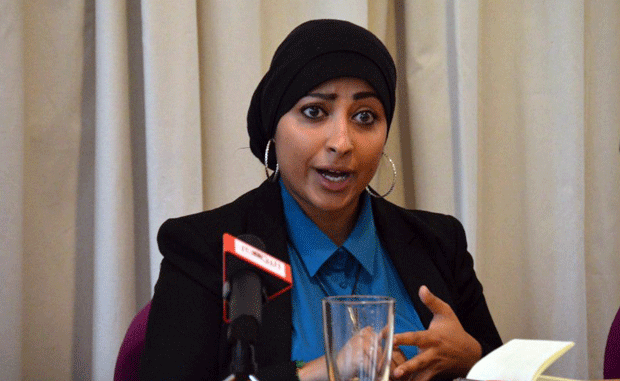
Maryam Al-Khawaja spoke out in October for the release of fellow human rights activist Nabeel Rajab. (Photo: David Coscia for Index on Censorship)
Nine people have been arrested in Bahrain for “misusing social media”, a charge which is punishable by a fine or up to two years in prison.
Human rights defender Nabeel Rajab was last week sentenced to six months in prison over a tweet he posted which was deemed insulting to public institutions. Rajab has been bailed, and tweeted on 21 January that he will appeal his conviction on 11 February.
Human Rights Watch has dedicated seven pages of its 25th annual report to Bahrain. The World Report 2015, released on Thursday, reviews the human rights situation in over 90 countries.
The report states that over 200 defendants have been sentenced to long stints in prison by the Bahraini courts on charges of national security or terrorism, with at least 70 of those being sentenced to life.
It says: “Bahrain’s courts convicted and imprisoned peaceful dissenters and failed to hold officials accountable for torture and other serious rights violations. The high rate of successful prosecutions on vague terrorism charges, imposition of long prison sentences, and failure to address the security forces’ use of lethal and apparently disproportionate force all reflected the weakness of the justice system and its lack of independence.”
In December, co-director of the Gulf Center for Human Rights (GCHR), Maryam Al-Khawaja, boycotted a court hearing which saw her sentenced to one year in prison. Al-Khawaja was charged with assaulting two policewomen last year when she traveled to Bahrain to visit her father Abdulhadi, who is currently serving a life sentence for his involvement in anti-government protests in 2011. In related news, the GCHR website was yesterday reportedly blocked in the United Arab Emirates.
Al-Khawaja’s sister Zainab was arrested in October on charges of insulting the king, and gave birth to her second child just a few days before being sentenced to three years in prison. She was then sentenced to an additional 16 months less than a week later, on separate charges of insulting a public official.
This article was published on 30 January 2015 at indexoncensorship.org
26 Jan 2015 | Events, mobile
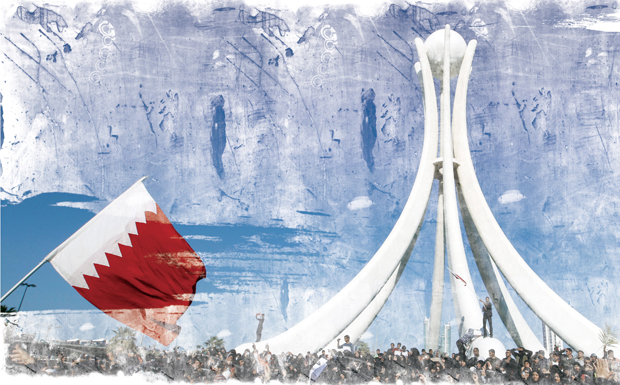
Lord Avebury, the Vice Chairman of the Parliamentary Human Rights Group cordially invites you to a press conference on:
Four years of revolution: Bahrainis insist on political change
Four years ago the people of Bahrain flocked to the streets in their thousands seeking fundamental political change after decades of discriminatory rule. They were repressed by the regime which adopted reprehensible tactics including systematic torture, extra-judicial killing, and the revocation of citizenships. The UK Government has chosen to stand by the regime, turning a blind eye to its rights abuses. It is time for the UK to change direction on Bahrain starting by designating it as a “country of concern” in line with the Foreign Affairs Committee recommendations.
WHERE: Fielden House, 13 Little College Street, London SW1P 3SH
WHEN: Tuesday 10 February 2015, 11:00am
20 Jan 2015 | Bahrain, Campaigns, News, Statements
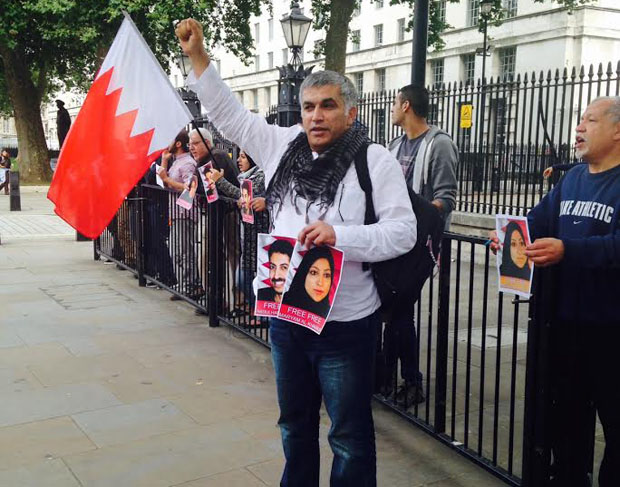
Nabeel Rajab during a protest in London in September (Photo: Milana Knezevic)
Human rights campaigner Nabeel Rajab was sentenced to six months, which would be suspended pending a fine, Rajab’s lawyer told the BBC.
Rajab has been granted bail while he appeals the verdict in his case.
In October a court ruled that Rajab would face criminal charges stemming from a single tweet in which both the ministry of interior and the ministry of defence allege that he “denigrated government institutions”. Rajab could have faced up to six years in prison.
“Nabeel Rajab has been sentenced for doing nothing more than exercising his right to express an opinion. We condemn the actions of the Bahraini authorities – whose foreign minister marched in Paris to defend freedoms that Bahrain denies the people in its own country. We urge the UK and other allies of Bahrain to join us in calling for this sentence to be overturned,” Index on Censorship CEO Jodie Ginsberg said.
In a visit to the Index on Censorship offices in September, Rajab campaigned on behalf of then-detained Maryam Al-Khawaja and spoke about the human rights situation in Bahrain.
