31 Aug 2018 | Bahrain, News
[vc_row][vc_column][vc_column_text]
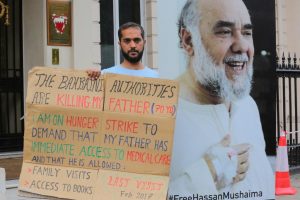
The Bahraini human rights mechanisms have largely failed to properly address concerns raised on behalf of Hassan Mushaima, and his life remains at risk. Because of this, his son, Ali Mushaima, is on a hunger strike outside of Bahrain’s Embassy in London.
Bahraini campaigner Ali Mushaima is returning to his protest site outside the Bahrain embassy in Knightsbridge, London, 24 hours after being hospitalised. Mushaima is on day 31 of a hunger strike in opposition to the treatment of his 70-year-old father Hassan Mushaima, who was locked-up in 2011 as part of the crackdown in Bahrain.
On Thursday Mushaima left the site in an ambulance and was taken to St Thomas’s Hospital in Westminster to receive treatment at around 14:30. He spent the night with his family. Since the beginning of his protest on 1 August, Mushaima has lost 13 Kg having only taken juices and milk. Mushaima’s doctor, who paid him a visit outside the Embassy on 29 August night, said his health conditions were critical, and that his body temperature and sugar level where extremely low. Over the 24 hours before being hospitalised, Mushaima developed chest and abdominal pain. According to his medical report, when the ambulance arrived, his blood sugar had dropped to 3.1. While in hospital, Mushaima did not consume any solid foods.
Mushaima is demanding basic rights for his father, including medical assistance, family visitation rights and access to his books. These have all been denied to him by the regime, which continue to violate Hassan Mushaima’s rights under UN minimum detention standards (known as Mandela Rules).
On 28 August, Mushaima received a call from his father who informed him that he was taken to the hospital for cancer screening. This came after two years in which the Bahraini authorities have denied him access to an oncologist. It appears that all of Hassan’s books, personal notes, writing material and even the Quran have been destroyed after being confiscated without “any legal or logical justification” in October 2017. The authorities appear to have taken this action even though the materials were previously approved by the prison administration. This information was provided to a fellow inmate by a prison officer while Hassan was at the hospital.
Mushaima has received cross-party support for his demands. Support came also from SNP Ian Blackford, who called on the Secretary of State to step in and demand Hassan Mushaima’s release. The co-leaders of the Green Party, Caroline Lucas MP and Jonathan Bartley, have additionally written to MENA Minister Alistair Burt to demand intervention.
BIRD has written to the Foreign Office to express concerns that it is relying on assurances by the Bahraini government and the UK-trained National Institute for Human Rights (NIHR) in Bahrain. Through its technical assistance programme, since 2012 the UK government has been funding various institutions in Bahrain that are complicit in the denial of adequate medical treatment, including the NIHR.
Ali Mushaima said: “I am returning to the embassy today to continue my protest. My demands are so basic and could all be granted tomorrow. The way the regime has treated my father is appalling. My body is weak, but this protest is my last resource, and if this is what it takes for them to treat my father humanely, then I will not stop until he is given the treatment he needs, family visits and access to his books. These are non-negotiable rights that should be afforded to all prisoners.”
BIRD Director of Advocacy, Sayed Ahmed Alwadaei said: “The UK has now become part of the problem, rather than a solution. It’s been a month since Ali started his hunger strike, only to find out that the UK will not call for an end to the cruelty Bahrain is subjecting him and his family to. Instead, the UK has decided to back the lies of a government that is deliberately denying a 70-year-old man his most basic human rights.”
Background:
In response to Mushaima’s hunger strike, Hassan Mushaima received a cancer scan and has been given access to vital medication that was previously unavailable to him, but several issues remain:
-
In October 2017, Hassan Mushaima’s books, personal notes, and writing materials were confiscated for no reason. They may have been destroyed.
-
Hassan Mushaima continues to be denied his right to family visitation without being subjected to humiliating measures, including being shackled. He last saw his family 18 months ago, in February 2017.
[/vc_column_text][vc_basic_grid post_type=”post” max_items=”4″ element_width=”6″ grid_id=”vc_gid:1535711781445-93a88da7-5e22-9″ taxonomies=”716″][/vc_column][/vc_row]
30 Aug 2018 | Bahrain
[vc_row][vc_column][vc_single_image image=”102297″ img_size=”full” add_caption=”yes”][vc_column_text]
Bahraini activist Ali Mushaima was hospitalised after completing one month of his hunger strike outside the Bahrain Embassy in London to protest the inhuman treatment of his 70-year-old father, political prisoner Hassan Mushaima, while serving a life sentence in Bahrain. Mushaima was taken to St Thomas’ Hospital in Westminster by ambulance Thursday afternoon.
Since the beginning of Mushaima’s protest on 1 August, he has lost 13 Kg. Mushaima’s doctor, who paid him a visit outside the Embassy last night, said his health conditions were critical, including low sugar levels which had reached 4.1, low body temperature and low blood pressure. This morning, Ali’s sugar levels reached 3.2.
On 28 August, Mushaima received a call from his father who informed him that he was taken to the hospital unshackled for a PET cancer scan. This came after two years in which the Bahraini authorities have denied him access to an oncologist. Hassan also told Ali that all of his books, personal notes, writing material and even the Quran might have been destroyed after being confiscated without “any legal or logical justification” in October 2017. The authorities appear to have taken this action even though the materials were previously approved by the prison administration. This information was provided to a fellow inmate by a prison officer while Hassan was at the hospital.
Mushaima has publicly spoken about his father’s mistreatment, including contacting the Foreign and Commonwealth Office, and writing to the Queen, asking Her to use Her strong friendship with the King of Bahrain to help him save his father.
Mushaima’s peaceful protest and his efforts to save his father have now gained cross-party support in the UK. SNP Ian Blackford, called on the Secretary of State to step in and demand Hassan Mushaima’s release. The co-leaders of the Green Party, Caroline Lucas MP and Jonathan Bartley, have additionally written to MENA Minister Alistair Burt to demand intervention.
BIRD has written to the Foreign Office to express concerns that it is relying on assurances by the Bahraini government and the UK-trained National Institute for Human Rights (NIHR) in Bahrain. Through its technical assistance programme, since 2012 the UK government has been funding various institutions in Bahrain that are complicit in the denial of adequate medical treatment, including the NIHR.
Mushaima told BIRD yesterday: “The Bahraini authorities are shameless. It took a month of hunger strike in London before they allowed my father to undertake his cancer screening in Bahrain. The same happened with my other requests which they ultimately acknowledged. I will not stop until my father gets what he is entitled to, and the more authorities abuse him, the more I will expose them.”
Commenting, BIRD Director of Advocacy, Sayed Ahmed Alwadaei said: “It is heartbreaking to see someone going through so much suffering to demand respect for the most basic human rights that everyone should be entitled to. Instead of meeting Ali’s simple demands, the Bahraini Government tried to publicly defame him. In so doing, the Gulf Kingdom is normalising a new worrying pattern of abuse against political prisoners, and by backing their lies, the UK has now become part of the problem, rather than a solution.”
Background:
In response to Ali’s hunger strike, Hassan Mushaima received a cancer scan and has been given access to vital medication that was previously unavailable to him, but several issues remain:
-
In October 2017, Hassan Mushaima’s books, personal notes, and writing materials were confiscated for no reason. They may have been destroyed.
-
Hassan Mushaima continues to be denied his right to family visitation without being subjected to humiliating measures, including being shackled. He last saw his family 18 months ago, in February 2017.
[/vc_column_text][/vc_column][/vc_row][vc_row][vc_column][vc_basic_grid post_type=”post” max_items=”12″ style=”load-more” items_per_page=”4″ element_width=”6″ grid_id=”vc_gid:1535634432336-8c8ef480-e703-5″ taxonomies=”4558, 3510, 716″][/vc_column][/vc_row]
29 Aug 2018 | Bahrain, Bahrain Statements, Campaigns -- Featured, Statements
[vc_row][vc_column][vc_single_image image=”95198″ img_size=”full” add_caption=”yes”][vc_column_text]For the second time since 2013, the United Nations (UN) Working Group on Arbitrary Detention (WGAD) has issued an Opinion regarding the legality of the detention of Mr. Nabeel Rajab under international human rights law.
In its second opinion, the WGAD held that the detention was not only arbitrary but also discriminatory. The 127 signatory human rights groups welcome this landmark opinion, made public on 13 August 2018, recognising the role played by human rights defenders in society and the need to protect them. We call upon the Bahraini Government to immediately release Nabeel Rajab in accordance with this latest request.
In its Opinion (A/HRC/WGAD/2018/13), the WGAD considered that the detention of Mr. Nabeel Rajabcontravenes Articles 2, 3, 7, 9, 10, 11, 18 and 19 of the Universal Declaration on Human Rights and Articles 2, 9, 10, 14, 18, 19 and 26 of the International Covenant on Civil and Political Rights, ratified by Bahrain in 2006. The WGAD requested the Government of Bahrain to “release Mr. Rajab immediately and accord him an enforceable right to compensation and other reparations, in accordance with international law.”
This constitutes a landmark opinion as it recognises that the detention of Mr. Nabeel Rajab – President of the Bahrain Center for Human Rights (BCHR), Founding Director of the Gulf Centre for Human Rights (GCHR), Deputy Secretary General of FIDH and a member of the Human Rights Watch Middle East and North Africa Advisory Committee – is arbitrary and in violation of international law, as it results from his exercise of the right to freedom of opinion and expression as well as freedom of thought and conscience, and furthermore constitutes “discrimination based on political or other opinion, as well as on his status as a human rights defender.” Mr. Nabeel Rajab’s detention has therefore been found arbitrary under both categories II and V as defined by the WGAD.
Mr. Nabeel Rajab was arrested on 13 June 2016 and has been detained since then by the Bahraini authorities on several freedom of expression-related charges that inherently violate his basic human rights. On 15 January 2018, the Court of Cassation upheld his two-year prison sentence, convicting him of “spreading false news and rumors about the internal situation in the Kingdom, which undermines state prestige and status” – in reference to television interviews he gave in 2015 and 2016. Most recently on 5 June 2018, the Manama Appeals Court upheld his five years’ imprisonment sentence for “disseminating false rumors in time of war”; “offending a foreign country” – in this case Saudi Arabia; and for “insulting a statutory body”, in reference to comments made on Twitter in March 2015 regarding alleged torture in Jaw prison and criticising the killing of civilians in the Yemen conflict by the Saudi Arabia-led coalition. The Twitter case will next be heard by the Court of Cassation, the final opportunity for the authorities to acquit him.
The WGAD underlined that “the penalisation of a media outlet, publishers or journalists solely for being critical of the government or the political social system espoused by the government can never be considered to be a necessary restriction of freedom of expression,” and emphasised that “no such trial of Mr. Rajab should have taken place or take place in the future.” It added that the WGAD “cannot help but notice that Mr. Rajab’s political views and convictions are clearly at the centre of the present case and that the authorities have displayed an attitude towards him that can only be characterised as discriminatory.” The WGAD added that several cases concerning Bahrain had already been brought before it in the past five years, in which WGAD “has found the Government to be in violation of its human rights obligations.” WGAD added that “under certain circumstances, widespread or systematic imprisonment or other severe deprivation of liberty in violation of the rules of international law may constitute crimes against humanity.”
Indeed, the list of those detained for exercising their right to freedom of expression and opinion in Bahrain is long and includes several prominent human rights defenders, notably Mr. Abdulhadi Al-Khawaja, Dr.Abduljalil Al-Singace and Mr. Naji Fateel – whom the WGAD previously mentioned in communications to the Bahraini authorities.
Our organisations recall that this is the second time the WGAD has issued an Opinion regarding Mr. Nabeel Rajab. In its Opinion A/HRC/WGAD/2013/12adopted in December 2013, the WGAD already classified Mr. Nabeel Rajab’s detention as arbitrary as it resulted from his exercise of his universally recognised human rights and because his right to a fair trial had not been guaranteed (arbitrary detention under categories II and III as defined by the WGAD).The fact that over four years have passed since that opinion was issued, with no remedial action and while Bahrain has continued to open new prosecutions against him and others, punishing expression of critical views, demonstrates the government’s pattern of disdain for international human rights bodies.
To conclude, our organisations urge the Bahrain authorities to follow up on the WGAD’s request to conduct a country visit to Bahrain and to respect the WGAD’s opinion, by immediately and unconditionally releasing Mr. Nabeel Rajab, and dropping all charges against him. In addition, we urge the authorities to release all other human rights defenders arbitrarily detained in Bahrain and to guarantee in all circumstances their physical and psychological health.
This statement is endorsed by the following organisations:
1- ACAT Germany – Action by Christians for the Abolition of Torture
2- ACAT Luxembourg
3- Access Now
4- Acción Ecológica (Ecuador)
5- Americans for Human Rights and Democracy in Bahrain – ADHRB
6- Amman Center for Human Rights Studies – ACHRS (Jordania)
7- Amnesty International
8- Anti-Discrimination Center « Memorial » (Russia)
9- Arabic Network for Human Rights Information – ANHRI (Egypt)
10- Arab Penal Reform Organisation (Egypt)
11- Armanshahr / OPEN Asia (Afghanistan)
12- ARTICLE 19
13- Asociación Pro Derechos Humanos – APRODEH (Peru)
14- Association for Defense of Human Rights – ADHR
15- Association for Freedom of Thought and Expression – AFTE (Egypt)
16- Association marocaine des droits humains – AMDH
17- Bahrain Center for Human Rights
18- Bahrain Forum for Human Rights
19- Bahrain Institute for Rights and Democracy – BIRD
20- Bahrain Interfaith
21- Cairo Institute for Human Rights – CIHRS
22- CARAM Asia (Malaysia)
23- Center for Civil Liberties (Ukraine)
24- Center for Constitutional Rights (USA)
25- Center for Prisoners’ Rights (Japan)
26- Centre libanais pour les droits humains – CLDH
27- Centro de Capacitación Social de Panama
28- Centro de Derechos y Desarrollo – CEDAL (Peru)
29- Centro de Estudios Legales y Sociales – CELS (Argentina)
30- Centro de Políticas Públicas y Derechos Humanos – Perú EQUIDAD
31- Centro Nicaragüense de Derechos Humanos – CENIDH (Nicaragua)
32- Centro para la Acción Legal en Derechos Humanos – CALDH (Guatemala)
33- Citizen Watch (Russia)
34- CIVICUS : World Alliance for Citizen Participation
35- Civil Society Institute – CSI (Armenia)
36- Colectivo de Abogados « José Alvear Restrepo » (Colombia)
37- Collectif des familles de disparu(e)s en Algérie – CFDA
38- Comisión de Derechos Humanos de El Salvador – CDHES
39- Comisión Ecuménica de Derechos Humanos – CEDHU (Ecuador)
40- Comisión Nacional de los Derechos Humanos (Costa Rica)
41- Comité de Acción Jurídica – CAJ (Argentina)
42- Comité Permanente por la Defensa de los Derechos Humanos – CPDH (Colombia)
43- Committee for the Respect of Liberties and Human Rights in Tunisia – CRLDHT
44- Commonwealth Human Rights Initiative – CHRI (India)
45- Corporación de Defensa y Promoción de los Derechos del Pueblo – CODEPU (Chile)
46- Dutch League for Human Rights – LvRM
47- European Center for Democracy and Human Rights – ECDHR (Bahrain)
48- FEMED – Fédération euro-méditerranéenne contre les disparitions forcées
49- FIDH, in the framework of the Observatory for the Protection of Human Rights Defenders
50- Finnish League for Human Rights
51- Foundation for Human Rights Initiative – FHRI (Uganda)
52- Front Line Defenders
53- Fundación Regional de Asesoría en Derechos Humanos – INREDH (Ecuador)
54- Groupe LOTUS (DRC)
55- Gulf Center for Human Rights
56- Human Rights Association – IHD (Turkey)
57- Human Rights Association for the Assistance of Prisoners (Egypt)
58- Human Rights Center – HRIDC (Georgia)
59- Human Rights Center « Memorial » (Russia)
60- Human Rights Center « Viasna » (Belarus)
61- Human Rights Commission of Pakistan
62- Human Rights Foundation of Turkey
63- Human Rights in China
64- Human Rights Mouvement « Bir Duino Kyrgyzstan »
65- Human Rights Sentinel (Ireland)
66- Human Rights Watch
67- I’lam – Arab Center for Media Freedom, Development and Research
68- IFEX
69- IFoX Turkey – Initiative for Freedom of Expression
70- Index on Censorship
71- International Human Rights Organisation « Club des coeurs ardents » (Uzbekistan)
72- International Legal Initiative – ILI (Kazakhstan)
73- Internet Law Reform Dialogue – iLaw (Thaïland)
74- Institut Alternatives et Initiatives Citoyennes pour la Gouvernance Démocratique – I-AICGD (RDC)
75- Instituto Latinoamericano para una Sociedad y Derecho Alternativos – ILSA (Colombia)
76- Internationale Liga für Menschenrechte (Allemagne)
77- International Service for Human Rights – ISHR
78- Iraqi Al-Amal Association
79- Jousor Yemen Foundation for Development and Humanitarian Response
80- Justice for Iran
81- Justiça Global (Brasil)
82- Kazakhstan International Bureau for Human Rights and the Rule of Law
83- Latvian Human Rights Committee
84- Lawyers’ Rights Watch Canada
85- League for the Defense of Human Rights in Iran
86- League for the Defense of Human Rights – LADO Romania
87- Legal Clinic « Adilet » (Kyrgyzstan)
88- Liga lidských práv (Czech Republic)
89- Ligue burundaise des droits de l’Homme – ITEKA (Burundi)
90- Ligue des droits de l’Homme (Belgique)
91- Ligue ivoirienne des droits de l’Homme
92- Ligue sénégalaise des droits humains – LSDH
93- Ligue tchadienne des droits de l’Homme – LTDH
94- Ligue tunisienne des droits de l’Homme – LTDH
95- MADA – Palestinian Center for Development and Media Freedom
96- Maharat Foundation (Lebanon)
97- Maison des droits de l’Homme du Cameroun – MDHC
98- Maldivian Democracy Network
99- MARCH Lebanon
100- Media Association for Peace – MAP (Lebanon)
101- MENA Monitoring Group
102- Metro Center for Defending Journalists’ Rights (Iraqi Kurdistan)
103- Monitoring Committee on Attacks on Lawyers – International Association of People’s Lawyers
104- Movimento Nacional de Direitos Humanos – MNDH (Brasil)
105- Mwatana Organisation for Human Rights (Yemen)
106- Norwegian PEN
107- Odhikar (Bangladesh)
108- Pakistan Press Foundation
109- PEN America
110- PEN Canada
111- PEN International
112- Promo-LEX (Moldova)
113- Public Foundation – Human Rights Center « Kylym Shamy » (Kyrgyzstan)
114- RAFTO Foundation for Human Rights
115- Réseau Doustourna (Tunisia)
116- SALAM for Democracy and Human Rights
117- Scholars at Risk
118- Sisters’ Arab Forum for Human Rights – SAF (Yemen)
119- Suara Rakyat Malaysia – SUARAM
120- Taïwan Association for Human Rights – TAHR
121- Tunisian Forum for Economic and Social Rights – FTDES
122- Vietnam Committee for Human Rights
123- Vigilance for Democracy and the Civic State
124- World Association of Newspapers and News Publishers – WAN-IFRA
125- World Organisation Against Torture – OMCT, in the framework of the Observatory for the Protection of Human Rights Defenders
126- Yemen Organisation for Defending Rights and Democratic Freedoms
127- Zambia Council for Social Development – ZCSD[/vc_column_text][/vc_column][/vc_row][vc_row][vc_column][vc_basic_grid post_type=”post” max_items=”4″ element_width=”6″ grid_id=”vc_gid:1535551119543-359a0849-e6f7-3″ taxonomies=”716″][/vc_column][/vc_row]
20 Aug 2018 | Bahrain, Bahrain Statements, Campaigns -- Featured, Statements
[vc_row][vc_column][vc_single_image image=”102260″ img_size=”full” add_caption=”yes”][vc_column_text]As Hassan Mushaima, a septuagenarian prisoner of conscience serving a life sentence in Bahrain, continues to face illegal restrictions on his access to medical care, international NGOs call for full and unrestricted access to medical care in detention for all prisoners of conscience. Our organisations raise deep concerns regarding the inefficacy of Bahrain’s human rights mechanisms in addressing Mushaima’s condition.
Mushaima suffers from a series of chronic medical conditions, including gout, diabetes and erratic blood pressure. He is also a former lymphoma cancer patient. He requires over 15 different types of medication to help with these conditions but has faced restricted access to his medicine. Additionally, his cancer was reportedly in remission as of late 2016, but prison authorities have consistently constrained his access to the regular screenings that he requires to ensure that it has not returned. He also faces restrictive conditions on family visits, with the result that he has not been able to meet with his family since February 2017. While the authorities have recently allowed Mushaima to receive his medication following initial international pressure around his case, they continue to withhold his access to an endocrinologist for his diabetes treatment and cancer screenings. Mushaima and other high profile prisoners of conscience, including Index on Censorship Freedom of Expression Award winner Abdulhadi Al-Khawaja and Index on Censorship Freedom of Expression Award nominee Dr. Abduljalil Al-Singace, have also reported that, since October 2017, prison authorities have confiscated all books, including religious books, papers, and writing materials.
The Bahraini government’s illegal restrictions on healthcare violate international detention standards, and prisoners of conscience have been singled out for mistreatment. Prison authorities force prisoners of conscience, including the elderly Mushaima and Dr. Al-Singace, to be strip-searched, chained, shackled, and marched to medical facilities if they want to attend medical appointments. They must face this treatment when attending external appointments, and when transiting within the prison to the internal medical facilities, which they refuse to do. There is no security justification for this treatment, as Mushaima and al-Singace have never presented any security risks in detention, nor posed any flight risk. This treatment is therefore interpreted by the prisoners, and by our organisations, to be both arbitrary and punitive, with the intention to humiliate and degrade prisoners of conscience. Such treatment contravenes the United Nations (UN) Standard Minimum Rules for the Treatment of Prisoners, also known as the Mandela Rules.
On 7 August, Bahrain’s National Institution for Human Rights (NIHR) released a statement regarding the health conditions of Hassan Mushaima, yet this statement was made without any direct investigation of his condition or consultation with him in prison. The NIHR’s assertions in their statement are misleading and incomplete, and they fail to address core concerns directly raised with the Institution. The statement declares that Mushaima has voluntarily declined medical services to be provided to him and has refused to attend six of his medical appointments in the last six months. What the statement neglects to mention is the degrading treatment Mushaima has endured in order to gain access to medical care.
In choosing to omit any reference to core concerns raised in complaints to the NIHR, including the use of punitive shackling, we in the international human rights community view the Institution’s statement as a clear attempt to obfuscate prison authorities’ degrading treatment of prisoners. We believe this does not represent a good faith effort to effectively address the concerns raised by international human rights groups, but rather appears to be yet another effort to whitewash human rights abuses perpetrated against Mushaima and other prisoners of conscience.
More broadly, Bahrain’s oversight bodies, including the NIHR and the Ministry of Interior Ombudsman, continually contribute to a pervasive culture of impunity in Bahrain through their failure to independently carry out their mandates. While a number of the undersigned organisations continue to present cases to these institutions, we remain seriously concerned over past instances of reprisals and intimidation, as well as false or misleading reporting that serves to conceal human rights abuses by the authorities. Through these actions, these human rights bodies have demonstrated a clear lack of independence and have failed to effectively seek accountability or to act in the best interest of victims.
A number of organisations have expressed these concerns. In July 2018 the UN Human Rights Committee found that Bahrain is failing to meet its treaty obligations under the International Covenant on Civil and Political Rights, specifically noting that the NIHR “lacks sufficient independence to perform its functions” and voicing concerns about “the lack of information on complaints received and investigations carried out in response to these complaints.” Additionally, the UN Committee against Torture in its 2017 State Review of Bahrain, as well as the European Parliament in an urgency resolution earlier this summer, expressed further alarm over the partiality and inefficacy of the NIHR.
The Bahraini human rights mechanisms have largely failed to properly address concerns raised on behalf of Hassan Mushaima, and his life remains at risk. Because of this, his son, Ali Mushaima, is on his 20th day of a hunger strike outside of Bahrain’s Embassy in London. In the early hours of 12 August, foamy dirty liquid was thrown on Ali Mushaima from the embassy’s balcony, in what appears to be an attempt to intimidate him and force him to leave the premises. Undeterred, he continues his protest demanding Bahraini authorities immediately provide Hassan Mushaima with unfettered access to medication and treatment, as well as for an end to restrictions on family visits and the return of confiscated books and reading materials.
We in the international human rights community call on the Bahraini government to establish truly independent and credible human rights mechanisms that are fully empowered to carry out their mandates and appropriately address human rights violations and abuses. We also call on the Bahraini authorities to lift illegal restrictions on prisoners, provide Mushaima and other prisoners of conscience with adequate medical care, and ultimately ensure his release.
Americans for Democracy & Human Rights in Bahrain (ADHRB)
Amnesty International
ARTICLE 19
Bahrain Institute for Rights and Democracy (BIRD)
European Center for Democracy and Human Rights (ECDHR)
Global Rights Watch
Gulf Centre for Human Rights (GCHR)
Index on Censorship
PEN International
Rafto Foundation for Human Rights[/vc_column_text][/vc_column][/vc_row][vc_row][vc_column][vc_basic_grid post_type=”post” max_items=”12″ style=”load-more” items_per_page=”4″ element_width=”6″ grid_id=”vc_gid:1534691207631-dfa3422d-2ad0-9″ taxonomies=”716″][/vc_column][/vc_row]
