15 Aug 2018 | Bahrain, Bahrain News, Middle East and North Africa, News, Statements
[vc_row][vc_column][vc_column_text]
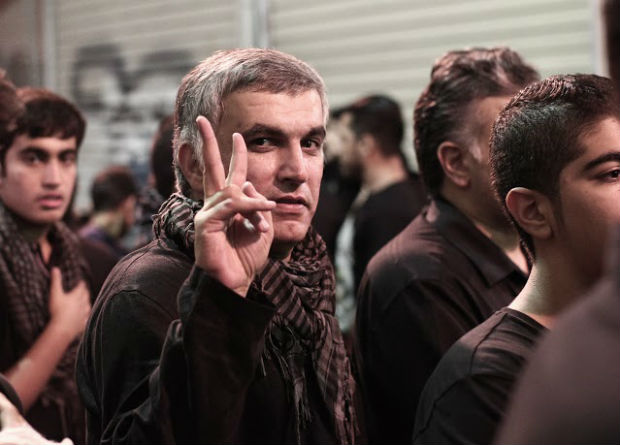
Bahraini human rights defender Nabeel Rajab (Photo: The Bahrain Institute for Rights and Democracy)
The United Nations (UN) Working Group on Arbitrary Detention has issued a formal decision declaring Bahrain’s imprisonment of human rights defender Nabeel Rajab unlawful. Rajab – who was arrested on 13 June 2016 and later sentenced to a total of seven years in prison for tweets and media appearances – is arbitrarily detained under eight articles of the Universal Declaration of Human Rights and seven articles of the International Covenant on Civil and Political Rights, according to the Working Group. It finds that Rajab should never have been prosecuted and that Bahraini authorities employed “vague and overly broad” legal provisions to target him for his “political views and convictions.” His detention, therefore, constitutes two different categories of arbitrary detention under the Working Group’s mandate, in that it contravenes his rights to freedom of opinion and expression, and it discriminates against him as a human rights defender.
“Our friend Nabeel has been in detention for more than two years,” said Index on Censorship chief executive Jodie Ginsberg. “Bahrain should release him immediately and pay compensation as urged by the UN Working Group on Arbitrary Detention. We hope that these findings will also encourage the UK government to do more to encourage its ally Bahrain to uphold its international human rights obligations.”
Bahrain is urged to immediately and unconditionally release Rajab — a 2012 Index on Censorship Freedom of Expression Award winner — from custody and “accord him an enforceable right to compensation and other reparations.” Moreover, the Working Group concludes that Bahrain’s consistent pattern of arbitrary detention against human rights defenders, activists, religious leaders, and other civil society actors may be approaching crimes against humanity.
Please find the Working Group’s key observations below:
· “Mr. Rajab has been arrested, detained, prosecuted and imprisoned for allegedly spreading false news abroad which damages the national interest and for allegedly spreading false rumours in wartime, insulting governing authorities and insulting a foreign country — pursuant to articles 133, 134, 215 and 216 of the Penal Code. . . these provisions of the Penal Code are so vague and overly broad that they could, as in the present case, result in penalties being imposed on individuals who had merely exercised their rights under international law.”
· “Given its finding that the deprivation of liberty of Mr. Rajab is arbitrary under category II … no such trial of Mr. Rajab should have taken place or take place in the future.”
· “The Working Group cannot help but notice that Mr. Rajab’s political views and convictions are clearly at the centre of the present case and that the authorities have displayed an attitude towards him that can only be characterised as discriminatory; indeed, he has been the target of persecution, including deprivation of liberty, for many years and there is no other explanation for this except that he is exercising his right to express such views and convictions.”
· “The deprivation of liberty of Nabeel Ahmed Abdulrasool Rajab, being in contravention of … the Universal Declaration of Human Rights and … the International Covenant on Civil and Political Rights, is arbitrary.”
· “The Working Group considers that … the appropriate remedy would be to release Mr. Rajab immediately and accord him an enforceable right to compensation and other reparations, in accordance with international law.”
· “The present case is one of several brought before the Working Group in the past five years concerning the arbitrary deprivation of liberty of persons in Bahrain . . . under certain circumstances, widespread or systematic imprisonment or other severe deprivation of liberty in violation of the rules of international law may constitute crimes against humanity.”
Commenting, Husain Abdulla, Executive Director of Americans for Democracy & Human Rights in Bahrain (ADHRB): “This is a landmark decision that clearly indicts Bahrain’s systematic and widespread arbitrary detention of activists like Nabeel Rajab for exercising their right to free expression. The Bahraini government must immediately heed the UN’s call to release Rajab and compensate him for the last two years he’s spent illegally languishing in prison. As the UN’s findings rightly suggest, this is not just a crime against a brave human rights defender, but part of Bahrain’s wider crimes against humanity.”
Sayed Ahmed Alwadaei, Director of Advocacy for the Bahrain Institute for Rights and Democracy (BIRD): “The UN has now unequivocally found that Bahrain is arbitrarily detaining Nabeel Rajab in violation of numerous international legal standards – these vital findings cannot be ignored. It is now incumbent on Bahrain’s allies like the United Kingdom, which has so far failed to address Rajab’s case, to publicly back the UN’s demands for his unconditional release. Anything short of that is a tacit endorsement Bahrain’s patently criminal behaviour.”
[/vc_column_text][/vc_column][/vc_row][vc_row][vc_column][vc_basic_grid post_type=”post” max_items=”4″ element_width=”6″ grid_id=”vc_gid:1534420203761-b82a3b89-1c77-7″ taxonomies=”3368″][/vc_column][/vc_row]
21 Jun 2018 | Bahrain, Bahrain News, News
[vc_row][vc_column][vc_column_text]
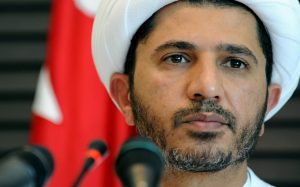
Sheikh Ali Salman
21 June 2018 – Bahrain’s High Criminal Court acquitted the leader of Bahrain’s dissolved opposition party Al-Wefaq, Sheikh Ali Salman, of politically motivated charges related to espionage.
The verdict marked the end of a long, flawed trial. Sheikh Salman was acquitted alongside his two co-defendants and leading figures in the Al-Wefaq party, Sheikh Hassan Ali Juma Sultan and Ali Mahdi Ali Al-Aswad. Sheikh Salman’s co-defendants were tried in absentia.
Sheikh Salman is currently serving a four year sentence in Jau Prison in relation to another freedom of expression case.
Commenting, BIRD’s Director of Advocacy, Sayed Ahmed Alwadaei: “This case should never have been initiated in the first place: Sheikh Ali Salman had been used as a pawn in Bahrain’s game of power politics. Despite his acquittal, Sheikh Salman will continue to languish in Jau Prison for exercising his right to freedom of expression. His conviction must be overturned and he must be released immediately.”
Background Information: The Qatari Case
Timeline of Events According to Bahrain’s Public Prosecution
-
August 2017 – Bahrain’s state television broadcasted an audio recording of a phone call between Sheikh Salman and the then Prime Minister and Minister of Foreign Affairs of Qatar, Sheikh Hamad Bin Jassim Bin Jabr Al-Thani. This event triggered Sheikh Salman’s prosecution.
-
1 November 2017 – Sheikh Salman was summoned by the Public Prosecution and charged undermining the “political, economic position and national interests with the purpose of overthrowing the regime” in Bahrain. He had been accused of maintaining intelligence contacts with Qatar. More specifically, his allegations included revealing national defence secrets and accepting financial sums from a foreign country, namely Qatar.
-
12 November 2017 – The Public Prosecution referred the case to the High Criminal Court.
-
24 April 2018 – The Public Prosecution stated that the case was postponed to 21 June for sentencing.
The Qatari Mediation as Referenced by the 2011 BICI Report
Paragraph 527 of the 2011 report by Bahrain’s Independent Commission of Inquiry (BICI), cited opposition sources suggested that the then Prime Minister and Minister of Foreign Affairs of Qatar, Sheikh Hamad Bin Jassim Bin Jabr Al-Thani, could act as the sponsor of a proposed United States initiative. Opposition sources also indicated that the State of Qatar’s Emir, Sheikh Hamad bin Khalifa Al-Thani, attempted to mediate between the Bahraini Government and opposition parties in the following days, and that this initiative was accepted by the opposition but rejected by the Government.
However, the mediating role of Qatar never arose as an issue before the Qatari crisis of 2017.
Background Information: Freedom of Expression Case
Sheikh Salman is currently imprisoned in Jau Prison as a result of a separate conviction related to speeches he delivered in 2014 against parliamentary elections that his party boycotted. Some of Sheikh Salman’s charged included publicly inciting hatred, civil disobedience and for promoting change within the ruling government. He was initially sentenced to four years in June 2015, and increased to nine-year prison sentence by the appeal court and then reduced back to four years on 3 April 2017 by the highest court, In reality he was convicted in relation to peacefully exercising his right to freedom of expression, following a grossly unfair trial.
Early last year, Sheikh Salman was among the 12 opposition activists and human rights defenders who were subjected to degrading treatment in Jau Prison. Since then, he has been denied the right to family visitations and access to books.
International Responses
United Nations
-
In February 2015, five UN experts expressed concern for the arrest and detention of Sheikh Salman, and called for his release.
-
In September 2015, the UN Working Group on Arbitrary Detention (WGAD) officially declared Sheikh Salman to be arbitrarily detained. The WGAD cited both freedom of expression and due process concerns, requested for his immediate release and that he receive his enforceable right to compensation.
United Kingdom (UK)
On 15 June 2018, in response to a parliamentary question on Sheikh Salman’s case, UK MENA Minister Alistair Burt merely stated that the Foreign and Commonwealth Office had “raised the case at a senior level with the Government of Bahrain”. The Minister, however, has failed to publicly condemn the charges.
[/vc_column_text][/vc_column][/vc_row][vc_row][vc_column][three_column_post title=”Bahrain” full_width_heading=”true” category_id=”716″][/vc_column][/vc_row]
5 Jun 2018 | Bahrain, Middle East and North Africa, News
[vc_row][vc_column][vc_column_text]
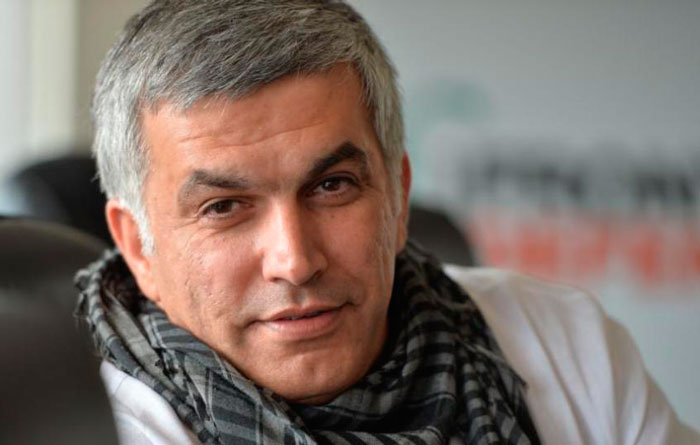
Human rights activist Nabeel Rajab has been subjected to ongoing judicial harassment.
Bahrain’s High Criminal Court of Appeal has upheld a five-year conviction for human rights activist Nabeel Rajab for critical tweets made from his account condemning Saudi-led airstrikes in Yemen and condemning the use of torture at Bahrain’s notorious Jau Prison.
Rajab, the president of the Bahrain Center for Human Rights and an Index on Censorship Freedom of Expression Award winner, has been sentenced in all to seven years in prison across two separate trials. In February 2018 he was sentenced to five years in prison for tweeting, which was added to a two-year conviction in June 2017 for “broadcasting fake news” relating to television interviews he gave in 2015.
Rajab has unsuccessfully appealed these convictions on four occasions and is expected to pursue a fifth and final appeal at Bahrain’s Court of Cassation.
Index on Censorship condemns the imprisonment of Rajab and the relentless harassment and intimidation the high-profile activist has seen since his involvement as a peaceful activist during the Bahrain uprising in 2011, during which time he has been in and out of prison on numerous occasions. He has been in prison on a continual basis since June 2016, during which time his health has deteriorated significantly.
“Nabeel Rajab is being persecuted by Bahrain for expressing his opinion,” Jodie Ginsberg, CEO of Index on Censorship, said. “Opinions are not crimes. The authorities should release him, and Bahrain’s allies – including the UK – should be advocating at the highest levels for his release.”
[/vc_column_text][/vc_column][/vc_row][vc_row][vc_column][vc_basic_grid post_type=”post” max_items=”4″ element_width=”6″ grid_id=”vc_gid:1544788614577-2ce74342-8c21-6″ taxonomies=”3368″][/vc_column][/vc_row]
10 Apr 2018 | Bahrain, Bahrain News, News
[vc_row][vc_column][vc_column_text]By Ciaran Willis, Lauren Brown and Samantha Chambers
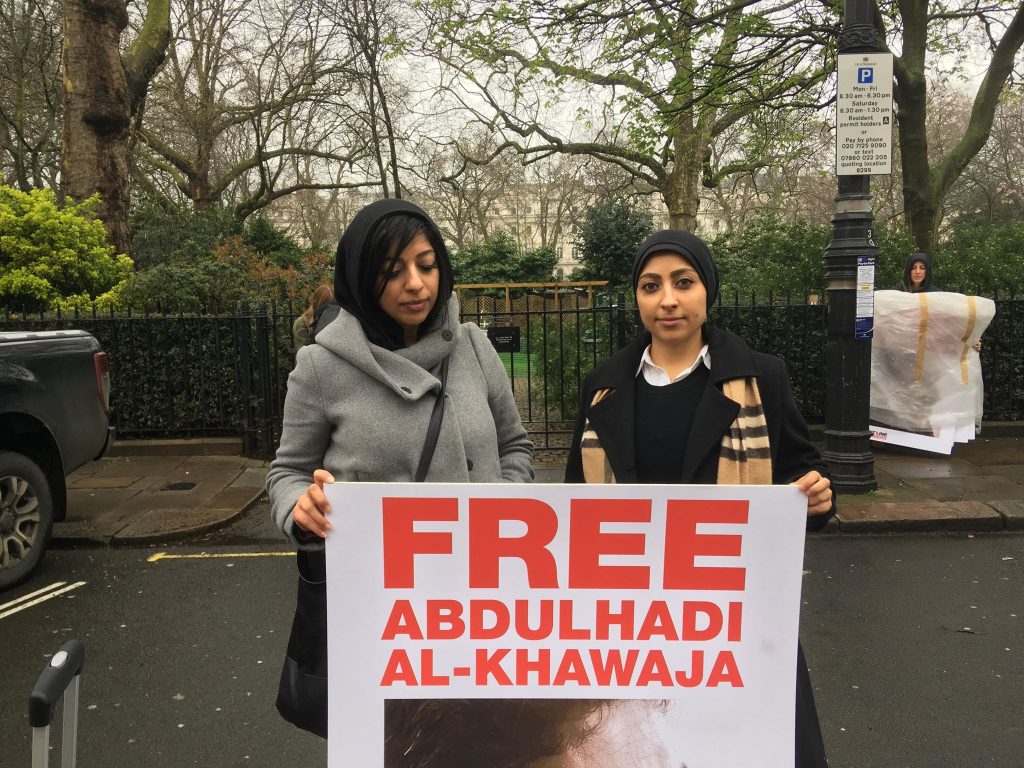
Zainab and Maryam al-Khawaja
The daughters of Abdulhadi al-Khawaja, the co-founder of Bahrain Centre for Human Rights, participated in a demonstration on Monday 9 April outside the Bahrain Embassy in London calling for his release on the seventh anniversary of his arrest.
Maryam and Zainab al-Khawaja joined NGOs and fellow supporters, as they chanted “free free Abdulhadi” and held placards with a picture of the Bahraini human rights activist.
It marked seven years since Abdulhadi al-Khawaja, founder of the 2012 Index on Censorship Freedom of Expression Award-winning Bahrain Centre for Human Rights, was imprisoned for his involvement in peaceful pro-democracy protests that swept the country during the Arab Spring. On 9 April 2011 twenty masked men broke into his house, dragged him down the stairs and arrested him in front of his family.
Bahrain has a poor track record on human rights, with many reports of torture and human rights defenders in jail. Al- Khawaja was part of the Bahrain 13, a group of journalists and activists who faced unfair trials following the unrest.
During his time in prison, Al-Khawaja has been tortured, sexually abused and admitted to hospital requiring surgery on a broken jaw.
His daughter Maryam al-Khawaja was imprisoned in Bahrain for a year before leaving the country in 2014. She faces prosecution on charges including insulting the king and defamation. She told Index: “For me, this isn’t just about my dad, it’s a reminder that we have thousands of prisoners in Bahrain, and we need to remember all of them, and we need to be fighting on behalf of all of them. These are all prisoners of conscience.”
A number of prominent Bahraini campaigners took part in the demonstration.
Jawad Fairooz, a former Bahrain MP and president of SALAM for Democracy and Human Rights, said: “We’re here to support Abdulhadi as a symbol of the demand of the people of Bahrain who want to live in the country with dignity and freedom.”
Sayed Ahmed Alwadaei, director of advocacy at the Bahrain Institute for Rights and Democracy and an activist who fled the country following torture, said: “I’m proud to belong to a nation that Abdulhadi is a part of. Abdulhadi to me is one of the most inspirational individuals.”
Cat Lucas, programme manager at English Pen’s Writers at Risk initiative, said that the government could be doing a lot more to challenge what is going on in Bahrain. She hopes the Bahraini Embassy will finally act, not just in the case of al-Khawaja, “but in the case of lots of writers and activists who are imprisoned for their peaceful human rights activities”.
Protesters have gathered outside the Embassy once a month since January 2018 to highlight the dire human rights situation and ask the UK government to take action.
Al- Khawaja’s daughter Zainab called on the UK to hold the Bahraini regime accountable: “Major governments are still supporting the Bahraini regime with weapons and political training. They’re the people behind them. I can feel as angry here as I would protesting in Bahrain, because I know what the government here is responsible for. I know one of the reasons people are being killed and tortured in Bahrain, including my father, is the support from the British and American governments.”
A group of NGOs, including Index on Censorship and Pen International, signed a letter last week calling on Bahrain to cease its abuse of fundamental human rights.They asked the authorities to immediately and unconditionally free Abdulhadi, provide proper access to medical care and allow international NGOs and journalists access to Bahrain.[/vc_column_text][vc_video link=”https://www.youtube.com/watch?v=8lkS7Fsyqso”][/vc_column][/vc_row][vc_row][vc_column][vc_basic_grid post_type=”post” max_items=”12″ style=”load-more” items_per_page=”4″ element_width=”6″ grid_id=”vc_gid:1523361455279-ef10ef07-647f-1″ taxonomies=”716″][/vc_column][/vc_row]
