12 Jun 2014 | Events
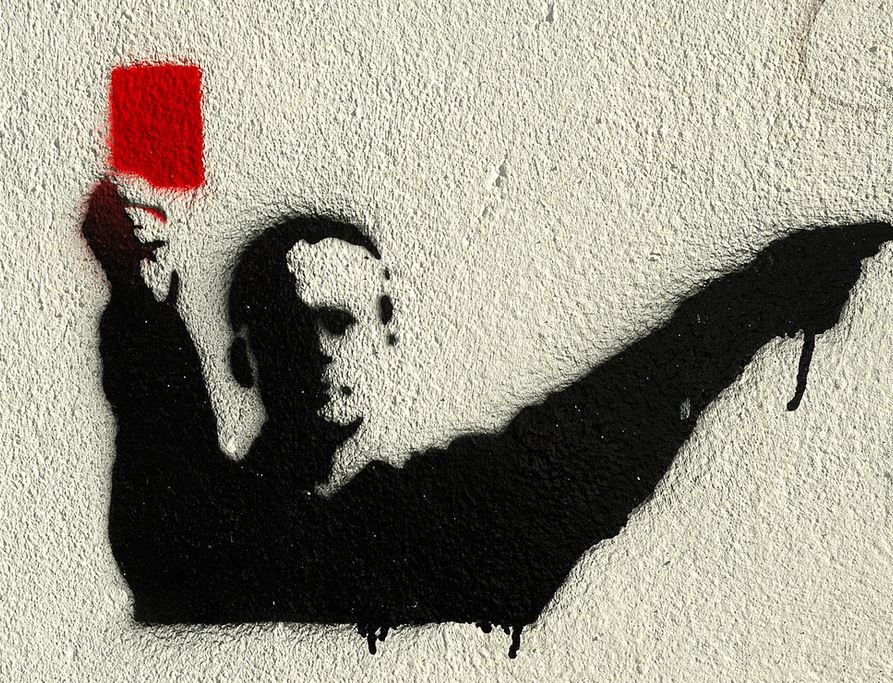
‘Football can inspire communities and break down barriers. Football is for all…everybody has the right to play football free from discrimination or prejudice’ – FIFA
You won’t often see Belgium playing ball with Russia, or Iran standing shoulder to shoulder with Argentina. But events like the World Cup offer a rare chance for politically opposed countries to interact in a way that governments don’t allow.
In a sporting tournament, should we ignore a country’s track record of suppressing journalists, censoring campaigners or blocking the internet? Or should we blow the whistle on free speech abusers and show the worst free-speech abusers a red card?
For our first #IndexDrawTheLine event, we are opening up our offices to anyone under the age of 25 to come and debate this thorny question. Join us to find out who the worst offenders at Rio 2014? And have your say on what referees should do: let countries play on or give them a red card?
WHEN: Monday 30th June, 5.30-7pm
WHERE: Index on Censorship, 92-94 Tooley Street, London, SE1 2TH
TICKETS: This event is FREE for under 25’s, please RSVP here.
DRAW THE LINE is a new project for tomorrow’s leaders, artists, journalists and campaigners to get involved in fighting censorship: share your thoughts in the #IndexDrawtheLine discussion forum, take on the debate at our monthly events or contribute to our Young Writers / Artists programme. Tell us – where do you draw the line?
5 Jun 2014 | Azerbaijan News, Events, News
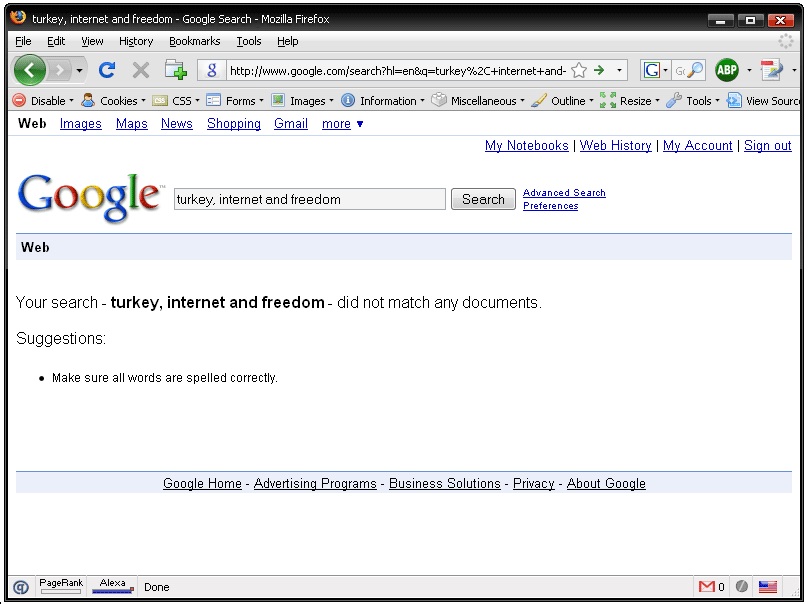
(Photo: Kusadasi-Guy via Creative Commons)
“Whenever we’ll have to choose between excessive regulation and protection of online freedom, we’ll definitely opt for freedom” Vladimir Putin, 1999
Since Putin said this, 3 days before becoming President, history has marched on…
“We will make arrangements without limiting and restricting freedom, but also without bowing to threats and without ignoring the dangers. We will hand over Turkey to generations who are not slaves to technology, but who rule and direct technology” Recep Tayyip Erdoğan, 2014
Terrorised twitter users, blackmailed bloggers and intimidated independent media, digital freedom has been facing a crack-down in Russia, Turkey and Azerbaijan.
Index on Censorship are bringing some of these countries foremost journalists and digital freedom advocates to Brussels to discuss events in their countries, to debate what the EU could do to help and to consider what we ourselves could learn from these experiences?
As we approach several major summits on internet governance, how can the EU tackle the growing risk of fragmentation, avoid calls for forced local hosting and stand up to the top-down approach favoured by the Russians?
“Is it because I was free that I was warned that I was going to lose my column if I would not stop criticizing the government? Is it because I was free that I was fired when I turned a deaf ear to warnings?” Amberin Zaman
The discussion, moderated by new Index CEO Jodie Ginsberg, will include:
- Andrei Soldatov – Investigative Journalist, Founder Agentura.ru. @AndreiSoldatov
- Anton Nossik – Blogger and Founding Editor-In-Chief of leading news websites inc. Gazeta.Ru, Lenta.Ru, Vesti.Ru, NTV.Ru (now NewsRu.com). @dolboed
- Dr Yaman Akdeniz – renowned advocate and Professor of Law, Istanbul Bilgi University, Founder and Director of Cyber-Rights.Org. @cyberrights
- Amberin Zaman – Censored former columnist at Haberturk, current journalist at Taraf and Turkey correspondent for The Economist.
- Arzu Geybulla – Azerbaijani Blogger, based in Istanbul. @arzugeybulla
WHEN: 5pm CET, Thursday 19 June 2014
WHERE: Google, Chaussée d’Etterbeek 180, Bruxelles, Belgium
TICKETS: Free but space limited – RSVP to [email protected]
Follow the discussion live @IndexEvents – #beatingretreat
28 Apr 2014 | Africa, Burundi, News, Politics and Society
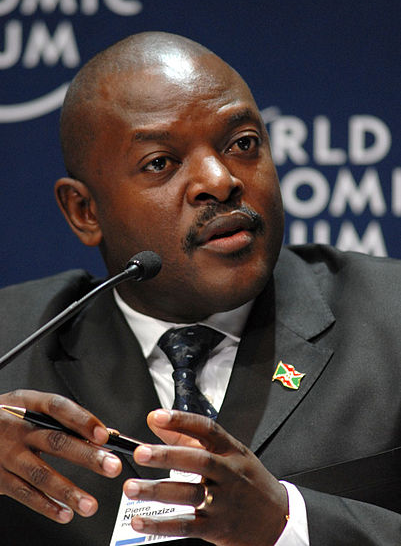
President Pierre Nkurunziza (Photo: World Economic Forum/Eric Miller)
After a bloody civil war that shook Burundi for 12 years, Pierre Nkurunziza and his former rebel group cum political party NCDD-FDD, came to power in 2005. The international community heaved a sigh of relief and Nkurunziza was given credit for ensuring stability. In 2010 however, President Nkurunziza and the NCDD-FDD were re-elected with an absolute majority during elections boycotted by the opposition. Matters then took a turn for the worse.
Nkurunziza clamped down on opposition and drove NCDD-FDD’s only coalition partner, UPRONA, out of the government. The Nkurunziza government also came to see members of civil society, who were critical, as opposition. Then it targeted the press with restrictive legislation.
International NGO’s have warned that press freedom in Burundi has reached a critical phase. US-based Freedom House ranks Burundi’s press as “not free”, mainly due to the country’s political and legal environment. Human Rights Watch stated that Burundi’s press law is “abusive”. Apart from occasional violence, arbitrary arrests and intimidation of journalists by security forces, the press law is at the heart of the problem for journalists who want to report critically on government policy.
Dating from April 2013, the press law gives the Nkurunziza government wide-ranging authority to severely limit the reporting of journalists. The law included new press-related crimes which, when committed, would be penalised with exorbitant fines or the withdrawal of press credentials. These fines could be three times the average annual salary of a Burundian. Under the law, journalists risk losing their livelihood and becoming indebted for the rest of their lives.
The law also required Burundian journalists to complete a degree in journalism. Experienced journalists would hereby become banished from the profession at a great cost for investigative and critical journalism. Journalists can also be compelled to release their sources. The principle of confidentiality is thrown away like a rag.
Perhaps most damaging to press freedom, journalists under this law are forbidden to report on topics concerning national defence, public safety, state security and the local currency. Any journalist that even remotely approaches any of these topics risks being prosecuted.
While NCDD-FDD officials state that they want to professionalise the media and ensure the press doesn’t incite violence, there appears to be more at stake. Even though journalists in Burundi persist in reporting on these topics and the law seems not to be enforced on a large scale for now, the mere existence of the law is a threat to the freedom of press and expression.
Nkurunziza and his party NCDD-FDD are looking to extend their rule in the 2015 general elections. In March, one of the key opposition parties, the Movement for Solidarity and Development (MSD) was suspended for four months after violent clashes between their supporters and the police. Twenty-one MSD activists were also sentenced to life in prison in the wake of this event. The International Crisis Group (ICG) has already expressed its concern regarding a possible escalation of violence in the coming elections. In the run-up to these elections of next year, considering this increasingly strained atmosphere between government and opposition, it is most important that the press is fully given the possibility to fulfil its role as fourth estate. The Burundian media, which at the moment is working to fulfil this role, has the crucial task to inform the populace, especially on the topics which they are now forbidden to report.
Several NGO’s already appealed to Nkurunziza and his government to revoke the press law. However, it seems as though more incentives are needed to persuade the NCDD-FDD of the importance of a revocation.
As Burundi’s most important donor country Belgium has the responsibility to put the topic of freedom of press and expression on the table. Belgium is currently re-negotiating its bilateral donor agreement with Burundi and it would be a missed opportunity if the Belgian government didn’t take the lead. It should be made clear that the bilateral agreement involves rights, but also obligations. One of those obligations should imply respecting the human right to freedom of expression and freedom of press.
Belgium must become a trailblazer by introducing conditionality in its bilateral agreement with Burundi. Ahead of the elections, journalists are hoping Belgium takes action.
This article was originally posted on April 28, 2014 at indexoncensorship.org
5 Feb 2014 | News, Politics and Society, United Kingdom
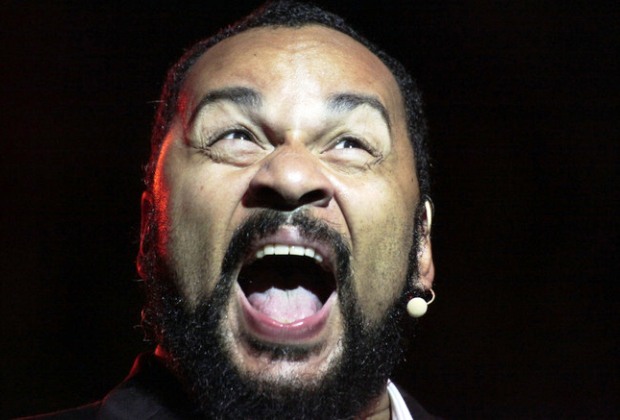
Dieudonné M’bala M’bala has been banned from entering the UK. The French comedian has long been a controversial figure in his home country, but he became internationally known when West Bromwich Albion striker Nicolas Anelka celebrated a goal with the now infamous quenelle — a sort of inverted nazi salute created by Dieudonné, his friend.
Dieudonné argues he is simply standing up to the establishment, and that the quenelle is an anti-establishment gesture. The facts tell a different story. He has made a number of clearly antisemitic comments, and has been convicted in France of inciting racial hatred.
Dieudonné was set to visit the UK to support Anelka, who has been charged by the Football Association over the incident, and faces a minimum five-match ban. As a colleague pointed out, it’s unclear how, exactly, further links to Dieudonné would help Anelka, but that is now beside the point, as he has been “excluded from the UK at the direction of the Secretary of State”. A letter from the Home Office, obtained by Swiss newspaper Tages-Anzeiger, states that he should not be allowed to board carriers to the UK. If he gets as far as the border, he’ll be turned away at the door, as it were.
But Dieudonné is not alone. Over the years, a number of controversial speakers, covering pretty much the entire spectrum of extremist ideologies, have been banned from entering the UK. The reasons given from the Home Office are almost always along the vague lines of the person in question not being “conducive to the public good”. Below are some the most high-profile cases.
Pamela Geller and Robert Spencer
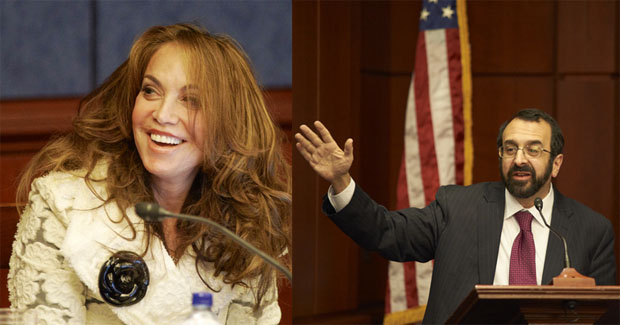
(Image: Mark Tenally/Demotix)
The American “counter-jihadists” were last May invited to speak at an EDL rally in Woolwich, London, at the scene of the brutal murder of Drummer Lee Rigby. However, they both received letters from the Home Office, informing them that based on past statements they were barred from entering the UK. One of Geller’s comments highlighted was: “Al-Qaeda is a manifestation of devout Islam… It is Islam.” In a joint statement, they declared that “…the British government is behaving like a de facto Islamic state. The nation that gave the world the Magna Carta is dead”.
Geert Wilders
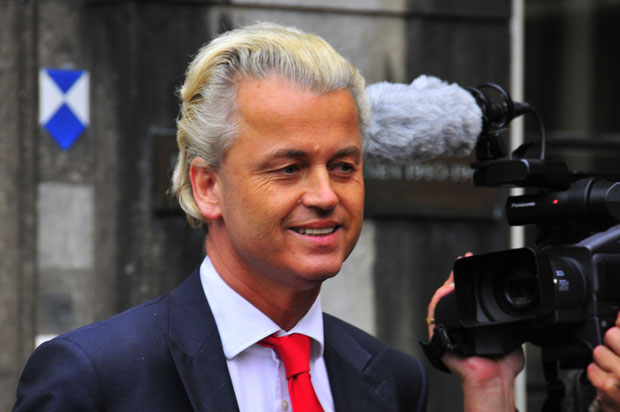
(Image: Frederik Enneman/Demotix)
In 2009, leader of the far-right Dutch Party for Freedom was set to travel to the UK to show his controversial film Fitna — which has been widely labelled as Islamophobic — in the House of Lords. Despite being told by the Home Office before travelling the he was barred from entry because his views “threaten community harmony and therefore public safety”, he still flew to Heathrow, where he was eventually stopped at the border. “Even if you don’t like me and don’t like the things I say then you should let me in for freedom of speech. If you don’t, you are looking like cowards,” was his message to British authorities at the time. The decision was later overturned.
Fred Phelps and Shirley Phelps-Roper
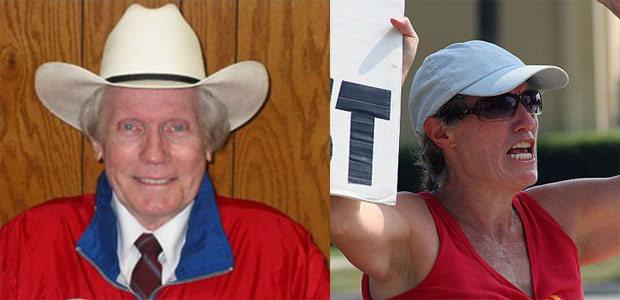
(Image: Wikimedia Commons)
The father and daughter, both members of the infamous Westboro Baptist Church — know, among other things, for picketing funerals — were planning on coming to Leicester to protest against a play about a man killed for being gay. The UK Border Agency said at the time: “Both these individuals have engaged in unacceptable behaviour by inciting hatred against a number of communities.”
Terry Jones
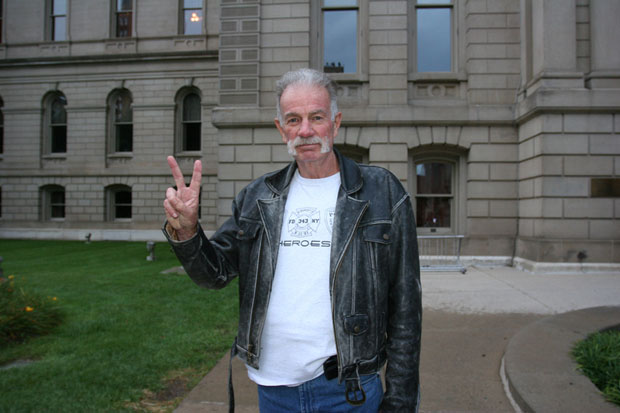
(Image: Mark Brunner/Demotix)
The American pastor became known across the world when he threatened to stage a mass burning of the Koran in 2010 to mark the anniversary of 9/11 — something which in the end did not take place. In 2011 he was invited to attend a number of demonstrations with far right group England Is Ours. However, he was banned by the Home Office, which cited “numerous comments made by Pastor Jones” and “evidence of his unacceptable behaviour”. Jones responded saying: “We feel this is against our human rights to travel and freedom of speech.”
Dyab Abou Jahjah

(Image: Wikimedia Commons)
The then Belgium-based founder of the Arab European League spoke at a meeting of the Stop The War Coalition in March 2009. He left the country with the intention of coming back after a few days, only to discover that he was barred from entering Britain. His organisation had previously published “a series of antisemitic and Holocaust revisionist cartoons in response to the Danish Muhammad cartoons controversy.” Around the time of his visit, the president of the Board of Deputies, Henry Grunwald QC, wrote to then-Home Secretary Jacqui Smith “raising concerns about Jahjah”. In a post on his website, he said he believed his ban was “mainly to do with the lobbying of the Zionists”.
Louis Farrakhan
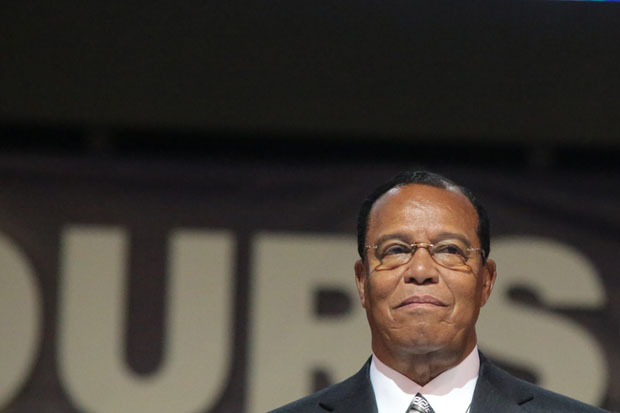
(Image: Thabo Jaiyesimi/Demotix)
The American Nation of Islam leader has been banned from entering the UK since 1986, due to racist and antisemitic remarks like calling Jews “bloodsuckers” and Judaism a “gutter religion”. The ban was briefly overturned in 2001 by a High Court ruling, but the government won out in the Appeals Court the following year.
Michael Savage
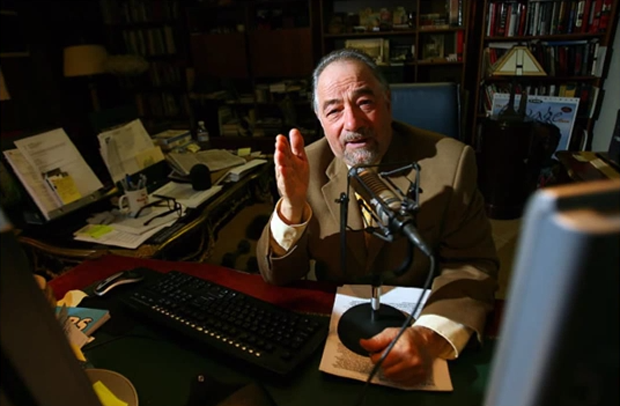
(Image: Clifford Dombrowski/YouTube)
In 2009, then Home Secretary Jacqui Smith announced a 16-person banned-list, made public in a bid to explain the authorities reasoning for barring people from entering the country. On the list was shock-jock Savage — a popular American talk radio host, who has outraged listeners with comments like “Latinos ‘breed like rabbits'” and “Muslims ‘need deporting'”. He was banned for being “likely to cause inter-community tension or even violence”. Savage reacted with disbelief, claiming he would sue Smith. The ban was reaffirmed in 2011.
This article was originally posted on 5 February 2014 at indexoncensorship.org
