2 Apr 2020 | News, Statements
[vc_row][vc_column][vc_column_text]Index on Censorship is among 107 organisations that are urging governments to respect human rights and civil liberties as they attempt to tackle the coronavirus pandemic through digital surveillance technologies.
“As the coronavirus continues to spread and threaten public health, governments are taking unprecedented actions to bring it under control. But the pandemic must not be used to usher in invasive digital surveillance,” said Jessica Ní Mhainín, Policy Research and Advocacy Officer at Index on Censorship. “Measures must have a legal basis, be targeted exclusively at curtailing the virus, and have safeguards in place to prevent violations of privacy.”
STATEMENT:
The Covid-19 pandemic is a global public health emergency that requires a coordinated and large-scale response by governments worldwide. However, states’ efforts to contain the virus must not be used as a cover to usher in a new era of greatly expanded systems of invasive digital surveillance.
We, the undersigned organisations, urge governments to show leadership in tackling the pandemic in a way that ensures that the use of digital technologies to track and monitor individuals and populations is carried out strictly in line with human rights.
Technology can and should play an important role during this effort to save lives, such as to spread public health messages and increase access to health care. However, an increase in state digital surveillance powers, such as obtaining access to mobile phone location data, threatens privacy, freedom of expression and freedom of association, in ways that could violate rights and degrade trust in public authorities – undermining the effectiveness of any public health response. Such measures also pose a risk of discrimination and may disproportionately harm already marginalised communities.
These are extraordinary times, but human rights law still applies. Indeed, the human rights framework is designed to ensure that different rights can be carefully balanced to protect individuals and wider societies. States cannot simply disregard rights such as privacy and freedom of expression in the name of tackling a public health crisis. On the contrary, protecting human rights also promotes public health. Now more than ever, governments must rigorously ensure that any restrictions to these rights is in line with long-established human rights safeguards.
This crisis offers an opportunity to demonstrate our shared humanity. We can make extraordinary efforts to fight this pandemic that are consistent with human rights standards and the rule of law. The decisions that governments make now to confront the pandemic will shape what the world looks like in the future.
We call on all governments not to respond to the Covid-19 pandemic with increased digital surveillance unless the following conditions are met:
1. Surveillance measures adopted to address the pandemic must be lawful, necessary and proportionate. They must be provided for by law and must be justified by legitimate public health objectives, as determined by the appropriate public health authorities, and be proportionate to those needs. Governments must be transparent about the measures they are taking so that they can be scrutinized and if appropriate later modified, retracted, or overturned. We cannot allow the Covid-19 pandemic to serve as an excuse for indiscriminate mass surveillance.
2. If governments expand monitoring and surveillance powers then such powers must be time-bound, and only continue for as long as necessary to address the current pandemic. We cannot allow the Covid-19 pandemic to serve as an excuse for indefinite surveillance.
3. States must ensure that increased collection, retention, and aggregation of personal data, including health data, is only used for the purposes of responding to the Covid-19 pandemic. Data collected, retained, and aggregated to respond to the pandemic must be limited in scope, time-bound in relation to the pandemic and must not be used for commercial or any other purposes. We cannot allow the Covid-19 pandemic to serve as an excuse to gut individuals’ right to privacy.
4. Governments must take every effort to protect people’s data, including ensuring sufficient security of any personal data collected and of any devices, applications, networks, or services involved in collection, transmission, processing, and storage. Any claims that data is anonymous must be based on evidence and supported with sufficient information regarding how it has been anonymised. We cannot allow attempts to respond to this pandemic to be used as justification for compromising people’s digital safety.
5. Any use of digital surveillance technologies in responding to Covid-19, including big data and artificial intelligence systems, must address the risk that these tools will facilitate discrimination and other rights abuses against racial minorities, people living in poverty, and other marginalised populations, whose needs and lived realities may be obscured or misrepresented in large datasets. We cannot allow the Covid-19 pandemic to further increase the gap in the enjoyment of human rights between different groups in society.
6. If governments enter into data sharing agreements with other public or private sector entities, they must be based on law, and the existence of these agreements and information necessary to assess their impact on privacy and human rights must be publicly disclosed – in writing, with sunset clauses, public oversight and other safeguards by default. Businesses involved in efforts by governments to tackle Covid-19 must undertake due diligence to ensure they respect human rights, and ensure any intervention is firewalled from other business and commercial interests. We cannot allow the Covid-19 pandemic to serve as an excuse for keeping people in the dark about what information their governments are gathering and sharing with third parties.
7. Any response must incorporate accountability protections and safeguards against abuse. Increased surveillance efforts related to Covid-19 should not fall under the domain of security or intelligence agencies and must be subject to effective oversight by appropriate independent bodies. Further, individuals must be given the opportunity to know about and challenge any Covid-19 related measures to collect, aggregate, and retain, and use data. Individuals who have been subjected to surveillance must have access to effective remedies.
8. Covid-19 related responses that include data collection efforts should include means for free, active, and meaningful participation of relevant stakeholders, in particular experts in the public health sector and the most marginalized population groups.
Signatories:
7amleh – Arab Center for Social Media Advancement
Access Now
African Declaration on Internet Rights and Freedoms Coalition
AI Now
Algorithm Watch
Alternatif Bilisim
Amnesty International
ApTI
ARTICLE 19
Asociación para una Ciudadanía Participativa, ACI Participa
Association for Progressive Communications (APC)
ASUTIC, Senegal
Athan – Freedom of Expression Activist Organization
Barracón Digital
Big Brother Watch
Bits of Freedom
Center for Advancement of Rights and Democracy (CARD)
Center for Digital Democracy
Center for Economic Justice
Centro De Estudios Constitucionales y de Derechos Humanos de Rosario
Chaos Computer Club – CCC
Citizen D / Državljan D
Civil Liberties Union for Europe
CódigoSur
Coding Rights
Coletivo Brasil de Comunicação Social
Collaboration on International ICT Policy for East and Southern Africa (CIPESA)
Comité por la Libre Expresión (C-Libre)
Committee to Protect Journalists
Consumer Action
Consumer Federation of America
Cooperativa Tierra Común
Creative Commons Uruguay
D3 – Defesa dos Direitos Digitais
Data Privacy Brasil
Democratic Transition and Human Rights Support Center “DAAM”
Derechos Digitales
Digital Rights Lawyers Initiative (DRLI)
Digital Security Lab Ukraine
Digitalcourage
EPIC
epicenter.works
European Digital Rights – EDRi
Fitug
Foundation for Information Policy Research
Foundation for Media Alternatives
Fundación Acceso (Centroamérica)
Fundación Ciudadanía y Desarrollo, Ecuador
Fundación Datos Protegidos
Fundación Internet Bolivia
Fundación Taigüey, República Dominicana
Fundación Vía Libre
Hermes Center
Hiperderecho
Homo Digitalis
Human Rights Watch
Hungarian Civil Liberties Union
ImpACT International for Human Rights Policies
Index on Censorship
Initiative für Netzfreiheit
Innovation for Change – Middle East and North Africa
International Commission of Jurists
International Service for Human Rights (ISHR)
Intervozes – Coletivo Brasil de Comunicação Social
Ipandetec
IPPF
Irish Council for Civil Liberties (ICCL)
IT-Political Association of Denmark
Iuridicum Remedium z.s. (IURE)
Karisma
La Quadrature du Net
Liberia Information Technology Student Union
Liberty
Luchadoras
Majal.org
Masaar “Community for Technology and Law”
Media Rights Agenda (Nigeria)
MENA Rights Group
Metamorphosis Foundation
New America’s Open Technology Institute
Observacom
Open Data Institute
Open Rights Group
OpenMedia
OutRight Action International
Pangea
Panoptykon Foundation
Paradigm Initiative (PIN)
PEN International
Privacy International
Public Citizen
Public Knowledge
R3D: Red en Defensa de los Derechos Digitales
RedesAyuda
SHARE Foundation
Skyline International for Human Rights
Sursiendo
Swedish Consumers’ Association
Tahrir Institute for Middle East Policy (TIMEP)
Tech Inquiry
TechHerNG
TEDIC
The Bachchao Project
Unwanted Witness, Uganda
WITNESS
World Wide Web Foundation
[/vc_column_text][/vc_column][/vc_row]
17 Oct 2019 | News, Student Reading Lists
[vc_row][vc_column][vc_column_text]Index on Censorship was established in 1972 in a febrile period: Idi Amin had taken power in Uganda, the Vietnam war continued, direct rule was imposed in Northern Ireland, there was a coup in Bolivia and Congo was renamed Zaire by its dictator president. As writer Robert McCrum said in our 40th anniversary issue: “The abuses of freedom worldwide in the 1970s were so appalling and so widespread that the magazine rapidly found itself in the frontline of campaigns. Index became a clarion voice in the cause of free expression.” The right to protest and freedom of expression are now being sought in Hong Kong and elsewhere, and Index is still to the forefront in reporting abuses. Here are just some of the conflicts between freedom and dictatorship we have reported on in the past 47 years.
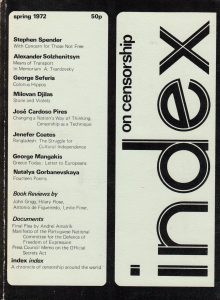
The first issue of Index on Censorship magazine, in March 1972
The Clockwork Show vol 1, issue 1, March 1972
In an anonymous article about life in Greece under the regime of the Colonels’ junta, the writer considered the psychology of the situation; the feelings and attitudes, the long-ranging impact of this harrowing experience. “There is nothing more demoralizing than to be bound to a public body, an administration, a government with which one can never for a moment identify, which is the exact opposite of everything one believes in. One cannot live side by side with Philistinism, chauvinism, bigotry, blatant hypocrisy, crass ignorance, injustice, violence and brutality and not be affected by them, even if one manages—only just—to keep them out of one’s own life. Under this regime there is no relief; no exception: the regime has penetrated every single aspect of public life.”
Read the full article
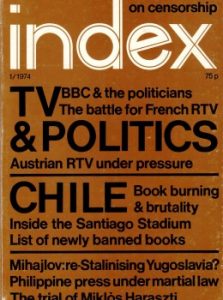
March 1974: TV, politics and Chile Index on Censorship magazine
Book burning and brutality vol 3, issue 1, March 1974
A fascinating insight into life in Chile six months after a coup ended the tyranny of President Salvador Allende: worse was to come under a military dictatorship, reported Michael Sanders, an Englishman in Santiago. “When Allende left Chile to address the UN in December 1972, a leading opposition newspaper had as its front-page a photo depicting the president flushing himself down a lavatory, with the caption ‘ good riddance’. The contrast in December 1973 is gloomy indeed. Not so much, or not only because of the drab uniformity of censored newspapers that, for all they may be censored, willingly reflect the views of the Military Junta. But for the fact that 43.6% of the population have been deprived of all means of expression, of all normal communication, and live in daily fear of their lives and jobs.”
Read the full article

Russia, East Germany, South Africa: May 1979 Index on Censorship magazine
Black journalists under apartheid volume 8, issue 3, May 1979
William A Hachten reports: Black journalists came to the fore in the Soweto riots of 1976 when they reported from the ghetto for a white press without access. Yet black journalists still faced daily harassment under apartheid, which worsened with the death of Steve Biko in 1977. Vusi Radebe, a black stringer for the Rand Daily Mail, said: “The situation is worse since the 1976 riots. Police will beat up reporters on the slightest provocation for what they consider obstruction of justice.” While whites had 23 newspapers, there were none for non-whites to express their political frustration. Black journalist Pearl Luthuli said: “The black journalist can’t be objective. We try to tell it like it is but the white editors won’t print it.” Another said: “We are black people first, journalists second. If it comes to a conflict between the struggle and the job, the struggle comes first.”
Read the full article

Beckett and Havel: Index on Censorship magazine, February 1984
Iran under the party of God, volume 13, issue 1, February 1984
“Censorship was planned by the regime of the Islamic Republic even before the February 1979 revolution brought Ayatollah Khomeini’s theocratic oligarchy to power. This particular kind of censorship may not be without precedent in history, but it must certainly be rare. There were attacks on coffee-houses, restaurants and other public places by men armed with clubs and stones; unveiled women were harassed; slogans of the opposition were cleaned from the walls; banks, cinemas and theatres were burned” – a personal account of the first years of the revolution and its attack on culture, by one of Iran’s leading writers Gholam Hoseyn Sa’edi. “And it keeps on happening. The Islamic regime of today has gone a step beyond censoring the creations of science, culture and art, beyond censoring life itself: it has rendered life vain and all but unliveable.”
Read the full article
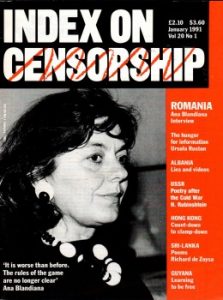
Romania, Albania, USSR: Index on Censorship magazine January 1991
A sense of solidarity, volume 20, issue 1, January 1991
Romania’s celebrated poet, Ana Blandiana, on censorship under Ceausescu and how she fought back. Her work was completely banned three times. “In my case, the form of censorship progressed from the banning of a word to that of a line, then of a poem, then of a book, to the total erasure of my signature as author: an eradication of identity. My inner freedom was assured by a decision I took in 1980, a personal one rather than as a writer. I decided to be outspoken and say what I thought at the risk of becoming a victim myself, rather than suspect a possibly honest person. At first it kept me sane, and then it helped me to be a normal writer, relatively free of self-censorship. This was the strongest form of censorship under Communism in the last 10 or 15 years, and was much more refined and subtle than the official censorship.”
Read the full article
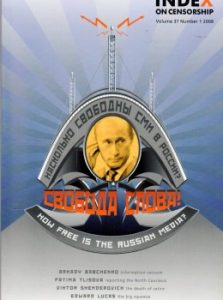
How free is the Russian media? Index on Censorship, Spring 2007
The Big Squeeze, volume 37, issue 1, Spring 2008
“The fact remains that since the departure of the oligarchs, Russian media freedom has gone from the imperfect and beleaguered to the moribund. At national television, which 90 per cent of Russians say is their main source of news, editors receive weekly or even daily instructions from the Kremlin on the ‘line to take’ on important stories; around half of Russian viewers think that what they watch is objective, a 2007 poll said. Foreign coverage is polemical and outrageously politicised. The message of all this is ‘be quiet’. If you annoy the rich and powerful you face threats, beatings or death. Even when the Kremlin is not directly involved, its reaction to the persecution of journalists sends a clear message: if you offend the powerful, don’t expect the law to protect you.” Edward Lucas gave an early taste of what freedom of expression meant under Putin.
Read the full article
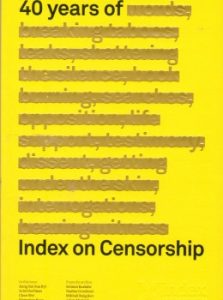
40 years of Index on Censorship March 2012
Grit in the engine, volume 41, issue 1, Spring 2012
Robert McCrum on the 40th anniversary of Index on Censorship. “The success of Index was not a foregone conclusion. Stephen Spender, its founder, was fully alert to the potential for windbaggery and failure. There was, he wrote, ‘the risk that the magazine will become simply a bulletin of frustration’. Actually, the opposite came to pass. Index became a clarion voice in the cause of free expression. The abuses of freedom worldwide in the 1970s were so appalling and so widespread that the magazine rapidly found itself in the frontline of campaigns. Perhaps the most important thing Index did, from the beginning, was to universalise an issue in peril of becoming a special interest: freedom was not ‘a luxury enjoyed by bourgeois individualists’. Along with self-expression, it was a human right, and an instrument of human consciousness.
Read the full article
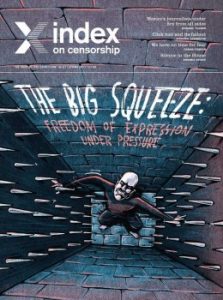
The big squeeze: Index on Censorship magazine Spring 2017
Freedom of expression under pressure, volume 46, issue 1, Spring 2017
The spring 2017 issue of Index on Censorship magazine looks at how pressures on free speech are currently coming from many different angles, not just one. Special features on how to spot fake news, articles from former BBC World Service director Richard Sambrook and former UK attorney general Dominic Grieve, an exclusive interview with the Spanish puppeteer arrested last year, and fiction from award-winning writer Karim Miské.
[/vc_column_text][/vc_column][/vc_row]
13 Nov 2018 | Campaigns -- Featured, Statements
Dear Mark Zuckerberg:
What do the Philadelphia Museum of Art, a Danish member of parliament, and a news anchor from the Philippines have in common? They have all been subject to a misapplication of Facebook’s Community Standards. But unlike the average user, each of these individuals and entities received media attention, were able to reach Facebook staff and, in some cases, receive an apology and have their content restored. For most users, content that Facebook removes is rarely restored and some users may be banned from the platform even in the event of an error.
When Facebook first came onto our screens, users who violated its rules and had their content removed or their account deactivated were sent a message telling them that the decision was final and could not be appealed. It was only in 2011, after years of advocacy from human rights organizations, that your company added a mechanism to appeal account deactivations, and only in 2018 that Facebook initiated a process for remedying wrongful takedowns of certain types of content. Those appeals are available for posts removed for nudity, sexual activity, hate speech or graphic violence.
This is a positive development, but it doesn’t go far enough.
Today, we the undersigned civil society organizations, call on Facebook to provide a mechanism for all of its users to appeal content restrictions, and, in every case, to have the appealed decision re-reviewed by a human moderator.
Facebook’s stated mission is to give people the power to build community and bring the world closer together. With more than two billion users and a wide variety of features, Facebook is the world’s premier communications platform. We know that you recognize the responsibility you have to prevent abuse and keep users safe. As you know, social media companies, including Facebook, have a responsibility to respect human rights, and international and regional human rights bodies have a number of specific recommendations for improvement, notably concerning the right to remedy.
Facebook remains far behind its competitors when it comes to affording its users due process. 1 We know from years of research and documentation that human content moderators, as well as machine learning algorithms, are prone to error, and that even low error rates can result in millions of silenced users when operating at massive scale. Yet Facebook users are only able to appeal content decisions in a limited set of circumstances, and it is impossible for users to know how pervasive erroneous content takedowns are without increased transparency on Facebook’s part. 2
While we acknowledge that Facebook can and does shape its Community Standards according to its values, the company nevertheless has a responsibility to respect its users’ expression to the best of its ability. Furthermore, civil society groups around the globe have criticized the way that Facebook’s Community Standards exhibit bias and are unevenly applied across different languages and cultural contexts. Offering a remedy mechanism, as well as more transparency, will go a long way toward supporting user expression.
Earlier this year, a group of advocates and academics put forward the Santa Clara Principles on Transparency and Accountability in Content Moderation, which recommend a set of minimum standards for transparency and meaningful appeal. This set of recommendations is consistent with the work of the UN Special Rapporteur on the promotion of the right to freedom of expression and opinion David Kaye, who recently called for a “framework for the moderation of user- generated online content that puts human rights at the very center.” It is also consistent with the UN Guiding Principles on Business and Human Rights, which articulate the human rights responsibilities of companies.
Specifically, we ask Facebook to incorporate the Santa Clara Principles into their content moderation policies and practices and to provide:
Notice: Clearly explain to users why their content has been restricted.
- Notifications should include the specific clause from the Community Standards that the content was found to violate.
- Notice should be sufficiently detailed to allow the user to identify the specific content that was restricted and should include information about how the content was detected, evaluated, and removed.
- Individuals must have clear information about how to appeal the decision.
Appeals: Provide users with a chance to appeal content moderation decisions.
- Appeals mechanisms should be easily accessible and easy to use.
- Appeals should be subject to review by a person or panel of persons that was not involved in the initial decision.
- Users must have the right to propose new evidence or material to be considered in the review.
- Appeals should result in a prompt determination and reply to the user.
- Any exceptions to the principle of universal appeals should be clearly disclosed and compatible with international human rights principles.
- Facebook should collaborate with other stakeholders to develop new independent self-regulatory mechanisms for social media that will provide greater accountability3
Numbers: Issue regular transparency reports on Community Standards enforcement.
- Present complete data describing the categories of user content that are restricted (text, photo or video; violence, nudity, copyright violations, etc), as well as the number of pieces of content that were restricted or removed in each category.
- Incorporate data on how many content moderation actions were initiated by a user flag, a trusted flagger program, or by proactive Community Standards enforcement (such as through the use of a machine learning algorithm).
- Include data on the number of decisions that were effectively appealed or otherwise found to have been made in error.
- Include data reflecting whether the company performs any proactive audits of its unappealed moderation decisions, as well as the error rates the company found.
Article 19, Electronic Frontier Foundation, Center for Democracy and Technology, and Ranking Digital Rights
Fundación Ciudadano Inteligente
7amleh – Arab Center for Social Media Advancement
Access Now
ACLU Foundation of Northern California
Adil Soz – International Foundation for Protection of Freedom of Speech
Africa Freedom of Information Centre (AFIC)
Albanian Media Institute
American Civil Liberties Union
Americans for Democracy & Human Rights in Bahrain (ADHRB)
Arab Digital Expression Foundation
Artículo 12
Asociación Mundial de Radios Comunitarias América Latina y el Caribe (AMARC ALC)
Association for Progressive Communications
Brennan Center for Justice at NYU School of Law
Bytes for All (B4A)
CAIR San Francisco Bay Area
CALAM
Cartoonists Rights Network International (CRNI)
Cedar Rapids, Iowa Collaborators
Center for Independent Journalism – Romania
Center for Media Studies & Peace Building (CEMESP)
Child Rights International Network (CRIN)
Committee to Protect Journalists (CPJ)
Digital Rights Foundation
EFF Austin
El Instituto Panameño de Derecho y Nuevas Tecnologías (IPANDETEC)
Electronic Frontier Finland
Elektronisk Forpost Norge
Foro de Periodismo Argentino
Foundation for Press Freedom – FLIP
Freedom Forum
Fundación Acceso
Fundación Ciudadano Inteligente
Fundación Datos Protegidos
Fundación Internet Bolivia.org
Fundación Vía Libre
Fundamedios – Andean Foundation for Media Observation and Study
Garoa Hacker Club
Gulf Center for Human Rights
HERMES Center for Transparency and Digital Human Rights
Hiperderecho
Homo Digitalis
Human Rights Watch
Idec – Brazilian Institute of Consumer Defense
Independent Journalism Center (IJC)
Index on Censorship
Initiative for Freedom of Expression – Turkey
Instituto Nupef
International Press Centre (IPC)
Internet without borders
La Asociación para una Ciudadanía Participativa ACI Participa
MARCH
May First/People Link
Media Institute of Southern Africa (MISA)
Media Rights Agenda (MRA)
Mediacentar Sarajevo
New America’s Open Technology Institute
NYC Privacy
Open MIC (Open Media and Information Companies Initiative)
OpenMedia
Pacific Islands News Association (PINA)
Panoptykon Foundation
PEN America
PEN Canada
Peninsula Peace and Justice Center
Portland TA3M
Privacy Watch
Raging Grannies
ReThink LinkNYC
Rhode Island Rights
SFLC.in
SHARE Foundation
SMEX
South East Europe Media Organisation
Southeast Asian Press Alliance (SEAPA)
SumOfUs
Syrian Archive
Syrian Center for Media and Freedom of Expression (SCM)
t4tech
Techactivist.org
The Association for Freedom of Thought and Expression
Viet Tan
Vigilance for Democracy and the Civic State
Visualizing Impact
Witness
4 Dec 2017 | About Index, History, Magazine, News
[vc_row][vc_column][vc_custom_heading text=”The first editor of Index on Censorship magazine reflects on the driving forces behind its founding in 1972″ google_fonts=”font_family:Libre%20Baskerville%3Aregular%2Citalic%2C700|font_style:400%20italic%3A400%3Aitalic”][vc_column_text][/vc_column_text][vc_row_inner][vc_column_inner][vc_column_text]A version of this article first appeared in Index on Censorship magazine in December 1981. [/vc_column_text][/vc_column_inner][/vc_row_inner][/vc_column][/vc_row][vc_row][vc_column][vc_column_text]
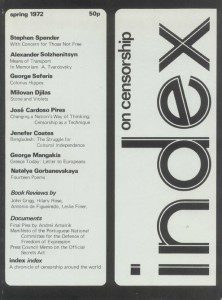
The first issue of Index on Censorship Magazine, 1972
Starting a magazine is as haphazard and uncertain a business as starting a book-who knows what combination of external events and subjective ideas has triggered the mind to move in a particular direction? And who knows, when starting, whether the thing will work or not and what relation the finished object will bear to one’s initial concept? That, at least, was my experience with Index, which seemed almost to invent itself at the time and was certainly not ‘planned’ in any rational way. Yet looking back, it is easy enough to trace the various influences that brought it into existence.
It all began in January 1968 when Pavel Litvinov, grandson of the former Soviet Foreign Minister, Maxim Litvinov, and his Englis wife, Ivy, and Larisa Bogoraz, the former wife of the writer, Yuli Daniel, addressed an appeal to world public opinion to condemn the rigged trial of two young writers and their typists on charges of ‘anti-Soviet agitation and propaganda’ (one of the writers, Alexander Ginzburg, was released from the camps in 1979 and now lives in Paris: the other, Yuri Galanskov, died in a camp in 1972). The appeal was published in The Times on 13 January 1968 and evoked an answering telegram of support and sympathy from sixteen English and American luminaries, including W H Auden, A J Ayer, Maurice Bowra, Julian Huxley, Mary McCarthy, Bertrand Russell and Igor Stravinsky.
The telegram had been organised and dispatched by Stephen Spender and was answered, after taking eight months to reach its addressees, by a further letter from Litvinov, who said in part: ‘You write that you are ready to help us “by any method open to you”. We immediately accepted this not as a purely rhetorical phrase, but as a genuine wish to help….’ And went on to indicate the kind oh help he had in mind:
My friends and I think it would be very important to create an international committee or council that would make it its purpose to support the democratic movement in the USSR. This committee could be composed of universally respected progressive writers, scholars, artists and public personalities from England, the United States, France, Germany and other western countries, and also from Latin America, Asia, Africa and, in the future, even from Eastern Europe…. Of course, this committee should not have an anti-communist or anti-Soviet character. It would even be good if it contained people persecuted in their own countries for pro-communist or independent views…. The point is not that this or that ideology is not correct, but that it must not use force to demonstrate its correctness.
Stephen Spender took up this idea first with Stuart Hampshire (the Oxford philosopher), a co-signatory of the telegram, and with David Astor (then editor of the Observer), who joined them in setting up a committee along the lines suggested by Litvinov (among its other members were Louis Blom-Cooper, Edward Crankshaw, Lord Gardiner, Elizabeth Longford and Sir Roland Penrose, and its patrons included Dame Peggy Ashcroft, Sir Peter Medawar, Henry Moore, Iris Murdoch, Sir Michael Tippett and Angus Wilson). It was not, admittedly, as international as Litvinov had suggested, but it was thought more practical to begin locally, so to speak, and to see whether or not there was something in it before expanding further. Nevertheless, the chosen name for the new organisation, Writers and Scholars International, was an earnest of its intentions, while its deliberate echo of Amnesty International (then relatively modest in size) indicated a feeling that not only literature but also human rights would be at issue.
By now it was 1971 and in the spring of that year the committee advertised for a director, held a series of interviews and offered me the job. There was no programme, other than Litvinov’s letter, there were no premises or staff, and there was very little money, but there were high hopes and enthusiasm.
It was at this point that some of the subjective factors I mentioned earlier began to come into play. Litvinov’s letter had indicated two possible forms of action. One was the launching of protests to ‘support and defend’ people who were being persecuted for their civic and literary activities in the USSR. The other was to ‘provide information to world public opinion’ about this state of affairs and to operate with ‘some sort of publishing house’. The temptation was to go for the first, particularly since Amnesty was setting such a powerful example, but precisely because Amnesty (and the International PEN Club) were doing such a good job already, I felt that the second option would be the more original and interesting to try. Furthermore, I knew that two of our most active members, Stephen Spender and Stuart Hampshire, on the rebound from Encounter after disclosures of CIA funding, had attempted unsuccessfully to start a new magazine, and I felt that they would support something in the publishing line. And finally, my own interests lay mainly in that direction. My experience had been in teaching, writing, translating and broadcasting. Psychologically I was too much of a shrinking violet to enjoy kicking up a fuss in public. I preferred argument and debate to categorical statements and protest, the printed page to the soapbox; I needed to know much more about censorship and human rights before having strong views of my own.
At that stage I was thinking in terms of trying to start some sort of alternative or ‘underground’ (as the term was misleadingly used) newspaper – Oz and the International Times were setting the pace were setting the pace in those days, with Time Out just in its infancy. But a series of happy accidents began to put other sorts of material into my hands. I had been working recently on Solzhenitzin and suddenly acquired a tape-recording with some unpublished poems in prose on it. On a visit to Yugoslavia, I called on Milovan Djilas and was unexpectedly offered some of his short stories. A Portuguese writer living in London, Jose Cardoso Pires, had just written a first-rate essay on censorship that fell into my hands. My friend, Daniel Weissbort, editor of Modern Poetry in Translation, was working on some fine lyrical poems by the Soviet poet, Natalya Gorbanevskaya, then in a mental hospital. And above all I stumbled across the magnificent ‘Letter to Europeans’ by the Greek law professor, George Mangakis, written in one of the colonels’ jails (which I still consider to be one of the best things I have ever published). It was clear that these things wouldn’t fit very easily into an Oz or International Times, yet it was even clearer that they reflected my true tastes and were the kind of writing, for better or worse, that aroused my enthusiasm. At the same time I discovered that from the point of view of production and editorial expenses, it would be far easier to produce a magazine appearing at infrequent intervals, albeit a fat one, than to produce even the same amount of material in weekly or fortnightly instalments in the form of a newspaper. And I also discovered, as Anthony Howard put it in an article about the New Statesman, that whereas opinions come cheap, facts come dear, and facts were essential in an explosive field like human rights. Somewhat thankfully, therefore, my one assistant and I settled for a quarterly magazine.
There is no point, I think, in detailing our sometimes farcical discussions of a possible title. We settled on Index (my suggestion) for what seemed like several good reasons: it was short; it recalled the Catholic Index Librorum Prohibitorum; it was to be an index of violations of intellectual freedom; and lastly, so help me an index finger pointing accusingly at the guilty oppressors – we even introduced a graphic of a pointing finger into our early issues. Alas, when we printed our first covers bearing the bold name of Index (vertically to attract attention nobody got the point (pun unintended). Panicking, we hastily added the ‘on censorship’ as a subtitle – Censorship had been the title of an earlier magazine, by then defunct – and this it has remained ever since, nagging me with its ungrammatically (index of censorship, surely) and a standing apology for the opacity of its title. I have since come to the conclusion that it is a thoroughly bad title – Americans, in particular, invariably associate it with the cost of living and librarians with, well indexes. But it is too late to change now.
Our first issue duly appeared in May 1972, with a programmatic article by Stephen Spender (printed also in the TLS) and some cautious ‘Notes’ by myself. Stephen summarised some of the events leading up to the foundation of the magazine (not naming Litvinov, who was then in exile in Siberia) and took freedom and tyranny as his theme:
Obviously there is a risk of a magazine of this kind becoming a bulletin of frustration. However, the material by writers which is censored in Eastern Europe, Greece, South Africa and other countries is among the most exciting that is being written today. Moreover, the question of censorship has become a matter of impassioned debate; and it is one which does not only concern totalitarian societies.
I contented myself with explaining why there would be no formal programme and emphasised that we would be feeling our way step by step. ‘We are naturally of the opinion that a definite need {for us} exists….But only time can tell whether the need is temporary or permanent—and whether or not we shall be capable of satisfying it. Meanwhile our aims and intentions are best judged…by our contents, rather than by editorials.’
[/vc_column_text][/vc_column][/vc_row][vc_row][vc_column width=”1/4″][vc_icon icon_fontawesome=”fa fa-quote-left” color=”custom” align=”right” custom_color=”#dd3333″][/vc_column][vc_column width=”3/4″][vc_custom_heading text=”My friends and I think it would be very important to create an international committee or council that would make it its purpose to support the democratic movement in the USSR.” google_fonts=”font_family:Libre%20Baskerville%3Aregular%2Citalic%2C700|font_style:400%20italic%3A400%3Aitalic”][/vc_column][/vc_row][vc_row][vc_column][vc_column_text]
In the course of the next few years it became clear that the need for such a magazine was, if anything, greater than I had foreseen. The censorship, banning and exile of writers and journalists (not to speak of imprisonment, torture and murder) had become commonplace, and it seemed at times that if we hadn’t started Index, someone else would have, or at least something like it. And once the demand for censored literature and information about censorship was made explicit, the supply turned out to be copious and inexhaustible.
One result of being inundated with so much material was that I quickly learned the geography of censorship. Of course, in the years since Index began, there have been many changes. Greece, Spain, and Portugal are no longer the dictatorships they were then. There have been major upheavals in Poland, Turkey, Iran, the Lebanon, Pakistan, Nigeria, Ghana and Zimbabwe. Vietnam, Cambodia and Afghanistan have been silenced, whereas Chinese writers have begun to find their voices again. In Latin America, Brazil has attained a measure of freedom, but the southern cone countries of Chile, Argentina, Uruguay and Bolivia have improved only marginally and Central America has been plunged into bloodshed and violence.
Despite the changes, however, it became possible to discern enduring patterns. The Soviet empire, for instance, continued to maltreat its writers throughout the period of my editorship. Not only was the censorship there highly organised and rigidly enforced, but writers were arrested, tried and sent to jail or labour camps with monotonous regularity. At the same time, many of the better ones, starting with Solzhenitsyn, were forced or pushed into exile, so that the roll-call of Russian writers outside the Soviet Union (Solzhenitsyn, Sinyavksy, Brodsky, Zinoviev, Maximov, Voinovich, Aksyonov, to name but a few) now more than rivals, in talent and achievement, those left at home. Moreover, a whole array of literary magazines, newspapers and publishing houses has come into existence abroad to serve them and their readers.
In another main black spot, Latin America, the censorship tended to be somewhat looser and ill-defined, though backed by a campaign of physical violence and terror that had no parallel anywhere else. Perhaps the worst were Argentina and Uruguay, where dozens of writers were arrested and ill-treated or simply disappeared without trace. Chile, despite its notoriety, had a marginally better record with writers, as did Brazil, though the latter had been very bad during the early years of Index.
In other parts of the world, the picture naturally varies. In Africa, dissident writers are often helped by being part of an Anglophone or Francophone culture. Thus Wole Soyinka was able to leave Nigeria for England, Kofi Awoonor to go from Ghana to the United States (though both were temporarily jailed on their return), and French-speaking Camara Laye to move from Guinea to neighbouring Senegal. But the situation can be more complicated when African writers turn to the vernacular. Ngugi wa Thiong’o, who has written some impressive novels in English, was jailed in Kenya only after he had written and produced a play in his native Gikuyu.
In Asia the options also tend to be restricted. A mainland Chinese writer might take refuge in Hong Kong or Taiwan, but where is a Taiwanese to go? In Vietnam, Cambodia, Laos, the possibilities for exile are strictly limited, though many have gone to the former colonising country, France, which they still regard as a spiritual home, and others to the USA. Similarly, Indonesian writers still tend to turn to Holland, Malaysians to Britain, and Filipinos to the USA.
In documenting these changes and movements, Index was able to play its small part. It was one of the very first magazines to denounce the Shah’s Iran, publishing as early as 1974 an article by Sadeq Qotbzadeh, later to become Foreign Minister in Ayatollah Khomeini’s first administration. In 1976 we publicised the case of the tortured Iranian poet, Reza Baraheni, whose testimony subsequently appeared on the op-ed page of the New York Times. (Reza Baraheni was arrested, together with many other writers, by the Khomeini regime on 19 October 1981.) One year later, Index became the publisher of the unofficial and banned Polish journal, Zapis, mouthpiece of the writers and intellectuals who paved the way for the present liberalisation in Poland. And not long after that it started putting out the Czech unofficial journal, Spektrum, with a similar intellectual programme. We also published the distinguished Nicaraguan poet, Ernesto Cardenal, before he became Minister of Education in the revolutionary government, and the South Korean poet, Kim Chi-ha, before he became an international cause célèbre.
[/vc_column_text][/vc_column][/vc_row][vc_row][vc_column width=”1/4″][vc_icon icon_fontawesome=”fa fa-quote-left” color=”custom” align=”right” custom_color=”#dd3333″][/vc_column][vc_column width=”3/4″][vc_custom_heading text=”Looking back, not only over the thirty years since Index was started, but much further, over the history of our civilisation, one cannot help but realise that censorship is by no means a recent phenomenon.” google_fonts=”font_family:Libre%20Baskerville%3Aregular%2Citalic%2C700|font_style:400%20italic%3A400%3Aitalic”][/vc_column][/vc_row][vc_row][vc_column][vc_column_text]
One of the bonuses of doing this type of work has been the contact, and in some cases friendship, established with outstanding writers who have been in trouble: Solzhenitsyn, Djilas, Havel, Baranczak, Soyinka, Galeano, Onetti, and with the many distinguished writers from other parts of the world who have gone out of their way to help: Heinrich Böll, Mario Vargas Llosa, Stephen Spender, Tom Stoppard, Philip Roth—and many other too numerous to mention. There is a kind of global consciousness coming into existence, which Index has helped to foster and which is especially noticeable among writers. Fewer and fewer are prepared to stand aside and remain silent while their fellows are persecuted. If they have taught us nothing else, the Holocaust and the Gulag have rubbed in the fact that silence can also be a crime.
The chief beneficiaries of this new awareness have not been just the celebrated victims mentioned above. There is, after all, an aristocracy of talent that somehow succeeds in jumping all the barriers. More difficult to help, because unassisted by fame, are writers perhaps of the second or third rank, or young writers still on their way up. It is precisely here that Index has been at its best.
Such writers are customarily picked on, since governments dislike the opprobrium that attends the persecution of famous names, yet even this is growing more difficult for them. As the Lithuanian theatre director, Jonas Jurasas, once wrote to me after the publication of his open letter in Index, such publicity ‘deprives the oppressors of free thought of the opportunity of settling accounts with dissenters in secret’ and ‘bears witness to the solidarity of artists throughout the world’.
Looking back, not only over the years since Index was started, but much further, over the history of our civilisation, one cannot help but realise that censorship is by no means a recent phenomenon. On the contrary, literature and censorship have been inseparable pretty well since earliest times. Plato was the first prominent thinker to make out a respectable case for it, recommending that undesirable poets be turned away from the city gates, and we may suppose that the minstrels and minnesingers of yore stood to be driven from the castle if their songs displeased their masters. The examples of Ovid and Dante remind us that another old way of dealing with bad news was exile: if you didn’t wish to stop the poet’s mouth or cover your ears, the simplest solution was to place the source out of hearing. Later came the Inquisition, after which imprisonment, torture and execution became almost an occupational hazard for writers, and it is only in comparatively recent times—since the eighteenth century—that scribblers have fought back and demanded an unconditional right to say what they please. Needless to say, their demands have rarely and in few places been met, but their rebellion has resulted in a new psychological relationship between rulers and ruled.
Index, of course, ranged itself from the very first on the side of the scribblers, seeking at all times to defend their rights and their interests. And I would like to think that its struggles and campaigns have borne some fruit. But this is something that can never be proved or disproved, and perhaps it is as well, for complacency and self-congratulation are the last things required of a journal on human rights. The time when the gates of Plato’s city will be open to all is still a long way off. There are certainly many struggles and defeats still to come—as well, I hope, as occasional victories. When I look at the fragility of Index‘s a financial situation and the tiny resources at its disposal I feel surprised that it has managed to hold out for so long. No one quite expected it when it started. But when I look at the strength and ambitiousness of the forces ranged against it, I am more than ever convinced that we were right to begin Index in the first place, and that the need for it is as strong as ever. The next ten years, I feel, will prove even more eventful than the ten that have gone before.
[/vc_column_text][/vc_column][/vc_row][vc_row][vc_column][vc_column_text]
Michael Scammell was the editor of Index on Censorship from 1972 to August 1980.
[/vc_column_text][/vc_column][/vc_row][vc_row content_placement=”top”][vc_column width=”1/3″][vc_custom_heading text=”Free to air” font_container=”tag:p|font_size:24|text_align:left” link=”url:%20https%3A%2F%2Fwww.indexoncensorship.org%2F2017%2F09%2Ffree-to-air%2F|||”][vc_column_text]Through a range of in-depth reporting, interviews and illustrations, the autumn 2017 issue of Index on Censorship magazine explores how radio has been reborn and is innovating ways to deliver news in war zones, developing countries and online
With: Ismail Einashe, Peter Bazalgette, Wana Udobang[/vc_column_text][/vc_column][vc_column width=”1/3″][vc_single_image image=”95458″ img_size=”medium” alignment=”center” onclick=”custom_link” link=”https://www.indexoncensorship.org/2017/09/free-to-air/”][/vc_column][vc_column width=”1/3″ css=”.vc_custom_1481888488328{padding-bottom: 50px !important;}”][vc_custom_heading text=”Subscribe” font_container=”tag:p|font_size:24|text_align:left” link=”url:https%3A%2F%2Fwww.indexoncensorship.org%2Fsubscribe%2F|||”][vc_column_text]In print, online. In your mailbox, on your iPad.
Subscription options from £18 or just £1.49 in the App Store for a digital issue.
Every subscriber helps support Index on Censorship’s projects around the world.
 SUBSCRIBE NOW[/vc_column_text][/vc_column][/vc_row]
