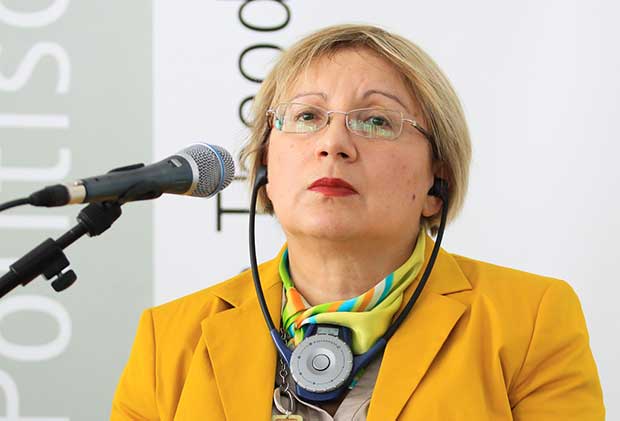
We — members of the Civic Solidarity Platform and the Sports For Rights Campaign — were relieved to learn that one of Azerbaijan’s most well-known political prisoners, Leyla Yunus, was released from detention yesterday and that that the Baku City Court of Appeal changed her sentence and that of her husband Arif into suspended sentences of 5 years, on probation. However, most of the charges against the couple have not been dropped and, while on probation, Leyla and Arif Yunus will not be able to leave the country. We remain seriously concerned about the state of health of Leyla Yunus, who has been diagnosed with diabetes and hepatitis C, and that of Arif Yunus, who suffers from high blood pressure. There are doubts that adequate medical assistance can be provided to Leyla Yunus in Azerbaijan.
As part of the ongoing civil society crackdown in Azerbaijan, Leyla and her husband Arif were arrested in late July and early August 2014, respectively. On 13 August 2015, they were convicted on charges of large‑scale fraud and tax evasion. Leyla was sentenced to 8.5 years in prison and Arif to 7 years. While in detention, they were humiliated by police officers, put in overcrowded cells, beaten several times and deprived of much needed medical treatment. On 13 November 2015, Arif Yunus was released under house arrest on health grounds. When ruling to change the sentences, the court of appeal dropped the charges of forgery, but retained others. The court also lifted the order to seize the house owned by the couple.
We, members of the Civic Solidarity Platform and the Sports for Rights Campaign, consider the new developments in the case of Arif and Leyla Yunus to be positive and a first step in the right direction. However, we continue to call for all charges against the couple to be dropped. Leyla Yunus requires an urgent medical examination and she should be granted the right to receive medical treatment abroad if necessary. Arif Yunus must also be provided with swift and adequate medical assistance.
Leyla and Arif Yunus are not the only political prisoners in Azerbaijan. Dozens of other civil society activists, human rights lawyers and journalists remain in detention or prison in Azerbaijan solely due to their professional activities and the peaceful and legitimate exercise of their fundamental rights and freedoms. They should be immediately and unconditionally released. The Azerbaijani government must respect its commitments before its own people, as well as its obligations under international human rights law.
Signed by:
Analytical Center for Interethnic Cooperation and Consultations
Article 19
Association UMDPL
Bulgarian Helsinki Committee
Baris Zvozkau Belarusian Human Rights House
Center for Civil liberties
Center for the Development of Democracy and Human Rights
Crude Accountability
Freedom Files
Helsinki Committee for Human Rights in Serbia
Helsinki Foundation for Human Rights
Human Rights House Foundation
Human Rights Monitoring Institute
Human Rights Movement “Bir Duino-Kyrgyzstan”
Index on Censorship
International Federation for Human Rights (FIDH)
International Partnership for Human Rights
Kazakhstan International Bureau for Human Rights and Rule of Law
We, the undersigned organisations, all dedicated to the value of creative freedom, are writing to express our grave concern that Ashraf Fayadh has been sentenced to death for apostasy.
Ashraf Fayadh, a poet, artist, curator, and member of British-Saudi art organisation Edge of Arabia, was first detained in August 2013 in relation to his collection of poems Instructions Within following the submission of a complaint to the Saudi Committee for the Promotion of Virtue. He was released on bail but rearrested in January 2014.
According to court documents, in May 2014 the General Court of Abha found proof that Fayadh had committed apostasy (ridda) but had repented for it. The charge of apostasy was dropped, but he was nevertheless sentenced to four years in prison and 800 lashes in relation to numerous charges related to blasphemy.
At Ashraf Fayadh’s retrial in November 2015 the judge reversed the previous ruling, declaring that repentance was not enough to avoid the death penalty. We believe that all charges against him should have been dropped entirely, and are appalled that Fayadh has instead been sentenced to death for apostasy, simply for exercising his rights to freedom of expression and freedom of belief.
As a member of the UN Human Rights Council (HRC), the pre-eminent intergovernmental body tasked with protecting and promoting human rights, and the Chair of the HRC’s Consultative Group, Saudi Arabia purports to uphold and respect the highest standards of human rights. However, the decision of the court is a clear violation of the internationally recognised rights to freedom of conscience and expression. Article 18 of the Universal Declaration of Human Rights (UDHR) states that, “[e]veryone has the right to freedom of thought, conscience and religion; this right includes freedom to change his religion or belief”. Furthermore, under Article 19 of the Universal Declaration of Human Rights, “everyone has the right to freedom of opinion and expression; this right includes freedom to hold opinions without interference and to seek, receive and impart information and ideas through any media and regardless of frontiers”. Saudi Arabia is therefore in absolute contravention of the rights that as a member of the UN HRC it has committed to protect.
There are also widespread concerns over an apparent lack of due process in the trial: Fayadh was denied legal representation, reportedly as a result of his ID having been confiscated following his arrest in January 2014. It is our understanding that Fayadh has 30 days to appeal this latest ruling, and we urge the authorities to allow him access to the lawyer of his choice.
We call on the Saudi authorities to release Ashraf Fayadh and others detained in Saudi Arabia in violation of their right to freedom of expression immediately and unconditionally.
List of signatories:
AICA (International Association of Art Critics)
Algerian PEN
All-India PEN
Amnesty International UK
Arterial Network
ARTICLE 19
Artists for Palestine UK
Austrian PEN
Banipal
Bangladesh PEN
Bread and Roses TV
British Humanist Association
Bulgarian PEN
Centre for Secular Space
CIMAM (International Committee for Museums and Collections of Modern Art)
Council of Ex-Muslims of Britain
Croatian PEN
Crossway Foundation
Danish PEN
English PEN
Ethiopian PEN-in-Exile
FIDH (International Federation for Human Rights)
Five Leaves Publications
Freemuse
German PEN
Haitian PEN
Human Rights Watch
Index on Censorship
International Humanist and Ethical Union
Iranian PEN in Exile
Jimmy Wales Foundation
Lebanese PEN
Ledbury Poetry Festival
Lithuanian PEN
Modern Poetry in Translation
National Coalition Against Censorship (NCAC)
Norwegian PEN
One Darnley Road
One Law for All
Palestinian PEN
PEN American Center
PEN Canada
PEN International
PEN South Africa
Peruvian PEN
Peter Tatchell Foundation
Portuguese PEN
Québec PEN
Russian PEN
San Miguel PEN
Scottish PEN
Slovene PEN
Society of Authors
South African PEN
Split This Rock
Suisse Romand PEN
School of Literature, Drama and Creative Writing, University of East Anglia
The Voice Project
Trieste PEN
Turkish PEN
Wales PEN Cymru
Ukrainian President Petro Poroshenko signed a decree on Wednesday 16 September banning at least 38 international journalists and bloggers from Ukraine for one year. The decree, published on the presidential website, says those listed are banned for being “actual or potential threat to national interests, national security, sovereignty and territorial integrity of Ukraine.”
Poroshenko said the people targeted were involved in Russia’s 2014 annexation of Crimea and the current aggression in eastern Ukraine.
“This ban is a serious blow to media freedom,” Index senior advocacy officer Melody Patry said. “There is no explanation whatsoever on what press coverage constitutes an actual or potential threat to national security. We appreciate that the situation in eastern Ukraine is sensitive but preventing journalists from reporting from within the country is not the solution and it’s undermining freedom of information.”
The Committee to Protect Journalists reports that the 34 journalists and seven bloggers named in the ban come from Bulgaria, Estonia, Germany, Hungary, Israel, Kazakhstan, Latvia, Macedonia, Moldova, Poland, Russia, Serbia, Slovakia, Spain, Switzerland and the United Kingdom.
The original list included three BBC media staff members – Moscow correspondent Steve Rosenberg, producer Emma Wells and cameraman Anton Chicherov – who were later removed from the ban list, media reported.
“We cannot accept that kind of censorship”, said Mogens Blicher Bjerregård, president of the European Federation of Journalists. Censorship is never the right answer, even to counter propaganda or to sanction journalists who allegedly crossed the Russian-Ukrainian border illegally. The ban is simply inappropriate. Peace and Development of our democracies need press freedom not banning journalists. We and the international society must firmly urge the Ukraine government to lift immediately the ban on named journalists.”
Over 380 people in total have been banned, including activists and Russian officials.
This measure was added to the Mapping Media Freedom platform, which monitors and map threats and violations to media freedom in Europe, including Ukraine and Russia.
The environment for media freedom in Ukraine has been deteriorating against the backdrop of the conflict in the eastern part of the country, making it one the the deadliest countries for journalists, with at least eight media workers killed since the beginning of 2014.
This statement was updated to reflect the later removal of three BBC journalists from the ban list.
Mapping Media Freedom
Click on the bubbles to view reports or double-click to zoom in on specific regions. The full site can be accessed at https://mappingmediafreedom.org/
George Orwell’s novel 1984 portrays a violent dystopian society surviving through the continuous suppression and falsification of information. We know first-hand that this is how oppression works throughout the world. One of us (Struckman-Johnson) spent decades piecing together difficult-to-find video clips, news articles, and photos in order to successfully teach about the patriarchal oppression of women around the world. One of us (Sternadori) was cautioned at the age of six by her parents (members of the Bulgarian Communist Party) never to repeat their political jokes, lest something horrible happened just by uttering some words.
We have come to embrace the idea that transparency is crucial to ending any form of violence. This is why we were shocked by the recent fervent attempts — in 2015, in the United States of America — to ban the screening of a documentary, Honor Diaries, which tackles the problem of worldwide honor killings and other violence against women, often embedded in state laws, tradition and political indifference.
Honor Diaries is set to be screened on Friday, 10 April, at 1:45 p.m., in the Muenster University Center Grand Ballroom at the University of South Dakota during the upcoming Women and Gender conference. In addition, Muslim women’s rights activist Raheel Raza, one of the nine women featured in the film, is attending the conference and will participate in a post-screening discussion.
But not all is well just because it ends well. The road to this screening has been fraught with obstacles. The film has been accused of Islamophobia, even though it is supported by groups such as Muslims Facing Tomorrow, the Alliance of Iranian Women and other organizations, most of which are women’s rights groups. The brave women shown in the documentary — like Raheel Raza — are either Muslim or were born in Muslim families, and they speak of making the film as an almost-religious duty to humanity.
The film, however, has faced backlash from other Muslims. According to an opinion piece appearing in The Boston Globe, the attempts to censor the film can be traced to an organization called the Council on American-Islamic Relations (CAIR). Indeed, the organization has campaigned to cancel at least one of the film’s screenings, as indicated by its 2014 letter to the United Nations Foundation.
What is curious is that, as one can see from the letter, CAIR appears to have no issues with the film’s content. The organization does not say that the film’s content is Islamophobic, and does not point to any specific elements in the film it finds questionable. CAIR’s problem seems to be not with the film, but with the two executive producers (who in the film business tend to have limited power over the production content) and one of the film’s 42 partner organizations, the Clarion Project, which is said to have funded the documentary. CAIR denies the female filmmakers any agency by shifting the focus of attention away from their work and away from the issues they raise. This is a textbook example of the so-called “ad hominem” logical fallacy, which entails damning the source while saying nothing about the actual content of the message.
How did this controversy play out at USD? It was more dramatic than we were used to seeing. At first, however, the conversation about screening Honor Diaries occurred in a very peaceful and ordinary manner. The film’s promotional team sent emails to faculty and staff members affiliated with the Women and Gender Studies program at USD, inviting them to host a screening. Some of these faculty and staff members forwarded the emails to one of us (Sternadori), suggesting that the film be included in the program of the Women and Gender conference in April. Then, once the film became part of the conference program in January, a student group, the Association for Advancement of Women’s Rights (AAWR), insistently asked to sponsor the film because “it tells an important story about women’s rights in the global community”.
All seemed well until a faculty member from USD’s College of Health Sciences emailed one of us (Sternadori) to say that she “truly believe[d] that showing this movie goes against ‘Inclusive Excellence’ that this University is working hard to achieve”. She followed up by meeting with other members of the university community and voicing her concerns to them. The tide shifted, and a film that is truly heartbreaking — in ways that should never be politicised — became the centre of a massive controversy.
On 20 March, AAWR sent an email to rescind its sponsorship of Honor Diaries because, according to the message, “we are concerned about disrespecting or presenting biased portrayals of the Muslim community.” At a planning meeting for the Women and Gender conference later that day, members of this women’s student group said they did not want to be involved with the film because their office in the Diversity Center is next to the office of the Muslim Student Association, and it is very important for them to maintain a good working relationship. Then, two USD faculty members insisted on removing the film from the conference program. (In addition, a screening of Honor Diaries scheduled for Sunday, 22 March, by the Campus Activities Board mysteriously disappeared from USD’s program of events).
In the end, to ban or not to ban Honor Diaries from the Women and Gender conference was fought over on two occasions by a group of people (including Sternadori and Struckman-Johnson) raised in communities with Christian roots. On both occasions, a mythical Muslim “community” was present like the elephant in the room. Some people very much wanted to defend it.
But they never considered some important questions: who are we to judge which Muslim community or group is more equal than others? Who are we to agree with CAIR’s condemnation of the film over the support from the Council of Muslims Facing Tomorrow and the Alliance of Iranian Women? And who is afraid of screening a film that exposes truly horrific human rights violations?
Even though Honor Diaries remained on the conference program as planned, some faculty still expressed concerns about how we should “frame” the post-screening discussion, given that no members of the Muslim Student Association and not even the faculty member who initially challenged the film are planning to attend. This raises yet another question: who are we to “frame” anything at a public university, where the free flow of ideas is supposed to be encouraged and not restricted?
This has also been very upsetting because it is not the first time in the history of USD’s Women and Gender conference when certain content has created discomfort and resistance — but it is the first time anyone has tried to ban such content. One of us (Struckman-Johnson) remembers the time in the 1980s when USD’s women faculty won a class action suit challenging the gender wage gap and then-President Joe McFadden set in motion the first women’s conference on campus. Since then, the conference has presented many controversial issues generating much “discomfort” — including abortion rights panels, exposes by Native women challenging tribal corruption (to the great displeasure of their Native communities), and even a presentation by a group of midwives who could have been arrested for participating in the conference.
And in the past few weeks, we have been fighting over which slivers of a community (or a perceived community) are more authentic and more deserving of our attention than others. The misguided effort to ban Honor Diaries has shaken our confidence in USD women’s ability to stand up to the oppression that so conveniently profits others. We cannot imagine that anyone who cares about the misery, suffering, mutilation and murder of women would consider banning this film.
It is encouraging, however, that, since the controversy began, we have seen an incredible outpouring of support. One of us (Sternadori) received approximately 1,270 emails from people thanking her for opposing the attempt to cancel the film screening. Colleagues from other universities expressed support as well. For example, Lyombe (Leo) Eko at the University of Iowa, wrote to say: “Banning this movie from the USD would be a naked act of censorship that is incompatible with everything universities stand for. The USD needs to teach its students that under the First Amendment, the rights of the speaker (the movie makers and Miglena Sternadori) trump the feelings of the viewers (the censors) on matters of public concern.”
We encourage the readers of Index on Censorship to watch Honor Diaries, which streams on Netflix and Amazon, and to carefully consider its content and the grounds on which it has been so vehemently criticised. We also hope that Orwell’s work will continue to be widely read. In 2015, he is as relevant as ever because — contrary to what the Party says in 1984 — ignorance is not strength.
As women, we have been socialized to play well with others. But we should not regard this as a categorical imperative. We know from the unending history of genocide and from experiments like those of Stanley Milgram and Philip Zimbardo that there are times when getting along with some people at the expense of others is the wrong choice that leads to loss of life and indescribable suffering on a large scale.