10 Jan 2014 | Digital Freedom, Europe and Central Asia, European Union, News

(Illustration: Shutterstock)
This article is part of a series based on our report, Time to Step Up: The EU and freedom of expression
The EU has made a number of positive contributions to digital freedom: it plays a positive part in the global debate on internet governance; the EU’s No-Disconnect Strategy, its freedom of expression guidelines and its export controls on surveillance equipment have all be useful contributions to the digital freedom debate, offering practical measures to better protect freedom of expression. Comparatively, some of the EU’s member states are amongst the world’s best for protecting online freedom. The World Wide Web Foundation places Sweden at the top of its 2012 Index of internet growth, utility and impact, with the UK, Finland, Norway and Ireland also in the top 10. Freedom House ranks all EU member states as “free”, and an EU member state, Estonia, ranks number one globally in the organisation’s annual survey, “Freedom in the World”. But these indices merely represent a snapshot of the situation and even those states ranked as free fail to fully uphold their freedom of expression obligations, online as well as offline.
As the recent revelations by whistleblower Edward Snowden have exposed, although EU member states may in public be committed to a free and open internet, in secret, national governments have been involved in a significant amount of surveillance that breaches international human rights norms, as well as these governments’ own legal commitments. It is also the case that across the EU, other issues continue to chill freedom of expression, including the removal or takedown of legitimate content.
The EU’s position on digital freedom is analysed in more detail in Index on Censorship’s policy paper “Is the EU heading in the right direction on digital freedom?” The paper points out that the EU still lacks a coherent overarching strategy and set of principles for promoting and defending freedom of expression in the digital sphere.
Surveillance
Recent revelations by former US National Security Agency (NSA) whistleblower Edward Snowden into the NSA’s PRISM programme have also exposed that mass state surveillance by EU governments is practised within the EU, including in the UK and France.
Mass or blanket surveillance contravenes Article 8 (the right to respect for private and family life) and Article 10 (the right to freedom of expression) of the European Convention on Human Rights. In its jurisprudence, the European Court of Human Rights has repeatedly stated that surveillance, if conducted without adequate judicial oversight and with no effective safeguards against abuse, will never be compatible with the European Convention.[1]
This state surveillance also breaches pledges EU member states have made as part of the EU’s new cybersecurity strategy, which was agreed in February 2013 and addresses mass state surveillance. The Commission stated that cybersecurity is predominantly the responsibility of member states, an approach some have argued gives member states the green light for increased government surveillance. Because the strategy explicitly states that “increased global connectivity should not be accompanied by censorship or mass surveillance”, member states were called upon to address their adherence to this principle at the European Council meeting on 24th October 2013. The Council was asked to address revelations that external government surveillance efforts, such as the US National Security Agency’s Prism programme, undermining EU citizens’ rights to privacy and free expression. While the Council did discuss surveillance, as yet there has been no common EU position on these issues.
At the same time, the EU has also played a role in laying the foundations for increased surveillance of EU citizens. In 2002, the EU e-Privacy Directive introduced the possibility for member states to pass laws mandating the retention of communications data for security purposes. In 2006, the EU amended the e-Privacy Directive by enacting the Data Retention Directive (Directive 2006/24/EC), which obliges member states to require communications providers to retain communications data for a period of between six months and two years, which could result in member states collecting a pool of data without specifying the reasons for such practice. A number of individual member states, including Germany, Romania and the Czech Republic, have consulted the European Convention on Human Rights and their constitutions and have found that the mass retention of individual data through the Data Retention Directive to be illegal.
While some EU member states are accused of colluding in mass population surveillance, others have some of the strongest protections anywhere globally to protect their citizens against surveillance. Two EU member states, Luxembourg and the Czech Republic, require that individuals who are placed under secret surveillance to be notified. Other EU member states have expanded their use of state surveillance, in particular Austria, the UK and Bulgaria. Citizens of Poland are subject to more phone tapping and surveillance than any other citizens in the European Union; the European Commission has claimed the police and secret services accessed as many as 1,300,000 phone bills in 2010 without any oversight either by the courts or the public prosecutor.
Internet governance
At a global level the EU has argued for no top-down state control of internet governance. There are efforts by a number of states including Russia, China and Iran to increase state control of the internet through the International Telecommunication Union (ITU). The debate on global internet governance came to a head at the Dubai World Conference on International Telecommunications (WCIT) summit at the end of 2012 which brought together 193 member states. At the WCIT, a number of influential emerging democratic powers aligned with a top-down approach with increased state intervention in the governance of the internet. On the other side, EU member states, India and the US argued the internet should remain governed by an open and collaborative multistakeholder approach. The EU’s influence could be seen through the common position adopted by the member states. The European Commission as a non-voting WCIT observer produced a common position for member states that opposed any new treaty on internet governance under the UN’s auspices. The position ruled out any attempts to make the ITU recommendations binding and would only back technology neutral proposals – but made no mention of free expression. The absence of this right is of concern as other rights including privacy (which was mentioned) do not always align with free speech. After negotiations behind closed doors, all 27 EU member states and another 28 countries including the US abstained from signing the final treaty. That states with significant populations and rising influence in their regions did not back the EU and leant towards more top-down control of the internet should be of significant concern for the EU.
Intermediate liability, takedown and filtering
European laws on intermediate liability, takedown and filtering are overly vague in defining what constitutes valid and legitimate takedown requests, which can lead to legal uncertainty for both web operators and users. Removal of content without a court order can be problematic as it places the content host in the position of judge and jury over content and inevitably leads to censorship of free expression by private actors. EU directorate DG MARKT[2] is currently looking into the results of a public consultation into how takedown requests affect freedom of expression, among other issues. It is expected that the directorate will outline a directive or communication on the criteria takedown requests must meet and the evidence threshold required, while also clarifying how “expeditiously” intermediaries must act to avoid liability. A policy that clarifies companies’ legal responsibilities when presented with takedown requests should help better protect online content from takedown where there is no legal basis for the complaint.
The EU must take steps to protect web operators from vexatious claims from individuals over content that is not illegal. Across the EU, the governments of member states are increasingly using takedown requests. Google has seen a doubling of requests from the governments of Germany, Hungary, Poland and Portugal from 2010-2012; a 45% increase from Belgium and double-digit growth in the Netherlands, Spain and the UK. Governments are taking content down for dubious reasons that may infringe Article 10 rights of the ECHR. In 2010, a number of takedown requests were made in response to ‘”government criticism” and four in response to “religious offence”. A significant 8% of takedown requests were in response to defamation offences. With regard to defamation charges, it must be noted that the public interest is not protected equally across all EU countries (see Defamation above).
Although corporate takedown is more prevalent than state takedown, particularly in the number of individual URLs affected, the outcome of the DG MARKT consultation must be to address both vexatious state and corporate takedown requests. The new communication or directive must be clearer than the EU e-Commerce directive has been with respect to the responsibility of member states. While creating a legal framework that was intended to protect internet intermediaries, the EU e-Commerce directive has failed to be entirely effective in a number of high-profile cases. EU member states use filters to prevent the distribution of child pornography with questionable effectiveness. However, filters have not been used by states to block other content after a Court of Justice of the European Union ruling stated EU law did not allow states to require internet service providers to install filtering systems to prevent the illegal distribution of content. The Court made it clear at the time that such filtering would require ISPs to monitor internet traffic, an infringement under EU law. This has granted European citizens strong protections against systematic web filtering on behalf of states. There continue to be legal attempts to force internet intermediaries to block content that is already in the public domain. In a recent case, brought by the Spanish Data Protection authority on behalf of a complainant, the authority demanded that the search engine Google remove results that pointed to an auction note for a reposessed home due to social security debts. The claimant insisted that referring to his past debts infringed on his right to privacy and asked for the search results to be removed. In June 2013, the Advocate General of the European Court of Justice decided Google did not need to comply to the request to block “legal and legitimate information that has entered the public domain” and that it is not required to remove information posted by third parties. Google has estimated that there are 180 cases similar to this one in Spain alone. A final decision in the case is expected before the end of this year, which could have profound implications for intermediate liability.
[1] In Liberty v. UK (58243/00) the ECHR stated: “95. In its case-law on secret measures of surveillance, the Court has developed the following minimum safeguards that should be set out in statute law in order to avoid abuses of power: the nature of the offences which may give rise to an interception order; a definition of the categories of people liable to have their telephones tapped; a limit on the duration of telephone tapping; the procedure to be followed for examining, using and storing the data obtained; the precautions to be taken when communicating the data to other parties; and the circumstances in which recordings may or must be erased or the tapes destroyed”; A. v. France (application no. 14838/89), 23.11.1993: found a violation of Article 8 after a recording was carried out without following a judicial procedure and which had not been ordered by an investigating judge; Drakšas v. Lithuania, 31.07.2012, found a violation of Article 13 (right to an effective remedy) on account of the absence of a judicial review of the applicant’s surveillance after 17 September 2003.
[2] The Internal Market and Services Directorate General
9 Jan 2014 | Europe and Central Asia, European Union, News, Politics and Society
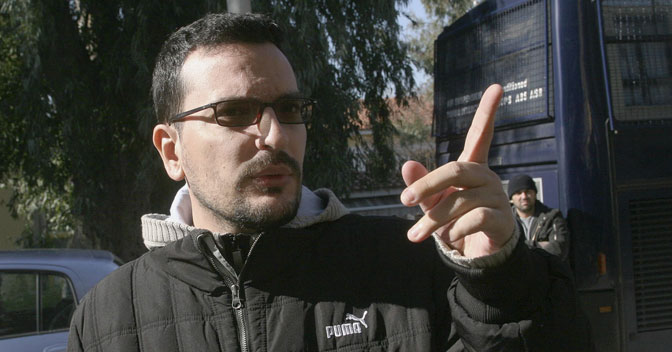
Sokratis Giolia, an investigative journalist, was shot dead outside his home in Athens prior to publishing the results of an investigation into corruption.
This article is part of a series based on our report, Time to Step Up: The EU and freedom of expression
The main threats to media freedom and the work of journalists are from political pressure or pressure exerted by the police, to non-legal means, such as violence and impunity. There have been instances where political pressure against journalists has led to self-censorship in a number of European Union countries. This pressure can manifest itself in a number of ways, from political pressure to influence editorial decisions or block journalists from promotion in state broadcasters to police or security service interventions into media investigations on political corruption.
The European Commission now has a clear competency to protect media freedom and should reflect on how it can deal with political interference in the national media of member states. As the heads of state or government of the EU member states have wider decision-making powers at the European Council this gives a forum for influence and negotiation, but this may also act as a brake on Commission action, thereby protecting media freedom.
Italy presents perhaps the most egregious example of political interference undermining media freedom in a EU member state. Former premier Silvio Berlusconi has used his influence over the media to secure personal political gain on a number of occasions. In 2009 he was thought to be behind RAI decision to stop broadcasting Annozero, a political programme that regularly criticised the government. In the lead up to the 2010 regional elections, Berlusconi’s party pushed through rules which effectively meant that state broadcasters had to either feature over 30 political parties on their talk shows or lose their prime time slots. Notably, Italian state broadcaster RAI refused to show adverts for the Swedish film Videocracy because it claimed the adverts were “offensive” to Silvio Berlusconi.
Under the government of Prime Minister Viktor Orbán, Hungary has seen considerable political interference in the media. In September 2011, popular liberal political radio station “Klubrádió” lost its licence following a decision by the Media Authority that experts believed was motivated by political considerations. The licence was reinstated on appeal. In December 2011, state TV journalists went on hunger strike after the face of a prominent Supreme Court judge was airbrushed out of a broadcast by state-run TV channel MTV. Journalists have complained that editors regularly cave into political interference. Germany has also seen instances of political interference in the public and private media. In 2009, the chief editor of German public service broadcaster ZDF, Nikolaus Brender, saw his contract terminated in controversial circumstances. Despite being a well-respected and experienced journalist, Brender’s suitability for the job was questioned by politicians on the channel’s executive board, many of whom represented the ruling Christian Democratic Union. It was decided his contract should not be renewed, a move widely criticised by domestic media, the International Press Institute and Reporters Without Borders, the latter arguing the move was “motivated by party politics” which, it argued, was “a blatant violation of the principle of independence of public broadcasters”. In 2011, the editor of Germany’s (and Europe’s) biggest selling newspaper, Bild, received a voicemail from President Christian Wulff, who threatened “war” on the tabloid if it reported on an unusual personal loan he received.
Police interference in the work of journalists, bloggers and media workers is a concern: there is evidence of police interference across a number of countries, including France, Ireland and Bulgaria. In France, the security services engaged in illegal activity when they spied on Le Monde journalist Gerard Davet during his investigation into Liliane Bettencourt’s alleged illegal financing of President Sarkozy’s political party. In 2011, France’s head of domestic intelligence, Bernard Squarcini, was charged with “illegally collecting data and violating the confidentiality” of the journalists’ sources. In Bulgaria, journalist Boris Mitov was summoned on two occasions to the Sofia City Prosecutor’s office in April 2013 for leaking “state secrets” after he reported a potential conflict of interest within the prosecution team. Of particular concern is Ireland, which has legislation that outlaws contact between ordinary police officers and the media. Clause 62 of the 2005 Garda Siochána Act makes provision for police officers who speak to journalists without authorisation from senior officers to be dismissed, fined up to €75,000 or even face seven years in prison. This law has the potential to criminalise public interest police whistleblowing.[1]
It is worth noting that after whistleblower Edward Snowden attempted to claim asylum in a number of European countries, including Austria, Finland, Germany, Italy, Ireland, the Netherlands, Spain, the governments of all of these countries stated that he needed to be present in the country to claim asylum. Others went further. Poland’s Foreign Minister Radosław Sikorski posted the following statement on Twitter: “I will not give a positive recommendation”, while German Foreign minister Guido Westerwelle said although Germany would review the asylum request “according to the law”, he “could not imagine” that it would be approved. The failure of the EU’s member states to give shelter to Snowden when so much of his work was clearly in the public interest within the European Union shows the scale of the weakness within Europe to stand up for freedom of expression.
Deaths, threats and violence against journalists and media workers
No EU country features in Reporters Without Borders’ 2013 list of deadliest countries for journalists. But since 2010, three journalists have been killed within the European Union. In Bulgaria in January 2010 , a gunman shot and killed Boris Nikolov Tsankov, a journalist who reported on the local mafia, as he walked down a crowded street. The gunman escaped on foot. In Greece, Sokratis Giolia, an investigative journalist, was shot dead outside his home in Athens prior to publishing the results of an investigation into corruption. In Latvia, media owner Grigorijs Nemcovs was the victim of an apparent contract killing, which Reporters Without Borders claims appeared to be carefully planned and executed.103 Nemcovs was also a political activist and deputy mayor, and his newspaper, Million, was renowned for its investigative coverage of political and local government corruption and mismanagement.
While it is rare for journalists to be killed within the EU, the Council of Europe has drawn attention to the fact that violence against journalists does occur in EU countries, particularly in south eastern Europe, including in Greece, Latvia, Bulgaria and Romania.[2] The South East Europe Media Organisation (SEEMO) has raised concerns over police violence against journalists covering political protests in many parts of south eastern Europe, particularly in Romania and Greece.
[1] There is an official whistleblowing mechanism instituted by the law, but it is not independent of the police.
[2] William Horsley for rapporteur Mats Johansson, ‘The State of Media Freedom in Europe’, Committee on Culture, Science, Education and Media, Council of Europe (18 June 2012).
27 Dec 2013 | Digital Freedom, Europe and Central Asia, European Union, News, Politics and Society, Religion and Culture
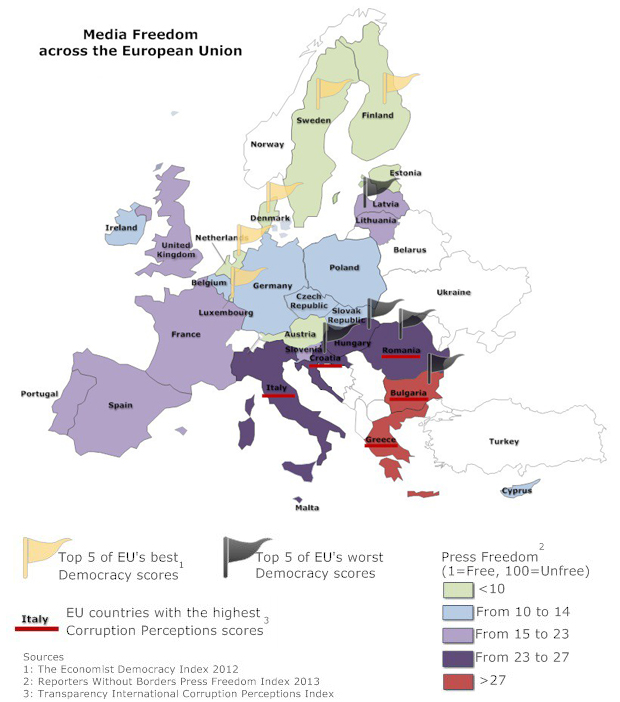
This article is part of a series based on our report, Time to Step Up: The EU and freedom of expression.
Since the entering into force of the Lisbon Treaty on 1 December 2009, which made the EU Charter of Fundamental Rights legally binding, the EU has gained an important tool to deal with breaches of fundamental rights.
The Lisbon Treaty also laid the foundation for the EU as a whole to accede to the European Convention on Human Rights. Amendments to the Treaty on European Union (TEU) introduced by the Lisbon Treaty (Article 7) gave new powers to the EU to deal with state who breach fundamental rights.
The EU’s accession to the ECHR, which is likely to take place prior to the European elections in June 2014, will help reinforce the power of the ECHR within the EU and in its external policy. Commission lawyers believe that the Lisbon Treaty has made little impact, as the Commission has always been required to assess whether legislation is compatible with the ECHR (through impact assessments and the fundamental rights checklist) and because all EU member states are also signatories to the Convention.[1] Yet external legal experts believe that accession could have a real and significant impact on human rights and freedom of expression internally within the EU as the Court of Justice of the European Union (CJEU) will be able to rule on cases and apply European Court of Human Rights jurisprudence directly. Currently, CJEU cases take approximately one year to process, whereas cases submitted to the ECHR can take up to 12 years. Therefore, it is likely that a larger number of freedom of expression cases will be heard and resolved more quickly at the CJEU, with a potential positive impact on justice and the implementation of rights in the EU.[2]
The Commission will also build upon Council of Europe standards when drafting laws and agreements that apply to the 28 member states. Now that these rights are legally binding and are subject to formal assessment, this may serve to strengthen rights within the Union.[3] For the first time, a Commissioner assumes responsibility for the promotion of fundamental rights; all members of the European Commission must pledge before the Court of Justice of the European Union that they will uphold the Charter.
The Lisbon Treaty also provides for a mechanism that allows European Union institutions to take action, whether there is a clear risk of a “serious breach” or a “serious and persistent breach”, by a member state in their respect for human rights in Article 7 of the Treaty of the European Union. This is an important step forward, which allows for the suspension of voting rights of any government representative found to be in breach of Article 7 at the Council of the European Union. The mechanism is described as a “last resort”, but does potentially provide leverage where states fail to uphold their duty to protect freedom of expression.
Yet within the EU, some remained concerned that the use of Article 7 of the Treaty, while a step forward, is limited in its effectiveness because it is only used as a last resort. Among those who argued this were Commissioner Reding, who called the mechanism the “nuclear option” during a speech addressing the “Copenhagen Dilemma” (the problem of holding states to the human rights commitments they make when they join). In March 2013, in a joint letter sent to Commission President Barroso, the foreign ministers of the Netherlands, Finland, Denmark and Germany called for the creation of a mechanism to safeguard principles such as democracy, human rights and the rule of law. The letter argued there should be an option to cut EU funding for countries that breach their human rights commitments.
It is clear that there is a fair amount of thinking going on internally within the Commission on what to do when member states fail to abide by “European values”. Commission President Barroso raised this in his State of the Union address in September 2012, explicitly calling for “a better developed set of instruments” to deal with threats to these rights.
This thinking has been triggered by recent events in Hungary and Italy, as well as the ongoing issue of corruption in Bulgaria and Romania, which points to a wider problem the EU faces through enlargement: new countries may easily fall short of both their European and international commitments.
Full report PDF: Time to Step Up: The EU and freedom of expression
Footnotes
[1] Off-record interview with a European Commission lawyer, Brussels (February 2013).
[2] Interview with Prof. Andrea Biondi, King’s College London, 22 April 2013.
[3] Interview with lawyer, Brussels (February 2013).
12 Dec 2013 | Digital Freedom Reports, Europe and Central Asia, European Union, Index Reports, News, Politics and Society
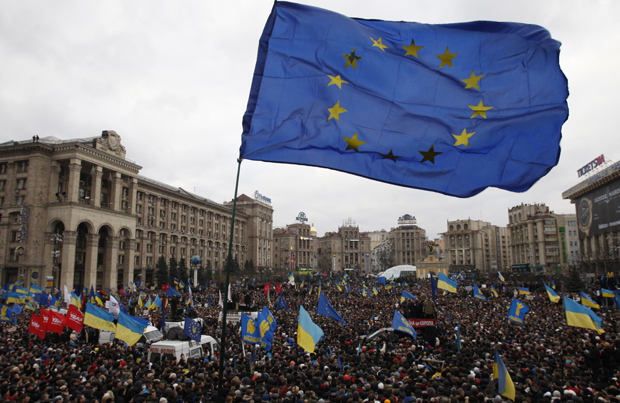
As Ukraine experiences ongoing protests over lack of European integration, Index’ new report looks at the EU’s relationship with freedom of expression (Photo: Anatolii Stepanov / Demotix)
Index on Censorship’s policy paper, Time to Step Up: The EU and freedom of expression, looks at freedom of expression both within the European Union’s 28 member states, which with over 500 million people account for about a quarter of total global economic output, but also how this union defends freedom of expression in the wider world. States that are members of the European Union are supposed to share “European values”, which include a commitment to freedom of expression. However, the way these common values are put into practice vary: some of the world’s best places for free expression are within the European Union – Finland, Netherlands, Denmark and Sweden – while other countries such as Italy, Hungary, Greece and Romania lag behind new and emerging global democracies.
This paper explores freedom of expression, both at the EU level on how the Commission and institutions of the EU protect this important right, but also across the member states. Firstly, the paper will explore where the EU and its member states protect freedom of expression internally and where more needs to be done. The second section will look at how the EU projects and defends freedom of expression to partner countries and institutions. The paper will explore the institutions and instruments used by the EU and its member states to protect this fundamental right and how they have developed in recent years, as well as the impact of these institutions and instruments.
Outwardly, a commitment to freedom of expression is one of the principle characteristics of the European Union. Every European Union member state has ratified the European Convention on Human Rights (ECHR); the International Covenant on Civil and Political Rights (ICCPR) and has committed to the Universal Declaration of Human Rights. To complement this, the Treaty of Lisbon has made the EU Charter of Fundamental Rights legally binding which means that the EU institutions and member states (if they act within the scope of the EU law) must act in compliance with the rights and principles of the Charter. The EU has also said it will accede to the ECHR. Yet, even with these commitments and this powerful framework for defending freedom of expression, has the EU in practice upheld freedom of expression evenly across the European Union and outside with third parties, and is it doing enough to protect this universal right?
Within the European Commission, there has been considerable analysis about what should be done when member states fail to abide by “European values”, Commission President Barroso raised this in his State of the Union address in September 2012, explicitly calling for “a better developed set of instruments” to deal with threats to these perceived values and the rights that accompany them. With threats to freedom of expression increasing, it is essential that this is taken up by the Commission sooner rather than later.
To date, most EU member states have failed to repeal criminal sanctions for defamation, with only Croatia, Cyprus, Ireland and the UK having done so. The parliamentary assembly of the Council of Europe called on states to repeal criminal sanctions for libel in 2007, since then little action has been taken by EU member states. There also remain significant issues in the field of privacy law and freedom of information across the EU.
While the European Commission has in the past tended to view its competencies in the field of media regulation as limited, due to the introduction of the Charter of Fundamental Rights into EU primary law, the Commission is looking at a possible enhancement of its role in this area.
With media plurality limited across Europe and in fact potentially threatened by the convergence of media across media both online and off (and the internet being the most concentrated media market), the Commission must take an early view on whether it wishes to intervene more fully in this field to uphold the values the EU has outlined. Political threats against media workers are too commonplace and risks to whistleblowers have increased as demonstrated by the lack of support given by EU member states to whistleblower Edward Snowden. That the EU and its member states have so clearly failed one of the most significant whistleblowers of our era is indicative of the scale of the challenge to freedom of expression within the European Union.
The EU and its member states have made a number of positive commitments to protect online freedom, including the EU’s positioning at WCIT, the freedom of expression guidelines and the No-Disconnect strategy helping the EU to strengthen its external polices around promoting digital freedom. These commitments have challenged top-down internet governance models, supported the multistakeholder approach, protected human rights defenders who use the internet and social media in their work, limited takedown requests, filters and others forms of censorship. But for the EU to have a strong and coherent impact at the global level, it now needs to develop a clear and comprehensive digital freedom strategy. For too long, the EU has been slow to prioritise digital rights, placing the emphasis on digital competitiveness instead. It has also been the case that positive external initiatives have been undermined by contradictory internal policies, or a contradiction of fundamental values, at the EU and member state level. The revelations made by Edward Snowden show that EU member states are violating universal human rights through mass surveillance.
The Union must ensure that member states are called upon to address their adherence to fundamental principles at the next European Council meeting. The European Council should also address concerns that external government surveillance efforts like the US National Security Agency’s Prism programme are undermining EU citizens’ rights to privacy and free expression. A comprehensive overarching digital freedom strategy would help ensure coherent EU policies and priorities on freedom of expression and further strengthen the EU’s influence on crucial debates around global internet governance and digital freedom. With the next two years of ITU negotiations crucial, it’s important the EU takes this strategy forward urgently.
While the European Commission has in the past tended to view its competencies in the field of media regulation as limited, due to the introduction of the Charter of Fundamental Rights into EU primary law, the Commission is looking at a possible enhancement of its role in this area.
With media plurality limited across Europe and in fact potentially threatened by the convergence of media across media both online and off (and the internet being the most concentrated media market), the Commission must take an early view on whether it wishes to intervene more fully in this field to uphold the values the EU has outlined.
Political threats against media workers are too commonplace and risks to whistleblowers have increased as demonstrated by the lack of support given by EU member states to whistleblower Edward Snowden. That the EU and its member states have so clearly failed one of the most significant whistleblowers of our era is indicative of the scale of the challenge to freedom of expression within the European Union.
Where the EU acts with a common approach among the member states, it has significant leverage to help promote and defend freedom of expression globally. To develop a more common approach, since the Lisbon Treaty, the EU has enhanced its set of policies, instruments and institutions to promote human rights externally, with new resources to do so. Enlargement has proved the most effective tool to promote freedom of expression with, on the whole, significant improvements in the adherence to the principles of freedom of expression in countries that have joined the EU or where enlargement is a real prospect. That this respect for human rights is a condition of accession to the EU shows that conditionality can be effective. Whereas the eastern neighbourhood has benefitted from the real prospect of accession (for some countries), in its southern neighbourhood, the EU has failed to promote freedom of expression by placing security interests first and also by failing to react quickly enough to the transitions in its southern neighbourhood following the events of the Arab Spring. The new strategy for this region is welcome and may better protect freedom of expression, but with Egypt in crisis, the EU may have acted too late. The EU must assess the effectiveness of some of its foreign policy instruments, in particular the dialogues for particular countries such as China.
The freedom of expression guidelines provide an excellent opportunity to reassess the criteria for how the EU engages with third party countries. Strong freedom of expression guidelines will allow the EU to better benchmark the effectiveness of its human rights dialogues. The guidelines will also reemphasise the importance of the EU, ensuring that the right to freedom of expression is protected within the EU and its member states. Otherwise, the ability of the EU to influence external partners will be limited.
Headline recommendations
• After recent revelations about mass state surveillance the EU must develop a roadmap that puts in place strong safeguards to ensure narrow targeted surveillance with oversight not mass population surveillance and must also recommit to protect whistle-blowers
• The European Commission needs to put in place controls so that EU directives cannot be used for the retention of data that makes mass population surveillance feasible
• The EU has expanded its powers to deal with human rights violations, but is reluctant to use these powers even during a crisis within a member state. The EU must establish clear red lines where it will act collectively to protect freedom of expression in a member state
• Defamation should be decriminalised across the EU
• The EU must not act to encourage the statutory regulation of the print media but instead promote tough independent regulation
• Politicians from across the EU must stop directly interfering in the workings of the independent media
• The EU suffers from a serious credibility gap in its near neighbourhood – the realpolitik of the past that neglected human rights must be replaced with a coherent, unified Union position on how to promote human rights
Recommendations
- The EU has expanded its powers to deal with human rights violations, but is reluctant to use these powers even during a crisis within a member state. The EU must establish clear red lines where it will act collectively to protect freedom of expression in a member state
- The EU should cut funding for member states that cross the red lines and breach their human rights commitments
Libel, privacy and insult
- Defamation should be decriminalised in line with the recommendations of the Council of Europe parliamentary assembly, and the UN and OSCE’s special rapporteurs on freedom of expression.
- Insult laws that criminalise insult to national symbols should be repealed
Freedom of information
- To better protect freedom of information, all EU member states should sign up to the Council of Europe Convention on Access to Official Documents
- Not all EU institutions, offices, bodies and agencies are acting on their freedom of information commitments. More must be done by the Commission to protect freedom of information
Media freedom & plurality
- The EU must revisit its competencies in the area of media regulation in order to prevent the most egregious breaches of the right to freedom of expression in particular the situations that arose in Italy and Hungary
- The EU must argue against statutory regulation of the print media and argue for independent self-regulation where media bandwidth is no longer limited by spectrum and other considerations
- Member states must not allow political interference or considerations of “political balance” into the workings of the media, where this happens the EU should be considered competent to act to protect media freedom and pluralism at a state level
- The EU is not doing enough to protect whistleblowers. National states must do more to protect journalists from threats of violence and intimidation
Digital
- The Commission must prepare a roadmap for collective action against mass state surveillance
- The EU is right to argue against top-down state control over internet governance it must find more natural allies for this position globally
- The Commission should proceed with a Directive that sets out the criteria takedown requests must meet and outline a process that protects anonymous whistle-blowers and intermediaries from vexatious claims
The EU and freedom of expression in the world
- The EU suffers from a credibility issue in its southern neighbourhood. To repair its standing in the wider world, the EU and its member states must not downgrade the importance of human rights in any bilateral or multilateral relationship
- The EU’s EEAS Freedom of Expression guidelines are welcome. To be effective, they need to focus on the right to freedom of expression for ordinary citizens and not just media actors
- The guidelines need to become the focus for negotiations with external countries, rather than the under-achieving human rights dialogues
- With criticism of the effectiveness of the human rights dialogues, the EU should look again at how the dialogues fit into the overall strategy of the Union and its member states
The European Union contains some of the world’s strongest defenders of freedom of expression, but also a significant number of member states who fail to meet their European and international commitments. To deal with this, in recent years, the European Union’s member states have made new commitments to better protect freedom of expression. The new competency of the European Court of Justice to uphold the values enshrined in the European Convention of Human Rights will provide a welcome alternative forum to the increasingly deluged European Court of Human Rights. This could have significant implications for freedom of expression within the EU. Internally within the EU there is still much that could be done to improve freedom of expression. It is welcome that that the EU and its member states have made a number of positive commitments to protect online freedom, with new action on vexatious takedown notices and coordinated action to protect the multistakeholder model of internet governance. Increasing Commission concern over media plurality may also be positive in the future.
Yet there are a number of areas where the EU must do more. The decriminalisation of defamation across Europe should be a focal point for European action in line with the Council of Europe’s recommendations. National insult laws should be repealed. The Commission should not intervene to increase its powers over national media regulators, but should act where it has clear competencies, in particular to prevent media monopolies and to help deal with conflict of interests between politicians and state broadcasters. Most importantly, discussions of mass population surveillance at the European Council in October must be followed by a roadmap outlining how the EU will collectively take action on this issue. Without internal reform to strengthen protections for freedom of expression, the EU will not enjoy the leverage it should to promote freedom of expression externally to partner countries. While the External Action Service freedom of expression guidelines are welcome, they must be impressed upon member countries as a benchmark for reform.
Externally, the EU has failed to deliver on the significant leverage it could have as the world’s largest trading block. Where the EU has acted in concert, with clear aims and objectives for partner countries, such as during the process of enlargement, it has had a big impact on improving and protecting freedom of expression. Elsewhere, the EU has fallen short, particularly in its southern neighbourhood and in its relationship with China, where the EU has continued human rights dialogues that have failed to be effective.
New commitments and new instruments post-Lisbon may better protect freedom of expression in the EU and externally. Yet, as the Snowden revelations show, the EU and its member states must do significantly more to deliver upon the commitments that have been agreed.
Full report PDF: Time to Step Up: The EU and freedom of expression
This article was posted on 12 Dec 2013 at indexoncensorship.org
