5 Sep 2017 | Campaigns -- Featured, Statements
[vc_row][vc_column][vc_column_text]
The Hague, 5 September 2017
Dear members of the International Association of Prosecutors members, executive committee and senate,
In the run-up to the annual conference and general meeting of the International Association of Prosecutors (IAP) in Beijing, China, the undersigned civil society organisations urge the IAP to live up to its vision and bolster its efforts to preserve the integrity of the profession.
Increasingly, in many regions of the world, in clear breach of professional integrity and fair trial standards, public prosecutors use their powers to suppress critical voices.
In China, over the last two years, dozens of prominent lawyers, labour rights advocates and activists have been targeted by the prosecution service. Many remain behind bars, convicted or in prolonged detention for legal and peaceful activities protected by international human rights standards, including the Universal Declaration of Human Rights. Azerbaijan is in the midst of a major crackdown on civil rights defenders, bloggers and journalists, imposing hefty sentences on fabricated charges in trials that make a mockery of justice. In Kazakhstan, Russia and Turkey many prosecutors play an active role in the repression of human rights defenders, and in committing, covering up or condoning other grave human rights abuses.
Patterns of abusive practices by prosecutors in these and other countries ought to be of grave concern to the professional associations they belong to, such as the IAP. Upholding the rule of law and human rights is a key aspect of the profession of a prosecutor, as is certified by the IAP’s Standards of Professional Responsibility and Statement of the Essential Duties and Rights of Prosecutors, that explicitly refer to the importance of observing and protecting the right to a fair trial and other human rights at all stages of work.
Maintaining the credibility of the profession should be a key concern for the IAP. This requires explicit steps by the IAP to introduce a meaningful human rights policy. Such steps will help to counter devaluation of ethical standards in the profession, revamp public trust in justice professionals and protect the organisation and its members from damaging reputational impact and allegations of whitewashing or complicity in human rights abuses.
For the second year in a row, civil society appeals to the IAP to honour its human rights responsibilities by introducing a tangible human rights policy. In particular:
We urge the IAP Executive Committee and the Senate to:
- introduce human rights due diligence and compliance procedures for new and current members, including scope for complaint mechanisms with respect to institutional and individual members, making information public about its institutional members and creating openings for stakeholder engagement from the side of civil society and victims of human rights abuses.
We call on individual members of the IAP to:
- raise the problem of a lack of human rights compliance mechanisms at the IAP and thoroughly discuss the human rights implications before making decisions about hosting IAP meetings;
- identify relevant human rights concerns before travelling to IAP conferences and meetings and raise these issues with their counterparts from countries where politically-motivated prosecution and human rights abuses by prosecution authorities are reported by intergovernmental organisations and internationally renowned human rights groups.
Supporting organisations:
Amnesty International
Africa Network for Environment and Economic Justice, Benin
Anti-Corruption Trust of Southern Africa, Kwekwe
Article 19, London
Asian Forum for Human Rights and Development (FORUM-ASIA)
Asia Justice and Rights, Jakarta
Asia Indigenous Peoples Pact, Chiang Mai
Asian Human Rights Commission, Hong Kong SAR
Asia Monitor Resource Centre, Hong Kong SAR
Association for Legal Intervention, Warsaw
Association Humanrights.ch, Bern
Association Malienne des Droits de l’Homme, Bamako
Association of Ukrainian Human Rights Monitors on Law Enforcement, Kyiv
Associazione Antigone, Rome
Barys Zvozskau Belarusian Human Rights House in exile, Vilnius
Belarusian Helsinki Committee, Minsk
Bir-Duino Kyrgyzstan, Bishkek
Bulgarian Helsinki Committee, Sofia
Canadian Human Rights International Organisation, Toronto
Center for Civil Liberties, Kyiv
Centre for Development and Democratization of Institutions, Tirana
Centre for the Development of Democracy and Human Rights, Moscow
China Human Rights Lawyers Concern Group, Hong Kong SAR
Civil Rights Defenders, Stockholm
Civil Society Institute, Yerevan
Citizen Watch, St. Petersburg
Collective Human Rights Defenders “Laura Acosta” International Organization COHURIDELA, Toronto
Comunidad de Derechos Humanos, La Paz
Coordinadora Nacional de Derechos Humanos, Lima
Destination Justice, Phnom Penh
East and Horn of Africa Human Rights Defenders Project, Kampala
Equality Myanmar, Yangon
Faculty of Law – University of Indonesia, Depok
Fair Trials, London
Federation of Equal Journalists, Almaty
Former Vietnamese Prisoners of Conscience, Hanoi
Free Press Unlimited, Amsterdam
Front Line Defenders, Dublin
Foundation ADRA Poland, Wroclaw
German-Russian Exchange, Berlin
Gram Bharati Samiti, Jaipur
Helsinki Citizens’ Assembly Vanadzor, Yerevan
Helsinki Association of Armenia, Yerevan
Helsinki Foundation for Human Rights, Warsaw
Human Rights Center Azerbaijan, Baku
Human Rights Center Georgia, Tbilisi
Human Rights Club, Baku
Human Rights Embassy, Chisinau
Human Rights House Foundation, Oslo
Human Rights Information Center, Kyiv
Human Rights Matter, Berlin
Human Rights Monitoring Institute, Vilnius
Human Rights Now, Tokyo
Human Rights Without Frontiers International, Brussels
Hungarian Civil Liberties Union, Budapest
IDP Women Association “Consent”, Tbilisi
IMPARSIAL, the Indonesian Human Rights Monitor, Jakarta
Index on Censorship, London
Indonesian Legal Roundtable, Jakarta
Institute for Criminal Justice Reform, Jakarta
Institute for Democracy and Mediation, Tirana
Institute for Development of Freedom of Information, Tbilisi
International Federation for Human Rights (FIDH)
International Partnership for Human Rights, Brussels
International Service for Human Rights, Geneva
International Youth Human Rights Movement
Jerusalem Institute of Justice, Jerusalem
Jordan Transparency Center, Amman
Justiça Global, Rio de Janeiro
Justice and Peace Netherlands, The Hague
Kazakhstan International Bureau for Human Rights and Rule of Law, Almaty
Kharkiv Regional Foundation Public Alternative, Kharkiv
Kosovo Center for Transparency, Accountability and Anti-Corruption – KUND 16, Prishtina
Kosova Rehabilitation Center for Torture Victims, Prishtina
Lawyers for Lawyers, Amsterdam
Lawyers for Liberty, Kuala Lumpur
League of Human Rights, Brno
Macedonian Helsinki Committee, Skopje
Masyarakat Pemantau Peradilan Indonesia (Mappi FH-UI), Depok
Moscow Helsinki Group, Moscow
National Coalition of Human Rights Defenders, Kampala
Netherlands Helsinki Committee, The Hague
Netherlands Institute of Human Rights (SIM), Utrecht University, Utrecht
NGO “Aru ana”, Aktobe
Norwegian Helsinki Committee, Oslo
Pakistan Rural Workers Social Welfare Organization (PRWSWO), Bahawalpur
Pensamiento y Acción Social (PAS), Bogotá
Pen International, London
People’s Solidarity for Participatory Democracy (PSPD), Seoul
Philippine Human Rights Advocates (PAHRA), Manila
Promo-LEX Association, Chisinau
Protection International, Brussels
Protection Desk Colombia, alianza (OPI-PAS), Bogotá
Protection of Rights Without Borders, Yerevan
Public Association Dignity, Astana
Public Association “Our Right”, Kokshetau
Public Fund “Ar.Ruh.Hak”, Almaty
Public Fund “Ulagatty Zhanaya”, Almaty
Public Verdict Foundation, Moscow
Regional Center for Strategic Studies, Baku/ Tbilisi
Socio-Economic Rights and Accountability Project (SERAP), Lagos
Stefan Batory Foundation, Warsaw
Suara Rakyat Malaysia (SUARAM), Petaling Jaya
Swiss Helsinki Association, Lenzburg
Transparency International Anti-corruption Center, Yerevan
Transparency International Austrian chapter, Vienna
Transparency International Česká republika, Prague
Transparency International Deutschland, Berlin
Transparency International EU Office, Brussels
Transparency International France, Paris
Transparency International Greece, Athens
Transparency International Greenland, Nuuk
Transparency International Hungary, Budapest
Transparency International Ireland, Dublin
Transparency International Italia, Milan
Transparency International Moldova, Chisinau
Transparency International Nederland, Amsterdam
Transparency International Norway, Oslo
Transparency International Portugal, Lisbon
Transparency International Romania, Bucharest
Transparency International Secretariat, Berlin
Transparency International Slovenia, Ljubljana
Transparency International España, Madrid
Transparency International Sweden, Stockholm
Transparency International Switzerland, Bern
Transparency International UK, London
UNITED for Intercultural Action the European network against nationalism, racism, fascism and in support of migrants, refugees and minorities, Budapest
United Nations Convention against Corruption Civil Society Coalition
Villa Decius Association, Krakow
Vietnam’s Defend the Defenders, Hanoi
Vietnamese Women for Human Rights, Saigon
World Organisation Against Torture (OMCT)
Zimbabwe Lawyers for Human Rights, Harare[/vc_column_text][/vc_column][/vc_row][vc_row][vc_column][vc_basic_grid post_type=”post” max_items=”4″ element_width=”6″ grid_id=”vc_gid:1504604895654-8e1a8132-5a81-8″ taxonomies=”8883″][/vc_column][/vc_row]
2 Aug 2017 | Campaigns, Campaigns -- Featured, Media Freedom, media freedom featured
[vc_row][vc_column][vc_column_text]
US Press Freedom Tracker
Index on Censorship joined more than 20 press freedom organisations announcing the launch today of the U.S. Press Freedom Tracker, a new nonpartisan website dedicated to documenting press freedom abuses across the United States.
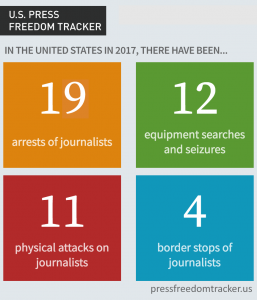
In recent months, journalists have been charged with crimes while covering protests in Washington D.C. and North Dakota; stopped at the border and subjected to searches of their electronic devices; and physically assaulted, in one case by a congressional candidate. Data collected on the U.S. Press Freedom Tracker shows that 19 journalists have been arrested in the course of their work in 2017 and that at least 10 reporters are currently facing charges. In 2017 at least four journalists have been stopped at the border and 11 have faced physical attacks, according to the tracker. These numbers may increase as we receive new information.
“While the focus has been on the Trump administration’s relationship with the press, American journalists have encountered more widespread obstacles to reporting — from violent protesters to police harassment — across the country as we detailed in our US report, researched and compiled with the methodology we developed for Mapping Media Freedom, our three-year-old database monitoring press freedom violations in 42 European area countries,” Melody Patry, head of advocacy at Index on Censorship, said.
“The United States has some of the strongest legal protections for press freedom in the world and a robust and varied media landscape, but this cannot be taken for granted. Open hostility, threats of leak prosecutions, and arrests have created a precarious situation for journalists,” said Alex Ellerbeck, senior research associate for the U.S. at the Committee to Protect Journalists and chair of the steering committee for the U.S. Press Freedom Tracker. “A full and honest accounting of challenges to press freedom in this country is sorely needed.”
The U.S. Press Freedom Tracker collects data based on news reports and tips submitted by journalists, professional organisations, and press freedom organisations. The coalition behind the tracker will use the research in letters, legal briefs, and advocacy campaigns.
“With the Trump administration ramping up its war on journalism, this initiative could not come at a more important time,” said Trevor Timm, executive director of the Freedom of the Press Foundation. “We hope it will be vital to highlighting the threats to press freedom in the U.S. and the important work journalists do to hold the government accountable.”
About the U.S. Press Freedom Tracker
Led by the Committee to Protect Journalists and Freedom of the Press Foundation, the site will serve as a central repository for data at a time when journalists in the U.S. are facing increased hostility. Freedom of the Press Foundation is leading the day-to-day operations of the U.S. Press Freedom Tracker, with its senior reporter, Peter Sterne, serving as the managing editor. The Committee to Protect Journalists is providing the initial funding and chairing the steering committee. The steering committee also includes representatives from the Reporters Committee for Freedom of the Press, the Knight Institute at Columbia University, Reporters Without Borders and Index on Censorship. A full list of partners is on the website.[/vc_column_text][/vc_column][/vc_row][vc_row][vc_column][vc_basic_grid post_type=”post” max_items=”12″ style=”load-more” items_per_page=”4″ element_width=”6″ grid_id=”vc_gid:1501680559388-7ab4706a-4916-9″ taxonomies=”8996″][/vc_column][/vc_row]
14 Jul 2017 | Azerbaijan, Digital Freedom, Mapping Media Freedom, Media Freedom, media freedom featured, News
[vc_row][vc_column][vc_column_text]
Afgan Mukhtarli. Credit: Meydan TV
Media outlets in Azerbaijan routinely deal with torture, assault, raids, imprisonment and endless intimidation, as verified reports submitted to Index on Censorship’s Mapping Media Freedom project show.
“The years-long crackdown on the independent press by the regime of Ilham Aliyev has accelerated in recent months. This is clearly one of the world’s worst environments for press freedom and, consequently, for the public’s right to information,” Hannah Machlin, project manager for Mapping Media Freedom, said.
International media freedom rankings confirm the country’s stagnating record where autocratic repression is consistent, if not the functioning political system itself. Although authorities continue to claim that the majority of the country’s 147 political prisoners are criminals, religious radicals and tax evaders, the international community of rights watchdogs view it differently. A new wave of attacks against media freedom advocates, journalists and activists within the past two months alone illustrate a place where the primacy of Ilham Aliyev, Azerbaijan’s president, and his word overrides the primacy of the words of others, particularly his critics.
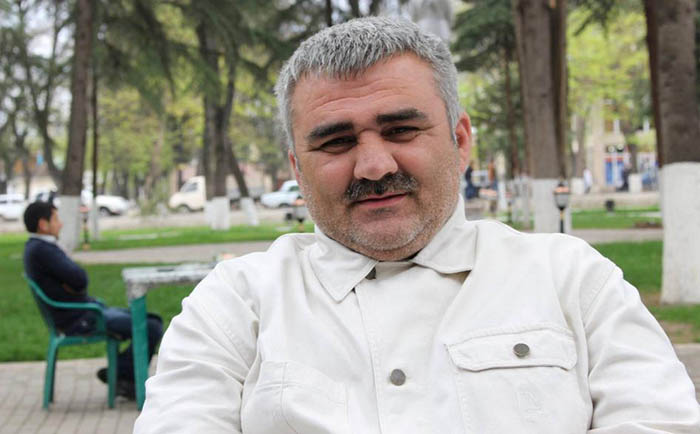
One such critic, Afgan Mukhtarli, an investigative journalist, disappeared on 29 May while on his way to his home in Tbilisi. Mukhtarli reappeared the next day across the border in Azerbaijan and was accused of illegal border crossing, smuggling (police allegedly found €12,000 on him) and resisting police. He was immediately sentenced to three months in pre-trial detention.
Speaking to Mapping Media Freedom, Mukhtarli’s wife Leyla Mustafayeva said she was relieved when she heard news of his arrest because after reporting her husband missing the day before, she had assumed he was dead. However, that is the only relief Mustafayeva has had since her husband’s kidnapping:
“I have no hope for the investigations. They have been stalled. They don’t want to investigate. Police allegedly cannot find any footage. The only video that was made available to our lawyer was shown two weeks after Mukhtarli’s disappearance and it’s just of my husband getting on the bus that usually takes him home.”
Mukhtarli’s case is unique in that his is the first cross-border operation alleged to be carried out in tandem with the Georgian government. While this has yet to be confirmed by officials in Georgia, Azerbaijani lawmaker and a member of the Parliament Human Rights Committee Elman Nasirov claimed Mukhtarli’s kidnapping was “the most successful operation carried out in recent years.” Nasirov also accused Mukhtarli of being a member of a far larger anti-Azerbaijan network.
[/vc_column_text][/vc_column][/vc_row][vc_row][vc_column][vc_separator color=”black” align=”align_left”][vc_row_inner][vc_column_inner width=”1/2″][vc_custom_heading text=”Mapping Media Freedom: Azerbaijan” font_container=”tag:p|font_size:24|text_align:left” use_theme_fonts=”yes” link=”url:https%3A%2F%2Fmappingmediafreedom.org%2Fplus%2F%3Fs%3DAzerbaijan|||”][vc_column_text]Index on Censorship monitors press freedom in Azerbaijan and 41 other European area countries.
As of 14/07/2017, there were 60 verified reports of violations connected to Azerbaijan in the Mapping Media Freedom database.[/vc_column_text][/vc_column_inner][vc_column_inner width=”1/2″][vc_single_image image=”94222″ img_size=”full” alignment=”center” onclick=”custom_link” link=”https://mappingmediafreedom.org/#/”][/vc_column_inner][/vc_row_inner][vc_separator color=”black” align=”align_left”][/vc_column][/vc_row][vc_row][vc_column][vc_column_text]“Muktharli was assigned to carry out subversive activities in Azerbaijan,” Nasirov asserted, claiming that as a preventive mechanism, Azerbaijani special forces made necessary arrangements with Georgian special forces. “The are principles and rules for this. Based on security principles, this how it was made possible to bring Mukhtarli to Azerbaijan,” said Nasirov in an interview with Azadlig Radio, the Azerbaijani service for Radio Free Europe Radio Liberty.
Police have questioned political activists, members of opposition parties, and journalists as part of the investigation. Sevinc Vagifqizi, a freelance reporter, was detained while waiting for news outside the state border services where Mukhtarli was being held. Speaking to journalists after her brief detention, Vagifqizi said that police allegedly thought she was going to disturb peace outside the building. Other journalists who have been questioned in the case of Mukhtarli are investigative journalist Khadija Ismayilova, who is facing a travel ban despite her release from jail, and, more recently, Aytac Ahmadova.
The circumstances of Mukhtalri’s arrest were notably suspicious. Outside of his abduction, Mukhtarli’s lawyer was also quick to report on the injuries Mukhtarli suffered, including a broken nose, multiple bruises and possibly a broken rib. Mukhtarli is not the only journalist who appears to have been subjected to alleged police brutality. Nijat Amiraslanov, a member of the NIDA civic movement and an independent journalist based in Gazakh, reportedly lost his front teeth while serving his 30-day administrative detention. In his statement, however, Amiraslanov said his teeth fell out on their own, and that there was no ill-treatment during his detention. After Amiraslanov’s teeth fell out, the journalist refused an appeal filed by his lawyer. Amiraslanov was released on 21 June after completing the detention period.
In another show of force, police raided the office of independent online television channel Kanal 13 on 3 June, confiscating computers and other documents. Police had already detained the channel’s manager Aziz Orucov (Garashoglu) earlier in May. Orucov was sentenced to 30 days of administrative detention on the grounds of allegedly resisting police. Additional charges of illegal entrepreneurship and abuse of power were brought against Orucov on the day of his release. He was sentenced to four months in pre-trial detention.
While these men await trial, another journalist and editor-in-chief of the news website Journalistic Research Center (jam.az) Fikrat Faramazoglu was sentenced to seven years in jail on 14 June. Faramazoglu was found guilty on charges of extortion. In his defence statement, the journalist said it was his reporting on a chain of brothels that were protected by the law-enforcement agencies that incited his arrest. Faramazoglu was also banned from working as a journalist for two years following the completion of his prison term.
A classic case of revolving door policy
Rather than continue to release its political prisoners, the Azerbaijani government continues to arrest more reporters and further tightens controls on the media sector.
“There are some ten journalists and bloggers currently in prison [in Azerbaijan]. Based on these new arrests, Azerbaijan is trying to return to the list of countries where journalists critical of the government end up in jail on bogus charges,” said Muzaffar Suleymanov from the Civil Rights Defenders, a Stockholm-based rights watchdog in an interview with Mapping Media Freedom. Furthermore, a recent decision by a Baku court to block access to independent and opposition news websites broadcasting from abroad is a matter of more concern, added Suleymanov.
Levan Asatiani from Amnesty International echoed these sentiments adding that, as an international community of watchdogs, they have not seen any improvements, only a further deterioration in the human rights situation in Azerbaijan.
“While there have been releases, there have been new arrests or travel bans introduced against former prisoners of conscience,” Asatiani said. There are also legal boundaries in place that prevent the work of remaining independent civil society organisations in Azerbaijan.
It is no longer enough to make statements and express concern says Suleymanov. The Council of Europe should hold its members responsible for violating human rights while the EU must set benchmarks in accordance with the human rights situation as it negotiates a new agreement with Azerbaijan, noted Asatiani.[/vc_column_text][/vc_column][/vc_row][vc_row][vc_column][vc_basic_grid post_type=”post” max_items=”12″ style=”load-more” items_per_page=”4″ element_width=”6″ grid_id=”vc_gid:1500022088088-43842239-2fe8-0″ taxonomies=”7145″][/vc_column][/vc_row]
11 Jul 2017 | Azerbaijan, Azerbaijan Statements, Campaigns, Campaigns -- Featured, Statements
President of France, Mr. Emmanuel Macron
L’Élysée
55 Rue du Faubourg Saint-Honoré
75008 Paris, France
Ministry of Europe and Foreign Affairs of France
37, Quai d’Orsay
75351 Paris, France
Embassy of France to Azerbaijan
9, rue Rassoul Rza
AZ 1000, Baku, Azerbaijan
Subject: Support for political prisoners in Azerbaijan
11 July 2017
Dear President Macron,
We are writing to you on behalf of the undersigned organisations to draw your attention to the repressive free speech situation in Azerbaijan and to request your support to ensure the release of those imprisoned on politically motivated grounds in this country. In particular, we urge you to use your administration’s influence and leverage to help ensure the implementation of the ruling issued by the European Court of Human Rights (ECtHR) on the case of political opposition activist Ilgar Mammadov. He remains in prison, although the Court concluded that he was detained in retaliation for his criticism of the government. The persistent non-execution of the ruling in his case by the Azerbaijani authorities is undermining the credibility of the human rights protection regime established by the Council of Europe and sets a dangerous precedent for all those wrongfully prosecuted in Azerbaijan who turn to the Court in search of justice.
In view of France’s role as a leading European state and host country for the ECtHR and other Council of Europe bodies, as well as its well-developed cooperation with Azerbaijan in trade and other areas, your engagement on this issue would be particularly important. We welcome the moral, value-based and human rights oriented leadership that you have embraced for your presidency and are confident that you will vigorously pursue human rights in relations with Azerbaijan’s government on the basis of the common standards set out in the European Convention on Human Rights.
In the last few years, Azerbaijan’s government has carried out a relentless crackdown on alternative voices in the country. Legislation seriously restricting the operation of NGOs has been enforced, independent media subjected to pressure, the political opposition has been marginalised and human rights defenders, journalists and political opposition activists have been arrested, convicted and imprisoned on politically motivated charges.
While some of those imprisoned on such grounds have been released as a result of international pressure, new arrests continue to take place. For example, well-known blogger Mehman Huseynov was arrested and sentenced to two years in prison on defamation charges in March this year after speaking out about police ill-treatment. Journalist Aziz Orujov and opposition member Gozel Bayramli were arrested on other spurious charges in May, while in the same month journalist Afgan Mukhtarli was abducted in Georgia only to resurface in Azerbaijani custody. Many government critics imprisoned in previous years also remain behind bars, including Ilgar Mammadov.
Ilgar Mammadov, who chaired the political opposition REAL party and served as director of the Council of Europe School of Political Studies in Azerbaijan, was detained in February 2013 after monitoring and reporting on street protests in the town of Ismayilli, which resulted in clashes with the police. He was groundlessly accused of instigating these clashes and sentenced to seven years in prison on trumped-up charges of organising mass riots and using violence against police. In a judgment issued in May 2014, the ECtHR found that Ilgar Mammadov’s arrest and detention violated his rights to liberty and security, judicial review of his detention and to be presumed innocent under the European Convention on Human Rights. The court also found that Azerbaijan’s government had imposed restrictions on his rights for purposes other than those permitted, in violation of its obligations under the Convention. The court concluded that Mammadov was detained on political rather than legal grounds for the purpose of punishing and silencing him for his criticism of the government.
It has now been more than three years since the ECtHR adopted its judgement in this case, but the Azerbaijani authorities have consistently failed to implement it, although Azerbaijan is legally bound to comply with ECtHR rulings as a party to the European Convention on Human Rights. The Azerbaijani authorities have ignored repeated calls by other Council of Europe bodies, including its Committee of Ministers – which supervises the implementation of court rulings, its Secretary General and its Human Rights Commissioner to execute the judgment on Mammadov’s case. In November 2016, Azerbaijan’s Supreme Court rejected an appeal submitted by Mammadov on the basis of the ECtHR ruling and upheld his seven- year prison sentence. As a result, he continues to be unlawfully imprisoned.
To date the case of Ilgar Mammadov is the only one where the relevant authorities have failed to implement an ECtHR ruling that has found that the detention of an individual violates the right to liberty and security under the European Convention on Human Rights. As emphasized in a joint statement issued by 44 members of the Civic Solidarity Platform and the Sport for Rights Coalition in May 2017, the non-implementation of the ECtHR’s judgment on this case has developed into a test of the legitimacy of the Council of Europe as the guardian of human rights and the rule of law in the region. Thus, this case is no longer only about the unlawful deprivation of liberty of Ilgar Mammadov. On the contrary, it has become a case that risks weakening the effectiveness of the entire human rights protection regime established by the Council of Europe, as well as eroding confidence in this regime among people in Azerbaijan and other member states who turn to the ECtHR when their rights are being trampled upon by their governments.
We urge you to do all in your power to help prevent this dangerous outcome and to ensure the implementation of the ECtHR judgment in the case of Ilgar Mammadov, as well as the release of him and others arbitrarily detained on politically motivated grounds in Azerbaijan. To this end, we urge you in particular to:
- Support the civil society appeal to the Committee of Ministers of the Council of Europe to refer the case of Ilgar Mammadov back to the ECtHR on the grounds of non-execution of the judgment under article 46.4 of the European Convention on Human Rights, which sets out a mechanism in cases where parties to the convention refuse to abide by a final
- Issue a public statement on the importance of the execution of ECtHR judgments in view of the integrity and credibility of the human rights protection regime established by the Council of Europe, giving particular attention to the failure by the Azerbaijani authorities to date to implement the ruling on the case of Ilgar Mammadov and the wider implications of
- Prominently raise the case of Ilgar Mammadov and others who have been deprived of their liberty in retaliation for their exercise of fundamental freedoms in Azerbaijan, including Mehman Huseynov, Aziz Orujov, Gozel Bayramli and Afgan Mukhtarli in relations with the Azerbaijani authorities and use all available means of leverage to press for their
- Invite representatives of Azerbaijani civil society to a meeting to demonstrate support with them and to discuss the challenges they face and ways in which your administration can help address these challenges and promote improved respect for the standards protecting fundamental freedoms set out in the European Convention on Human
We thank you for your consideration of the issues raised in this letter and would be happy to provide additional information should you so request.
Sincerely,
- Association UMDPL (Ukraine)
- Bir Duino (Kyrgyzstan)
- Canadian Journalist for Free Expression (Canada)
- Center for Civil Liberties (Ukraine)
- Center for Participation and Development (Georgia)
- Centre for the Development of Democracy and Human Rights (Russia)
- Crude Accountability (USA)
- Eastern Partnership Civil Society Forum
- Fair Trails (UK)
- Freedom Files (Poland/Russia)
- Freedom Now (USA)
- German-Russian Exchange (DRA – Germany)
- Helsinki Committee for Human Rights (Serbia)
- Helsinki Foundation for Human Rights (Poland)
- Human Rights Matter (Germany)
- Human Rights Watch (USA)
- Index on Censorship (UK)
- International Partnership for Human Rights (Belgium)
- Kazakhstan International Bureau for Human Rights and the Rule (Kazakhstan)
- Legal Policy Research Center (Kazakhstan)
- Legal Transformation Center (Belarus)
- Libereco – Partnership for Human Rights (Germany/Switzerland)
- Moscow Helsinki Group (Russia)
- Norwegian Helsinki Committee (Norway)
- PEN America (USA)
- People in Need (Czech Republic)
- Public Association “Dignity” (Kazakhstan)
- Public Verdict Foundation (Russia)
- Regional Center for Strategic Studies (Azerbaijan)
- The Barys Zvozskau Belarusian Human Rights House (Belarus)
- The Kosova Rehabilitation Centre for Torture Victims (Kosovo)
- Truth Hounds (Ukraine)
- World Organisation against Torture (OMCT)
Human rights defenders from Azerbaijan who have signed the letter:
- Akif Gurbanov, Institute for Democratic Initiatives
- Alasgar Mammadli, lawyer
- Anar Mammadli, Election Monitoring and Democracy Training Center
- Annagi Hajibayli, Azerbaijan Lawyers Association
- Asabali Mustafayev, lawyer
- Bashir Suleymanli, Civil Rights Institute
- Intiqam Aliyev, Legal Education Society
- Khadija Ismayilova, human rights defender, investigative journalist
- Latafat Malikova, Regional Human Rights and Education Public Union
- Rasul Jafarov, Human Rights Club
- Samir Kazimli, human rights defender
- Xalid Bagirov, human rights defender, lawyer
- Zohrab Ismayıl, Public Association for Assistance to Free Economy
