Contents – Truth, trust & tricksters: Free expression in the age of AI
Contents

Contents
The screening on 5 Oct will be introduced by Georgia Beeston, Index on Censorship’s Communications and Events Manager
Bombarded with news from all angles every day, important stories can easily pass us by. To help you cut through the noise, every Friday Index publishes a weekly news roundup of some of the key stories covering censorship and free expression. This week, we look at threats to cut funding for an Israeli film festival and arrests for projecting photographs onto Windsor Castle.
Israeli film festival faces funding cut threat
Israeli Culture Minister Miki Zohar has threatened to cut funding for the country’s national film awards after its top award was won by a movie about a Palestinian boy.
The Sea, written and directed by Israeli director Shai Carmeli-Pollak, won best film at the Ophir Awards, and automatically became Israel’s entry for the best international feature category at next year’s Oscars.
The movie follows the story of a 12-year-old Palestinian boy who attempts to travel from the West Bank to Tel Aviv to see the sea. It received 13 nominations, winning five.
In a post on X, translated from Hebrew, Zohar said: ‘There is no greater slap in the face of Israeli citizens than the embarrassing and detached annual Ophir Awards ceremony. Starting with the 2026 budget, this pathetic ceremony will no longer be funded by taxpayers’ money. Under my watch, Israeli citizens will not pay from their pockets for a ceremony that spits in the faces of our heroic soldiers’
The news comes during boycotts of the Israeli film industry from across Hollywood, with hundreds of actors, directors and producers taking part. The debate even made its way to the Emmy awards this week, with actors such as Javier Bardem vocalising his support for Palestine.
Trump picture on Windsor Castle leads to four arrests
Protest group Led by Donkeys made the news this week with their protest against a state visit to the UK by US President Donald Trump.
Four members of the group were arrested following the projection of images linking Trump to convicted sex offender Jeffery Epstein.
A spokesperson for the group told the Guardian: “We’ve done, I reckon, 25 or 30 projections since we’ve been going. Often the police come along and we have a chat to them, and they even have a laugh with us and occasionally tell us to not do it. But no one’s ever been arrested before, so it is ridiculous that four of our guys have been arrested for malicious communications.”
The protest group has previously taken over a screen at a Reform UK event, placed a large banner depicting a bombed out Gaza across from the London HQ of the Labour party, an action which led to the arrest of two of the organisation’s founders.
The news comes during a crackdown on freedom of speech in the US this week, with Trump initiating a $15 billion lawsuit against the New York Times for publishing a story linking him to Epstein.
The New York Times responded with the following statement: “This lawsuit has no merit. It lacks any legitimate legal claims and instead is an attempt to stifle and discourage independent reporting. The New York Times will not be deterred by intimidation tactics. We will continue to pursue the facts without fear or favor and stand up for journalists’ First Amendment right to ask questions on behalf of the American people.”
Togo’s former defence minister arrested after criticising government
Marguerite Gnakadé, former defence minister in the West African nation of Togo, has been arrested after calling for the end of dynastic rule in the country.
Gnakadé has been a vocal critic of the government, calling for the resignation of the President, and for the military to stand with the people in ending the government’s rule.
Faure Gnassingbé became President of Togo following the death of his father Gnassingbé Eyadéma in 2005, who had been president since 1967. He continued in this role until he became president of the council of ministers, using constitutional amendments to hold on to power, a move that has been met with protests that left at least five people dead.
Togo has a history of repressing dissenting voices, violent repression of protests, the imprisonment of journalists critical to the regime and the 2024 banning of demonstrations organised by political parties.
Politicians in over 50 countries used ant-LGBTQ+ rhetoric during elections
A report from Outright International has found that anti-LGBTQ+ rhetoric has been used by politicians during elections in 51 out of 61 jurisdictions studied.
The NGO, which promotes LGBTQ+ rights, looked at elections worldwide throughout 2024, a year it describes as a ‘super election year’ in which more than 1.5 billion people were eligible to vote, which the NGO described as a “unique opportunity” to assess inclusion in democracies across the globe.
History was also made in 2024 with the election of Sarah McBride, the first trans person to be elected to the US House of Representatives, set against the backdrop of increasing ant-LGBTQ+ rhetoric from members of the country’s Republican party.
In countries such as Georgia laws have been passed to cut down on freedoms for LGBTQ+ people, with the ruling Georgia Dream party banning same-sex marriages and gender-affirming treatments while promoting “traditional family values”.
Alberto de Belaúnde, a director at Outright International,said: “You talk with a politician from Peru … or Hungary or the UK, you start to see common trends and you realise that it’s a global, coordinated and increasingly well-funded effort to diminish LGBTIQ people.”
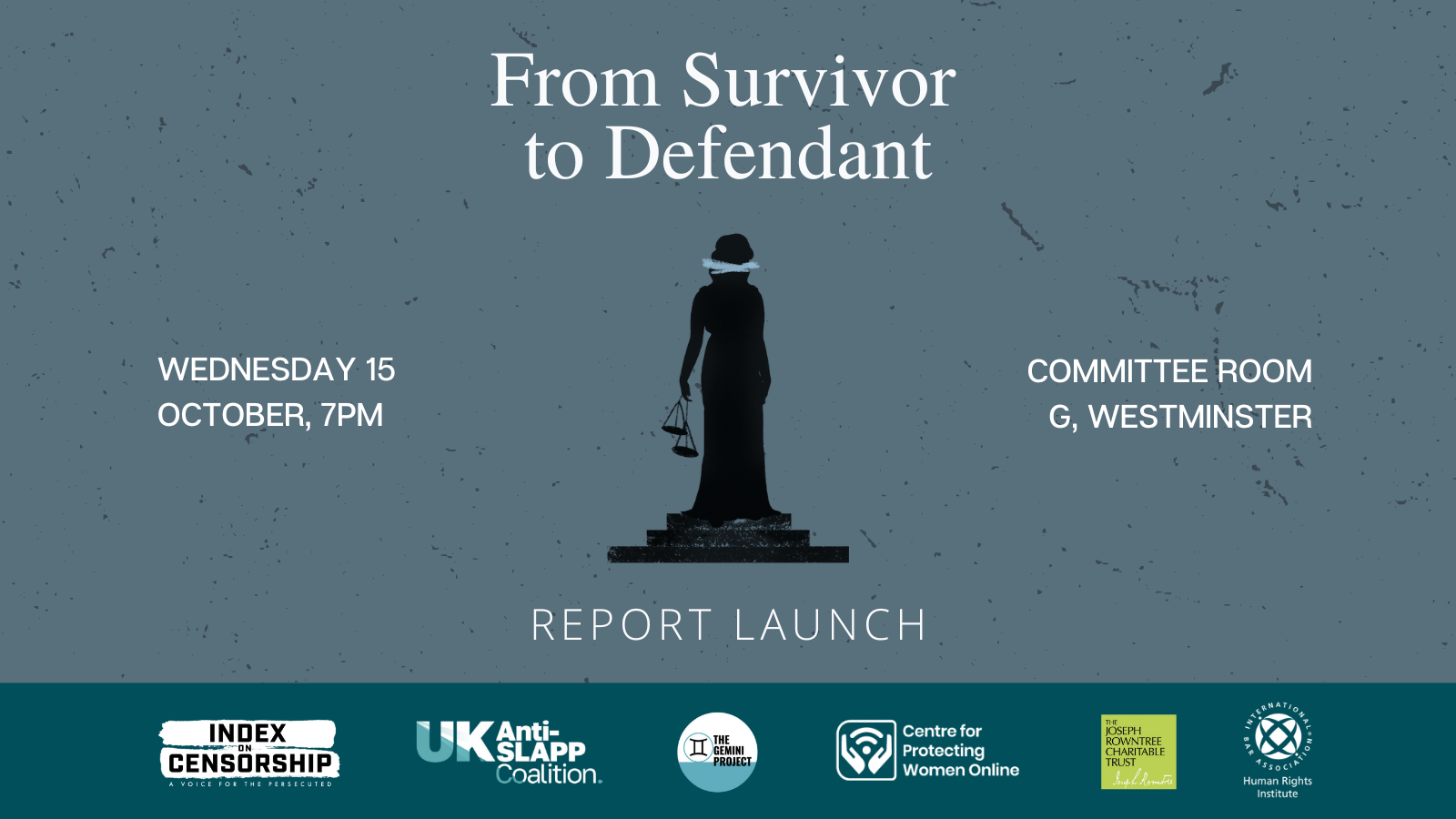
Since 2017, the #MeToo movement has encouraged millions of women to share their experiences of sexual and gender-based violence (SGBV). But speaking out hasn’t come without risks. Some survivors (and the journalists covering their stories) have faced legal threats from the very people accused of perpetrating SGBV. As a result, British courts have been weaponised to continue abuse, with few protections in place.
SLAPPs (strategic lawsuits against public participation) are lawsuits aimed at stifling public interest speech. They are designed not to win in court, but to intimidate, drain resources and silence voices. Their aim isn’t justice, but suppression.
Join us for the launch, sponsored by Baroness Helena Kennedy KC, of From Survivor to Defendant, a new report from Index on Censorship exploring how SLAPPs are being used against survivors of SGBV across the UK and Ireland.
With words from Baroness Helena Kennedy KC (House of Lords), Jemimah Steinfeld (Index on Censorship), Olga Jurasz (Centre for Protecting Women Online, The Open University), SLAPP targets Nina Cresswell and Verity Nevitt, and Mark Stephens CBE (Howard Kennedy).
RSVP to confirm your attendance here.
The report was prepared with the generous support of the Joseph Rowntree Charitable Trust and the Open University’s Centre for Protecting Women Online.
Index is grateful for the contributions of the survivors, and especially the Gemini Project who shared their research with us.
We are grateful to our event co-sponsors, the International Bar Association’s Human Rights Institute.